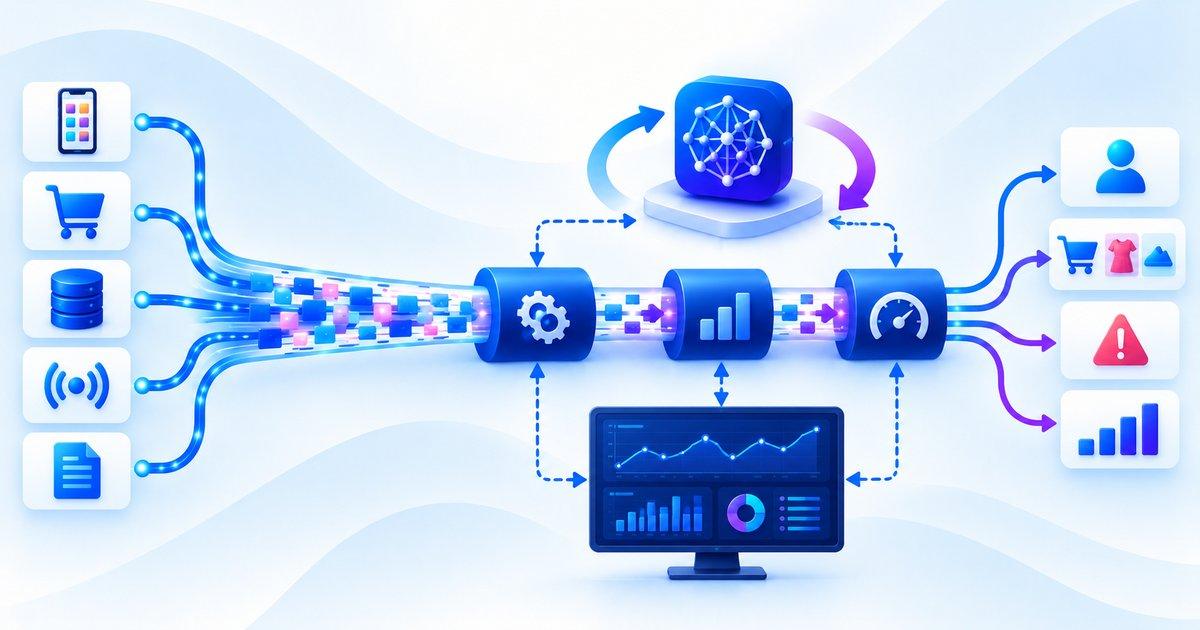

Section 1: Understanding Why Feature Interactions Matter in Machine Learning
A machine learning dataset may contain dozens, hundreds, or even thousands of features, but those features rarely contribute to a prediction independently. In many real-world problems, the predictive effect of one variable changes depending on the value of another. A customer's income may mean something different depending on age. A transaction amount may have a different risk profile depending on account history. Application latency may depend not only on traffic volume but also on request type and geographic location. These relationships are known as feature interactions, and they are one of the primary reasons that simple machine learning models can miss important predictive structure.
Feature interactions become particularly important when an underlying business or physical process is conditional. A feature may be useful by itself, but its real predictive value may emerge only when another variable provides context. This means that analyzing features independently can provide an incomplete picture of the data. An engineer may identify several moderately predictive variables and still overlook the fact that a particular combination of those variables provides a much stronger signal.
What Is a Feature Interaction?
A feature interaction occurs when the effect of one feature on a model's prediction depends on the value of another feature.
Consider a simple regression model containing two variables:

In this formulation, the contribution of  is represented by
  , and the contribution of
  is represented by
  . The model treats their effects as additive. The change produced by does not explicitly depend on the value of .
An interaction term introduces a different assumption:

The additional term  allows the effect of one feature to change according to the other. The relationship is now conditional rather than purely additive.
This is a small mathematical modification, but it can represent a significant difference in how the underlying problem is modeled.
For example, suppose represents income and represents debt ratio in a credit-risk model. Higher income may generally reduce default risk, while a higher debt ratio may increase it. But the impact of debt ratio could be substantially different for customers with very low income compared with customers with high income. The interaction captures this dependency.
The important point is that the value of a feature cannot always be understood in isolation.
Why Simple Models Miss Important Relationships
Simple models are often intentionally restrictive. A linear model is computationally efficient, relatively easy to interpret, and useful as a baseline, but a standard linear formulation assumes that feature effects can be represented independently and additively.
Suppose a model predicts customer churn using tenure and support-ticket volume. It might learn that shorter tenure is associated with higher churn and that more support interactions are associated with higher churn. But perhaps the combination is particularly important: customers with short tenure and unusually high support volume may be dramatically more likely to leave than either variable alone would suggest.
A purely additive model cannot naturally express that the effect of support activity becomes stronger when tenure is low.
The engineer can address this by explicitly adding an interaction term or choosing a model capable of learning nonlinear relationships.
Without such mechanisms, a model can remain systematically biased in regions where variables interact strongly.
This is one reason model performance can sometimes improve unexpectedly when a carefully chosen interaction feature is introduced. The improvement may not come from adding an entirely new source of information. Instead, the interaction allows the model to use existing information in a more appropriate way.
Feature Interactions Reflect Real Business Logic
Feature interactions are not merely mathematical constructions created to improve metrics. They often correspond directly to how real-world systems behave.
In fraud detection, transaction amount may have limited meaning in isolation. A large transaction from a long-established device may be normal, while the same transaction from a new device combined with an unfamiliar geographic location may be considerably more suspicious.
In recommendation systems, a user's interest in a particular product category may depend on current context. The same item may have different relevance depending on the user's recent activity, device, location, or time of day.
In operations, system load may depend jointly on traffic volume and request complexity. A certain volume of simple requests may be easy to handle, while the same traffic volume consisting of computationally expensive requests may create severe resource pressure.
In each example, the prediction depends on a combination of conditions.
This is why feature interactions can be thought of as a way of representing context.
One variable tells the model something about the current state, while another variable changes the meaning of that state.
How Feature Interactions Influence Model Choice
The presence of interactions can influence which machine learning algorithm is appropriate.
Linear models generally require explicit interaction terms if engineers want them represented. Decision trees can capture interactions naturally because each split creates a conditional region of the feature space. Random forests and gradient-boosted trees can therefore model many nonlinear relationships without requiring every interaction to be manually engineered.
Neural networks can learn even more complex interactions through layers of nonlinear transformations.
However, greater model complexity does not automatically make explicit interaction analysis unnecessary.
Understanding interactions can help engineers determine why a complex model performs well, whether learned relationships make domain sense, and whether a simpler model with carefully engineered features could achieve comparable results.
This is particularly valuable when interpretability, maintainability, and computational efficiency are important.
“Why Simpler Machine Learning Models Sometimes Win in Production” reinforces this broader engineering principle: additional complexity should be justified by measurable value rather than assumed to be beneficial merely because it makes the model more sophisticated.
Key Takeaway
Feature interactions occur when the predictive effect of one variable depends on another, allowing models to capture conditional relationships that simple additive approaches can miss. They often reflect real business and operational behavior, and a feature with weak standalone predictive power can become highly valuable through interaction with another feature. Effective interaction engineering requires selective discovery, rigorous validation, and careful control of complexity so that meaningful relationships are captured without introducing overfitting or unstable production behavior.
Section 2: How Engineers Discover and Represent Feature Interactions
Once engineers recognize that important predictive information can exist in combinations of features, the next challenge is discovering which interactions actually matter. This is more difficult than simply multiplying every numerical feature by every other feature. A production dataset may contain hundreds or thousands of variables, creating an enormous number of possible combinations. Some interactions reflect meaningful relationships in the underlying system, while others represent random correlations, data artifacts, or patterns that exist only in the training sample.
Effective interaction engineering therefore combines domain knowledge, statistical analysis, visualization, model behavior, and systematic validation. The objective is not to generate as many interactions as possible. It is to identify relationships that add stable predictive information and represent a useful structure that the model would otherwise struggle to capture.
Domain Knowledge Is Often the Best Starting Point
The most reliable source of interaction hypotheses is often knowledge of the underlying problem.
Consider a fraud-detection system. An engineer familiar with the domain may already know that transaction amount becomes more suspicious when combined with account age, device history, or geographic movement. In a recommendation system, a user's interest in a category may depend on recent activity, device type, or time of day. In a cloud-capacity model, resource pressure may depend jointly on request volume and request complexity.
These are not arbitrary mathematical combinations. They are hypotheses about how the real system behaves.
Domain knowledge provides an efficient way to narrow the search space. Instead of considering every possible interaction, engineers can begin with combinations that have a plausible operational explanation.
This can also improve interpretability. When a model includes an interaction because engineers understand why two variables should work together, it is easier to explain the resulting behavior to domain experts and stakeholders.
However, domain knowledge should be treated as a hypothesis rather than proof. An interaction that sounds reasonable still needs to demonstrate predictive value on unseen data.
Explicit Interaction Features
The simplest way to represent an interaction is by creating a new feature from existing variables.
For two numerical features and , a common interaction term is:

A linear model can then learn a coefficient associated with that combined feature.
This changes the model from:
to:
The coefficient  allows the contribution of one variable to depend on the other.
This is particularly useful when the base model is intentionally simple. Instead of switching to a more complex algorithm, engineers can give a linear model a small number of carefully selected interactions that represent known relationships.
The approach can provide a useful balance between predictive power and interpretability.
Interaction Features for Categorical Variables
Interactions are not limited to numerical variables.
Categorical variables can also be combined to create feature crosses.
Suppose a dataset contains device type and geographic region. Treating these variables independently assumes that their effects can be modeled separately. A crossed feature instead represents combinations such as:

This can reveal patterns specific to a particular combination.
A certain device may have unusual behavior only in a particular region. A particular customer segment may respond differently to a product category than the general population. A support issue may have very different resolution characteristics depending on both issue type and customer tier.
These patterns can be difficult for simple additive models to represent unless the joint categorical state is explicitly introduced.
However, categorical crosses can create large numbers of possible combinations. Engineers therefore need strategies for handling rare categories and unseen combinations in production.
Polynomial Features and Nonlinear Relationships
Polynomial expansion provides another traditional method for representing interactions.
Given features and , an engineer might create:

The resulting expanded feature space allows a linear algorithm to represent certain nonlinear relationships.
This approach can be useful when the underlying system has smooth mathematical behavior. For example, a relationship may depend on the square of a quantity or on the joint effect of two continuous measurements.
The major limitation is dimensional growth.
As more features are introduced, polynomial expansion can generate a large number of terms. Many of those terms may provide little value while increasing memory usage and overfitting risk.
Polynomial features therefore work best when the original feature set is relatively small and the transformations have a clear justification.
Avoiding Leakage During Interaction Creation
Interaction features must respect the same temporal and causal availability rules as individual features.
Suppose an engineer constructs an interaction using one feature available at prediction time and another feature generated only after the prediction outcome is known. The resulting interaction may look extremely predictive during offline evaluation while being impossible to compute in production.
This is a form of feature leakage.
The correct question is always whether every variable used to construct the interaction would have been available at the exact prediction timestamp.
This becomes particularly important when combining historical aggregates, post-event information, labels, or operational outcomes.
Feature engineering must therefore preserve the prediction-time data boundary.
“The Journey of a Dataset: From Raw Data to Production ML” provides a useful framework for thinking about this issue because interaction features are ultimately part of the same data pipeline and must maintain valid lineage from raw inputs through production inference.
Key Takeaway
Feature interactions can be discovered through domain knowledge, explicit mathematical transformations, categorical crosses, visualization, statistical analysis, tree-based models, automated feature engineering, and model-interpretability techniques. The strongest workflow uses these methods selectively: domain knowledge provides hypotheses, models and data reveal evidence, and rigorous validation determines whether an interaction represents stable predictive structure rather than noise, sparsity, or leakage.
Section 3: Using Feature Interactions to Improve Model Performance Without Overfitting
Discovering a feature interaction is only the beginning. The more important engineering question is whether that interaction represents a stable relationship that will improve predictions on unseen data and continue to behave sensibly in production. An interaction can dramatically improve training performance simply because it gives a model additional flexibility, but flexibility without sufficient evidence can quickly become overfitting. This is particularly important when engineers generate large numbers of pairwise or higher-order combinations, because the number of potential interactions can grow much faster than the amount of reliable information available in the dataset.
Effective interaction engineering therefore requires a balance between representational power, statistical reliability, generalization, and operational simplicity. Engineers need to distinguish genuine predictive structure from accidental correlations, validate candidate interactions rigorously, control dimensionality, and continually test whether the relationships remain stable as the underlying data changes.
Interaction Features Increase Model Capacity
Every new feature gives a machine learning model additional information or additional structure that it can use to fit the target. Interaction features go further because they allow the model to represent dependencies between variables.
Consider a model containing income and debt ratio. If the model receives only the two original features, a simple linear formulation may assume that the effect of each variable is independent of the other. Adding an interaction feature such as:

allows the model to represent a relationship in which the effect of income changes as debt ratio changes.
This can significantly reduce bias when the real system contains such an interaction.
But additional capacity creates a corresponding risk.
If the interaction does not represent a stable relationship, the model can use it to explain random variation in the training dataset. The model may then perform better during development while performing no better or even worse on unseen data.
Interaction engineering is therefore a direct example of the classical machine learning trade-off between underfitting and overfitting.
Separating Signal From Coincidence
One of the most difficult problems in interaction discovery is distinguishing a real relationship from a coincidental one.
Imagine a dataset containing hundreds of features. There may be tens of thousands of possible pairwise interactions. If engineers test enough combinations, some will appear highly predictive purely by chance.
This becomes especially dangerous when the dataset is relatively small.
An interaction may appear strongly associated with the target in one training sample because of random fluctuations. Once the model encounters a different sample, the relationship can disappear.
The appropriate response is not to avoid interaction analysis altogether. It is to require stronger evidence before accepting an interaction as production-worthy.
A meaningful interaction should ideally improve performance across validation folds, remain useful on held-out data, and have a reasonable explanation for why it should continue to exist outside the original training sample.
The question is not:
“Did this interaction improve the score?”
It is:
“Why should this interaction continue to improve the score on future data?”
That distinction separates robust feature engineering from metric optimization.
Validation Must Occur on Unseen Data
Interaction features should be evaluated using the same principles applied to any machine learning feature, but the need for rigorous validation becomes especially important as the number of candidate interactions increases.
Suppose a baseline model produces an AUC of 0.82. After introducing a large set of interactions, the training AUC rises to 0.94.
That result says little about whether the interactions are useful.
If validation AUC remains near 0.82, the additional feature capacity has primarily captured patterns specific to the training data.
A stronger test is to compare the baseline and interaction-enhanced models across multiple validation folds or, where appropriate, a temporally separated evaluation dataset.
The interaction should demonstrate a reproducible improvement rather than a one-time gain.
This is particularly important for production systems where future data can differ from historical data even when the overall task remains unchanged.
Regularization Can Control Interaction Complexity
When engineers introduce many interaction features into models such as linear regression, logistic regression, or generalized linear models, regularization can help prevent the model from assigning excessive importance to weak or unstable terms.
With L1 regularization, some coefficients can be driven toward zero, encouraging a sparse representation. This can be useful when hundreds or thousands of candidate interactions have been generated but only a subset contain reliable signal.
L2 regularization instead penalizes large coefficients and can reduce the impact of individual interaction terms without necessarily eliminating them entirely.
Regularization does not magically make poor features useful, but it can reduce the tendency of a model to overreact to noise.
It is particularly effective when combined with thoughtful candidate generation.
For example, rather than generating every conceivable interaction across the entire feature set, engineers can generate plausible candidates based on domain knowledge and then use regularization and validation to determine which relationships are worth retaining.
Interaction Explosion and Sparse Combinations
Feature interactions create a combinatorial problem.
With  features, the number of possible pairwise interactions is:

For 100 features, that means 4,950 potential pairs. At 1,000 features, the number reaches 499,500.
Higher-order interactions increase the search space even more rapidly.
The resulting feature matrix can become large, expensive to store, and difficult to train.
Categorical interactions can create an additional problem: sparsity.
Suppose one categorical feature contains 100 values and another contains 200 values. A complete cross can create up to 20,000 possible combinations. Many combinations may occur very rarely, while some may not appear at all in training data.
Rare interactions are difficult to estimate reliably because the model has little evidence from which to learn their behavior.
They can also create production problems when previously unseen combinations appear after deployment.
Engineers may need to group rare categories, apply frequency thresholds, use smoothing, employ hashing techniques, or rely on models that can generalize beyond exact category combinations.
The goal is to avoid turning useful interaction modeling into an uncontrolled feature-generation problem.
Interaction Stability Is More Important Than Peak Performance
A production interaction should be stable across reasonable changes in the data.
An interaction that provides a 1% improvement consistently across several validation periods may be more valuable than one that provides a 5% improvement on one historical sample and disappears afterward.
This is particularly important in systems where user behavior, product offerings, market conditions, or operational processes change over time.
A stable relationship provides evidence that the interaction reflects something structural in the problem.
An unstable interaction may indicate noise, leakage, sampling effects, or a temporary condition.
“Why Machine Learning Models Behave Differently in the Real World” is relevant to this principle because patterns discovered during development do not necessarily remain unchanged after deployment. Interaction-driven improvements should therefore be tested for robustness rather than accepted solely because they produce a strong offline metric.
Key Takeaway
Feature interactions can substantially improve predictive performance by allowing models to represent conditional relationships, but they also increase the risk of overfitting, sparsity, leakage, and unstable behavior. Engineers should validate interactions on unseen data, use regularization and controlled feature generation, evaluate performance across important segments, compare explicit interactions with more expressive models, and monitor important relationships after deployment. A production-worthy interaction is not simply one that improves a training metric, it is one that provides stable, generalizable, and operationally meaningful predictive value.
Section 4: Why Feature Interactions Matter for Production Machine Learning
Feature interactions become most valuable when they help a production machine learning system represent the complexity of the real world without introducing unnecessary model complexity. In development environments, engineers can experiment with thousands of transformations and combinations. Production systems impose different constraints. Features must be computable at inference time, maintainable across data pipelines, stable as user behavior changes, and understandable enough to troubleshoot when predictions begin to drift.
This is why feature interactions should be viewed not simply as a feature-engineering technique but as a mechanism for representing context-dependent behavior inside a production ML system.
Production Data Rarely Behaves Independently
The assumption that features contribute independently is often convenient for modeling, but it rarely reflects how real systems operate.
Customer behavior depends on context. Transaction risk depends on account history and device behavior. Infrastructure performance depends on workload characteristics. Demand depends on both time and location. Product relevance depends on the relationship between the user, the item, and the surrounding context.
A production model that treats these variables entirely independently may therefore discard useful structure.
Consider a recommendation system. A user may frequently purchase a particular category, making that preference an important feature. However, the relevance of the category may change depending on the device the user is using, the time of day, recent browsing behavior, or whether the user is actively searching.
The feature “user likes category” contains information, but the interaction between that preference and current context can provide much stronger predictive signal.
Feature interactions allow models to represent these conditional states.
This is one reason interaction-aware modeling can become particularly important when a machine learning system is deployed into environments where behavior is highly contextual.
Fraud Detection Depends on Joint States
Fraud detection provides another strong example of why interactions matter.
A large transaction is not necessarily fraudulent.
A new device is not necessarily suspicious.
A geographic change is not automatically evidence of fraud.
But these signals can become significantly more informative when they occur together.
For example, a newly created account making an unusually large purchase from an unfamiliar device while exhibiting geographic behavior inconsistent with its historical activity represents a very different risk state from any individual signal alone.
This is a joint feature state.
Tree-based models can often learn these relationships through sequential splits. Neural networks can learn them through nonlinear representations. Simpler models may need explicit interaction features.
The underlying lesson is that many risk systems are governed by combinations of conditions rather than individual measurements.
This also explains why removing features based solely on their marginal predictive value can sometimes damage a model. A feature that appears weak across the full population may become highly valuable when another condition is present.
Feature Interactions Can Capture Temporal Context
Time-related features are especially likely to interact.
The effect of hour of day may depend on day of week. Seasonal behavior may vary by geography. Recent activity may mean something different for a newly acquired customer compared with an established customer.
A single “hour” feature cannot fully represent these relationships.
Consider an application predicting traffic volume. The pattern at 9:00 AM on a weekday may be radically different from the pattern at 9:00 AM on a weekend. Both records share the same hour, but their broader contexts differ.
The interaction between hour and day type provides information that neither variable fully captures alone.
Temporal interactions can also reveal changes in product behavior. A feature that was predictive during one stage of a product lifecycle may become less informative as user habits evolve.
This makes interaction analysis useful not only during modeling but also during production monitoring.
Interactions Can Inform Model Retraining
Changes in feature relationships can also provide evidence that a model may need to be retrained.
Suppose the relationship between customer tenure and engagement was highly predictive when a model was developed. A major product redesign then changes how new and existing users interact with the application.
Neither feature may become invalid individually.
The interaction between them may simply no longer represent the same behavioral process.
This can create gradual model degradation that is difficult to diagnose through individual feature monitoring.
“How ML Teams Decide When to Retrain a Model” provides useful context for this broader problem. Model maintenance decisions should consider not only whether individual features remain available but whether the predictive relationships learned during training continue to hold in the production environment.
Key Takeaway
Feature interactions are important in production because real-world behavior is usually contextual rather than purely additive. They can improve recommendation, ranking, fraud detection, forecasting, and enterprise ML while also revealing hidden data-quality issues and changes in joint feature distributions. The most effective production systems do not create interactions indiscriminately; they identify high-value relationships, validate them rigorously, monitor their behavior over time, and retain them only when their predictive and operational value justifies the added complexity.
Conclusion
Feature interactions reveal an important reality of machine learning: the predictive value of a feature cannot always be understood in isolation. In many real-world systems, the effect of one variable changes depending on another variable, and the combination contains information that a simple additive model may fail to represent.
This is why feature interactions matter across areas such as fraud detection, recommendation, ranking, forecasting, customer analytics, risk modeling, and enterprise machine learning. A transaction amount may become meaningful only when combined with account history and device behavior. A user's preference may change in importance depending on time, product, or context. A system metric may become predictive only under particular workload conditions.
Simple linear models can miss these relationships unless engineers explicitly introduce interaction terms or other nonlinear transformations. More expressive algorithms, including tree-based models and neural networks, can often learn interactions automatically. However, even when the model learns them implicitly, understanding those interactions remains valuable for feature engineering, interpretability, debugging, monitoring, and model maintenance.
The discovery process can begin with domain knowledge, where engineers form hypotheses about relationships that should exist in the underlying system. Exploratory visualization and statistical analysis can then help determine whether those hypotheses are supported by data. Tree-based models and interpretability techniques can reveal relationships that were not obvious beforehand, while automated feature engineering can search broader combinations when the feature space becomes too large for manual analysis.
But interaction discovery must be handled carefully.
Frequently Asked Questions
1. What are feature interactions in machine learning?
Feature interactions occur when the effect or predictive contribution of one feature depends on the value of another feature. The combined relationship can provide predictive information that is not captured by considering either feature independently.
2. Why are feature interactions important?
They allow machine learning models to represent conditional relationships found in real-world data. Many systems depend on combinations of circumstances rather than isolated variables, making interaction effects important for prediction and model understanding.
3. Can a linear model learn feature interactions?
A standard linear model does not explicitly represent interactions between variables. Engineers can add interaction terms such as to allow the model to capture certain conditional relationships.
4. Do tree-based models automatically learn feature interactions?
Yes. Decision trees can represent interactions through sequential conditional splits, and ensembles such as random forests and gradient-boosted trees can learn many nonlinear and interaction effects without explicit manual construction.
5. What is an interaction term?
An interaction term is a feature created to represent the joint effect of two or more variables. A common numerical example is the product , which allows the effect of one feature to vary with the other.
6. What are feature crosses?
Feature crosses combine two or more categorical or other variables into a joint representation. For example, combining device type and geographic region can help a model capture patterns specific to particular device-region combinations.
7. How can engineers discover feature interactions?
Engineers can discover interactions using domain knowledge, exploratory visualization, statistical interaction tests, tree-based models, automated feature engineering, and model-interpretability techniques. The resulting candidates should then be validated on unseen data.
8. Can a feature with weak standalone importance still be valuable?
Yes. A feature may have limited predictive value by itself but become highly informative when combined with another feature. Removing features solely because their marginal importance is low can therefore eliminate useful interaction signals.
9. Can feature interactions cause overfitting?
Yes. Creating many interaction terms increases model capacity and can allow the model to fit random patterns in the training data. Cross-validation, regularization, controlled feature generation, and held-out evaluation help determine whether an interaction generalizes.
10. What is interaction explosion?
Interaction explosion occurs when the number of possible feature combinations becomes extremely large. With features, there are  possible pairwise interactions, and higher-order combinations grow even faster. This can create computational, storage, and overfitting problems.
11. Can feature interactions introduce data leakage?
Yes. An interaction can combine a feature available at prediction time with another feature that becomes available only after the prediction event. The resulting feature can create artificially strong offline performance that cannot be reproduced in production.
12. Are higher-order interactions useful?
They can be. Some predictions depend on three or more variables simultaneously. However, explicitly creating higher-order interactions can cause severe dimensionality and sparsity problems, so they are often better learned implicitly by expressive models.
13. How do feature interactions affect model interpretability?
Explicit interaction features can make conditional relationships easier to inspect, particularly in simpler models. They can show that the contribution of one variable changes depending on another. However, predictive interaction should not automatically be interpreted as a causal relationship.
14. Should feature interactions be monitored after deployment?
Important interactions can be worth monitoring because relationships between features may change even when individual feature distributions appear stable. Changes in joint feature behavior can reveal distribution shift, data-quality issues, or changes in the underlying business process.
15. When should engineers explicitly add feature interactions?
Explicit interactions are most useful when they represent a meaningful relationship, improve performance on unseen data, remain stable, can be computed correctly at prediction time, and provide value that justifies their additional complexity. They are particularly useful when a simpler model needs help representing a known nonlinear or conditional relationship.