
Section 1: Understanding How Knowledge Distillation Works
Large AI models can capture sophisticated patterns, but their size can make them difficult to deploy efficiently. They may require substantial memory, specialized hardware, and significant computational resources for inference. For some applications, this cost is acceptable. For others, particularly latency-sensitive systems, high-volume services, mobile applications, and edge devices, the model is simply too expensive or too large to use directly.
Knowledge distillation addresses this challenge by separating learning capability from deployment size.
Instead of requiring the smaller production model to learn everything independently from raw training labels, engineers use a larger, more capable teacher model to generate additional learning signals. A smaller student model is then trained to reproduce the useful behavior of that teacher.
The concept is deceptively simple, but the underlying idea is powerful: a large model can act as a source of supervision for a smaller model.
The student does not need to become an exact copy of the teacher. It needs to learn enough of the teacher's useful behavior to meet the requirements of the application while operating with fewer computational resources.
The Teacher–Student Architecture
Knowledge distillation is commonly organized around two models: the teacher and the student.
The teacher model is typically larger or more capable. It may have more parameters, greater representational capacity, or access to an architecture that is computationally expensive but highly effective. The teacher is trained first and serves as the source of additional supervision.
The student model is deliberately smaller.
Its architecture is selected according to the deployment requirements. It may have fewer layers, fewer parameters, lower computational complexity, or a structure specifically designed for efficient inference.
During distillation, the student receives training examples and learns to reproduce useful information generated by the teacher.
Consider a multiclass classification problem. A conventional training dataset might tell the student that an image belongs to class A. This is a hard label: one category is treated as correct while the others are treated as incorrect.
The teacher can provide a much richer output.
Instead of simply indicating class A, it might assign high probability to class A, a smaller probability to class B, and an even smaller probability to class C. Those relative probabilities contain information about how the teacher views the relationships among the possible classes.
The student can use that richer signal during training.
This creates a fundamental distinction between learning from the dataset's labels and learning from a model that has already interpreted those labels and the underlying data.
The teacher effectively becomes an additional source of supervision.
Why Teacher Predictions Contain More Information Than Hard Labels
Hard labels provide a binary or categorical statement about the target. They tell the model which answer is considered correct but generally provide little information about the relationships among the incorrect alternatives.
Teacher predictions can contain substantially more structure.
Suppose a teacher classifies an image as a dog with high probability, while assigning a smaller probability to wolf and an even smaller probability to fox. Those lower probabilities may reveal that the teacher recognizes semantic similarities among the classes.
A hard label would discard that information.
The student can benefit from learning not only which class is correct, but also how the teacher distributes its belief across alternatives.
These outputs are often called soft targets or soft labels.
Soft targets provide a smoother learning signal than hard one-hot labels. Instead of forcing the student to treat every incorrect class as equally wrong, the teacher communicates relative similarities among the candidate outputs.
This can help the student learn decision boundaries that reflect more of the teacher's learned structure.
The value becomes especially apparent when the original task contains classes that are naturally related.
The teacher may have learned subtle distinctions that are not explicitly represented in the one-hot training labels. Distillation gives the student access to some of that information through the teacher's output distribution.
The student is therefore not merely memorizing the teacher's final answer.
It is learning the relationships encoded in the teacher's predictions.
Training the Student Model
The student training process typically begins with the same underlying examples used for the task, but the student receives additional information generated by the teacher.
For each training example, the teacher produces its prediction. The student produces its own prediction. The training objective then encourages the student's output to become similar to the teacher's output while also remaining aligned with the ground-truth target when such labels are available.
This creates a combined learning process.
The student is effectively asked to satisfy two related objectives:
What does the dataset say the correct answer is?
and
How does the more capable teacher behave on this example?
The result is a smaller model trained to approximate a more capable model's behavior.
The advantage is particularly useful when the teacher has already captured complex patterns through a larger architecture.
Instead of forcing the student to discover every useful representation from scratch, the student receives guidance from the teacher throughout training.
However, the student remains constrained by its own architecture.
A very small student may simply lack the capacity required to reproduce every behavior of the teacher. The engineering task is therefore to choose a student architecture that is small enough to provide meaningful efficiency gains but capable enough to preserve the behaviors that matter.
This makes student design part of the compression problem.
Knowledge distillation should therefore not be interpreted as a guarantee that a small model will become equivalent to a large one. It is a mechanism for transferring useful behavior from a larger model into a more efficient representation.
This relationship is closely connected to the broader ideas explored in "Model Compression: How Engineers Shrink AI Without Losing Intelligence" Model compression is not simply about removing parameters. It is about finding more efficient ways to represent and execute useful model behavior. Knowledge distillation approaches that problem by allowing a smaller model to learn from the outputs of a larger system.
The result is an important shift in how engineers think about model size.
A large teacher can serve as an expensive source of knowledge during development, while a smaller student can provide the practical deployment characteristics required in production.
That separation allows organizations to use sophisticated models where computational resources are available and deploy more efficient models where latency, memory, or cost is constrained.
Key Takeaway
Knowledge distillation uses a large teacher model to supervise a smaller student model, allowing the student to learn from richer signals than hard training labels alone provide. Soft targets, logits, and temperature-based probability distributions can expose relationships learned by the teacher, while combined training objectives help the student preserve useful behavior. The result is a smaller model that can approximate important capabilities of a larger AI system at a fraction of its deployment cost.
Section 2: What Knowledge Actually Transfers From a Large Model?
Knowledge distillation is often described as teaching a smaller model to imitate a larger one, but that description can make the process sound simpler than it really is. The student model is not receiving a literal copy of the teacher's internal knowledge. Instead, it is exposed to signals generated by the teacher and learns to reproduce behaviors, relationships, representations, and decision patterns that are useful for the target task.
This distinction matters because a large model contains far more information than a smaller model can necessarily represent. The engineering problem is therefore one of selective knowledge transfer.
The team needs to determine which aspects of the teacher's behavior are most valuable for the application, how those behaviors can be communicated to the student, and how much information the student can realistically absorb given its smaller capacity.
The result is a form of compression in which the student attempts to retain the most useful parts of a much richer model.
Learning Class Relationships
One of the simplest forms of knowledge transfer occurs through the relationships among possible outputs.
A conventional supervised learning label often provides only one answer. If an image belongs to class A, the training label marks A as correct and effectively treats the other classes as incorrect. The label does not explain that class B may be somewhat similar to A while class C is highly dissimilar.
A teacher model can reveal those relationships through its output distribution.
Suppose the teacher predicts that an image is 80% likely to belong to class A, 15% likely to belong to class B, and 5% likely to belong to class C. The student receives more information than simply being told that A is the correct answer.
The relative probabilities communicate something about the teacher's learned representation of the task.
This can be particularly useful for problems where categories are naturally related. In image classification, related visual concepts may receive similar probabilities. In language classification, different intents may have overlapping characteristics. In ranking systems, the teacher's relative scores can reveal how it distinguishes among candidate results.
The student can learn these relationships even when the original labels do not explicitly encode them.
This is one reason soft targets are central to knowledge distillation.
The teacher effectively provides a richer description of the task than a hard label alone.
The student is not simply learning “A is correct.”
It is learning something closer to “A is the most likely answer, B shares some characteristics with it, and C is substantially less plausible.”
Those relationships can help a smaller model reproduce some of the decision structure learned by the larger system.
Transferring Representations and General Patterns
Knowledge transfer can also occur through representations rather than only final predictions.
Large models often transform raw inputs into internal representations that capture useful structures. In a vision system, these representations might encode increasingly complex visual patterns. In language systems, representations can capture relationships among words, concepts, syntax, or context. In ranking and recommendation systems, representations can capture relationships among users, items, queries, or behavioral patterns.
A student model may be trained to reproduce useful aspects of these representations.
This can provide a richer learning signal than asking the student to match only the final output.
The underlying principle is that the teacher has already discovered useful ways of organizing information. The student can be guided toward similar structures rather than having to discover every useful relationship independently.
However, representation transfer must be designed carefully because teacher and student architectures may be very different.
A large teacher might contain layers or internal structures that have no direct equivalent in the student. Engineers may therefore need to identify an intermediate representation that can reasonably be mapped between the two architectures.
The goal is not to reproduce the teacher's internals exactly.
It is to transfer useful abstractions that help the student make better predictions.
This distinction becomes particularly important when the teacher has learned general patterns that extend beyond individual training examples. A student trained only to memorize teacher outputs might perform well on familiar examples but generalize poorly to new ones.
A good distillation process attempts to preserve the teacher's broader behavior rather than simply copying its observed answers.
What the Student Cannot Easily Learn
Knowledge distillation has a fundamental limitation: the student has less capacity than the teacher.
There is no guarantee that every capability present in the teacher can be represented in the student.
A small architecture may reproduce the teacher's common behavior while struggling with rare edge cases. It may approximate broad classification patterns but lose subtle distinctions. It may preserve average performance while becoming weaker on specific subgroups or difficult examples.
This creates a compression frontier.
As the student becomes smaller, efficiency improves, but the amount of teacher behavior it can faithfully represent may decline.
The engineering objective is therefore to identify which capabilities are essential and which can be sacrificed.
A production recommendation system may prioritize ranking quality for its most important traffic segments. A mobile vision model may prioritize latency and memory while accepting a small reduction in accuracy. A language-processing system may prioritize performance on a narrow set of tasks rather than attempting to reproduce every capability of a much larger general-purpose model.
This makes task definition critical.
The question should not be whether the student is an exact replacement for the teacher in every possible situation. It should be whether the student provides enough of the teacher's useful behavior for the intended application.
This is closely connected to the broader idea of transfer learning. "Transfer Learning Beyond LLMs: How Knowledge Moves Between ML Tasks" explores how learned representations and patterns can provide useful starting points beyond the original training task. Knowledge distillation applies a related principle within a teacher–student framework: information learned by a powerful model becomes supervision for a smaller model.
The distinction is that the student is explicitly optimized to operate under tighter resource constraints.
That makes the process particularly useful when organizations need a deployment model that is cheaper, faster, or smaller than the system that produced the original capability.
The most effective distillation strategies therefore focus on what must be preserved, not on reproducing everything indiscriminately.
A teacher may contain enormous amounts of learned behavior, but the student only needs the portion that is relevant to its deployment objective.
This selective transfer is what makes knowledge distillation a practical form of AI compression.
Key Takeaway
Knowledge distillation can transfer class relationships, learned representations, ranking behavior, and broader task-specific patterns from a large teacher into a smaller student. However, a student cannot necessarily reproduce every capability of its teacher because its architecture and capacity are more limited. Successful distillation therefore depends on identifying the behaviors that matter most, using representative distillation data, and optimizing the student for the actual deployment task rather than attempting to reproduce the teacher perfectly.
Section 3: Engineering the Right Student Model
Knowledge distillation gives engineers a powerful way to transfer useful behavior from a large teacher model into a smaller student model. But getting the student to work well isn't simply a matter of making the architecture smaller and hoping it retains everything important.
The student is still its own model, with its own capacity, computational characteristics, strengths, and failure modes.
The real engineering challenge is to determine how small the student can become while still meeting the application's requirements. That means balancing predictive quality with latency, memory consumption, throughput, infrastructure cost, and the constraints of the hardware or environment where the model will run.
So the best student model isn't automatically the smallest one. It's the one that preserves enough of the teacher's useful behavior to meet the product's needs while providing meaningful efficiency gains.
Choosing Student Capacity
Choosing the student architecture is one of the most important decisions in a distillation project.
Make the student too large, and much of the efficiency benefit disappears. Make it too small, and it may not have enough representational capacity to reproduce the behaviors that matter.
This creates a practical quality-efficiency frontier.
Engineers can start with a student that is substantially smaller than the teacher and then evaluate what happens as its capacity is reduced. The important question isn't simply whether the student matches the teacher on one aggregate benchmark. You also need to know whether it preserves the behaviors that matter to the actual application.
Imagine a classification model where the teacher performs extremely well on common classes but is particularly valuable on a smaller set of difficult cases. A student that preserves overall accuracy but performs poorly on those difficult examples may not be an acceptable replacement.
The same issue appears in other applications. A recommendation model may need to preserve ranking quality for high-value traffic, while a mobile vision model may need to prioritize accuracy within strict memory and latency limits.
Student capacity should therefore be selected according to deployment priorities, not according to an arbitrary compression target.
There is another important consideration: parameter count isn't the whole story. Two models with similar numbers of parameters can have very different inference characteristics because of their operations, memory access patterns, and compatibility with the target hardware.
That means the student should be designed with its final deployment environment in mind from the beginning.
Avoiding Teacher Imitation Without Understanding the Task
It's tempting to think that the student simply needs to copy whatever the teacher does.
But blindly reproducing teacher outputs can create several problems.
First, the teacher can contain errors. A student trained entirely on teacher predictions can inherit those errors. If the teacher is systematically wrong for a particular subset of inputs, distillation may transfer the weakness rather than correct it.
Second, the student still needs appropriate exposure to the underlying task.
The distillation dataset determines which parts of the teacher's behavior the student gets to observe. If important edge cases aren't present, the student has little opportunity to learn how the teacher behaves in those situations.
Third, the student's smaller capacity means it may need to prioritize some behaviors over others.
That makes the training objective and the choice of distillation data especially important.
Combining teacher-derived supervision with reliable ground-truth labels can help keep the student aligned with the actual task. A representative evaluation set can then determine whether the student generalizes beyond the examples used directly during distillation.
The teacher should therefore be treated as a source of useful supervision, not as an unquestionable source of truth.
This matters even more when the teacher was optimized for a broader objective than the student's target application.
A general-purpose teacher may contain capabilities that aren't relevant to the student. Trying to reproduce all of them can waste the student's limited capacity.
The engineering goal is to transfer the capabilities that actually provide value in the intended deployment scenario.
This connects closely with the production-model principles explored in "Why Simpler Machine Learning Models Sometimes Win in Production" A model with the highest theoretical capability isn't always the best production choice. A smaller model can be preferable when it delivers sufficient performance with lower latency, lower cost, easier deployment, and simpler operations.
Key Takeaway
Engineering the right student model means balancing capacity, predictive quality, latency, memory, throughput, and cost. Distillation can be combined with quantization and pruning, but every compression stage needs careful evaluation. The student shouldn't blindly imitate the teacher; it should preserve the capabilities that matter for the target application, using representative data and reliable evaluation to determine whether the resulting efficiency gains justify any loss in model behavior.
Section 4: Where Knowledge Distillation Creates Real-World Value
Knowledge distillation becomes strategically valuable when the efficiency of a smaller model changes what an AI product can realistically do. The goal is not merely to reduce the number of parameters stored in a model. The real objective is to make useful intelligence easier to serve, scale, deploy, and integrate into environments where a large teacher model would be too expensive or operationally demanding.
This distinction matters because model compression is ultimately valuable only when it improves the economics or usability of the production system.
A smaller student model may reduce inference latency, require less memory, consume fewer compute resources, and support higher request throughput. In some cases, it can also make deployment possible on hardware that cannot accommodate the original model. These advantages can affect the architecture of the product itself.
Low-Latency AI Applications
Latency is one of the clearest reasons to use a distilled model.
In an interactive AI application, users expect systems to respond quickly. A recommendation engine that delays page rendering, a search system that takes too long to rank results, or an intelligent assistant that responds slowly can create a poor experience even when the underlying predictions are highly accurate.
A large model may provide excellent quality while requiring substantial computation for each inference request. A distilled student can provide a practical alternative when the application needs faster responses.
The important point is that latency improvement should be measured at the system level.
A smaller student may reduce model computation, but total application latency also includes feature retrieval, preprocessing, networking, serialization, queueing, and other downstream operations. A model that is theoretically much smaller may therefore deliver only modest end-to-end improvement if another component dominates the response time.
This is why engineers should benchmark the student within the actual serving architecture.
They should examine average latency, tail latency, throughput, and behavior under realistic concurrency rather than evaluating a single inference call.
Knowledge distillation can be particularly attractive when the teacher is used primarily during development or offline processing while a student is deployed for real-time inference.
This creates a useful division of responsibilities.
The expensive model provides high-quality supervision during development. The smaller model provides efficient predictions during production.
The result can be a system that retains much of the teacher's useful behavior while meeting the latency requirements of the application.
Building Efficient AI as a Product Capability
The greatest long-term value of knowledge distillation appears when efficiency becomes a reusable product capability.
Organizations rarely deploy just one model. As AI adoption increases, they may operate models across search, recommendations, classification, personalization, forecasting, assistants, fraud prevention, and many other workflows.
If every production model requires the maximum available compute, infrastructure costs and operational complexity can grow rapidly.
A systematic distillation capability can help organizations create smaller deployment models from larger research or teacher models.
This creates a repeatable development pattern:
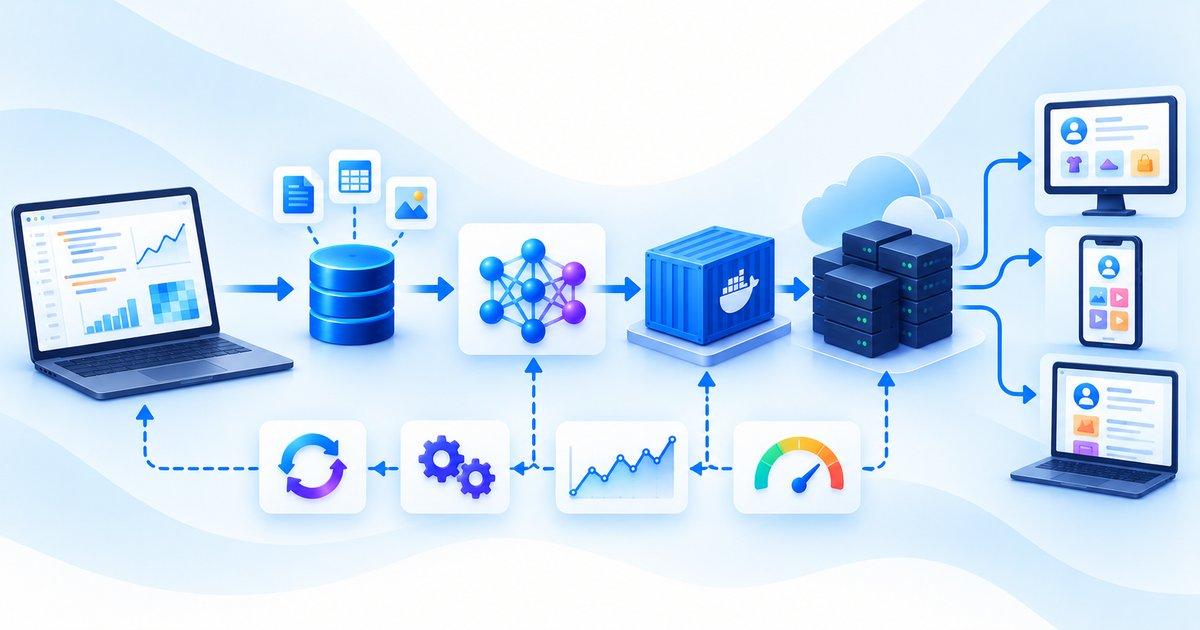
Train or select a capable teacher → define the target deployment constraints → distill into a student → evaluate quality and efficiency → optimize for hardware → deploy and monitor.
Such a workflow separates experimentation from production requirements.
Research teams can continue using larger models when they provide meaningful capability improvements, while production systems can use distilled students where efficiency matters more.
This separation can also accelerate product development.
A company may be able to experiment with advanced models without committing to their full serving cost. Once a capability is proven valuable, the organization can distill the relevant behavior into a smaller model tailored to the production workload.
That makes model innovation and production efficiency less tightly coupled.
The economic implications are equally important.
"The Hidden Engineering Work Behind Every Successful Machine Learning Product" highlights that successful AI products depend on infrastructure, deployment, monitoring, reliability, scalability, and operational discipline in addition to model quality. Distillation contributes to that broader engineering objective by reducing the computational burden of delivering model capability in production.
Key Takeaway
Knowledge distillation creates real-world value when smaller models enable lower latency, lower inference cost, higher throughput, broader deployment, or efficient on-device intelligence. The strongest use cases are those where model efficiency directly changes the economics or feasibility of the product. The goal is not simply to create a smaller model, but to make advanced AI capabilities practical within real production constraints.
Conclusion
Knowledge distillation addresses one of the central challenges in modern AI engineering: how to retain useful model capability while reducing the computational burden required to deliver it.
Large models can provide exceptional predictive performance and broad capabilities, but their size can make them expensive, slow, memory-intensive, or difficult to deploy in production. This is particularly challenging for applications that require low latency, high throughput, cost-efficient inference, or deployment on mobile and edge hardware.
Knowledge distillation provides a structured way to address this problem.
Instead of forcing a smaller model to learn entirely from conventional ground-truth labels, engineers use a larger teacher model as an additional source of supervision. The smaller student model learns to approximate useful aspects of the teacher's behavior while operating with substantially fewer resources.
The important insight is that the teacher provides more information than a simple correct-or-incorrect label.
Teacher predictions can expose relationships among possible outputs, relative confidence, and patterns that are not explicitly represented in hard labels. Soft targets, logits, and temperature-based probability distributions allow the student to learn some of this richer structure.
The student therefore does not simply memorize a collection of answers.
It attempts to learn the behavioral patterns that make the teacher effective.
However, distillation is not magic.
A student model has less capacity than its teacher, which means it may not reproduce every capability. Rare behaviors, subtle distinctions, and complex reasoning patterns can be particularly difficult to transfer when the student is substantially smaller.
The objective should therefore never be to make the student identical to the teacher under every possible condition.
The objective is to preserve the capabilities that actually matter for the intended application.
This makes student-model design one of the most important engineering decisions in the distillation process.
Frequently Asked Questions
1. What is knowledge distillation in machine learning?
Knowledge distillation is a technique in which a smaller student model learns from a larger teacher model. The student uses information generated by the teacher, often alongside original training labels, to approximate useful teacher behavior with fewer computational resources.
2. What is the difference between a teacher model and a student model?
The teacher is typically the larger or more capable model that provides supervision. The student is a smaller model designed for more efficient deployment. During distillation, the student learns to reproduce useful aspects of the teacher's behavior.
3. Why can a student model learn from teacher predictions?
Teacher predictions contain information beyond a hard target label. Their probability distributions can reveal relationships among possible outputs and the relative confidence of the teacher. This provides a richer learning signal that can help a smaller model learn useful decision patterns.
4. What are soft labels in knowledge distillation?
Soft labels are probability distributions or similar teacher-generated targets that represent the teacher's relative preferences across possible outputs. Unlike hard labels, they preserve information about how strongly the teacher favors different alternatives.
5. What is temperature in knowledge distillation?
Temperature is commonly used to soften a model's output probability distribution during distillation. A higher temperature produces a less concentrated distribution, making relationships among lower-probability alternatives more visible to the student.
6. What are logits and why are they useful for distillation?
Logits are the raw output scores produced by a model before they are converted into probabilities. They contain relative information about the model's preferences among outputs and can be used as part of the supervision signal for the student.
7. Can knowledge distillation work with any machine learning model?
Distillation is applicable across many model families and tasks, including classification, computer vision, ranking, natural-language processing, recommendation, and other predictive systems. The exact distillation method depends on the architecture, outputs, and behavior that need to be transferred.
8. How much smaller can a distilled model become?
There is no universal compression ratio. The achievable reduction depends on the teacher, student architecture, task complexity, distillation data, hardware requirements, and acceptable performance trade-offs. Engineers should optimize for the application's required quality and efficiency rather than a predetermined size reduction.
9. Does knowledge distillation reduce model accuracy?
It can. A smaller student has less capacity than the teacher and may lose some capabilities during compression. The objective is to minimize meaningful degradation while achieving a sufficiently large efficiency gain for the intended application.
10. Can knowledge distillation be combined with quantization and pruning?
Yes. Distillation can be combined with quantization, pruning, architectural optimization, and other compression techniques. These methods target different forms of redundancy, but their combined effects should be measured carefully because each additional transformation can affect model quality.
11. How is a student model evaluated?
The student should be evaluated using both predictive and production-oriented metrics. These may include task-specific quality, important data slices, latency, memory usage, throughput, hardware utilization, inference cost, and behavior under realistic workloads.
12. Can knowledge distillation be used for large language models?
Yes. Distillation can be used to transfer selected capabilities from larger language models into smaller models for specific applications. The effectiveness depends on the student architecture, teacher behavior, distillation data, training objective, and which capabilities need to be preserved.
13. Why is knowledge distillation useful for edge AI?
Edge devices often have tight limits on memory, computation, power, and storage. A distilled student can capture useful behavior from a larger model while requiring fewer resources, potentially making local inference practical on mobile, embedded, robotics, and other constrained hardware.
14. What are the main limitations of knowledge distillation?
The student may not reproduce every capability of the teacher, particularly rare or highly complex behaviors. Distillation can also transfer errors or biases present in the teacher. The quality and representativeness of the distillation data are important, and aggressive compression can reduce generalization or performance on important edge cases.
15. When should an organization use knowledge distillation?
Knowledge distillation is particularly useful when a large model provides valuable capabilities but its inference cost, latency, memory footprint, or hardware requirements are too high for the intended deployment. It is most attractive when a smaller student can preserve enough of the teacher's useful behavior to satisfy the product's actual requirements at significantly lower operational cost.