Section 1: Why Time Series Is Ready for Foundation Models
Time-series machine learning has traditionally been built around highly specific forecasting problems. A company develops a model for product demand, an energy provider forecasts electricity consumption, a manufacturer predicts equipment behavior, or a financial institution models a particular market variable. Although these systems can be highly effective, each new forecasting problem often requires its own data pipeline, feature engineering process, model architecture, training procedure, and validation strategy.
This task-specific approach works when the number of forecasting problems is manageable. But organizations increasingly operate thousands of temporal signals simultaneously. Every machine, customer, store, transaction stream, application, and sensor can generate data that changes over time. The result is a growing need for models that can learn general temporal patterns rather than starting from scratch for every dataset.
This creates an opportunity for foundation models for time series.
Time Series Contains Reusable Patterns
Many time-series datasets differ in their domain but share fundamental structures.
Demand can rise and fall with daily or weekly seasonality. Industrial sensors can contain periodic behavior and gradual degradation. Website traffic can exhibit recurring cycles and sudden spikes. Electricity consumption can change according to time, weather, and human activity.
Although the underlying values are different, the mathematical patterns can be similar.
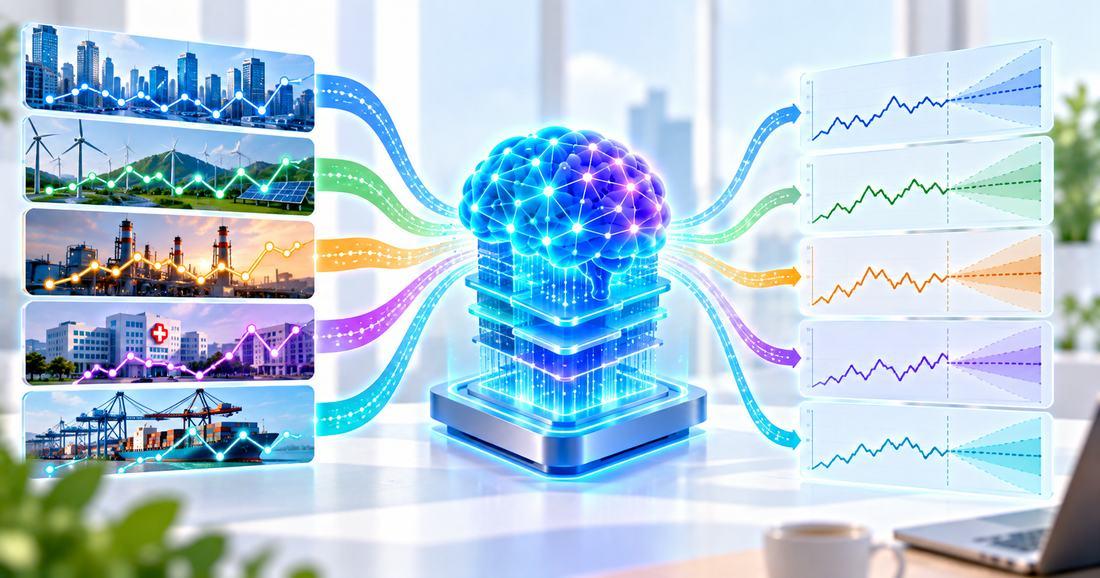
A foundation model can potentially learn these recurring temporal structures from large and diverse collections of time-series data. Instead of learning only the relationship between features and a single target variable, the model can learn more general representations of how values evolve over time.
This creates the possibility of transferring temporal knowledge between problems.
A model trained across many time-series datasets might learn concepts related to trend, seasonality, periodicity, sudden changes, persistence, and temporal dependencies even before it encounters a particular downstream forecasting task.
Traditional Forecasting Can Require Significant Task-Specific Work
Conventional forecasting pipelines frequently depend on dataset-specific assumptions.
Engineers may need to determine appropriate lag variables, rolling statistics, seasonal features, external regressors, forecasting horizons, aggregation levels, and transformations. These decisions can be highly effective when domain knowledge is strong, but they also create substantial engineering effort.
Different forecasting problems can require substantially different feature pipelines.
A retail model may depend on promotions and calendar events. An energy model may depend on weather and grid conditions. An equipment model may rely on sensor measurements and maintenance events.
The resulting systems are often difficult to standardize.
Foundation models offer a potential alternative by learning temporal representations directly from large collections of observations.
Instead of manually specifying every useful temporal relationship, engineers can allow the pretrained model to discover some of those structures during pretraining.
Large Volumes of Unlabeled Temporal Data Already Exist
One reason time series is particularly attractive for foundation-model approaches is the sheer amount of temporal data produced by modern systems.
Smart devices continuously generate measurements. Applications produce logs and metrics. Industrial systems record telemetry. Businesses capture transactions and operational events. Buildings produce energy and environmental data.
Much of this information does not have a manually assigned label.
Yet the sequence itself contains learning signals.
A model can be trained to predict future observations, reconstruct missing sections, identify temporal relationships, or learn representations of recurring patterns without requiring humans to annotate each sequence.
This makes self-supervised pretraining a natural mechanism for extracting knowledge from large temporal datasets.
It also connects with the broader representation-learning principles discussed in “Self-Supervised Learning for Structured Data: What Comes After Labeled Datasets?” The central idea is similar: use abundant unlabeled information to learn reusable representations before applying task-specific supervision.
Key Takeaway
Time series is well suited to foundation-model approaches because modern organizations generate enormous quantities of unlabeled temporal data containing reusable patterns such as trends, seasonality, periodicity, anomalies, and cross-variable relationships. Pretraining can potentially create general temporal representations that transfer across forecasting and other downstream tasks, including zero-shot and few-shot applications. The central challenge is proving that this learned temporal knowledge genuinely generalizes across domains while still incorporating the external variables and structural differences that make each forecasting problem unique.
Section 2: How Foundation Models Learn General Patterns From Temporal Data
The defining idea behind a time-series foundation model is pretraining. Instead of creating a separate forecasting model for every dataset, engineers expose a model to large collections of temporal sequences and train it to learn reusable patterns. The objective is to develop a general representation of how data evolves over time before the model is adapted to a specific forecasting or prediction task.
This process requires different thinking from traditional forecasting because the model must learn patterns that remain useful across datasets with different scales, frequencies, domains, and objectives.
Predicting the Next Part of a Sequence
One of the most natural pretraining objectives for time series is future prediction.
The model receives historical observations and attempts to predict what comes next. During training, it performs this task repeatedly across many windows and datasets.
Over time, the model can learn recurring structures such as trends, periodic behavior, persistence, sudden changes, and relationships between recent and longer-term observations.
The objective resembles language-model pretraining in one important respect: the model learns from sequences by using the information available before a particular point to predict what follows.
For time series, however, the relationships are governed by temporal dynamics rather than linguistic structure.
A useful model therefore needs to understand not just sequence order but also the timescale over which patterns operate.
Learning Multiple Temporal Scales
Different patterns occur at different frequencies.
Electricity demand can have hourly, daily, and weekly cycles. Retail sales may contain seasonal patterns spanning months. Equipment telemetry can contain rapid fluctuations as well as slow degradation.
A foundation model that focuses only on short-term relationships may miss longer-term patterns. A model that focuses exclusively on long historical windows may become computationally expensive and less responsive to recent changes.
Pretraining can encourage the model to represent multiple temporal scales simultaneously.
This allows a downstream forecasting task to benefit from patterns that may not be obvious from a limited amount of task-specific data.
Masking and Reconstruction
Another approach is to hide portions of a time series and ask the model to reconstruct them.
For example, some observations in a sensor sequence can be masked while the model attempts to infer the missing values from surrounding context.
This teaches the model to understand relationships within the sequence rather than simply memorizing direct future values.
Masked reconstruction can also help the model learn temporal dependencies when the forecasting objective is not the only downstream application.
A representation that captures normal sequence structure may later support anomaly detection, interpolation, data repair, or classification.
Learning Across Multiple Variables
Many real-world time series are multivariate.
A manufacturing system may contain temperature, pressure, vibration, speed, and power signals. A smart-building dataset may combine occupancy, weather, HVAC activity, and energy consumption. A financial dataset can contain multiple related market variables.
A foundation model can learn relationships across these variables while simultaneously learning temporal patterns.
This creates richer representations than treating each series independently.
However, the relationships are not necessarily identical across domains. A correlation between two industrial sensors may have a very different meaning from a correlation between economic indicators.
The model therefore needs sufficient diversity during pretraining to distinguish general temporal structure from domain-specific behavior.
Learning Representations Beyond Forecasting
The ultimate purpose of pretraining is not necessarily to optimize one forecasting horizon.
A strong temporal representation can potentially support several downstream applications. The same pretrained model could provide useful representations for forecasting, anomaly detection, classification, imputation, event detection, and temporal clustering.
This makes representation quality an important evaluation criterion.
The model should learn temporal structure that remains useful when the downstream objective changes.
The idea is closely related to “Online Machine Learning: How Models Learn From Data as It Arrives,” because both approaches emphasize the importance of learning from temporal information continuously rather than treating observations as completely independent examples. Foundation models extend this idea by attempting to learn transferable temporal representations before specialization.
Key Takeaway
Time-series foundation models learn general temporal knowledge through large-scale pretraining objectives such as future prediction, masked reconstruction, multivariate representation learning, and exposure to diverse temporal conditions. The goal is to learn reusable patterns across different timescales, domains, sampling behaviors, and variables so the resulting representation can transfer to forecasting and other downstream tasks. The strength of the foundation ultimately depends not only on model architecture and dataset size, but on the diversity, quality, and temporal integrity of the pretraining data.
Section 3: Adapting Time-Series Foundation Models to Real-World Forecasting Problems
A time-series foundation model becomes valuable only when its general temporal knowledge can be transferred to a specific forecasting problem. Pretraining provides a broad representation of temporal behavior, but real-world applications still have their own data characteristics, forecasting horizons, external variables, business constraints, and evaluation requirements. The challenge is therefore to adapt a general temporal model without losing the knowledge that makes pretraining useful.
Start With the Downstream Forecasting Problem
The first step is to define exactly what the application needs to predict.
A retail organization may need daily forecasts for thousands of products. An energy operator may need predictions every few minutes. A manufacturer may need to forecast sensor behavior several hours ahead. These problems are all time-series tasks, but their requirements are very different.
Forecast horizon, sampling frequency, number of variables, prediction granularity, and available historical context all influence how a pretrained model should be used.
Engineers should therefore avoid assuming that one adaptation strategy will work equally well across every forecasting problem.
Zero-Shot Forecasting
One of the most interesting capabilities of a time-series foundation model is zero-shot forecasting.
The pretrained model is applied directly to a new time series without task-specific training. Its ability to forecast depends on whether the temporal patterns represented during pretraining transfer effectively to the new series.
This can be especially useful when organizations need forecasts for many related series and do not have enough historical data to build separate models for each one.However, zero-shot performance should be evaluated carefully.
A model can generalize well to one domain and poorly to another. Differences in sampling frequency, scale, seasonality, volatility, and external drivers can affect transfer quality.
Zero-shot capability is therefore best treated as an empirical property rather than an assumption.
Few-Shot Adaptation
When zero-shot predictions are not sufficient, a small amount of task-specific data can be used for few-shot adaptation.
The goal is to provide enough information for the foundation model to adjust to the specific characteristics of the target series without requiring a complete training process from scratch.
This can be useful when historical data is limited, when a new product has recently launched, or when a new sensor has only a short operating history.
Few-shot adaptation can also reduce the engineering effort associated with developing separate forecasting systems for every new series.
Fine-Tuning for Specialized Domains
Some applications require deeper customization.
Fine-tuning allows the foundation model's parameters to be updated using task-specific data. The model can therefore adapt its temporal representations to a particular domain while retaining information acquired during pretraining.
This may be appropriate when the target environment has specialized behavior that is not sufficiently represented in the foundation dataset.
For example, an industrial forecasting task may contain operating patterns that differ substantially from the temporal structures present in general-purpose datasets.
Fine-tuning can improve specialization, but it also introduces additional compute, training complexity, and potential overfitting.
Engineers should therefore determine whether the downstream performance improvement justifies the additional adaptation cost.
Transfer Learning Across Different Forecasting Tasks
The same pretrained representation can potentially support more than one downstream task.
A model pretrained on equipment telemetry might be adapted for future-value prediction, anomaly detection, event classification, or imputation.
This makes the foundation model a reusable temporal component rather than a forecasting model tied to one specific output.
However, transfer should be measured rather than assumed.
A representation that performs well for forecasting may not necessarily provide equally useful information for anomaly detection or classification.
The broader opportunity is to evaluate how much task-specific learning is required after pretraining.
Avoiding Temporal Leakage During Adaptation
Time-series adaptation has a particularly important leakage risk: information from the future can accidentally enter training or validation data.
Randomly splitting a time series into training and test samples can allow future observations to influence the model's learned representation.
Foundation models make this issue more complicated because leakage can occur during both pretraining and downstream adaptation.
A proper evaluation should preserve temporal ordering and ensure that every input contains only information that would have been available at the prediction time.
This is part of the broader discipline described in “From Experiment to Production: The Decisions That Shape an ML System.” A foundation model should be evaluated under the same information constraints that will exist when the system is actually deployed.
Key Takeaway
Adapting time-series foundation models involves choosing among zero-shot forecasting, few-shot learning, fine-tuning, and task-specific transfer based on the characteristics of the downstream problem. Engineers must account for forecast horizon, sampling frequency, external variables, temporal leakage, and distribution changes while comparing foundation-model approaches against strong models trained specifically for the target dataset. The real value of a temporal foundation model is demonstrated when it transfers useful knowledge efficiently while requiring less task-specific data and engineering effort.
Section 4: Why Time-Series Foundation Models Could Change Predictive Machine Learning
Time-series forecasting has historically been one of the most specialized areas of machine learning. A model is usually designed around a particular dataset, forecasting horizon, sampling frequency, and domain. Retail demand, energy consumption, financial signals, industrial telemetry, and application metrics can require very different modeling pipelines.
Time-series foundation models introduce the possibility of changing that development pattern.
Instead of building every forecasting model independently, organizations could increasingly start with pretrained temporal models that already contain general knowledge about how sequences evolve. Downstream systems would then adapt that knowledge to individual forecasting problems.
This shift could change not only model development, but also how organizations think about predictive machine learning infrastructure.
From Individual Forecasting Models to Reusable Temporal Intelligence
Traditional forecasting architecture often creates a separate model for each important prediction problem.
One team may build a demand model.
Another may build an equipment model.
A third may create an energy forecasting pipeline.
Although these models solve different problems, they may repeatedly learn similar temporal structures such as trends, seasonality, persistence, periodicity, and sudden changes.
Foundation models create the possibility of learning these patterns once and reusing them across multiple applications.
This could reduce duplicated experimentation and make new forecasting projects faster to develop.
The organization can treat temporal representation as a shared capability rather than rebuilding it for every prediction task.
Few-Shot and Zero-Shot Forecasting Could Lower the Entry Barrier
One of the most significant potential changes is the ability to generate useful predictions with limited task-specific data.
A conventional forecasting model typically requires sufficient historical observations from the target problem before it can be trained effectively.
A pretrained model may already understand general temporal patterns and therefore require less downstream data.
This could be valuable for newly launched products, recently installed equipment, newly created business units, or other situations where historical data is limited.
Few-shot adaptation could allow engineers to specialize a general model with relatively small amounts of data, while zero-shot forecasting could potentially provide an initial forecast without dedicated training.
The practical importance of these capabilities will depend on how well the pretrained representation transfers to the target domain.
The Model Becomes More General-Purpose
Foundation models could also broaden what a time-series model is expected to do.
Rather than building separate systems for forecasting, anomaly detection, classification, imputation, and event detection, a shared temporal representation could potentially support several of these tasks.
This creates a more general-purpose approach to temporal machine learning.
A model pretrained on equipment data, for example, could provide representations that support both future sensor-value prediction and identification of abnormal operating states.
The same principle could apply to business event streams, infrastructure metrics, or energy data.
This does not mean one model will automatically outperform specialized models for every task.
The advantage is architectural reuse.
Foundation Models Could Make Long-Tail Forecasting More Practical
Organizations often have thousands or millions of time series, but only a subset receive extensive modeling attention.
High-value or high-volume series may justify dedicated forecasting pipelines.
Smaller or less frequently observed series may not.
A general-purpose time-series foundation model could potentially reduce this imbalance by providing a reusable forecasting capability across a much larger number of series.
Instead of deciding whether each individual series deserves a separately trained model, teams could apply a shared foundation and reserve deeper customization for cases where it creates measurable value.
This could make forecasting systems more scalable across large and heterogeneous collections of temporal signals.
External Context Will Become More Important
Foundation models will not eliminate the need for domain-specific information.
Many real forecasting problems depend heavily on factors outside the target series.
Weather affects energy demand.
Promotions affect retail sales.
Maintenance affects equipment behavior.
Holidays affect consumer activity.
Operational decisions affect future measurements.
Future time-series systems will therefore increasingly need mechanisms for incorporating external variables alongside the pretrained temporal representation.
This creates a useful architecture in which general temporal knowledge comes from pretraining while contextual variables provide task-specific information.
The challenge will be ensuring that the foundation remains general enough to transfer while still being expressive enough to incorporate specialized signals.
Forecasting Will Become More Integrated With Decision Systems
Forecasts rarely exist for their own sake.
Organizations use them to make decisions about inventory, staffing, energy storage, maintenance, capacity, pricing, and resource allocation.
A foundation model can therefore become part of a larger decision architecture.
A pretrained temporal model forecasts future demand.
An optimization system determines inventory allocation.
A planning system schedules resources.
The forecast becomes a reusable component of a broader operational workflow.
This reinforces the distinction between predictive quality and business value.
A foundation model is valuable not simply because it produces forecasts, but because those forecasts improve downstream decisions.
Continuous Learning Could Become Easier
Time series is naturally connected to continuously arriving data.
New observations appear every minute, hour, or day. The environment changes, and the model needs to remain relevant.
A pretrained foundation model provides an opportunity to separate general temporal knowledge from continuously updated domain knowledge.
The foundation can provide a stable starting point, while downstream components adapt as new data arrives.
Depending on the application, updates could involve fine-tuning, continued pretraining, recalibration, or specialized forecasting layers.
This may make model maintenance more modular than maintaining a collection of entirely independent forecasting pipelines.
The broader principle is closely related to “Adaptive Machine Learning: How Models Respond to Changing Environments.” Time-series systems operate in inherently dynamic environments, so the ability to retain general knowledge while adapting to new temporal behavior could become an important advantage.
Key Takeaway
Time-series foundation models could change predictive machine learning by transforming forecasting from a collection of isolated, task-specific models into a more reusable foundation-based ecosystem. Zero-shot and few-shot forecasting, shared temporal representations, broader downstream applications, and continuous adaptation could reduce duplicated engineering effort and make predictive intelligence available across many more time series. Their success, however, will depend on genuine cross-domain transfer, effective use of external context, manageable compute costs, and rigorous evaluation across diverse temporal environments.
Conclusion
Time-series machine learning has traditionally been built around individual forecasting problems. A retail organization develops demand models, an energy company forecasts consumption, a manufacturer predicts equipment behavior, and a financial institution models market variables. Each application can require its own data pipeline, feature engineering process, model architecture, and ongoing maintenance.
Foundation models for time series introduce a different possibility.
Instead of learning exclusively from one forecasting dataset, a model can be pretrained across large collections of temporal data and learn general patterns that may transfer to multiple downstream tasks. Trends, seasonality, persistence, periodicity, temporal dependencies, anomalies, and relationships among variables can become part of a reusable temporal representation.
The potential impact is significant because organizations already generate enormous quantities of time-series data.
Sensors continuously record measurements. Applications produce metrics and events. Businesses capture transactions and demand signals. Energy systems track consumption and generation. Industrial equipment produces telemetry throughout its operating life.
Much of this information is unlabeled, yet it contains valuable temporal structure.
Self-supervised and pretraining objectives can therefore extract learning signals without requiring every observation to have a manually defined target.
The resulting foundation model can potentially be adapted to forecasting, anomaly detection, classification, imputation, interpolation, and other temporal tasks.
One of the most interesting opportunities is zero-shot and few-shot forecasting.
A traditional forecasting model generally requires task-specific historical data and training. A pretrained temporal model may be able to make useful predictions on an unfamiliar series without dedicated training or with only a small amount of adaptation data.
This could be particularly valuable when organizations manage thousands or millions of individual time series and cannot justify building a separate model for each one.
However, generalization is the defining challenge.
Time-series datasets differ substantially in sampling frequency, scale, temporal structure, noise, missingness, forecast horizon, and external dependencies. A pattern that transfers effectively across energy datasets may not transfer to industrial telemetry. A model trained primarily on regular time intervals may struggle with event-driven data.
Foundation models therefore need to learn representations that capture genuinely reusable temporal structures while avoiding excessive dependence on any single domain.
External variables remain equally important.
Historical observations alone may not explain future outcomes. Retail demand can depend on promotions and holidays. Energy consumption can depend on weather. Equipment behavior can depend on load and maintenance activity. Business events can be influenced by operational decisions.
Future temporal foundation models will therefore need effective mechanisms for incorporating contextual variables while maintaining their ability to generalize.
Evaluation also needs to evolve.
A foundation model should not be judged solely by performance on one forecasting dataset. Engineers need to examine zero-shot performance, few-shot adaptation, fine-tuning efficiency, transfer across domains, behavior at different forecasting horizons, robustness to missing and shifted data, and computational requirements.
The key question is not simply whether a pretrained model can forecast accurately.
It is whether the model can transfer temporal knowledge efficiently across diverse problems.
The economics of foundation models also matter.
Large-scale pretraining can be expensive, and the resulting model may require significant infrastructure for inference and updates. The benefits become compelling only when the reusable foundation reduces enough downstream training, engineering, and maintenance effort to justify those costs.
Frequently Asked Questions
1. What is a time-series foundation model?
A time-series foundation model is a pretrained machine learning model designed to learn general patterns from temporal data and transfer those representations to downstream tasks such as forecasting, anomaly detection, classification, and imputation.
2. How is a time-series foundation model different from a traditional forecasting model?
A traditional forecasting model is usually trained for a particular dataset, target, and forecasting objective. A time-series foundation model is pretrained across broader collections of temporal data with the goal of learning reusable temporal representations that can later be adapted to multiple tasks.
3. What types of time-series data can foundation models learn from?
They can potentially learn from sensor telemetry, demand data, energy consumption, application metrics, financial series, industrial measurements, event streams, and other temporal datasets. The usefulness of pretraining depends on the diversity and quality of the data included.
4. What is zero-shot time-series forecasting?
Zero-shot forecasting means applying a pretrained time-series model to a new series without performing task-specific training. The model relies on temporal patterns learned during pretraining to generate predictions for the new problem.
5. What is few-shot forecasting?
Few-shot forecasting uses a small amount of task-specific historical data to adapt a pretrained foundation model. It aims to provide useful specialization without requiring the large training process typically associated with building a model from scratch.
6. Why is self-supervised learning useful for time series?
Time-series datasets often contain enormous quantities of unlabeled observations. Self-supervised objectives such as future prediction or masked reconstruction allow models to learn temporal structure directly from those observations without requiring humans to annotate every example.
7. What temporal patterns can foundation models learn?
Depending on their architecture and training data, models can learn patterns such as trends, seasonality, periodicity, persistence, temporal dependencies, anomalies, changes in behavior, and relationships among multiple variables.
8. Can time-series foundation models handle multivariate data?
Yes. Multivariate foundation models can learn from multiple variables observed over time and potentially capture relationships between those variables as well as temporal patterns within individual series.
9. Do time-series foundation models eliminate the need for feature engineering?
Not necessarily. Foundation models can learn useful temporal representations automatically, but domain-specific features and external variables can remain important. In some applications, engineered information may provide context that is difficult to infer from the target series alone.
10. How do foundation models handle different forecasting horizons?
Different applications can require very different forecast horizons. A model may need to predict the next few minutes in one application and several months in another. Adaptation, architecture design, and pretraining strategy need to account for these differences rather than assuming one horizon works universally.
11. What are the biggest challenges with time-series foundation models?
Major challenges include cross-domain generalization, different sampling frequencies, missing and irregular observations, temporal leakage, distribution shift, external variables, forecasting-horizon differences, computational cost, and determining whether pretrained knowledge actually transfers to a specific application.
12. Can a foundation model work when the time series is very short?
Potentially. One advantage of pretraining is that a model may already contain useful temporal knowledge before seeing much task-specific history. Few-shot or zero-shot approaches can therefore be valuable for newly launched products, new sensors, or other series with limited historical observations.
13. How should time-series foundation models be evaluated?
Evaluation should examine more than accuracy on a single dataset. Useful dimensions include zero-shot performance, few-shot adaptation, fine-tuning efficiency, transfer across domains, forecasting performance at different horizons, robustness to missing or shifted data, and computational cost.
14. Are traditional forecasting models becoming obsolete?
No. Statistical forecasting methods and specialized machine learning models can remain highly effective, particularly when the dataset is well understood or the problem has strong domain-specific characteristics. Foundation models are better viewed as another layer of capability rather than an automatic replacement for established forecasting approaches.
15. What is the future of time-series foundation models?
The field is moving toward reusable temporal models that can support many datasets and tasks with limited task-specific training. Organizations may increasingly combine general foundation models with specialized forecasting layers, external variables, adaptive learning, and domain-specific models to create scalable predictive systems.