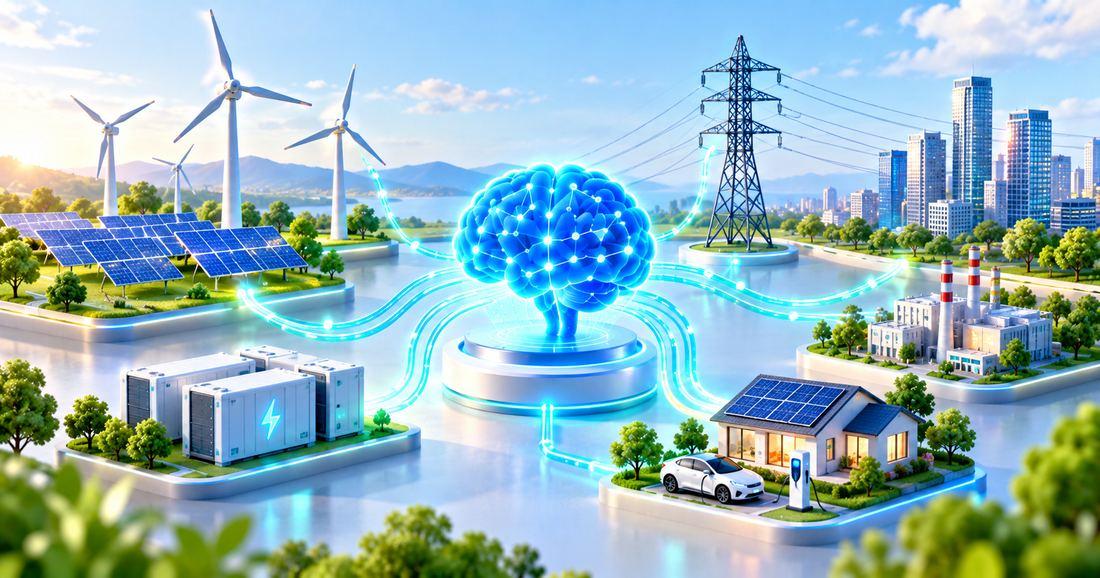
Section 1: Why Energy Systems Are Becoming a Machine Learning Problem
Power systems have always depended on forecasting, optimization, and control. Utilities and energy operators have long used mathematical models to estimate electricity demand, schedule generation, maintain infrastructure, and balance supply with consumption. What is changing is the scale, speed, and complexity of the information these systems must process.
Electricity demand is influenced by weather, time of day, seasonality, economic activity, industrial operations, consumer behavior, and increasingly distributed energy resources. At the same time, renewable generation introduces additional variability because solar and wind output depend on environmental conditions. Batteries, electric vehicles, rooftop generation, and flexible loads create new sources of both complexity and opportunity.
These conditions make energy systems increasingly suitable for machine learning.
The role of machine learning is not necessarily to replace established power-system engineering. Instead, it can learn complex relationships from historical and real-time data and provide better estimates for the optimization and control systems already responsible for operating the grid.
Energy Demand Is Highly Dynamic
Electricity consumption is not constant.
Demand changes between weekdays and weekends, morning and evening, different seasons, and different weather conditions. Industrial facilities may have predictable production schedules, while residential demand can respond rapidly to temperature changes.
Traditional forecasting methods can capture many recurring patterns, but modern energy systems generate increasingly granular data that can reveal more complex relationships.
Smart meters can provide detailed consumption measurements. Building-management systems can report equipment behavior. Weather services provide temperature, humidity, solar radiation, and wind information. Grid operators can observe system conditions across many locations.
Machine learning can combine these variables to estimate how demand is likely to change.
This is valuable because even relatively small forecasting improvements can influence downstream decisions about generation, storage, scheduling, and procurement.
Renewable Energy Introduces Additional Uncertainty
Renewable generation creates another important machine learning problem.
Solar power depends heavily on sunlight, cloud cover, time of day, and atmospheric conditions. Wind generation depends on wind speed and other environmental variables. Output can therefore change significantly even when broader demand remains relatively stable.
For an energy operator, knowing that renewable generation will change is not enough.
The timing and magnitude of that change matter.
A forecast indicating that solar generation will decline during an afternoon period can influence decisions about battery charging, conventional generation, reserve capacity, or demand response.
Machine learning models can combine historical generation data with weather and environmental information to estimate expected renewable output.
The resulting forecasts can then become inputs to optimization systems responsible for balancing supply and demand.
The Grid Is a Constrained System
Energy optimization cannot be treated as an unconstrained prediction problem.
Power systems operate within physical and operational limits. Generation capacity, transmission capacity, storage characteristics, ramp rates, voltage conditions, and other requirements constrain what actions are possible.
This distinction is critical.
A machine learning model may predict that a particular generation pattern would reduce operating costs. That does not mean the proposed configuration is physically feasible.
The machine learning component therefore needs to work within a broader architecture where forecasts are combined with optimization and control mechanisms.
The model predicts.
The power-system algorithms determine what can actually be done.
This is one reason energy optimization is a natural application of the principles discussed in “The Rise of Hybrid AI: Combining Machine Learning With Traditional Algorithms” Learned models can estimate uncertain conditions while conventional algorithms enforce physical constraints and determine feasible operating decisions.
Key Takeaway
Energy systems are becoming an important machine learning domain because they generate large volumes of dynamic data while facing uncertainty, physical constraints, and increasingly distributed resources. Machine learning can improve demand and renewable-generation forecasting, identify equipment behavior, and estimate future system conditions, while optimization and control algorithms translate those predictions into feasible operational decisions. The emerging opportunity is therefore not simply smarter energy forecasting, but intelligent energy management built around prediction, optimization, and continuous system feedback.
Section 2: How Machine Learning Optimizes Demand, Generation, Storage, and Grid Operations
Machine learning becomes especially valuable in energy systems when predictions are connected to operational decisions. Forecasting electricity demand, renewable generation, equipment condition, or market conditions is useful on its own, but the greater opportunity comes from using those predictions to determine how energy resources should be scheduled, stored, distributed, and consumed.
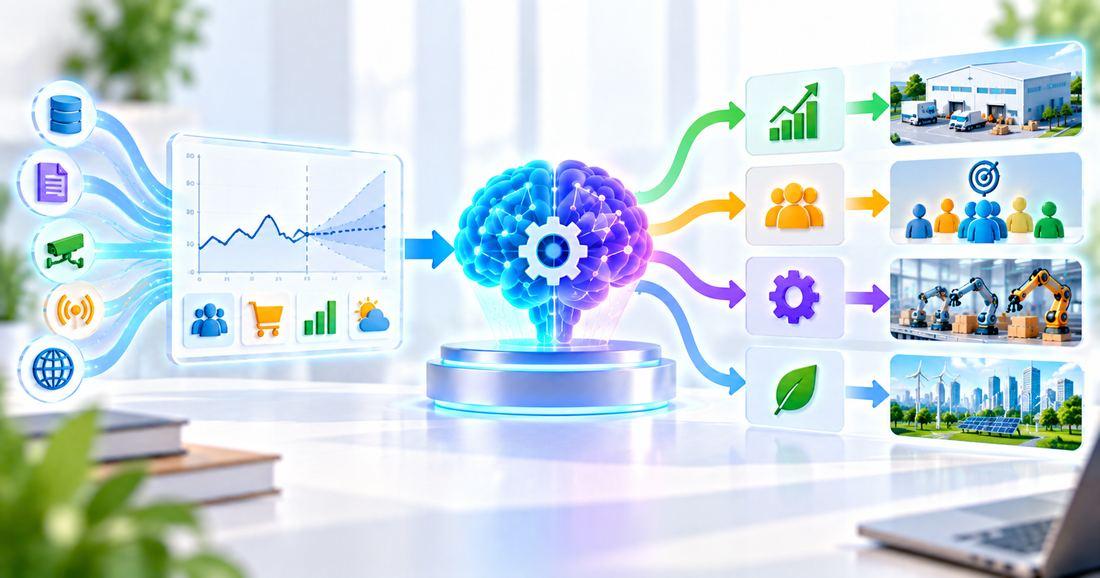
This creates a layered architecture in which machine learning estimates uncertain future conditions while optimization and control systems determine how the power system should respond.
Demand Forecasting for Smarter Energy Management
Accurate demand forecasting is one of the most important applications of machine learning in energy optimization. Electricity consumption depends on multiple interacting variables, including historical demand, weather, time of day, day of week, seasonality, holidays, economic activity, and local behavior.
Machine learning can combine these signals to identify nonlinear patterns that may be difficult to represent using simple forecasting equations.
A forecasting system can operate at different time horizons. Short-term forecasts can support near-term grid balancing and operational scheduling, while longer-term forecasts can influence capacity planning, procurement, and maintenance decisions.
The value of forecasting comes from its connection to action.
If an operator expects demand to rise significantly during a particular period, generation and storage resources can be scheduled accordingly. If demand is expected to remain low, unnecessary generation can potentially be avoided.
The forecast therefore becomes an input to a larger optimization problem.
Renewable Generation Forecasting
Solar and wind generation create another major optimization opportunity because their output is variable.
A solar forecasting model can combine historical generation with weather-related information such as cloud conditions and solar radiation. Wind forecasting systems can incorporate wind speed, direction, and historical turbine behavior.
The objective is not simply to predict renewable output accurately.
Operators need forecasts that are useful for scheduling and balancing decisions.
If expected solar generation is lower than usual during a particular period, an energy-management system may need to account for additional generation or storage requirements. If renewable production is expected to exceed demand, the system may determine whether energy should be stored, exported, or used by flexible loads.
This transforms renewable forecasting into a decision-support capability.
Battery Storage Optimization
Energy storage introduces a particularly interesting machine learning and optimization problem.
A battery has limited capacity and cannot be charged or discharged without constraints. Its current state of charge matters, while future demand, renewable generation, electricity prices, and system conditions remain uncertain.
Machine learning can forecast these future variables.
An optimization system can then determine the most appropriate charging and discharging schedule.
For example, a battery may be charged when renewable generation is abundant and discharged during periods of higher demand. However, immediately discharging the battery may not always be optimal because a larger demand event could occur later.
The system therefore needs to evaluate the value of preserving available storage for future conditions.
This makes battery management a sequential decision problem rather than a simple prediction task.
Demand Response and Flexible Consumption
Not all energy optimization needs to come from the supply side.
Some consumption can be shifted or adjusted based on system conditions.
Commercial buildings may modify heating or cooling schedules. Industrial facilities may shift flexible processes. Electric-vehicle charging can potentially be coordinated around grid demand and renewable availability.
Machine learning can estimate how different customers or devices are likely to respond to incentives, pricing signals, or control strategies.
Those predictions can then be used to design demand-response decisions.
A system may estimate which loads are flexible, when they can be adjusted, and what level of response can reasonably be expected.
This provides another way to balance the system without relying exclusively on additional generation.
Predictive Maintenance for Energy Infrastructure
Machine learning can also improve optimization indirectly by predicting equipment condition.
Transformers, turbines, generators, batteries, and other energy assets produce operational data that can contain early indicators of degradation.
A predictive-maintenance model can estimate the likelihood of abnormal behavior or failure.
The next question is operational: when should maintenance occur?
Scheduling maintenance immediately may reduce equipment risk but could conflict with periods of high demand. Delaying maintenance may improve short-term availability while increasing the probability of failure later.
A prescriptive maintenance system can combine predicted equipment condition with energy demand, workforce availability, spare parts, and operational constraints to identify an appropriate maintenance window.
This illustrates how predictive and prescriptive capabilities can work together.
Market and Cost Optimization
Energy systems can also involve variable electricity prices and multiple procurement choices.
Machine learning can forecast demand, market conditions, or renewable availability, while optimization algorithms evaluate procurement and scheduling alternatives.
The system may compare the cost of purchasing energy, using stored electricity, adjusting flexible consumption, or relying on available generation resources.
This type of decision-making demonstrates why the economic dimension of AI infrastructure matters, a principle explored in “The Economics of Machine Learning: Measuring the True Cost of a Model” An energy optimization model must ultimately be evaluated not only by prediction accuracy but by whether its decisions create measurable operational and economic value.
Key Takeaway
Machine learning can improve energy optimization by forecasting demand, renewable generation, equipment condition, flexible consumption, and other uncertain system variables. These predictions become most valuable when combined with optimization and control mechanisms that determine how generation, storage, demand response, maintenance, and grid resources should be coordinated. The central opportunity is therefore to connect predictive intelligence with operational decision-making across the entire energy system.
Section 3: Designing Reliable AI-Powered Energy Systems for Real-World Conditions
Machine learning can improve energy forecasting and optimization, but deploying AI into power systems requires a significantly higher level of reliability than many conventional machine learning applications. Energy infrastructure operates continuously, physical constraints cannot simply be ignored, and decisions can have consequences across interconnected parts of the system. A forecasting error that is acceptable in one application may create substantial operational problems when it influences generation scheduling, battery control, or grid management.
For this reason, reliable energy AI requires engineers to design the complete system around uncertainty, changing conditions, physical constraints, and safe operational behavior.
Data Quality Determines Energy Model Reliability
Energy systems generate enormous amounts of data through smart meters, sensors, substations, generation equipment, weather systems, market platforms, and building-management systems. However, large volumes of data do not guarantee high-quality information.
Sensors can malfunction, measurements can arrive late, timestamps can become misaligned, and communication failures can create gaps in telemetry. Weather observations may also differ across geographic locations, while energy meters can behave differently after hardware upgrades or configuration changes.
These issues can directly affect machine learning performance.
An energy forecasting model trained on corrupted or incorrectly aligned observations may learn patterns that do not represent the physical system. Engineers therefore need data validation, anomaly detection, timestamp checks, missing-data monitoring, and clear data lineage before relying on model predictions.
Physical Constraints Must Remain Explicit
Machine learning models learn statistical relationships from data, but power systems operate according to physical and engineering constraints.
A model can predict that a particular generation schedule appears economically favorable, but that schedule may violate transmission limits or generation capabilities. A battery model may recommend aggressive charging and discharging without properly respecting operational constraints.
This is why AI should generally operate within a broader optimization and control architecture.
Machine learning can estimate uncertain quantities such as demand, renewable output, or equipment condition. Optimization and control systems can then determine which actions are physically and operationally feasible.
This separation creates an important safety boundary.
The model predicts what may happen.
The control system determines what can safely happen.
Forecast Errors Need to Be Managed
No energy forecast will be perfectly accurate.
Demand can change unexpectedly. Clouds can move across solar installations. Wind conditions can shift rapidly. Equipment can behave differently from historical patterns.
A robust energy-management system must therefore account for forecast uncertainty rather than treating every prediction as certain.
Prediction intervals, probabilistic forecasts, scenario generation, and uncertainty-aware optimization can help decision systems understand the range of possible outcomes.
For example, a battery scheduler can consider several demand scenarios rather than relying only on a single expected value. This can reduce the likelihood that an extreme but plausible event leaves the system without adequate flexibility.
Distribution Shift Can Change Energy Behavior
Energy systems are highly dynamic, which makes distribution shift particularly important.
Consumer behavior can change with weather, economic conditions, electrification, or new technologies. Solar and wind installations can alter regional generation patterns. Electric-vehicle adoption can introduce new demand profiles. Buildings can change their consumption after efficiency upgrades.
A model trained several years earlier may therefore encounter conditions that were poorly represented during development.
Engineers need to monitor whether the statistical characteristics of incoming data remain consistent with the assumptions underlying the model.
This connects with “Adaptive Machine Learning: How Models Respond to Changing Environments” Energy systems are a natural environment for adaptive methods because demand, generation, and asset behavior evolve continuously rather than remaining stationary.
Reliability Requires Fallback Strategies
An AI-powered energy system should not assume that the machine learning component will always produce a valid output.
A forecasting service may become unavailable. Telemetry may stop arriving. A model may detect conditions outside its training distribution. An optimization process may fail to produce a feasible solution.
The system needs predefined fallback behavior.
It may use a previous validated forecast, a simpler statistical model, a conservative operating policy, or manual control depending on the application.
The appropriate fallback should be determined by the operational risk.
For critical infrastructure, the system should fail in a controlled and predictable manner rather than generating an unchecked recommendation when information quality is uncertain.
Monitoring Must Include the Physical System
Traditional ML monitoring often focuses on data drift and model metrics. Energy systems require broader observability.
Engineers need to understand whether predictions remain accurate, whether optimization decisions remain feasible, and whether those decisions produce the expected physical outcomes.
For example, a demand model may maintain stable error statistics while an optimization layer consistently schedules resources inefficiently because a new operating constraint has emerged.
Monitoring therefore needs to connect model behavior with system-level outcomes.
Metrics can include forecast error, reserve margins, battery state-of-charge behavior, equipment health indicators, constraint violations, and other operational measurements relevant to the application.
Key Takeaway
Reliable AI-powered energy systems require more than accurate machine learning models. Engineers must combine high-quality data pipelines, explicit physical constraints, uncertainty-aware forecasting, distribution-shift monitoring, fallback strategies, system-level observability, cybersecurity, and appropriate human oversight. Machine learning becomes most valuable when it operates as one component of a resilient energy architecture that can adapt to changing conditions while maintaining safe and physically feasible behavior.
Section 4: Why Machine Learning Could Reshape the Future of Intelligent Power Systems
The energy industry is entering a period in which electricity generation, consumption, storage, and distribution are becoming increasingly interconnected and data-driven. Renewable energy is expanding, distributed resources are becoming more common, electric vehicles are creating new demand patterns, and organizations are gaining access to increasingly detailed measurements of how energy systems operate.
These changes create an opportunity for machine learning to become more than a forecasting tool.
It can become part of an intelligent energy architecture that continuously observes system conditions, predicts future states, identifies potential problems, and supports decisions about how energy resources should be coordinated.
From Static Planning to Adaptive Energy Systems
Traditional energy planning often relies on historical assumptions, predefined schedules, and models that represent expected operating conditions. These methods remain important, particularly because power systems are governed by well-understood physical relationships and operational requirements.
However, modern energy environments are becoming less predictable.
Demand profiles can change as electric vehicles and smart appliances become more common. Distributed solar and battery installations can alter local power flows. Extreme weather can create unusual combinations of demand and generation. Equipment conditions can change gradually over time.
Machine learning can help energy systems adapt by continuously learning from new observations.
Instead of relying entirely on fixed assumptions, operators can update forecasts and recommendations as new information becomes available.
This creates a transition from static planning toward adaptive energy management.
The Grid Can Become More Data-Driven
Smart meters, connected devices, sensors, distributed generation systems, and digital substations are producing increasingly granular information.
This data can provide visibility into the current state of the energy system and reveal patterns that would be difficult to identify manually.
Machine learning can use these observations to estimate demand at finer geographic and temporal resolutions, identify abnormal consumption patterns, detect equipment degradation, and forecast renewable generation.
The result can be a more responsive operating environment.
Instead of reacting only after a problem becomes visible, operators can potentially detect early signals and make adjustments before those signals develop into larger operational issues.
Distributed Energy Resources Will Increase the Need for Intelligence
One of the most significant changes in power systems is the growth of distributed energy resources.
Rooftop solar installations, batteries, electric vehicles, microgrids, and flexible loads introduce thousands or millions of smaller resources that can affect the system.
Coordinating these resources manually becomes increasingly difficult.
Machine learning can help estimate how distributed resources are likely to behave. Optimization systems can then use those predictions to coordinate charging, discharging, flexible demand, or local generation.
This creates an opportunity to transform many small independent assets into a coordinated energy-management layer.
The challenge is significant because individual resources have different operating constraints, ownership models, availability patterns, and response characteristics.
AI Can Support More Granular Energy Efficiency
Energy optimization is not limited to utility-scale infrastructure.
Buildings, factories, data centers, commercial facilities, and homes can also use machine learning to improve energy efficiency.
A building-management system can learn relationships between occupancy, weather, equipment operation, and electricity consumption. Instead of applying the same control strategy throughout the day, the system can adjust operations based on expected conditions.
Industrial facilities can use similar approaches to identify energy-intensive processes and determine when operating parameters appear inconsistent with expected behavior.
The value comes from moving beyond simple consumption measurement toward context-aware optimization.
High energy consumption is not necessarily inefficient.
The important question is whether the consumption is appropriate given the operating conditions.
Machine Learning Can Improve Renewable Integration
As renewable generation becomes a larger part of the energy mix, forecasting becomes increasingly important.
Solar and wind production can change quickly, creating uncertainty for system operators.
Better forecasts can support decisions about reserves, storage, generation scheduling, and demand response.
Machine learning can also help estimate uncertainty rather than producing only one expected generation value. This allows optimization systems to consider different possible renewable-output scenarios.
The result is a more flexible approach to balancing a system in which generation may vary rapidly.
Energy Storage Could Become More Intelligent
Battery systems are another area where AI can influence future energy operations.
Current battery state, expected renewable output, demand forecasts, electricity prices, and future system requirements all affect the value of charging or discharging at a particular moment.
Machine learning can improve forecasts while optimization determines how those forecasts should influence battery schedules.
Over time, learning systems could also identify patterns in battery behavior that help improve operational strategies and detect degradation.
This creates a connection between energy optimization and asset intelligence.
Digital Twins Could Expand Energy Optimization
Digital twins can provide a virtual representation of physical energy assets or systems and allow operators to study possible operating conditions.
Machine learning can improve these models by learning relationships from historical and real-time data.
For example, a digital representation of a power-generation asset can incorporate equipment condition, sensor readings, environmental conditions, and historical performance.
Engineers can then evaluate how different operating strategies might affect efficiency, reliability, and future system behavior.
This connects naturally with “Machine Learning for Digital Twins: How AI Is Learning to Model the Physical World” The combination of learned system representations with energy optimization could provide new ways to test operational strategies before applying them to physical infrastructure.
Key Takeaway
Machine learning could reshape power systems by enabling more adaptive demand management, renewable integration, distributed-resource coordination, predictive maintenance, energy efficiency, and storage optimization. Its greatest value will come from working alongside physical models, optimization algorithms, and control systems rather than replacing them. The future of intelligent energy is likely to be a continuously learning and increasingly data-driven system that can forecast changing conditions, evaluate operational options, and respond within clearly defined physical and safety constraints.
Conclusion
Machine learning is becoming an increasingly important component of modern energy systems because the challenges facing electricity generation, distribution, storage, and consumption are becoming more dynamic and data-intensive.
Power systems have always depended on forecasting and optimization, but the growth of renewable generation, distributed energy resources, electric vehicles, smart meters, connected equipment, and storage systems is creating an environment in which traditional assumptions are becoming more difficult to maintain.
Machine learning provides an opportunity to learn from these increasingly complex data streams.
Demand forecasting models can estimate how electricity consumption may change across locations and time periods. Renewable-energy models can predict solar and wind generation using historical observations and environmental conditions. Predictive-maintenance models can identify patterns associated with equipment degradation. Models can also help estimate how buildings, industrial facilities, batteries, and flexible consumers are likely to respond to changing conditions.
However, prediction is only one part of the problem.
Energy systems operate under strict physical and operational constraints. A forecast does not determine how generation should be scheduled. A prediction of increased demand does not specify how storage, generation, or flexible consumption should respond. A model can identify an equipment problem without determining when maintenance should occur.
This is why the strongest energy AI architectures combine machine learning with optimization, simulation, control systems, physical models, and domain knowledge.
Frequently Asked Questions
1. What is machine learning for energy optimization?
Machine learning for energy optimization uses data-driven models to forecast demand, renewable generation, equipment behavior, energy prices, consumption patterns, and other variables that influence how energy systems should be operated. These predictions can then support optimization and control decisions.
2. How is machine learning used in power systems?
Machine learning can be used for demand forecasting, renewable-energy forecasting, predictive maintenance, anomaly detection, energy-efficiency analysis, load forecasting, battery management, demand response, and other applications where historical and real-time data can improve operational decisions.
3. Why is electricity demand forecasting important?
Accurate demand forecasts help energy operators plan generation, storage, procurement, and demand-response activities. Forecasting can be performed over different time horizons depending on whether the goal is real-time balancing, short-term scheduling, or longer-term planning.
4. How does machine learning help renewable energy?
Machine learning can estimate future solar and wind generation using historical generation data and environmental variables. These forecasts can help operators coordinate generation, storage, reserves, and flexible demand when renewable output is variable.
5. Can machine learning optimize battery storage?
Machine learning can forecast variables that influence battery decisions, including demand, renewable generation, prices, or future operating conditions. An optimization system can then use those forecasts to determine when and how much the battery should charge or discharge.
6. What is predictive maintenance in the energy industry?
Predictive maintenance uses equipment data to identify patterns associated with degradation, abnormal behavior, or potential failure. Energy operators can use these predictions to plan maintenance before failures occur and potentially coordinate maintenance with operating requirements.
7. Does machine learning replace traditional power-system models?
No. Machine learning typically complements traditional power-system engineering. Physical models, optimization algorithms, and control systems remain important for enforcing technical constraints and ensuring that operational decisions are feasible.
8. What is demand response?
Demand response refers to adjusting electricity consumption in response to system conditions, prices, or other signals. Machine learning can help predict which consumers, buildings, devices, or industrial processes are likely to change consumption and by how much.
9. How does AI improve energy efficiency in buildings?
Machine learning can learn relationships between energy consumption and factors such as occupancy, weather, equipment operation, and time. These models can identify unusual consumption patterns and support more efficient heating, cooling, lighting, and other building operations.
10. What are the main challenges of using machine learning in energy systems?
Important challenges include noisy sensor data, missing measurements, changing demand patterns, renewable-generation uncertainty, distribution shift, physical constraints, cybersecurity, model reliability, computational requirements, and the need to maintain safe fallback behavior.
11. Why is uncertainty important in energy machine learning?
Energy predictions are never perfectly certain. Weather can change, demand can fluctuate, and equipment can behave unexpectedly. Representing uncertainty helps optimization and control systems prepare for a range of possible future conditions rather than relying entirely on a single forecast.
12. Can machine learning help integrate electric vehicles into the grid?
Yes. Machine learning can help forecast charging demand and identify behavioral patterns, while optimization systems can coordinate charging schedules around grid conditions, electricity prices, renewable availability, and other operational requirements.
13. What is smart-grid machine learning?
Smart-grid machine learning refers to the use of machine learning within increasingly connected electricity networks. Applications can include demand forecasting, anomaly detection, renewable forecasting, asset monitoring, demand response, and optimization of distributed energy resources.
14. How can energy AI systems remain reliable when conditions change?
Reliable systems use continuous monitoring, data-quality checks, distribution-shift detection, uncertainty-aware predictions, staged model deployment, fallback mechanisms, and controlled retraining or adaptation. These techniques help identify when the environment has changed enough to affect model behavior.
15. What is the future of machine learning for energy optimization?
The field is moving toward increasingly integrated systems that combine forecasting, optimization, storage management, demand response, predictive maintenance, renewable integration, and real-time monitoring. Future energy systems may continuously learn from operational data and coordinate distributed resources while remaining within physical, safety, and economic constraints.