Section 1: Why a Successful ML Prototype Is Not a Production System
A machine learning project often begins with a promising experiment. A data scientist identifies a business problem, collects a dataset, trains a model, evaluates it, and discovers that the model performs better than an existing baseline. The team may then demonstrate the results through a notebook, dashboard, or simple application and conclude that the project is ready for the next stage.
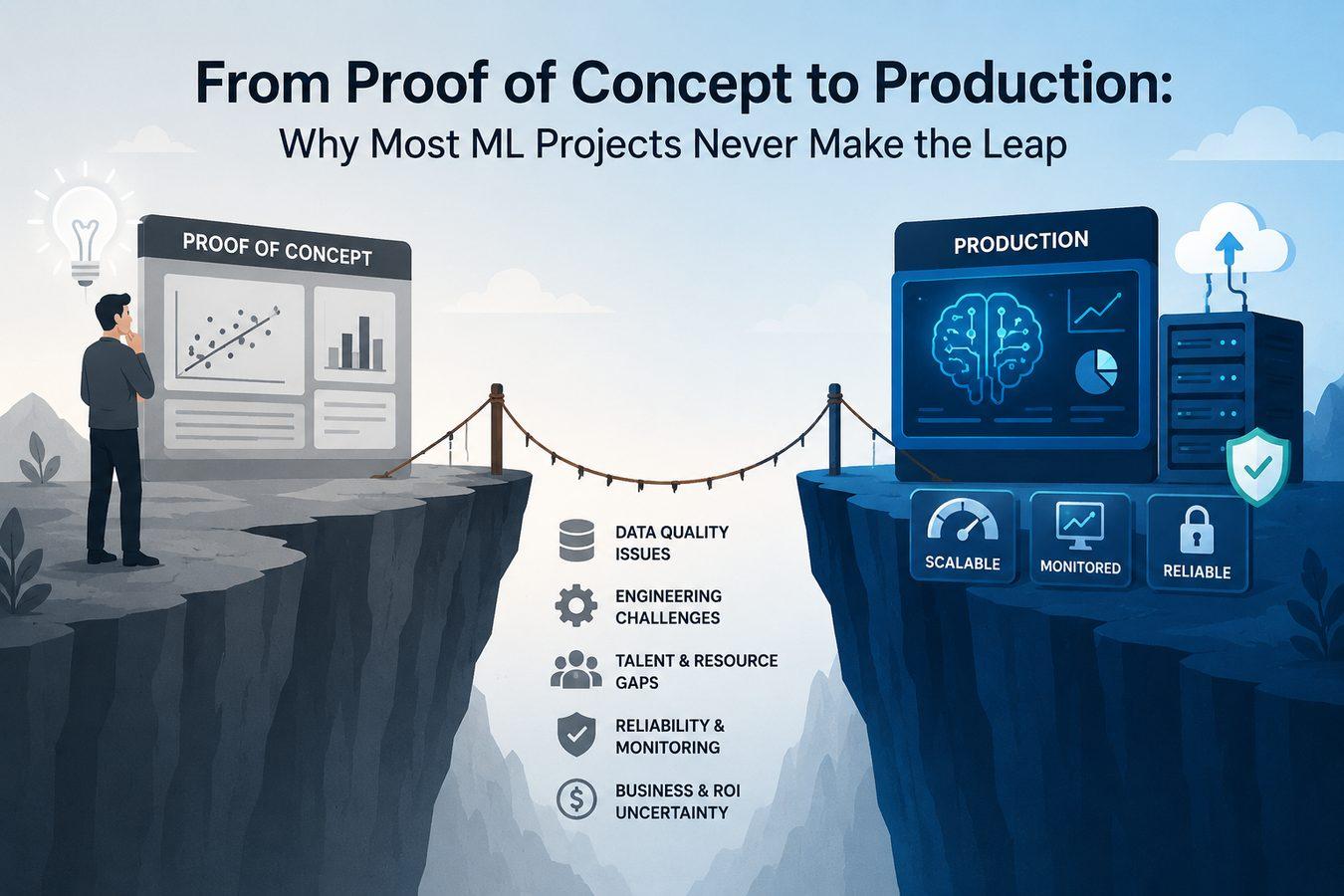
This is where an important distinction becomes necessary: a successful proof of concept is not the same as a production-ready machine learning system.
A proof of concept demonstrates that an idea can work under controlled conditions. Production requires demonstrating that the entire system can operate reliably, repeatedly, securely, and economically under real-world conditions. The model is only one component of that system. Data pipelines, feature generation, model serving, infrastructure, monitoring, testing, security, user workflows, and operational ownership all become important.
Understanding this difference is one of the most important skills for ML engineers because many projects fail not during model development, but during the transition from experimentation to operational deployment.
The Difference Between a PoC and Production
A proof of concept (PoC) is designed primarily to answer a question: Can this approach solve the problem?
A data scientist may use a manually cleaned dataset, execute preprocessing steps in a notebook, train several models, and select the one that produces the strongest validation result. The objective is to reduce technical uncertainty and determine whether further investment is justified.
Production asks a much broader set of questions.
Can the system automatically obtain new data? Can preprocessing execute consistently? Can predictions be generated within the required latency? Can the service handle thousands or millions of requests? What happens when the data source becomes unavailable? How will model performance be monitored? How will a new model version be deployed? Who responds when the system fails?
These requirements transform the project from a modeling exercise into a software and systems engineering problem.
A notebook may be perfectly adequate for a PoC. It is rarely sufficient as the complete architecture for a production ML service.
Production systems require repeatability. The same data-processing logic should execute consistently whether the system is processing today's records or next month's records. Model dependencies should be controlled, deployment should be reproducible, and operational failures should have defined recovery mechanisms.
The transition from PoC to production therefore involves converting an experimental workflow into an engineered system.
The Hidden Assumptions Inside ML Prototypes
One reason prototypes fail during deployment is that they frequently contain assumptions that are invisible during experimentation.
A prototype may use a clean dataset prepared manually by the data science team. In production, however, data may arrive from multiple databases, APIs, event streams, or operational systems. Records may be incomplete, duplicated, delayed, incorrectly formatted, or missing altogether.
Similarly, a prototype may assume that features are always available. A model predicting customer behavior might rely on information that was easy to calculate during experimentation but difficult to generate within the latency requirements of a live application.
Manual preprocessing creates another hidden dependency. A data scientist may execute several notebook cells to clean data, encode categories, remove anomalies, and generate features. Unless these transformations are converted into reliable production pipelines, the deployed model may receive data in a different format from the data used during development.
The development environment can also hide problems. A prototype may depend on a specific Python version, library version, package configuration, or locally stored artifact. Moving the model into another environment can introduce compatibility problems.
These issues illustrate why productionization requires engineers to identify and eliminate implicit assumptions.
Every important step performed manually during experimentation should be examined and, where appropriate, automated, versioned, tested, and monitored.
Defining Production Readiness Early
Teams can avoid many problems by defining production requirements before completing the PoC.
The business requirements should identify what outcome the model is expected to improve and how success will be measured. Technical requirements should specify latency, throughput, availability, scalability, security, and integration requirements.
Teams should also define appropriate SLAs (Service Level Agreements). If an ML-powered application is customer-facing, the required response time and availability may be very different from those of an internal batch-processing system.
Ownership must also be established. Someone needs responsibility for the model, data pipeline, infrastructure, monitoring, and business outcome. Without clear ownership, a model can become an orphaned experiment that technically works but has no team responsible for maintaining it.
A useful production-readiness assessment should therefore consider four dimensions: model performance, data reliability, system reliability, and business usefulness.
The first question is whether the model performs adequately. The second is whether the required data can be produced consistently. The third is whether the complete system can operate reliably at the required scale. The fourth is whether the resulting capability creates enough value to justify ongoing investment.
This distinction is critical because organizations should not automatically productionize every successful experiment. A PoC exists to reduce uncertainty. Sometimes its most valuable outcome is demonstrating that an idea should not proceed to production.
Before investing further, teams should also confirm that the underlying problem genuinely benefits from machine learning rather than a simpler solution. "How to Decide Whether a Business Problem Actually Needs Machine Learning" explores this decision-making process and the importance of establishing business value before committing to an ML solution.
Key Takeaway
A proof of concept demonstrates that a machine learning idea can work; production engineering demonstrates that it can work reliably in the real world. The transition requires more than improving model accuracy. Teams must eliminate hidden assumptions, automate data and feature pipelines, establish reliable model serving, define SLAs, address security and scalability, create monitoring and ownership structures, and connect technical performance to measurable business outcomes. The most successful ML teams therefore design with production requirements in mind from the beginning rather than treating productionization as a final step after the model is complete.
Section 2: The Engineering Gaps Between Experimentation and Production
The transition from a machine learning prototype to a production system requires much more than packaging a trained model. During experimentation, teams often focus on whether a model can learn useful patterns. Production requires the surrounding engineering system to reliably deliver the right data, generate predictions consistently, handle failures, and operate at the required scale.
This creates several engineering gaps between experimentation and production. The most important involve data pipelines, model serving, testing, infrastructure, security, and reliability. Closing these gaps is what transforms an ML experiment into an operational capability.
Building Reliable Data Pipelines
A production ML system depends on a reliable data pipeline. During a PoC, data may be downloaded from a file, manually cleaned, and loaded directly into a notebook. Production systems rarely have that luxury.
Data may arrive continuously from databases, APIs, event streams, application logs, sensors, or other enterprise systems. The pipeline must ingest this information, validate it, transform it, and make it available to the model in the required format.
Data validation is particularly important. Production data can contain missing values, unexpected categories, duplicate records, incorrect timestamps, or malformed fields. A model that assumes perfectly clean input can fail when exposed to these conditions.
Data pipelines also need to address data freshness. Some applications can operate using daily or hourly data, while others require real-time information. A fraud detection system, for example, may need the latest transaction information within milliseconds or seconds. Using stale data can significantly reduce the usefulness of an otherwise accurate model.
Feature generation creates another challenge. Features used during training must be calculated consistently during inference. If training and production use different preprocessing logic, the model can experience training-serving skew, producing unreliable predictions even when the underlying model has not changed.
Reliable production pipelines therefore require automation, validation, monitoring, versioning, and clear ownership.
Turning Models Into Production Services
A trained model must also become an operational component that other systems can reliably access. This often requires model serving infrastructure.
For real-time applications, the model may be exposed through an API. An application sends an input request, the service performs preprocessing and inference, and a prediction is returned. This architecture requires careful attention to response latency, concurrency, authentication, error handling, and scalability.
Other workloads are better suited to batch inference. Instead of generating predictions immediately, the system may process thousands or millions of records on a scheduled basis. Batch processing can be more economical when predictions do not need to be generated immediately.
The distinction between batch and real-time inference should be determined by business requirements rather than technology preference. The appropriate architecture depends on how quickly predictions are needed, how frequently they are generated, and how much infrastructure the organization can justify.
Latency and scalability become important once an ML service receives production traffic. A model that takes two seconds to process one request may appear acceptable during a prototype demonstration but become impractical when thousands of users make simultaneous requests.
Production systems therefore need mechanisms for load management, scaling, caching where appropriate, and graceful failure.
Testing Machine Learning Systems
Traditional software testing is necessary but insufficient for ML systems. Production ML requires testing across several layers.
Unit testing can validate individual components such as preprocessing functions, feature calculations, and utility code. These tests help ensure that basic software behavior remains consistent.
Data testing verifies that incoming datasets satisfy expected schemas, ranges, distributions, and quality requirements. This is particularly important because changes in upstream systems can affect model inputs without changing the model itself.
Model testing evaluates whether the trained model meets predefined performance requirements. Teams can test accuracy, precision, recall, calibration, robustness, and other task-specific metrics.
Integration testing examines how the model interacts with data pipelines, APIs, databases, applications, and other services. A model can perform perfectly in isolation while failing because an integration sends data in an unexpected format.
Regression testing is also essential when models are retrained or replaced. A new version should not simply be evaluated on whether its headline metric improved. Teams should verify that it does not introduce unacceptable regressions across important segments, edge cases, or business workflows.
Testing should therefore cover the complete ML system rather than treating the model artifact as the only component that requires validation.
Infrastructure, Security, and Reliability
Production ML also introduces infrastructure requirements that are often absent from prototypes. The system needs appropriate deployment environments, resource management, logging, monitoring, and failure-handling mechanisms.
Security must be considered throughout the architecture. Model endpoints may require authentication and authorization, while sensitive training and inference data may require encryption, access controls, and appropriate retention policies.
Organizations must also consider fault tolerance. What happens if the model service becomes unavailable? What happens if the feature store cannot be reached? What happens when an upstream data source stops responding?
A production system needs defined responses to these failures. Depending on the application, it may use retries, fallback models, cached results, degraded functionality, or human intervention.
Observability is equally important. Teams need visibility into system health, request volume, latency, errors, resource utilization, and model-specific signals. Without observability, engineers may discover a production problem only after users report it.
The engineering gap between experimentation and production is therefore substantial. A prototype primarily answers whether a model can work. A production system must ensure that the model can work reliably, repeatedly, securely, and economically within a larger software environment.
This is why production ML increasingly requires practices associated with MLOps and platform engineering. The evolution from isolated model APIs toward more comprehensive intelligent platforms is discussed in "The Evolution of AI Deployment: From APIs to Intelligent Platforms," which examines how AI systems are becoming increasingly integrated with deployment infrastructure and operational platforms.
Key Takeaway
Moving ML from experimentation to production requires closing several engineering gaps. Organizations need reliable data pipelines, consistent feature generation, appropriate model-serving architectures, comprehensive testing, secure infrastructure, fault tolerance, and observability. The model itself is only one component of the production system. Successful teams treat data, models, infrastructure, and operational workflows as one integrated engineering system rather than assuming that a validated notebook can simply be deployed unchanged.
Section 3: Managing Models After Deployment
Deploying a machine learning model is not the end of the ML lifecycle. In many ways, it is the point at which the most important operational work begins. A model that performed well during development can deteriorate after deployment because production data changes, user behavior evolves, business processes are modified, or the relationship between inputs and outcomes shifts.
Traditional software can often be tested against a defined set of functional requirements and then operated relatively predictably. Machine learning systems are different because their behavior depends on data distributions and learned relationships. As those conditions change, model performance can change as well.
Production ML therefore requires continuous monitoring, versioning, retraining, feedback mechanisms, and clearly defined ownership.
Why Production ML Requires Continuous Monitoring
A production model should never be treated as a static artifact. Teams need to continuously observe both the model and the environment in which it operates.
Model performance is the most obvious signal. Depending on the application, teams may monitor accuracy, precision, recall, ranking quality, forecasting error, or other task-specific metrics. However, performance monitoring can be difficult when ground-truth labels become available only weeks or months after predictions are generated.
For this reason, teams should also monitor data drift. Data drift occurs when the statistical characteristics of incoming data change compared with the data used during model development. For example, customer demographics, transaction amounts, product usage, or traffic patterns may shift over time.
Concept drift is different. It occurs when the relationship between inputs and outcomes changes. A feature that was strongly predictive in the past may become less useful because customer behavior, market conditions, or business processes have changed.
Data-quality monitoring provides another layer of protection. Missing values, unexpected categories, schema changes, unusual distributions, or delayed data can indicate problems upstream of the model.
Production monitoring should therefore cover both technical and business signals. A model may maintain stable statistical characteristics while its business impact declines, or it may show data drift without immediately experiencing a measurable performance decline. Teams need enough visibility to understand both situations.
Model Versioning and Reproducibility
Continuous ML development requires rigorous model versioning. Every production model should have an identifiable version that can be connected to the training process, configuration, and deployment environment that produced it.
This is important because production systems evolve continuously. A team may retrain a model with new data, modify feature engineering, change hyperparameters, or replace the underlying algorithm. If these changes are not tracked systematically, it becomes difficult to determine which version produced a particular prediction.
Training datasets should also be versioned or otherwise reproducibly identified. A model is not defined solely by its algorithm. The training data has a major influence on its behavior.
The same principle applies to feature versions. Changes in preprocessing or feature calculations can alter model outputs even when the model architecture remains unchanged. Production teams should therefore track the feature definitions and transformation logic associated with each model version.
Experiment tracking can connect these elements by recording training parameters, evaluation results, datasets, model artifacts, and relevant configuration. This creates a reproducible chain from experimentation to deployment.
Reproducibility becomes particularly important when an organization needs to investigate a production incident. Engineers should be able to determine what model was active, what data and configuration produced it, and why it was promoted to production.
Retraining and Continuous Improvement
Models can become outdated, which raises the question of when to retrain. Retraining should not necessarily happen on an arbitrary fixed schedule. The appropriate approach depends on how quickly the underlying environment changes and how expensive retraining is.
Some applications may require frequent retraining because customer behavior changes rapidly. Others may remain stable for long periods and require only occasional updates.
Teams can define retraining triggers based on measurable signals such as model-performance degradation, significant data drift, new labeled examples, or changes in business requirements.
However, new data should not automatically enter the training pipeline. It must first be evaluated for quality, relevance, labeling accuracy, and representativeness. Retraining a model with poor-quality production data can make the system worse rather than better.
Feedback loops are therefore essential. Production outcomes can provide evidence about which predictions were correct and which were not. Human reviewers can provide additional feedback when they accept, reject, or modify model recommendations.
These feedback mechanisms can create a continuous improvement cycle:
Deploy → Monitor → Collect Feedback → Evaluate → Retrain → Validate → Redeploy.
Each cycle should include appropriate safeguards so that improvements are demonstrated before a new model reaches production.
Ownership and the MLOps Operating Model
One of the most common reasons production ML systems deteriorate is unclear ownership. During experimentation, a data scientist may own the project. After deployment, however, multiple teams may become involved.
Data scientists may remain responsible for model development and experimentation. ML engineers may own productionization, model serving, and lifecycle management. Platform teams may manage infrastructure, deployment systems, observability, and shared services. Data engineers may own data pipelines and feature infrastructure.
A business owner is also important because technical metrics alone do not determine whether the system continues to create value. Someone must understand whether the model is improving the intended business process and whether changing requirements require the system to evolve.
These responsibilities should be explicit. Teams should know who receives production alerts, who approves model changes, who investigates performance degradation, who manages retraining, and who decides whether a model should ultimately be retired.
Without clear ownership, monitoring alerts may go unanswered, outdated models may remain in production, and technical debt can accumulate.
The transition from PoC to production therefore creates an ongoing operating model rather than a one-time deployment event. Successful ML organizations treat models as living production systems that require maintenance, measurement, and continuous improvement.
This becomes especially important for AI products that generate user interactions and feedback at scale. "Building AI Products That Improve with Every Interaction" explores how interaction data and feedback can become part of a continuous improvement loop for intelligent products.
Key Takeaway
Production ML requires continuous monitoring, versioning, retraining, feedback, and ownership. Data drift and concept drift can reduce model effectiveness, while poorly controlled changes can make systems difficult to reproduce or audit. A mature MLOps operating model connects data scientists, ML engineers, platform teams, data engineers, and business owners around clearly defined responsibilities. The goal is to transform a deployed model from a static artifact into a continuously monitored and responsibly managed production system.
Section 4: Connecting Production ML to Business Value
A machine learning system is not successful simply because it survives deployment. Production ML must ultimately improve a measurable business outcome. Organizations can invest significant resources in data pipelines, model infrastructure, monitoring, and engineering talent while receiving limited value if employees do not use the system, predictions do not influence decisions, or the model does not improve an economically important process.
The final stage of production ML maturity is therefore connecting technical performance to business value. Teams need to understand which outcomes the model is expected to influence, how much improvement is required, what risks the system creates, and whether the ongoing operational cost remains justified.
Moving From Technical Metrics to Business Metrics
Technical metrics remain essential, but organizations should avoid treating them as the final measure of success. A model may improve accuracy while producing little practical benefit if the additional correct predictions do not change business decisions.
Consider a recommendation model that improves ranking accuracy but does not increase purchases or engagement. The technical improvement may be statistically meaningful, but its business value remains limited.
Production teams should therefore connect model metrics to outcomes such as conversion, revenue, cost reduction, productivity, retention, or customer experience. The appropriate metric depends on the application and the decision the model supports.
A fraud model, for example, should be evaluated not only through precision and recall but also through prevented losses, investigation costs, false-positive impacts, and customer experience. A forecasting system may be evaluated through inventory costs, stockouts, or planning efficiency rather than forecasting error alone.
This connection ensures that technical teams understand why the system exists and whether continued investment is justified.
Managing Production Risk
Production ML introduces risks that must be actively managed. Even a well-tested model can produce model failures when data changes, upstream systems malfunction, or the production environment differs from development assumptions.
Organizations should define how the system behaves when predictions are unreliable. Some applications may require human oversight, particularly when decisions have significant financial, operational, or customer consequences. Rather than allowing the model to make every decision automatically, teams can establish confidence thresholds that route uncertain cases to human reviewers.
Another safeguard is the ability to roll back a problematic model version. When a new model performs unexpectedly after deployment, the organization should be able to restore a previously validated version without rebuilding the entire service.
Production systems can also use staged deployment approaches to reduce risk. A new model may initially process traffic in a controlled environment before becoming responsible for a larger percentage of decisions.
Risk management should also address security, data quality, operational failures, and inappropriate model usage. The objective is not to eliminate every possible error but to ensure that failures are detected quickly and have controlled consequences.
Creating a Production Readiness Framework
Organizations can make deployment decisions more consistently by establishing a production readiness framework that evaluates the entire ML system before launch.
Technical readiness should examine model performance, latency, scalability, integration, infrastructure, testing, and reliability. The team should know whether the system can meet expected production requirements.
Data readiness should confirm that production data is available, validated, monitored, and processed consistently with the data used during development. Feature pipelines should be automated and protected against unexpected changes.
Operational readiness should cover monitoring, alerting, incident response, model versioning, retraining procedures, ownership, and rollback mechanisms. A model should not enter production without clear responsibility for maintaining it.
Business readiness should establish whether users understand the system, whether predictions can be incorporated into workflows, and whether the expected business benefits justify the ongoing cost.
This framework helps prevent a common failure mode where a model is technically ready but operationally or commercially unprepared.
Knowing When to Stop a Project
One of the most important production ML decisions is knowing when to stop or pause a project. Organizations can become emotionally attached to prototypes after significant engineering and data science effort has been invested.
A project should be reconsidered when it demonstrates insufficient ROI. If the expected business improvement cannot justify infrastructure, maintenance, governance, and staffing costs, continued investment may not be rational.
Poor user adoption is another warning sign. Even a technically strong system may fail if employees do not trust its predictions, customers do not use the capability, or the workflow makes it difficult to act on model outputs.
Teams should also reconsider deployment when production evaluation reveals unreliable performance across important segments or operating conditions. Improving the model may be possible, but organizations should determine whether the required additional investment remains economically justified.
Finally, excessive operational complexity can outweigh the benefits of ML. A system requiring substantial infrastructure, frequent retraining, constant human intervention, and complicated governance may be less valuable than a simpler rule-based or manually assisted process.
Stopping an ML project is not necessarily a failure. A PoC can successfully demonstrate that an approach is technically feasible while also revealing that production deployment is not worthwhile.
This distinction is essential to mature ML engineering. The purpose of productionization is not to deploy every successful experiment, but to identify and operate the systems that create durable business value.
"The Business of AI: What Every ML Engineer Should Know Beyond Coding" explores this broader connection between AI engineering, business outcomes, and organizational value.
Key Takeaway
Production ML succeeds when technical capability becomes measurable business impact. Organizations should connect model performance to revenue, cost, productivity, customer outcomes, or risk reduction; establish safeguards for incorrect predictions; evaluate technical, data, operational, and business readiness; and remain willing to stop projects that do not justify their complexity. The strongest ML organizations treat production deployment as a business decision as much as an engineering milestone.
Conclusion
The journey from machine learning proof of concept to production is not simply a matter of deploying a trained model. It is a transformation from an experimental data science project into a reliable software and business system. A prototype can demonstrate that a model can identify patterns in historical data, but production requires the organization to prove that the complete system can operate consistently with real data, real users, real infrastructure, and real business constraints.
The first major lesson is that model accuracy is only one component of production readiness. A model can perform exceptionally well in a controlled notebook environment while depending on manually prepared data, assumptions that do not hold in production, or evaluation datasets that do not represent future conditions. Production requires automated and reliable data pipelines, consistent feature generation, scalable model serving, comprehensive testing, security controls, observability, and defined operational ownership.
The second lesson is that ML systems are living systems. Unlike conventional software, their behavior depends heavily on the data environment in which they operate. Data drift, concept drift, changes in user behavior, new products, market conditions, and business-process changes can gradually reduce model effectiveness. Continuous monitoring is therefore essential. Organizations must track model performance, data quality, prediction distributions, business outcomes, and other signals that reveal when a system is beginning to degrade.
Versioning and reproducibility are equally important. Every production prediction should be connected to the appropriate model version, training data, feature logic, and configuration. Without these controls, teams may be unable to determine why a prediction occurred or which version introduced a problem. Reproducibility also makes retraining, debugging, auditing, and controlled experimentation significantly easier.
Frequently Asked Questions (FAQs)
1. Why do machine learning projects fail to reach production?
Many ML projects fail because of unreliable data pipelines, insufficient integration, unclear business value, poor scalability, lack of monitoring, security requirements, unclear ownership, or excessive operational complexity rather than because the model itself is inaccurate.
2. What is the difference between an ML proof of concept and a production system?
A PoC demonstrates that an ML idea can work under controlled conditions. A production system must operate reliably with real data and users while satisfying requirements for scalability, security, monitoring, reliability, cost, and business integration.
3. How do you know when an ML prototype is production-ready?
A prototype is closer to production readiness when the model meets defined business requirements, data pipelines are reliable, the system has been tested under realistic conditions, infrastructure can support expected workloads, monitoring and ownership are established, and the expected business value justifies deployment.
4. Why isn't high model accuracy enough for production?
Accuracy does not measure latency, reliability, data quality, scalability, security, cost, user adoption, or business impact. A highly accurate model can still fail if it cannot operate reliably or does not improve a meaningful business outcome.
5. What engineering work is required after an ML prototype?
Teams typically need to build automated data pipelines, production feature processing, model-serving infrastructure, APIs or batch workflows, testing frameworks, monitoring, security controls, deployment pipelines, versioning, rollback mechanisms, and operational procedures.
6. What role do data pipelines play in production ML?
Data pipelines provide reliable, validated, and appropriately timed information to the model. They ensure that production inputs are processed consistently with the data used during development and help detect data-quality or freshness problems.
7. Should ML models be deployed through APIs or batch pipelines?
It depends on business requirements. Real-time APIs are appropriate when predictions are needed immediately, while batch inference is often more efficient when large numbers of predictions can be generated on a scheduled basis.
8. What testing is required for production machine learning?
Production ML typically requires software unit tests, data validation, model performance testing, integration testing, regression testing, and testing of infrastructure and deployment workflows.
9. Why is monitoring important after deploying an ML model?
Monitoring helps detect changes in model performance, data distributions, system reliability, latency, infrastructure health, and business outcomes. It allows teams to identify problems before they become major production failures.
10. What is model drift?
Model drift describes degradation in model effectiveness as the production environment changes. Related concepts include data drift, where input distributions change, and concept drift, where the relationship between inputs and outcomes changes.
11. How often should production ML models be retrained?
There is no universal schedule. Retraining frequency should depend on how quickly the underlying environment changes, model performance, available new data, business requirements, and the cost and risk associated with retraining.
12. Who should own a machine learning system after deployment?
Ownership is typically shared across data scientists, ML engineers, data engineers, platform teams, and business stakeholders, but responsibilities should be explicitly assigned for model performance, data quality, infrastructure, monitoring, incidents, retraining, and business outcomes.
13. How should companies measure the business value of production ML?
Companies should connect model outputs to measurable outcomes such as revenue, conversion, cost reduction, productivity, retention, customer satisfaction, operational efficiency, or risk reduction rather than evaluating the system solely through technical metrics.
14. When should a company stop an ML project instead of deploying it?
A project should be reconsidered when expected ROI is insufficient, user adoption is poor, production performance is unreliable, required infrastructure becomes disproportionately complex, or a simpler solution can achieve the business objective more effectively.
15. What is the best framework for moving ML from proof of concept to production?
A practical framework evaluates four areas: technical readiness, data readiness, operational readiness, and business readiness. The organization should verify model performance, reliable data pipelines, testing and monitoring, security and ownership, scalability and reliability, and measurable business value before committing to production deployment.