
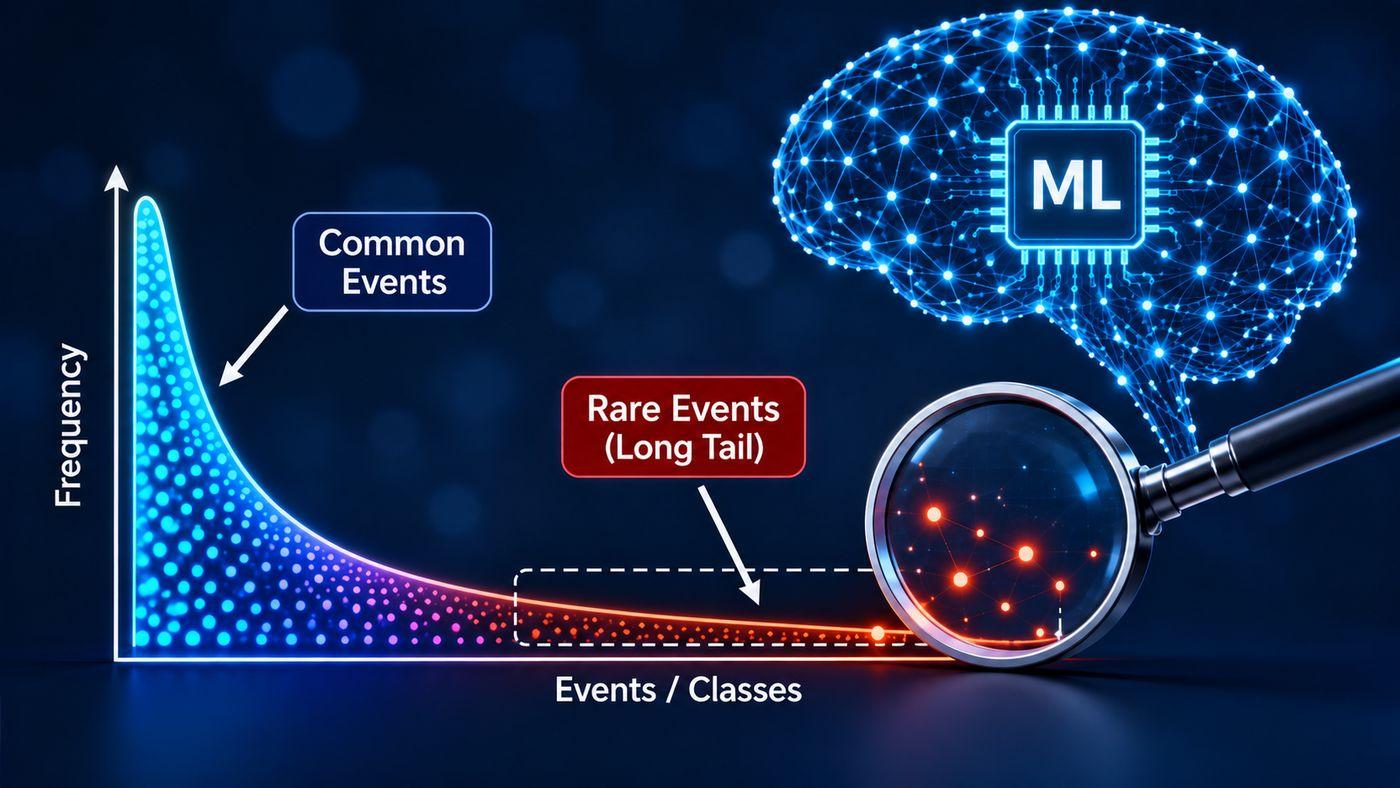
Section 1: Why Rare Events Are So Difficult to Predict
Machine learning systems generally learn most effectively when they encounter enough examples of the patterns they are expected to recognize. This assumption becomes difficult when the events that matter most occur only rarely. Fraudulent transactions may represent a tiny proportion of financial activity, critical equipment failures may happen only occasionally, and serious security incidents may be extremely uncommon compared with normal system behavior. Yet these rare events can carry financial, operational, safety, or reputational consequences that are far greater than their frequency suggests.
This creates the long tail problem in machine learning. A dataset can contain millions of common observations and only a small number of observations representing unusual or high-impact outcomes. Standard learning objectives tend to be dominated by the majority class, making it difficult for models to learn reliable patterns associated with the rare events. The challenge is therefore not simply that the minority class is small. Rare-event prediction combines limited examples, sparse labels, changing patterns, and difficult evaluation requirements.
Understanding Long-Tail Distributions
A long-tail distribution occurs when a relatively small number of common events account for most observations while a large variety of less frequent events make up the tail. In machine learning, the head of the distribution may contain routine transactions, normal equipment behavior, ordinary customer activity, or standard network traffic. The tail contains unusual cases that occur much less frequently.
The critical characteristic is that frequency and importance are not the same thing. A rare event may represent only a fraction of one percent of observations while causing a disproportionate amount of damage. A fraudulent transaction is rare compared with legitimate transactions, but identifying it may be more valuable than correctly classifying thousands of normal transactions. Likewise, an industrial failure may be uncommon but extremely expensive when it occurs.
This creates a difficult learning environment because the model receives abundant evidence about normal behavior but limited evidence about the outcomes the organization most needs to detect.
Long-tail behavior can also exist within the positive class itself. Some rare events are not simply one category. They may contain many different subtypes, each appearing only a few times. A cybersecurity system, for example, may encounter many common attack patterns while occasionally encountering entirely new techniques. The tail can therefore be both sparse and highly diverse.
Why Class Imbalance Misleads Standard ML
One of the most common characteristics of rare-event prediction is class imbalance. Class imbalance occurs when one category contains substantially more observations than another.
This can produce the accuracy paradox. Imagine a dataset in which only one out of every thousand transactions is fraudulent. A model that predicts every transaction as legitimate would achieve approximately 99.9% accuracy. Yet it would detect none of the fraudulent transactions.
The model has a high overall score but provides essentially no value for the business objective.
This happens because standard optimization approaches often focus on aggregate performance. If the majority class dominates the dataset, improving predictions for common cases can contribute much more to overall accuracy than improving predictions for rare cases.
The result can be weak minority learning, where the model fails to identify meaningful patterns associated with the rare class. The minority examples may also be too diverse for the model to learn a stable representation from the limited observations available.
Decision thresholds introduce another important factor. A model may produce probabilities rather than direct classifications, and the threshold used to convert those probabilities into actions can dramatically affect the tradeoff between missed events and false alarms.
Consequently, rare-event prediction cannot be evaluated effectively using aggregate accuracy alone. The model must be optimized according to the actual cost and importance of detecting the tail.
Why Rare Events Often Matter Most
The importance of rare events becomes clear when examining their financial losses. Fraud, severe credit events, expensive operational failures, and major security incidents may represent a tiny percentage of total activity while accounting for a significant share of total losses.
Rare events can also create serious safety risks. Equipment failures, infrastructure incidents, or dangerous operating conditions may occur infrequently but have severe consequences when they do occur. In these environments, identifying unusual patterns early can be more valuable than optimizing routine predictions.
The same principle applies to security incidents. Most network activity may be legitimate, while malicious activity represents only a small fraction of total traffic. A model must therefore identify highly unusual behavior without generating an overwhelming number of false alerts.
There are also important operational failures that live in the tail. An application may handle millions of normal requests successfully but occasionally experience an unusual sequence of events that causes a major outage. Those tail conditions can be difficult to predict precisely because they occur so infrequently.
This creates an important engineering challenge: the rarest events may deserve the greatest attention.
A successful rare-event system therefore needs to optimize for business impact rather than simply maximizing performance across the full dataset. The objective is to identify meaningful signals in the tail while controlling false positives, managing uncertainty, and adapting as rare events evolve.
This broader problem-definition step is essential before selecting specialized ML techniques. Organizations should first establish whether predicting the rare event can materially improve a business decision and whether the available evidence is sufficient to support useful prediction. "How to Decide Whether a Business Problem Actually Needs Machine Learning" provides a useful framework for determining whether the predictive problem itself justifies an ML investment.
Key Takeaway
Rare-event prediction is difficult because the events that matter most often provide the least training data. Long-tail distributions create class imbalance, sparse labels, limited minority examples, changing patterns, and misleading aggregate metrics. Successful ML systems must therefore look beyond accuracy and focus on the economic and operational importance of the tail, the quality of available rare-event data, and the consequences of false positives and false negatives. Understanding these challenges is the foundation for designing machine learning systems capable of detecting rare but consequential events.
Section 2: Techniques for Learning From the Long Tail
Rare-event prediction requires more than simply telling a machine learning algorithm to pay greater attention to the minority class. When the positive class is extremely small, standard training approaches can overlook important patterns because the majority class dominates the learning process. Engineers therefore use specialized strategies to rebalance training data, change the learning objective, detect anomalies without requiring many positive examples, and transfer knowledge from related domains.
The most effective approach depends on the nature of the rare event, the amount of labeled data available, and the consequences of incorrect predictions.
Resampling and Rebalancing
One of the most common approaches is resampling, which changes how examples are presented to the model during training. The objective is not necessarily to change the underlying real-world distribution but to ensure that rare examples have sufficient influence during learning.
Oversampling increases the representation of minority examples. The simplest approach duplicates existing rare observations, although more sophisticated techniques can generate synthetic minority examples. Oversampling can help the model pay greater attention to rare patterns, but excessive duplication can increase the risk of overfitting.
Undersampling takes the opposite approach by reducing the number of majority-class observations. This can make training more balanced and computationally efficient when the majority class contains millions of examples. However, aggressive undersampling can remove useful information about normal behavior.
Stratified sampling can help preserve an appropriate representation of rare classes when creating training and validation datasets. This is particularly important when positive examples are limited because a random split might accidentally place too few rare events into one evaluation subset.
Synthetic minority examples can also help expand the representation of rare patterns. However, generated examples must remain realistic. Creating artificial observations that do not resemble genuine rare events can cause the model to learn patterns that fail in production.
Resampling should therefore be treated as a modeling strategy rather than a simple preprocessing step. The resulting model must still be evaluated against data that reflects the true production distribution.
Cost-Sensitive and Specialized Learning
Another approach is to change how the model penalizes errors. Instead of attempting to make the training data appear balanced, engineers can assign greater importance to mistakes involving rare events.
Class weights allow the learning algorithm to assign a larger penalty to misclassifying minority examples. If missing a fraudulent transaction is significantly more costly than incorrectly flagging a legitimate transaction, the training process can reflect that difference.
More generally, weighted loss functions allow organizations to encode the business consequences of different prediction errors. This is useful because rare-event ML is often fundamentally a cost-sensitive problem. The most desirable model is not necessarily the one that minimizes total classification error; it is the one that produces the most favorable balance of business consequences.
For difficult classification problems, focal loss can place greater emphasis on hard-to-classify examples. Instead of allowing large numbers of easy majority examples to dominate training, the learning objective focuses more strongly on observations where the model struggles.
Threshold optimization provides another important mechanism. A trained model may output a probability rather than a final class. The organization can adjust the decision threshold according to its tolerance for false positives and false negatives. A lower threshold may detect more rare events but generate more alerts, while a higher threshold may reduce false alarms at the cost of missed events.
The threshold should therefore be selected according to business capacity and risk rather than simply using a default value.
Transfer Learning and Domain Knowledge
Rare-event problems can also benefit from transfer learning, particularly when a related problem has substantially more available data. Instead of learning every representation from a small rare-event dataset, engineers can start with a model that has already learned useful patterns from a broader dataset.
Pretrained representations can reduce the amount of task-specific data required. A language model may already understand general language relationships before being adapted for a specialized rare-event classification task. A computer vision model may already recognize general visual structures before being adapted to identify uncommon industrial defects.
Domain expertise can provide another advantage. Specialized features developed with help from subject-matter experts can expose signals that are difficult to learn from limited examples alone. Experts may know which transaction patterns indicate suspicious activity, which sensor combinations precede failures, or which operational conditions are associated with unusual events.
This makes expert knowledge especially valuable in the long tail. Engineers can combine statistical learning with domain-specific rules, carefully engineered features, and human review to compensate for the scarcity of rare examples.
The broader challenge is similar to limited-data machine learning: organizations must maximize the information extracted from every useful example rather than relying solely on increased dataset size. "Machine Learning Under Data Constraints: Building Models When Data Is Limited" examines strategies such as transfer learning, augmentation, domain knowledge, and data-centric approaches for building models when labeled information is scarce.
Ultimately, learning from the long tail requires a combination of techniques. Resampling can improve minority representation, cost-sensitive learning can reflect business risk, anomaly detection can address situations where positive examples are extremely limited, and transfer learning can provide useful prior knowledge. The correct strategy depends on the structure of the problem rather than any single algorithmic preference.
Key Takeaway
Rare-event ML requires techniques that prevent the majority class from overwhelming the learning process. Resampling, class weighting, specialized loss functions, threshold optimization, anomaly detection, one-class learning, transfer learning, and domain expertise can all improve the ability to detect tail events. The strongest systems combine these approaches with realistic validation and business-aware decision thresholds rather than relying on class balancing alone.
Section 3: Evaluating Rare-Event Models Correctly
Building a model that can identify rare events is only half the challenge. The next question is whether the model is actually performing well enough to support a business decision. Rare-event problems make evaluation particularly difficult because the minority class may represent only a tiny fraction of observations. Metrics that work reasonably well for balanced datasets can become misleading when positive events are extremely uncommon.
A model can achieve extremely high overall accuracy while detecting almost none of the events that matter. Effective evaluation therefore requires metrics, thresholds, and monitoring strategies specifically designed for the long tail.
Why Accuracy Is Often the Wrong Metric
The accuracy paradox is one of the most common problems in rare-event machine learning. Imagine a dataset where only 0.1% of transactions are fraudulent. A model that classifies every transaction as legitimate would achieve 99.9% accuracy while completely failing its intended purpose.
For this reason, engineers usually examine precision and recall alongside accuracy. Precision measures how many predictions identified as positive are actually positive. Recall measures how many of the actual rare events the system successfully detects.
These metrics represent different business tradeoffs. A fraud system with very high recall may identify most fraudulent transactions but generate many false alarms. A system with extremely high precision may produce fewer false alerts but miss a significant number of fraudulent cases.
The F1 score combines precision and recall into a single measure, which can be useful for comparing models when both types of errors matter. However, even F1 should not automatically be treated as the final business metric. The preferred balance depends on the consequences of incorrect decisions, review capacity, and the cost of missed events.
Rare-event evaluation should therefore begin by understanding what the organization is actually trying to optimize.
Ranking and Threshold Selection
Many ML models produce a probability or risk score rather than a direct yes-or-no classification. This creates an important opportunity for ranking and threshold optimization.
Instead of asking whether a model correctly labels every observation, a business may want to know whether the highest-risk cases are concentrated near the top of the ranking. This is particularly useful when human investigators have limited capacity and can review only a fixed number of alerts.
Precision-recall curves can help organizations understand how precision changes as recall increases across different thresholds. This provides a more informative view of rare-event performance than relying on a single classification threshold.
Threshold selection should ultimately reflect business constraints. Suppose a security team can investigate only 500 alerts per day. A model that produces 20,000 high-risk cases may detect more events, but the organization cannot realistically investigate all of them. The practical threshold must therefore balance detection quality with operational capacity.
A lower threshold generally increases recall but produces more alerts. A higher threshold can reduce false positives while potentially missing additional rare events.
The appropriate threshold is therefore not purely a machine learning decision. It is a product, operations, and risk-management decision.
Production Monitoring for Tail Events
Rare-event models require continuous monitoring because the long tail can change over time. New fraud patterns emerge, attackers modify their behavior, equipment conditions evolve, and customer activity changes.
A major challenge is rare-event drift. The frequency and characteristics of the target event can change, making historical performance less representative of current conditions.
Organizations should monitor distribution changes in both normal and rare-event populations. Changes in feature distributions can indicate that the production environment is moving away from the conditions represented in training data.
Teams should also watch for detection degradation. If precision declines while alert volumes increase, the system may be identifying more normal cases as suspicious. If recall declines, important events may be escaping detection.
Because ground-truth labels for rare events can arrive slowly, organizations may need human review as part of the monitoring process. Analysts can validate suspicious cases, provide feedback, and help identify new patterns that were not represented in the original training data.
This creates a continuous feedback loop in which production observations improve both evaluation and future model development.
Rare-event ML is therefore not a one-time classification exercise. Evaluation must continue throughout the system lifecycle, with metrics, thresholds, business costs, and production behavior considered together.
For high-stakes rare-event applications, auditability adds another layer of importance. Organizations may need to reconstruct why an unusual event was or was not flagged, which model version made the prediction, and whether human reviewers intervened. "Machine Learning for High-Stakes Decisions: Designing Systems That Can Be Audited" explores these requirements in greater detail.
Key Takeaway
Rare-event models require evaluation strategies designed around imbalance, business consequences, and operational constraints. Accuracy alone is often misleading; precision, recall, F1, ranking quality, threshold economics, and error costs provide a more complete picture. Production monitoring must also detect changes in rare-event frequency, data distributions, and model effectiveness. The strongest systems continuously balance detection capability against false-alarm costs while incorporating human review and business risk into their evaluation framework.
Section 4: Designing Machine Learning Systems for the Long Tail
Rare-event prediction cannot be solved reliably through model training alone. A production system must continuously discover new examples, adapt to changing event patterns, combine statistical predictions with business rules, and ensure that high-risk cases receive appropriate attention. Long-tail systems are therefore best treated as continuous risk-detection capabilities rather than static classification models.
Building Better Data Collection Loops
One of the biggest challenges in rare-event ML is obtaining enough high-quality examples of the events the model is expected to detect. Organizations can address this through active learning, targeted labeling, and structured feedback systems.
Active learning allows the model to identify observations where its uncertainty is greatest or where additional labels are likely to provide meaningful learning value. Instead of asking experts to review large numbers of routine cases, teams can prioritize unusual or ambiguous examples.
Targeted labeling can also focus specifically on underrepresented regions of the data. For example, if a fraud system contains millions of legitimate transactions but very few confirmed fraud cases, investigators can prioritize emerging transaction patterns that appear suspicious rather than labeling additional routine transactions.
Organizations should also create mechanisms for rare-event capture. Production systems can preserve unusual cases, investigator decisions, customer reports, equipment failures, or security incidents so that these observations can eventually contribute to future model development.
This creates valuable feedback systems. Human decisions and operational outcomes become new evidence that can improve detection. However, the feedback must be validated carefully because human review itself can contain inconsistencies or biases.
Combining Models and Rules
Rare-event detection often works best when machine learning is combined with deterministic business logic rather than used in isolation. A hybrid detection system can combine statistical predictions, expert rules, external signals, and human review.
Expert rules can capture known patterns that are straightforward to express. For example, a security system may know that certain configurations or access behaviors violate explicit policies. The ML system can then handle more complex patterns that are difficult to encode manually.
The ML component can provide an ML score representing the probability or risk associated with an event. This score can then be combined with rules that incorporate business context, transaction value, user history, or operational constraints.
Hybrid architectures are especially useful when the cost of mistakes is significant. A prediction can trigger additional verification rather than automatically producing a final decision.
Human escalation provides another safeguard. Unusual or high-confidence-risk cases can be routed to specialists, while routine cases are processed automatically. This reduces unnecessary manual work without requiring the organization to trust the model blindly.
The result is an architecture in which ML provides pattern recognition while rules and humans provide additional context, controls, and accountability.
Continuous Adaptation to Emerging Events
Long-tail systems must operate in environments where rare events can change over time. New fraud techniques, attack methods, equipment failure modes, and customer behaviors can emerge after the model has been trained.
This creates the problem of concept drift. The relationship between observed features and the target event may change, meaning patterns that were predictive previously may become less useful.
Organizations should therefore monitor for new attack patterns, emerging failure modes, and other changes in the underlying event distribution. Sudden changes in alert patterns, feature distributions, or human-review outcomes can provide early indications that the model is encountering unfamiliar conditions.
Retraining strategies should account for these changes. Simply retraining on the latest data may not be sufficient if the newest rare events are still underrepresented. Teams may need to combine historical examples with newly captured cases while ensuring that the training dataset remains representative.
Continuous adaptation also requires careful validation. A new model may improve detection of recently observed events while becoming worse at detecting previously known patterns. Evaluation should therefore cover both new and established parts of the long tail.
The goal is not to build a model that perfectly predicts every future rare event. That is rarely possible. The objective is to create a system that can detect changing conditions, collect new evidence, and adapt safely.
Turning Rare-Event Detection Into a Business Capability
The most mature organizations treat rare-event prediction as more than an isolated ML project. It becomes part of broader risk management and operational decision-making.
Fraud detection, cybersecurity, equipment monitoring, and safety systems can become integrated into enterprise workflows where detection triggers investigation, intervention, or preventive action. ML becomes one component of a broader risk-management process.
This creates opportunities for stronger operational resilience. Organizations that can detect emerging failures or unusual behavior earlier can respond before those events create larger disruptions. The value of rare-event ML is therefore often measured not only by model metrics but by avoided losses, reduced downtime, faster investigation, or improved safety.
Supporting these capabilities requires reliable AI infrastructure. Production systems need data pipelines, model-serving infrastructure, monitoring, alert management, feedback collection, retraining workflows, and appropriate access controls. Rare-event detection often operates continuously, making reliability particularly important.
Long-term success also depends on maintaining a clear business strategy. The organization must determine which events require detection, what actions should follow, how much false-alarm volume can be supported, and when humans must intervene.
A successful rare-event system is therefore a coordinated capability:
Detect → Prioritize → Investigate → Act → Learn → Adapt.
This cycle allows organizations to move beyond static anomaly detection toward continuously improving risk-management systems.
The transition from an experimental rare-event model to a reliable production capability also requires the engineering discipline discussed in "From Proof of Concept to Production: Why Most ML Projects Never Make the Leap." A rare-event model is valuable only when its predictions can be delivered reliably, monitored continuously, integrated into workflows, and improved as new evidence becomes available.
Key Takeaway
Designing ML systems for the long tail requires more than addressing class imbalance during training. Organizations need targeted data collection, active learning, hybrid model-and-rule architectures, human escalation, continuous monitoring, concept-drift detection, and retraining strategies that can adapt to emerging events. The strongest systems turn rare-event prediction into an ongoing business capability that continuously detects, prioritizes, investigates, and learns from unusual events while balancing detection quality against operational cost and risk.
Conclusion
The long tail problem illustrates one of the most difficult challenges in machine learning: the events that matter most can be the events for which the organization has the least amount of training data. Fraud, security incidents, equipment failures, severe operational disruptions, and other rare outcomes may occur only occasionally, yet their consequences can be disproportionately large. This creates an environment where conventional ML approaches can perform extremely well on the majority of observations while failing to identify the minority events that actually matter most to the business.
The first step toward solving this problem is recognizing that rare-event prediction is not simply an ordinary classification problem with an imbalanced dataset. Limited positive examples, expensive labels, changing event definitions, incomplete signals, and evolving behavior all contribute to the difficulty. Organizations therefore need to design the entire ML lifecycle around the characteristics of the long tail.
Specialized learning strategies can help. Resampling and rebalancing techniques give minority examples greater influence during training, while cost-sensitive learning allows organizations to reflect the different consequences of false positives and false negatives. Anomaly detection and one-class learning can become valuable when labeled examples of the rare event are extremely limited. Transfer learning and domain expertise can provide additional knowledge when the available target dataset is too small to support learning entirely from scratch.
Evaluation must also change. Accuracy is often an inappropriate primary metric when rare events represent a tiny fraction of observations. Precision, recall, F1 score, ranking quality, threshold analysis, and business-specific error costs provide a more useful understanding of model performance. The correct threshold is not determined solely by statistical optimization; it depends on the organization's risk tolerance, investigation capacity, and the consequences of missed or incorrectly flagged events.
Production monitoring is equally important because rare events evolve. Fraud patterns change, attackers develop new techniques, equipment failure modes emerge, and customer behavior shifts. A model trained on historical rare events can therefore become less effective as the environment changes. Continuous monitoring for data drift, concept drift, detection degradation, and emerging patterns is essential.
Frequently Asked Questions (FAQs)
1. What is the long tail problem in machine learning?
The long tail problem occurs when a small number of common observations account for most of the dataset while numerous rare events appear infrequently. These rare events may be difficult to learn despite being highly important to the business.
2. Why are rare events difficult for machine learning models to predict?
Rare events provide limited training examples, which makes it difficult for models to learn stable patterns. They may also have noisy labels, incomplete signals, changing characteristics, and substantial variation within the minority class.
3. What is class imbalance?
Class imbalance occurs when one class contains substantially more observations than another. In rare-event problems, the target event may represent only a tiny fraction of the total dataset.
4. Why is accuracy misleading for rare-event prediction?
A model can achieve very high accuracy by predicting the majority class almost every time. For example, if only 0.1% of transactions are fraudulent, predicting every transaction as legitimate produces high accuracy while detecting no fraud.
5. How can machine learning models handle highly imbalanced data?
Common approaches include oversampling, undersampling, class weighting, specialized loss functions, threshold optimization, anomaly detection, synthetic data, and carefully designed evaluation strategies.
6. What is oversampling?
Oversampling increases the representation of minority-class examples during model training. It can involve duplicating existing examples or generating carefully controlled synthetic examples.
7. What is focal loss?
Focal loss is a specialized loss function that places greater emphasis on difficult-to-classify examples and reduces the influence of large numbers of easy examples. It can be useful in highly imbalanced classification problems.
8. When should anomaly detection be used instead of classification?
Anomaly detection can be useful when reliable positive examples are extremely scarce or when new types of rare events may emerge that were not represented in historical labeled data.
9. How should rare-event ML models be evaluated?
Evaluation should consider metrics such as precision, recall, F1 score, precision-recall curves, ranking quality, calibration, false-positive and false-negative costs, and business outcomes rather than relying primarily on accuracy.
10. What is the difference between precision and recall for rare events?
Precision measures how many flagged cases are actually rare events, while recall measures how many of the actual rare events the system successfully detects. Increasing recall often increases the number of false positives, so the appropriate balance depends on the business context.
11. How can organizations reduce false positives?
Organizations can optimize decision thresholds, improve feature quality, incorporate business rules and contextual information, use better ranking strategies, and route uncertain cases to human reviewers.
12. How does concept drift affect rare-event prediction?
Concept drift occurs when the relationship between input variables and the target event changes over time. A model trained on historical fraud, security, or failure patterns may therefore become less effective when new patterns emerge.
13. Can synthetic data help with rare-event machine learning?
Yes. Synthetic data can provide additional training scenarios when genuine examples are scarce or difficult to collect. However, synthetic examples must be realistic and validated against genuine production data to avoid introducing misleading patterns.
14. How should rare-event models be monitored in production?
Production monitoring should track data distributions, alert volumes, precision, recall when labels become available, prediction confidence, false-positive rates, drift, emerging patterns, and business outcomes. Human review can also provide valuable feedback when rare-event labels are delayed.
15. What is the best strategy for building ML systems for rare events?
There is no single best technique. A strong strategy combines high-quality and targeted data collection, appropriate sampling, cost-sensitive learning, anomaly detection where appropriate, domain expertise, business-aware evaluation, human oversight, drift monitoring, and continuous retraining. The objective is to create a continuously improving risk-detection capability rather than relying on a static model.