Section 1: Why ML Data Needs Contracts
Machine learning systems are often described as models surrounded by data pipelines, feature stores, APIs, and application services. In practice, those components form a network of dependencies in which a seemingly small data change can affect model behavior far downstream.
A software engineer would rarely accept an important API dependency without defining what the interface guarantees. A service might specify the request schema, response format, data types, error behavior, versioning policy, and compatibility expectations. These agreements allow teams to evolve systems independently without constantly breaking one another.
Machine learning data dependencies have historically been less formal.
An upstream application may generate an event that a data pipeline consumes. A data engineering team may transform that event into a feature. An ML pipeline may use the feature during training and inference. If the upstream application changes the event structure, the downstream ML system may continue operating without an obvious software failure.
That is what makes data dependencies particularly dangerous.
The system can remain technically healthy while becoming semantically incorrect.
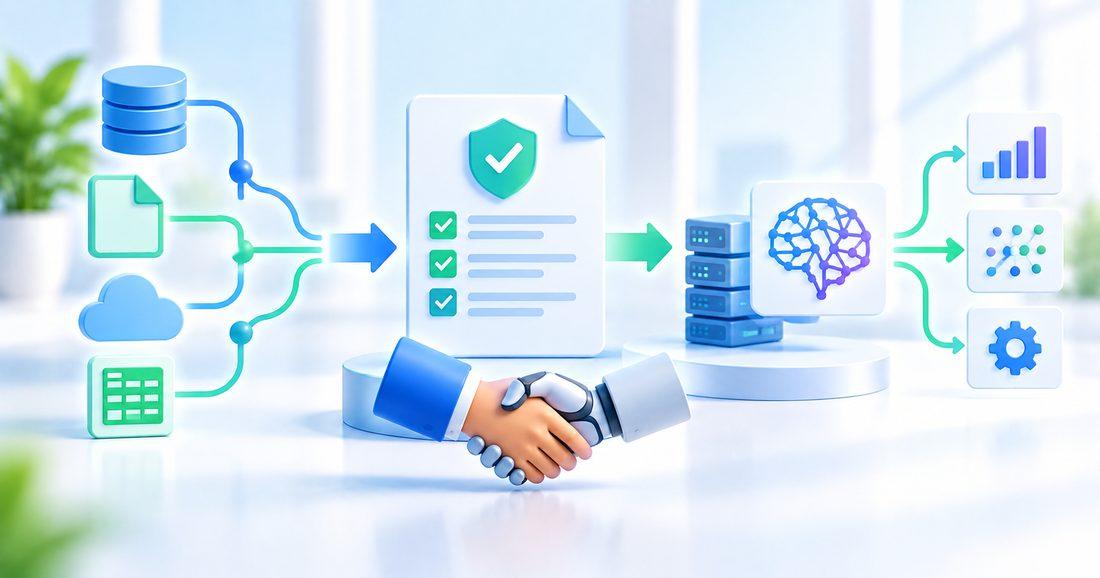
Data contracts address this problem by bringing an explicit interface between data producers and consumers. They define what downstream users can expect and what upstream producers are responsible for maintaining.
The Hidden Fragility of ML Data Dependencies
An ML model may depend on dozens or hundreds of individual data fields.
Consider a model that predicts whether a customer is likely to churn. One feature may represent the number of support interactions during the previous 30 days. Another may represent recent product usage. Another may represent the customer's account age.
Now imagine that an upstream application changes the way support interactions are recorded.
The field still exists. The data type is still numeric. The pipeline still runs. The model still receives a value.
Yet the meaning of that value has changed.
Previously, the feature may have counted completed support interactions. After the change, it may count every support-event initiation. The model has not crashed, but it is no longer receiving the information it was trained to interpret.
This type of failure can be difficult to detect because traditional software monitoring may report everything as healthy.
The database is available. The pipeline completed successfully. The API returned a valid response. The model generated predictions.
The problem exists in the meaning of the data.
Other failures are more obvious but can still be difficult to manage. An upstream team may remove a field, rename a field, change a data type, increase the percentage of missing values, or alter the frequency at which records are generated. Each change can affect downstream ML behavior in different ways.
The deeper problem is that the assumptions are often implicit.
The ML team knows what a field is expected to mean. The producing team knows how the field is generated. But there may be no explicit engineering artifact connecting those assumptions.
Data contracts make that relationship visible.
Why ML Systems Need Stronger Data Guarantees
The consequences of data changes can be unusually subtle in machine learning because models learn statistical relationships rather than executing a fixed set of deterministic rules.
A conventional application may fail loudly when a required field disappears. An ML model can often continue operating when a feature becomes distorted.
That ability to continue operating can actually make the problem harder to detect.
A model may generate plausible predictions from degraded inputs. Those predictions can then enter downstream systems and affect users or business decisions before anyone realizes that a data contract has been violated.
The situation becomes even more complicated during model training.
If a training dataset contains a silent change in feature meaning or quality, the resulting model may encode that change. The training job may complete successfully, and offline evaluation may still produce acceptable numbers if the evaluation data contains the same inconsistency.
The resulting model can then be deployed with assumptions that no longer match the intended production environment.
This is one reason ML teams need stronger guarantees around data semantics and behavior, not just infrastructure availability.
Contracts cannot guarantee perfect data. They can, however, make important assumptions explicit and provide mechanisms for detecting when those assumptions stop being true.
The broader production engineering challenge is closely related to "The Hidden Engineering Work Behind Every Successful Machine Learning Product" A successful ML product depends on much more than the model itself. Data pipelines, feature systems, deployment infrastructure, monitoring, and operational ownership all contribute to reliability.
Data contracts strengthen the relationship between these components by defining clearer boundaries between the systems that produce data and the ML systems that consume it.
The result is a fundamental shift in how teams think about ML data.
Instead of treating upstream data as something that will probably remain compatible, teams can treat it as an explicit engineering dependency with defined guarantees.
That does not eliminate data failures.
It makes those failures easier to detect, communicate, diagnose, and manage.
And that is precisely the kind of discipline that machine learning systems need as they become larger, more distributed, and more deeply integrated into production software.
Key Takeaway
ML systems are unusually vulnerable to silent data failures because a dataset or feature can remain technically valid while its meaning, quality, or distribution changes. Schemas alone are not enough. Data contracts create explicit interfaces between data producers and ML consumers by defining expectations around structure, semantics, quality, and ownership, bringing the same kind of engineering discipline to data that software teams have long applied to APIs.
Section 2: What a Data Contract Contains
A data contract becomes useful only when it defines the expectations that matter to the systems consuming the data. Simply documenting a table or listing the names and data types of its fields is not enough for many machine learning workloads. ML systems depend not only on whether data has the expected structure, but also on whether that data retains the expected meaning, quality, timing, and behavioral characteristics.
For this reason, an effective machine learning data contract needs to operate at several levels.
It should establish the shape of the data, clarify what the data means, define acceptable quality and freshness expectations, and make ownership and change management explicit. Together, these elements create an agreement that allows data producers and ML consumers to evolve independently while reducing the risk of unexpected downstream failures.
Schema and Data-Type Guarantees
The most visible component of a data contract is the schema.
A contract can specify which fields should exist, what data types they should use, which fields are required, how nested structures are organized, and which values or categories are permitted. These definitions create an explicit structural interface between a producing system and its consumers.
For example, a feature pipeline may depend on an event containing a customer identifier, event timestamp, transaction value, and transaction type. A contract can make it clear that the identifier is a string, the timestamp follows a defined format, the transaction value is numeric, and the transaction type belongs to an established set of categories.
This provides an important first layer of protection.
If an upstream system removes a required field or changes a numeric field to an incompatible structure, automated validation can detect the change before downstream processing continues.
However, schema guarantees alone are not sufficient for ML.
A field can retain its data type while changing in ways that materially affect model behavior. A numeric feature can move from one unit to another. A categorical field can introduce new values. A timestamp can change timezone semantics. A field that was previously required can begin containing a large percentage of null values.
These changes may be syntactically valid while still violating the assumptions of the model.
That is why structural validation should be treated as the first layer of a broader contract, rather than the entire contract itself.
Ownership, Versioning, and Change Management
A contract is only effective when someone is responsible for honoring it.
This makes ownership a critical part of data contracts.
The producing team should be clearly identified, along with the consumers or domains that depend on the data. Responsibilities should include maintaining the data source, responding to contract violations, communicating planned changes, and managing deprecation.
Without ownership, a contract can become documentation that nobody actively maintains.
Versioning is equally important because data systems need to evolve.
A producer may need to add a field, modify an existing definition, change how records are generated, or eventually remove a deprecated field. The organization needs a controlled mechanism for distinguishing compatible changes from breaking changes.
For example, adding an optional field may be safe for existing consumers, while removing a field that an ML model requires may be a breaking change.
This is analogous to API evolution.
The goal is not to prevent change. It is to make change predictable and manageable.
When a breaking modification is necessary, downstream consumers should have a path to adapt. That might involve running multiple versions temporarily, introducing a replacement field, migrating models, or coordinating a defined deprecation period.
For ML systems, change management is particularly important because data modifications can affect both training and inference.
A field definition may change between model-training runs. A feature may be available during historical training but behave differently after deployment. A contract gives teams a common mechanism for understanding and governing those changes.
This connects directly to the broader ML lifecycle described in "The Journey of a Dataset: From Raw Data to Production ML" Data moves through multiple stages before and after reaching a model, and each stage can introduce transformations or dependencies. Explicit contracts help maintain consistency across that lifecycle by making expectations about the data visible to both producers and consumers.
The deeper value of a data contract is therefore not the document itself.
It is the agreement and enforcement mechanism behind the document.
A useful contract establishes what the data should look like, what it means, what quality is expected, who owns it, and how changes should be managed. Automated checks can then turn those expectations into enforceable controls.
This changes the relationship between data producers and ML consumers.
Instead of downstream teams discovering unexpected changes through model degradation or production incidents, the organization can detect contract violations much earlier and address them at the interface where the change occurred.
Key Takeaway
A strong ML data contract defines far more than schema. It establishes explicit expectations around structure, semantics, quality, freshness, completeness, ownership, versioning, and change management. By turning these assumptions into measurable and enforceable agreements, data contracts create a reliable interface between producers and ML consumers and make data evolution safer for production machine learning systems.
Section 3: Using Data Contracts to Make ML Pipelines More Reliable
Defining a data contract is only the beginning. Its real value appears when the contract is integrated into the engineering workflow and actively used to prevent incompatible data from reaching machine learning systems.
A contract that exists only as documentation cannot protect a model from an unexpected upstream change. To create meaningful reliability improvements, teams need to connect contracts with validation, automated testing, deployment processes, data observability, and ML operations.
This changes the role of data quality from a reactive activity into a preventive engineering practice.
Instead of discovering that a feature changed after model performance deteriorates in production, the organization can detect a contract violation much earlier. Instead of waiting for an ML engineer to notice unusual predictions, automated checks can identify a breaking change when the data is produced or consumed.
The result is a stronger interface between data systems and machine learning systems.
Catching Breaking Changes Before Production
One of the most important benefits of data contracts is their ability to catch incompatible changes before those changes reach production models.
Consider a model that depends on a feature representing a customer's average transaction value. An upstream team decides to change how that metric is calculated. The field remains present, the data type remains numeric, and the pipeline continues to run.
Without a contract, the change may pass through the entire system unnoticed.
The model may begin receiving values generated under a different definition, and engineers may discover the problem only after observing changes in predictions or model performance.
A contract can make the expected behavior explicit.
If the feature has a defined semantic meaning, acceptable range, freshness requirement, and other constraints, automated validation can identify that the producer's output no longer satisfies the agreement.
This creates an opportunity to stop or isolate the problematic data before it reaches sensitive downstream systems.
The same principle applies to structural changes.
Removing a required field, changing the type of an attribute, introducing incompatible categorical values, or substantially altering record structure can trigger contract validation before downstream consumers are affected.
This is particularly valuable for ML because data failures do not always cause obvious software failures.
A model can continue producing outputs from bad inputs.
Detecting violations at the data interface therefore provides an earlier and often more actionable failure signal than waiting for model degradation.
The goal is not to prevent every data change.
It is to distinguish compatible evolution from changes that violate the assumptions of downstream consumers.
Integrating Contracts With Data Observability and MLOps
Data contracts become substantially more powerful when integrated into the broader ML platform.
Data observability can monitor whether contracted properties remain true in production. Automated validation can check schema, quality, freshness, and semantic constraints. CI/CD pipelines can test proposed changes before deployment. Lineage systems can identify which models depend on a particular dataset or feature.
MLOps workflows can then incorporate those signals into model training and deployment decisions.
For example, a training pipeline might refuse to consume a dataset version that violates a critical contract. A model deployment pipeline might block a release if required production features no longer satisfy their defined quality expectations.
This creates a sequence of controls across the lifecycle:
Define expectations → validate producer output → test compatibility → monitor production data → block unsafe changes → update consumers deliberately.
The benefit is that data quality becomes connected to operational decisions.
A contract violation is no longer simply a warning in a dashboard. Depending on its severity, it can trigger an alert, prevent publication, stop a downstream pipeline, or block a model deployment.
The correct response should be based on risk.
A minor deviation in an optional field may only require monitoring. A severe violation of a critical model feature may justify stopping the pipeline until the issue is resolved.
This approach also improves incident diagnosis.
When a model behaves unexpectedly, engineers can inspect whether relevant data contracts were violated around the same time. If a critical feature suddenly exceeded its acceptable range or became substantially less complete, the data pipeline becomes an immediate candidate for investigation.
Without those explicit guarantees, engineers may spend significant time debugging the model itself.
The broader production context is closely related to "From Experiment to Production: The Decisions That Shape an ML System" Taking an ML system into production requires more than proving that a model works on historical data. The surrounding data, serving, testing, deployment, and operational systems must also behave predictably. Data contracts strengthen one of those critical boundaries by making data expectations explicit and enforceable.
The deeper value of data contracts is therefore preventive.
They move organizations from a model of “something changed, and now the ML system is behaving strangely” toward “the interface changed, the contract detected it, and the affected systems can respond before model behavior is compromised.”
That is a significant shift in reliability.
Key Takeaway
Data contracts make ML pipelines more reliable when they are actively enforced through validation, contract testing, training-serving consistency checks, observability, and MLOps workflows. Their greatest value is early detection: incompatible structural, semantic, or quality changes can be identified at the data boundary before they silently propagate into models and production decisions.
Section 4: Making Data Contracts Work at Organizational Scale
Data contracts become significantly more valuable as machine learning systems grow larger and more interconnected. A small ML team may be able to coordinate directly with the engineers producing its training data. In a large organization, that approach quickly breaks down. Dozens or hundreds of teams may produce datasets, events, and features consumed by analytics systems, applications, recommendation engines, fraud models, forecasting systems, and other AI workloads.
At that scale, undocumented assumptions become a significant operational risk.
A data contract provides a mechanism for turning those assumptions into explicit agreements. But establishing contracts across an organization is not purely a technical exercise. It requires clear ownership, practical governance, disciplined change management, and enough automation to make compliance part of the normal engineering workflow rather than an additional manual process.
The objective is not to prevent teams from changing their systems.
It is to make those changes visible, predictable, and manageable for the systems that depend on the data.
Defining Ownership Across Data Producers and ML Consumers
A data contract needs clear ownership because an agreement without accountability is difficult to enforce.
The producer should understand what it is responsible for delivering, while consumers should understand what assumptions they are making about the data. This creates a shared responsibility model in which neither side treats data quality as somebody else's problem.
For example, an application team may own the events generated by a customer-facing service. A data platform team may own the transformation pipeline that converts those events into a reusable dataset. An ML team may own a model that consumes the resulting features.
When something changes, these teams need to know who is responsible for assessing the impact.
Ownership should therefore include more than simply naming a team.
It should define who maintains the contract, who approves breaking changes, who responds to violations, and who communicates important modifications to downstream consumers. This becomes particularly important for critical ML features whose failure can affect production decisions.
Without clear ownership, downstream teams may discover a contract violation only after model performance changes. They may then spend significant time tracing the issue back through several systems before finding the source.
Explicit ownership shortens that path.
It also encourages data producers to treat their outputs as products with consumers, rather than internal implementation details.
This mindset is particularly important in organizations where data is reused across many ML applications. A seemingly local change may have consequences far beyond the team making the change.
Building a Contract-Driven Data Culture
Technology alone cannot create a contract-driven organization.
Teams need a shared understanding that data is a product with consumers, dependencies, and quality expectations. Producers need to recognize that changes to their outputs can affect systems they may never directly interact with. ML teams need to communicate which data properties are genuinely critical rather than imposing unnecessary constraints.
This requires a culture of explicit communication.
Feature definitions should be understandable. Important quality requirements should be documented. Ownership should be visible. Changes should be traceable. Contract violations should be treated as engineering signals rather than simply operational annoyances.
The benefits compound over time.
As more datasets adopt explicit contracts, organizations develop clearer dependency graphs. Engineers can understand which changes are safe, which require migration, and which models may be affected. Data-quality incidents become easier to diagnose because the expected behavior of important interfaces is documented and testable.
This also supports broader data-centric engineering.
The same discipline that protects ML pipelines from unexpected schema or semantic changes can improve the quality of the datasets themselves. "Data-Centric AI: Why Improving Your Dataset Can Beat Changing Your Model" highlights the importance of treating data quality, labeling, representation, and coverage as engineering concerns. Data contracts extend that idea by focusing on the relationship between the teams that produce data and the systems that depend on it.
The result is a more mature data ecosystem.
Rather than allowing every ML team to independently discover the assumptions behind its dependencies, the organization develops reusable standards for how data should be produced, documented, validated, changed, and consumed.
This is particularly important as organizations scale their AI capabilities.
The number of models may increase rapidly. The same feature may feed many systems. Data may move between batch and streaming architectures. Multiple teams may contribute to a single production workflow. Without explicit interfaces, the coordination burden grows rapidly.
Data contracts provide a mechanism for containing that complexity.
They establish boundaries between teams while still allowing those teams to move independently within those boundaries.
The broader engineering principle is familiar from software development: well-defined interfaces allow complex systems to scale because individual components can evolve without requiring everyone to understand every internal implementation detail.
Data contracts bring that principle into the data layer.
The strongest organizations therefore do not treat data contracts as a documentation project.
They treat them as part of the operating model for reliable data and machine learning.
Contracts define expectations. Automated tests enforce them. Observability detects violations in production. Lineage identifies affected consumers. Versioning manages evolution. Ownership ensures that someone is accountable when those guarantees are broken.
Together, these mechanisms create a system where data changes become intentional engineering events rather than silent sources of downstream model failure.
Key Takeaway
Data contracts scale effectively when organizations establish clear ownership, controlled versioning, automated enforcement, risk-based governance, and a shared culture of treating data as a product. The goal is not to freeze data systems or slow engineering velocity. It is to provide stable interfaces that allow data producers and ML consumers to evolve independently while making breaking changes visible, testable, and manageable.
Conclusion
Machine learning systems depend on data more deeply than most traditional software systems depend on any single input. A model's behavior can be affected not only by whether a dataset is available, but by changes in its schema, semantics, quality, freshness, completeness, and distribution.
The difficulty is that many of these changes can occur without producing an obvious software failure.
A pipeline may complete successfully. An API may continue returning responses. A database may remain available. Yet a feature may have changed meaning, a critical field may contain unexpected values, or an upstream application may begin producing data at a different frequency. The ML system can continue operating while its assumptions gradually become invalid.
This is where data contracts provide a valuable engineering discipline.
A data contract establishes an explicit agreement between the systems that produce data and the systems that consume it. Rather than relying on informal knowledge or undocumented assumptions, teams can define what data should look like, what it means, what quality is expected, how fresh it should be, who owns it, and how changes should be managed.
The result is similar in spirit to the role that APIs and interface contracts play in software engineering.
The objective is not to prevent data from changing.
It is to make important changes intentional, visible, testable, and manageable.
One of the most important lessons is that schema alone is insufficient.
Knowing that a field is numeric does not guarantee that it represents the same concept it represented yesterday. A categorical field can retain its type while introducing new values. A timestamp can maintain its format while changing its semantic interpretation. A feature can remain populated while its missingness or distribution changes enough to affect a model.
Machine learning systems therefore need contracts that capture semantics and quality as well as structure.
This becomes particularly important because ML failures can be silent. Traditional software may fail loudly when a required field disappears. A model may continue producing apparently plausible predictions from distorted inputs.
That makes early detection extremely valuable.
Contract validation can identify incompatible structural changes, invalid values, unexpected completeness levels, semantic changes, or other violations before they propagate into training pipelines or production inference. The earlier the problem is detected, the easier it is generally to identify its source and prevent downstream impact.
Data contracts also become more powerful when integrated with other engineering practices.
Contract testing can verify that producers and consumers remain compatible. Data observability can monitor whether contracted expectations remain true in production. Data lineage can reveal which models and applications depend on a particular dataset. MLOps workflows can use contract checks as release gates before training or deployment.
Together, these practices create a stronger control system around ML data.
Frequently Asked Questions
1. What is a data contract?
A data contract is an explicit agreement between a data producer and its consumers that defines expectations about the structure, meaning, quality, freshness, ownership, and evolution of a dataset or data interface.
2. Why are data contracts important for machine learning?
ML systems are highly dependent on data, and data changes can affect model behavior without causing obvious software failures. Data contracts make important assumptions explicit and provide mechanisms for detecting incompatible changes before they silently damage models or pipelines.
3. How are data contracts different from data schemas?
A schema primarily describes the structure and types of data. A data contract can go further by defining semantics, quality expectations, freshness, completeness, ownership, compatibility, and change-management requirements that downstream consumers depend on.
4. What should a machine learning data contract contain?
A useful ML data contract can define required fields, data types, allowed values, semantic definitions, expected ranges, completeness requirements, freshness expectations, ownership, versioning rules, compatibility requirements, and procedures for managing breaking changes.
5. Who owns a data contract?
Ownership should be explicit. The data-producing team is typically responsible for maintaining the data and honoring the defined guarantees, while consuming teams communicate their critical requirements and manage their dependence on the interface. Organizations should clearly define who handles violations and contract changes.
6. How do data contracts improve ML pipeline reliability?
They allow teams to detect structural, semantic, and quality changes earlier. Instead of waiting for a model's performance to degrade, automated contract checks can identify incompatible data before it reaches training or production inference.
7. Can data contracts prevent breaking changes?
They can help detect and control breaking changes, but they cannot prevent a producer from ever needing to change its data. Versioning, compatibility testing, migration periods, and deprecation processes allow organizations to manage necessary changes safely.
8. How do data contracts support data quality?
Contracts can specify measurable expectations around completeness, valid ranges, freshness, volume, allowed values, and other quality characteristics. Automated checks can then determine whether incoming data continues to meet those expectations.
9. What role does versioning play in data contracts?
Versioning allows producers and consumers to distinguish between compatible and incompatible changes. It provides a controlled way to introduce new definitions, migrate consumers, support multiple representations temporarily, and deprecate older versions safely.
10. How are data contracts tested?
Contracts can be tested through automated schema validation, quality checks, compatibility testing, producer-side validation, consumer-side tests, and deployment or pipeline gates. These checks can be integrated into software and data delivery workflows.
11. Can data contracts help prevent training-serving skew?
Yes. By explicitly defining feature semantics, formats, quality requirements, and other assumptions, contracts can help keep training and inference data aligned. They should be used alongside feature management, validation, lineage, and monitoring practices.
12. How do data contracts work with data observability and MLOps?
Data contracts define what should be true, while observability monitors whether those expectations remain true in production. MLOps workflows can then use contract-validation results to trigger alerts, block unsafe training or deployment steps, or initiate investigation.
13. What happens when a producer needs to change a contracted dataset?
The change should be evaluated for compatibility. Safe changes can proceed through normal workflows, while breaking changes may require a new version, migration period, temporary support for multiple versions, or coordinated updates to downstream consumers.
14. Are data contracts useful for both batch and streaming ML systems?
Yes. The specific implementation differs, but both batch and streaming systems can benefit from explicit expectations around schema, semantics, quality, freshness, and compatibility. Streaming environments may place additional emphasis on event structure, ordering, delivery behavior, and latency.
15. How can organizations adopt data contracts without slowing development?
The strongest approach is to automate routine validation and use risk-based governance. Standard changes should move quickly through automated checks, while critical or breaking changes receive stronger review and coordinated migration. This makes contracts an engineering safeguard rather than a bureaucratic approval process.