Section 1: Understanding Where Label Noise Comes From
Machine learning systems are often built around a convenient assumption: the labels in the training dataset represent the correct answers. In supervised learning, those labels define the target behavior that the model is expected to learn. An image is marked as a particular category, a transaction is identified as fraudulent or legitimate, an email is classified as spam or not spam, and a customer interaction is assigned an outcome.
But labels are not necessarily ground truth.
They are observations created through human judgments, business processes, automated systems, historical decisions, or indirect signals. Each of these sources can introduce errors. Some labels may be completely incorrect. Others may be inconsistent across similar examples. Still others may be ambiguous because the underlying concept itself is difficult to define.
This creates label noise: situations in which the target labels used for machine learning do not perfectly represent the true outcome the model is supposed to learn.
The problem is more serious than a few bad rows in a dataset. When label errors are systematic, they can influence the patterns the model learns and prevent it from developing reliable decision boundaries. Understanding where those errors originate is therefore the first step toward building a more trustworthy supervised learning system.
Human Annotation Errors
Human annotation is one of the most common sources of label noise.
Many ML applications depend on people to classify or annotate examples. Images may need to be categorized, documents may need to be assigned topics, conversations may need intent labels, and content may need safety or quality classifications.
Humans make mistakes.
An annotator may overlook an important detail, misunderstand the instructions, select the wrong category, or simply make a data-entry error. Repetitive annotation work can also introduce fatigue, which can reduce consistency over time.
The quality of annotation depends heavily on the clarity of the labeling task.
If guidelines are vague, different annotators may interpret the same example differently. One person may classify an ambiguous support request as a billing issue while another categorizes it as an account problem. Neither decision may be obviously unreasonable, but the resulting dataset contains inconsistent targets.
Annotation quality can also vary across annotators.
Some workers may have substantially more domain knowledge than others. A specialist reviewing a technical document may identify distinctions that a general annotator misses. If both labels are treated as equally authoritative without considering expertise, the dataset can contain inconsistent or systematically biased targets.
This is why annotation should be treated as an engineering process, not simply a data-entry activity.
Clear instructions, representative examples, quality checks, reviewer calibration, and targeted expert review can reduce many forms of human-generated label noise.
Ambiguous and Subjective Labels
Not every disagreement between labels represents an error.
Some machine learning problems contain genuine ambiguity.
Consider a system designed to classify the sentiment of a customer message. A user might write, “Great, another issue with my order.” One annotator may interpret this as negative sentiment because of the context, while another may classify it differently because the literal wording includes a positive term.
Similar ambiguity appears in image classification, content moderation, medical annotation, intent classification, and many other domains.
The important distinction is between incorrect labels and uncertain concepts.
If an example has one objectively correct answer but receives the wrong label, that is an annotation error. If multiple labels can reasonably describe the example because the underlying categories overlap, the problem may instead be one of task definition.
Trying to eliminate all disagreement in such cases can create misleading certainty.
The team may need to refine the label taxonomy, introduce an "uncertain" or "other" category, allow multiple labels, or establish more precise annotation rules.
This distinction has practical consequences for model training.
A model cannot be expected to learn a perfectly sharp decision boundary when the human-generated target itself is inherently ambiguous. In some applications, preserving uncertainty may be more truthful than forcing every example into a single category.
Annotator disagreement can therefore be valuable diagnostic information.
If experts consistently disagree on a particular class of examples, the issue may not be that the dataset contains careless labeling. It may reveal that the machine learning problem itself needs to be defined more precisely.
Systematic vs Random Label Noise
One of the most important distinctions in label quality is whether errors are random or systematic.
Random label noise occurs when individual examples are mislabeled without a consistent relationship to particular classes, populations, or features. A small number of accidental annotation mistakes may behave this way.
Systematic label noise is more dangerous because the errors follow a pattern.
Perhaps one category is consistently under-labeled. Perhaps a particular annotator interprets a class differently from everyone else. Perhaps labels generated by an old business rule systematically exclude a particular type of event.
Systematic errors can create a strong but incorrect learning signal.
Imagine that a particular customer segment is frequently labeled as "low risk" because the historical process rarely investigated that segment. A model trained on this dataset may learn that those customers are low risk even if the underlying reality is very different.
Increasing model capacity will not solve this problem.
The model is doing exactly what the training objective asks it to do: finding patterns that explain the labels it has been given.
This is why understanding the label-generation mechanism is so important.
Engineers need to ask where labels came from, who or what produced them, what rules influenced them, whether definitions changed over time, and whether certain groups or scenarios were treated differently.
The broader Data-Centric AI perspective reinforces this idea. "Data-Centric AI: Why Improving Your Dataset Can Beat Changing Your Model" explores why systematic improvements to data quality, labeling, representation, and coverage can sometimes provide greater gains than repeatedly changing the model architecture.
Label noise is one of the clearest examples of that principle.
Before responding to poor model performance by adopting a larger or more complex model, ML teams should investigate whether the target labels themselves are reliable enough to support the learning task.
The model may not be failing to learn.
It may be learning from labels that are telling it the wrong story.
Key Takeaway
Label noise can originate from human annotation mistakes, ambiguous concepts, historical processes, automated labeling systems, and systematic biases in how outcomes are defined. The most important first step is to understand how labels were generated and distinguish genuine annotation errors from legitimate ambiguity. Without reliable targets, even sophisticated models can learn patterns that are technically consistent with the dataset but wrong for the real-world problem.
Section 2: How Label Noise Damages Machine Learning Models
Label noise does not simply make a dataset look untidy. It changes the learning problem itself.
In supervised machine learning, the optimization process uses training examples and their associated labels to discover patterns that minimize prediction error. When those labels contain mistakes, the model receives contradictory signals about what constitutes a correct prediction. Some examples tell the model one thing while similar examples tell it something else. The resulting learning process can become less stable, less generalizable, and more difficult to interpret.
The impact depends on the amount, structure, and location of the noise.
A few randomly mislabeled examples may have little practical effect, particularly when the dataset is large and the underlying signal is strong. Systematic label errors can be much more damaging because they create consistent but incorrect relationships that the model may learn confidently.
This is why label quality should be considered part of the model's effective training environment.
Conflicting Learning Signals
A supervised model learns by adjusting its parameters based on the relationship between inputs and target labels. When two similar inputs receive different labels without a meaningful reason, they create conflicting learning signals.
Imagine a binary classification problem in which two nearly identical transactions are assigned different outcomes. From the model's perspective, the available features do not provide enough information to explain why the examples should receive different labels. The optimization process must still attempt to fit those targets, creating tension between learning the broader pattern and fitting individual contradictory examples.
As label noise increases, the model can spend more of its capacity explaining inconsistencies that are artifacts of the dataset rather than genuine properties of the underlying problem.
This can affect the shape of the learned decision boundary. Instead of separating classes based on meaningful patterns, the model may create increasingly complex boundaries to accommodate incorrect examples.
The result is particularly problematic when the incorrect labels occur near class boundaries.
A mislabeled observation in a region where classes are already difficult to distinguish can make the distinction even harder to learn. The model may interpret annotation errors as evidence that the boundary itself is more complicated than it actually is.
This demonstrates why label noise is not merely a data-cleaning concern.
It directly influences the statistical structure the model is asked to learn.
Impact on Generalization and Production Performance
The ultimate concern with label noise is not whether the training process looks imperfect. It is whether the model learns behavior that fails to generalize to the real world.
A noisy training dataset can teach a model relationships that are partly artifacts of incorrect annotations. When the model encounters clean, representative production cases, those learned relationships may not hold.
The result can be a gap between offline evaluation and production behavior.
This gap can become larger when the evaluation set shares the same labeling process as the training data. If both datasets contain similar systematic errors, the model may appear reliable offline because it has learned the same biases embedded in the evaluation labels.
Production users may then experience a different level of performance.
For example, a customer-support classifier trained and evaluated using inconsistent historical categories may appear accurate against those historical labels. Once deployed, however, its classifications may not align with how current support teams actually understand and resolve requests.
The problem is not necessarily that the production model changed.
The underlying definition of the target may have been inconsistent from the beginning.
This is why reliable ML evaluation requires more than a single aggregate score. Teams should analyze important error categories, examine representative examples, and verify that the labels used for measurement correspond closely to the real-world outcome the model is intended to predict.
The broader lesson is that evaluation quality is part of model quality.
If the target itself is unreliable, a strong benchmark score can create false confidence.
This makes label noise closely connected to the broader challenge of production ML. "Why Machine Learning Models Behave Differently in the Real World" explores why strong development performance does not necessarily translate into equivalent production behavior. One contributing factor can be a mismatch between what the model was trained to predict and what the real-world system actually needs.
Label noise can create precisely that mismatch.
The model learns from the labels it receives, not from an abstract definition of truth that exists independently of the dataset. When those labels contain contradictions or systematic errors, the model may optimize effectively while moving farther away from the behavior the organization actually wants.
That is why diagnosing label noise should be part of model development rather than an activity reserved for after deployment.
Key Takeaway
Label noise can damage ML systems by creating conflicting learning signals, encouraging overfitting, distorting evaluation results, and weakening generalization to production data. The most dangerous situations occur when labeling errors are systematic or when the same flawed labeling process affects both training and evaluation. A model can therefore appear to perform well while learning the wrong target, making label quality a critical component of reliable machine learning.
Section 3: Detecting and Reducing Label Noise
Once a machine learning team recognizes that noisy labels may be limiting model performance, the next challenge is finding those errors systematically. In a large dataset, manually inspecting every training example is usually impractical. A dataset containing millions of records may include only a relatively small number of problematic labels, and those examples may be distributed unevenly across classes, annotators, time periods, or customer segments.
This makes label-noise detection an information-retrieval problem as much as a data-quality problem.
The goal is not to identify every questionable example indiscriminately. It is to prioritize observations that are most likely to contain labeling problems, understand why the disagreement exists, and determine whether correcting those examples actually improves the model.
Effective teams combine model behavior, annotation metadata, human review, and domain knowledge to create a systematic process for improving label quality.
Using Model Disagreement to Find Suspicious Labels
A trained model can provide useful signals for identifying potentially mislabeled examples.
Consider an observation whose recorded label says that it belongs to one class while a well-performing model assigns a very high probability to another class. One such disagreement does not prove that the label is incorrect. The model may simply be making a mistake.
However, when similar patterns appear repeatedly, the examples become worth investigating.
This makes model-label disagreement a useful prioritization mechanism.
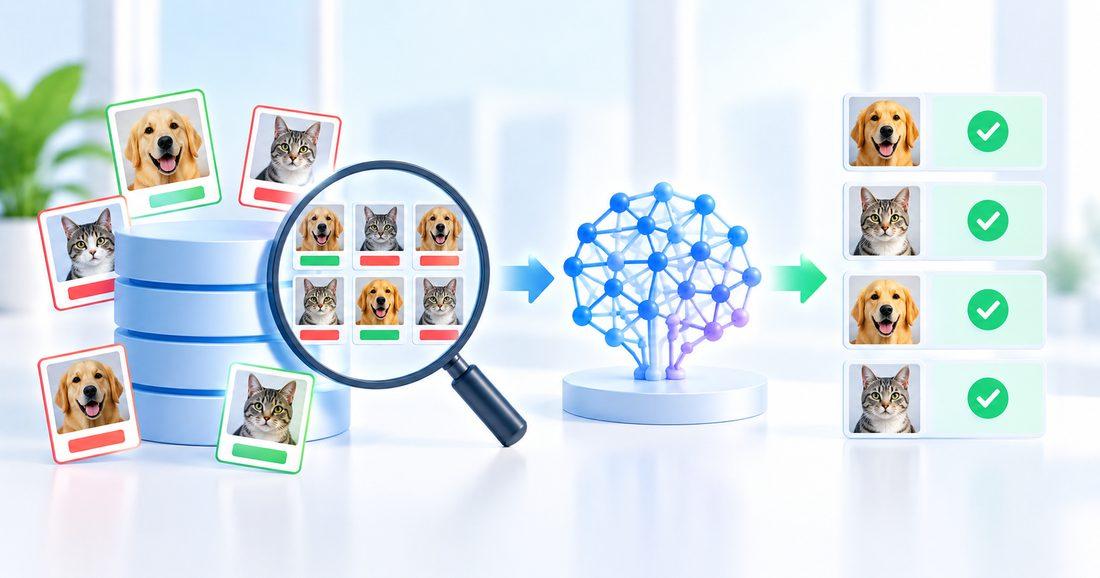
Teams can rank examples according to how strongly the model disagrees with the assigned label and send a selected subset for human review. High-confidence disagreements can be particularly interesting because they may indicate either mislabeled examples or systematic weaknesses in the model.
The review process should remain human-led.
The purpose of the model is not to declare that the label is wrong. Its purpose is to identify examples where human attention is likely to be valuable.
This distinction is important because models can also develop systematic errors. If engineers automatically replace every human label with the model's prediction, they risk converting model bias into training-data bias.
Another useful signal is prediction instability.
When different models, training runs, or data subsets consistently disagree about the same examples, those observations may represent difficult or ambiguous cases. Such examples should be investigated because they can reveal both label-quality problems and weaknesses in the problem definition.
The most valuable result is not necessarily a collection of deleted records.
It may be a better understanding of which examples are genuinely ambiguous, which are incorrectly labeled, and which represent difficult but legitimate cases that the model needs to learn.
Improving the Labeling Process
Correcting existing labels addresses historical problems, but long-term improvement requires reducing the probability that similar errors will occur again.
This means improving the label-generation process itself.
Clear annotation guidelines are foundational. Reviewers should understand the intended definitions, boundary cases, and expected treatment of ambiguous examples. Representative examples can make difficult distinctions easier to interpret.
Calibration exercises can also help.
Before large-scale annotation begins, multiple reviewers can label the same sample and discuss disagreements. This allows teams to identify confusing categories and refine the guidelines before thousands of examples are labeled incorrectly.
Quality-control mechanisms can be added throughout the workflow.
Some examples can receive multiple independent labels. High-disagreement cases can receive additional expert review. Annotators whose output consistently differs from established standards can receive additional training or their work can be sampled more heavily for quality checks.
The process should evolve as the task evolves.
New product features, user behaviors, policies, or business definitions may create labeling cases that did not exist when the original guidelines were written. Treating annotation guidelines as static documentation can therefore create new forms of label noise over time.
A strong labeling process is continuously revised based on observed disagreements and production errors.
This connects directly to the broader principles discussed in "Machine Learning Without Perfect Data: Strategies for Real-World Datasets" Real-world datasets inevitably contain imperfections, so reliable ML systems need processes for identifying, evaluating, and managing those imperfections rather than assuming that training data is automatically correct.
Data-Centric AI extends this philosophy further by making label improvement part of the normal development workflow.
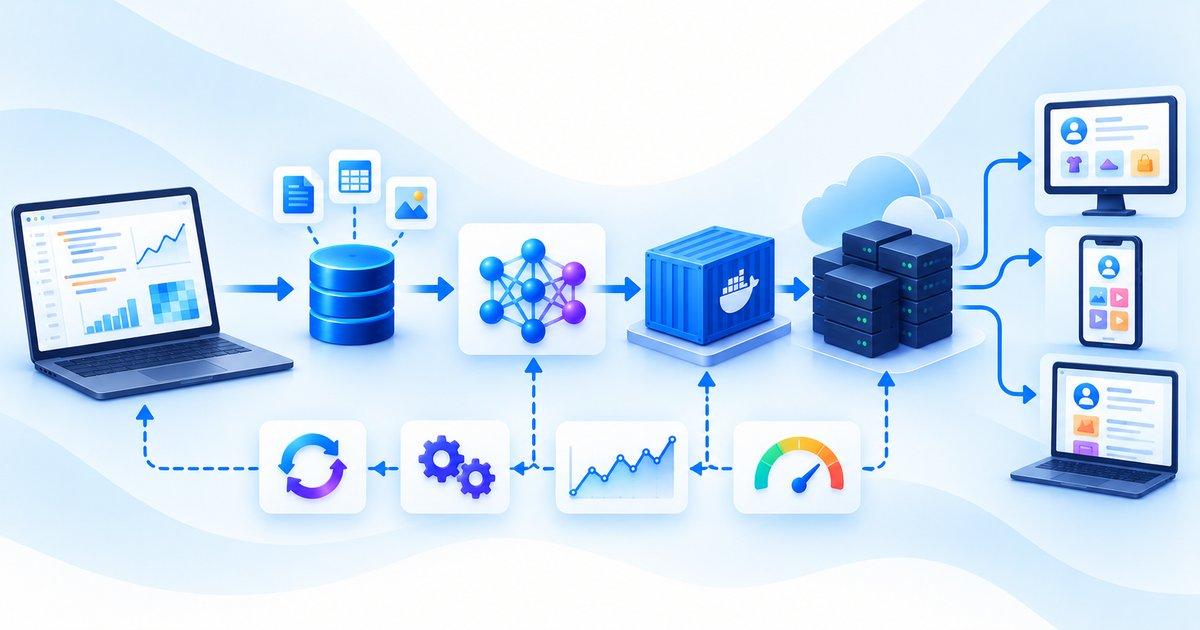
The strongest teams therefore create a feedback loop:
Identify suspicious examples → review the labels → understand the cause → correct the data or guidelines → retrain → measure the result.
The loop should also include production feedback.
When a model encounters recurring errors after deployment, those cases may reveal labeling gaps that were not visible during initial dataset construction. Carefully selected production examples can then be added to future review and annotation cycles.
The objective is not to eliminate all disagreement or produce an artificially perfect dataset.
It is to develop a dataset in which the labels are consistent enough, accurate enough, and representative enough to support the decisions the model is expected to make.
Key Takeaway
Label noise can be reduced systematically by combining model disagreement analysis, annotator-agreement measurement, targeted label audits, controlled correction, and improved annotation processes. Models are useful for finding suspicious examples, but human and domain-expert review remains essential for determining whether a disagreement represents an actual error or legitimate ambiguity. The strongest approach creates a continuous feedback loop in which labeling quality improves alongside model performance.
Section 4: Building ML Systems That Are Resilient to Noisy Labels
Eliminating every incorrect label from a real-world dataset is rarely possible. Even carefully designed annotation processes can produce occasional mistakes, ambiguous examples can generate legitimate disagreement, and production systems can introduce new labeling problems as business rules and user behavior evolve.
The engineering objective is therefore broader than simply creating a perfectly labeled dataset.
Successful machine learning systems need to reduce avoidable label noise, tolerate unavoidable noise, and continuously improve the quality of the targets they learn from.
This requires combining robust training techniques with disciplined dataset design, reliable evaluation sets, continuous label-quality monitoring, and feedback loops that connect production behavior back to the training process.
The result is a more resilient ML lifecycle in which the model does not depend on the unrealistic assumption that every label will always be correct.
Robust Training Techniques
When some degree of label noise is unavoidable, engineers can use training strategies that reduce the influence of unreliable examples.
The central idea is to prevent individual incorrect labels from dominating the optimization process. Depending on the problem, teams may use regularization, sample weighting, loss functions designed to reduce sensitivity to difficult or potentially noisy examples, or training procedures that emphasize examples that appear consistently informative.
Another approach is to identify questionable examples during training and treat them differently from highly trusted examples.
For example, a dataset may contain labels generated automatically from historical behavior alongside labels reviewed by domain experts. The two sources should not necessarily be treated as equally reliable. Higher-confidence labels can receive greater weight, while uncertain examples can be handled more cautiously.
This does not mean that sophisticated robust-training methods can replace good data.
A model cannot reliably recover from systematic target errors simply by changing its loss function. If an important class is consistently mislabeled, the underlying target definition still needs to be addressed.
Robust training is therefore best viewed as a defense mechanism, not a substitute for dataset quality.
It allows the model to remain reasonably stable when some incorrect labels inevitably remain after data-quality efforts have been applied.
Creating a Data Quality Feedback Loop
The strongest approach connects training data, model behavior, and production outcomes into a continuous feedback loop.
When a production prediction is incorrect, the failure can provide information about both the model and the dataset. A recurring error pattern may indicate that the model lacks sufficient examples of a particular scenario. It may reveal that the label definition is ambiguous. It may expose a systematic annotation problem that was not visible during initial development.
These observations can feed back into the data-improvement process.
Suppose a customer-support model repeatedly misclassifies a newly introduced type of request. Engineers investigate and discover that the training dataset contains very few examples of that category. Targeted data collection and expert labeling can then provide additional examples, after which the model can be retrained and evaluated.
The same feedback mechanism can identify incorrect historical labels.
If a subset of examples consistently generates strong model disagreement and human review confirms that the original labels were wrong, those observations can be corrected in a new dataset version.
However, production feedback must be handled carefully.
The cases that generate user complaints or human corrections are not necessarily representative of the entire population. If teams automatically add every problematic example to training, they can create a new sampling bias in which the model increasingly overfits to the cases that attract attention.
Feedback therefore needs validation, sampling, and prioritization.
The strongest process is an ongoing cycle:
Observe production behavior → identify suspicious or difficult examples → review labels → improve the dataset or annotation rules → retrain → evaluate against a trusted benchmark → redeploy.
This process reflects the broader engineering principle that reliable machine learning depends on more than model architecture. "The Hidden Engineering Work Behind Every Successful Machine Learning Product" emphasizes the importance of the surrounding systems and operational processes that allow ML products to remain reliable after deployment. Label quality is one of those underlying processes because the data-generation loop directly influences future model behavior.
The broader lesson is that noisy labels should be treated as a managed engineering risk.
Teams should not expect to remove every imperfect target. Instead, they should identify the most damaging errors, improve the processes that generate them, make evaluation data more trustworthy, use robust methods where appropriate, and continuously learn from production failures.
That approach creates a more resilient ML system because it recognizes an important reality: training data is not a permanent source of truth.
It is an evolving representation of reality that needs to be investigated, maintained, and improved.
Key Takeaway
Robust machine learning systems do not depend on the unrealistic assumption that every training label is correct. They combine robust training methods, carefully designed datasets, trusted evaluation sets, continuous label-quality monitoring, and production feedback loops to reduce the impact of noisy targets. The goal is not perfect labels at all times, but a sustainable process that continuously makes the training signal more accurate, consistent, and representative of the real-world task.
Conclusion
Machine learning systems are only as reliable as the learning signals provided during training. In supervised learning, that signal is largely defined by the labels attached to training examples. When those labels are incorrect, inconsistent, ambiguous, or systematically biased, the model is being asked to learn from a distorted representation of the problem.
This is why label noise is much more than a data-cleaning inconvenience.
A few random annotation mistakes may have limited impact, particularly when the dataset is large and the underlying patterns are strong. But systematic label noise can be substantially more damaging. If a particular class is consistently mislabeled, if historical business rules encode the wrong outcome, or if different annotators apply conflicting definitions, the model may learn those errors as though they were legitimate patterns.
Increasing model complexity does not automatically solve the problem.
In fact, a highly flexible model can sometimes make the situation worse by fitting noisy examples more effectively. A model may achieve impressive training performance while learning relationships that do not generalize to real-world data. If the validation and test sets contain the same labeling problems as the training data, even evaluation can create false confidence.
This makes label quality part of model quality.
The first step toward managing label noise is understanding where the labels came from. Human annotation, historical records, automated systems, business rules, user behavior, and proxy outcomes can all generate targets, and each source has different failure modes.
Teams also need to distinguish between genuine labeling errors and legitimate ambiguity.
Not every disagreement between annotators means someone made a mistake. Some ML tasks contain inherently subjective or ambiguous cases where multiple interpretations are reasonable.
Frequently Asked Questions
1. What is label noise in machine learning?
Label noise occurs when the target labels in a machine learning dataset contain incorrect, inconsistent, ambiguous, or otherwise unreliable information. Because supervised models learn from those targets, noisy labels can distort what the model learns.
2. Why does label noise occur?
Label noise can originate from human annotation mistakes, unclear labeling guidelines, annotator disagreement, historical business processes, automated labeling systems, incorrect proxy labels, user feedback, or changes in how the target outcome is defined.
3. What is the difference between label noise and ambiguous labels?
Label noise generally refers to labels that do not accurately represent the intended target, while ambiguity occurs when an example genuinely supports multiple reasonable interpretations. Ambiguous cases may require better definitions or different labeling strategies rather than simply being treated as incorrect.
4. How does label noise affect model performance?
Label noise can introduce conflicting learning signals, make decision boundaries harder to learn, encourage overfitting, reduce generalization, and make model performance more difficult to evaluate accurately.
5. Can deep learning models handle noisy labels?
Some deep learning systems can tolerate a certain amount of label noise, particularly when the underlying signal is strong and the noise is limited. However, deep models can also memorize noisy labels. Robust training techniques can reduce sensitivity to noise, but they cannot fully compensate for systematically incorrect targets.
6. What is the difference between random and systematic label noise?
Random label noise consists of errors that occur without a consistent pattern. Systematic label noise follows a pattern, such as consistently mislabeling a particular category or population. Systematic noise is generally more dangerous because the model may learn the incorrect pattern as a meaningful relationship.
7. How can engineers detect mislabeled training examples?
Teams can use model-label disagreement, prediction instability, annotation disagreement, targeted data audits, class-level error analysis, domain rules, and production feedback to identify examples that deserve review.
8. How does annotator disagreement reveal label noise?
Frequent disagreement among annotators can indicate unclear guidelines, inconsistent interpretations, insufficient domain knowledge, or genuine ambiguity in the task. Examining disagreement patterns helps teams determine whether the issue is annotation error or a problem with the definition of the target itself.
9. Should noisy examples always be removed?
No. Some unusual or disputed examples may contain valuable information. Removing examples indiscriminately can reduce coverage or eliminate important edge cases. Teams should first determine whether the label is actually incorrect, ambiguous, or representative of a legitimate rare event.
10. Can label noise affect validation and test datasets?
Yes. If validation or test labels contain errors, they can produce misleading estimates of model performance. A model can be incorrectly penalized for predicting the real outcome or rewarded for reproducing the same labeling errors contained in the evaluation set.
11. How can organizations improve labeling quality?
Organizations can improve labeling through clearer annotation guidelines, reviewer calibration, multiple independent labels for selected examples, expert review of difficult cases, systematic audits, disagreement analysis, and continuous updates to labeling processes as the underlying task evolves.
12. What role does Data-Centric AI play in reducing label noise?
Data-Centric AI treats dataset improvement as a deliberate part of ML development. Teams investigate label quality, correct problematic examples, improve coverage and consistency, version datasets, and measure whether data improvements produce meaningful changes in model performance.
13. How can robust training methods reduce the impact of noisy labels?
Robust training methods can reduce the influence of unreliable examples through approaches such as regularization, sample weighting, specialized loss functions, or other training strategies that make models less sensitive to individual noisy observations. These techniques complement rather than replace efforts to improve label quality.
14. How should teams monitor label quality in production?
Teams can monitor annotation agreement, label distributions, review outcomes, recurring model errors, human corrections, and changes associated with specific labeling sources or time periods. Production signals should be investigated carefully because user feedback and observed errors may themselves contain bias.
15. What is the most effective way to deal with label noise in machine learning?
The most effective approach is a combination of understanding how labels are generated, systematically identifying suspicious examples, improving labeling processes, maintaining trusted evaluation data, using robust training where appropriate, and creating continuous feedback loops from production. The goal is not perfect labels, but a reliable and continuously improving learning signal that reflects the real-world task.