Section 1: Why Model Performance Alone Does Not Determine AI Success
The Difference Between a High-Performing Model and a Successful AI Product
A model's performance is usually measured using a defined evaluation dataset, benchmark, or task-specific metric. For a classification model, this might include precision, recall, F1 score, or area under the ROC curve. For a language model, evaluation may involve reasoning accuracy, instruction following, coding performance, or human preference.
These measurements are important, but they describe only a portion of the behavior of a complete application.
Imagine a company deploying an AI-powered customer-support assistant. The selected language model performs well on general question-answering benchmarks. However, the application retrieves outdated product documentation, occasionally accesses the wrong customer record, and takes several seconds to respond because of inefficient API calls.
The model may be performing exactly as expected given the information it receives, yet the product delivers an unsatisfactory experience.
This illustrates the difference between model quality and system quality. Model quality concerns the capability of the underlying algorithm. System quality concerns whether the complete application delivers the expected outcome under real operating conditions.
A production AI system must satisfy multiple requirements simultaneously. It needs accurate outputs, reliable data access, acceptable latency, predictable operating costs, appropriate security, and maintainable integrations. Failure in any one of these dimensions can undermine the entire application.
This is why model selection should be treated as an architectural decision rather than the entire engineering strategy.
The best model for a product is not necessarily the one with the highest benchmark score. It is the model that satisfies the application's requirements when evaluated alongside the infrastructure, data, latency, security, and cost constraints of the complete system.
Real-World AI Applications Depend on Multiple Interconnected Components
A production AI application is typically a collection of interconnected services rather than a single model endpoint.
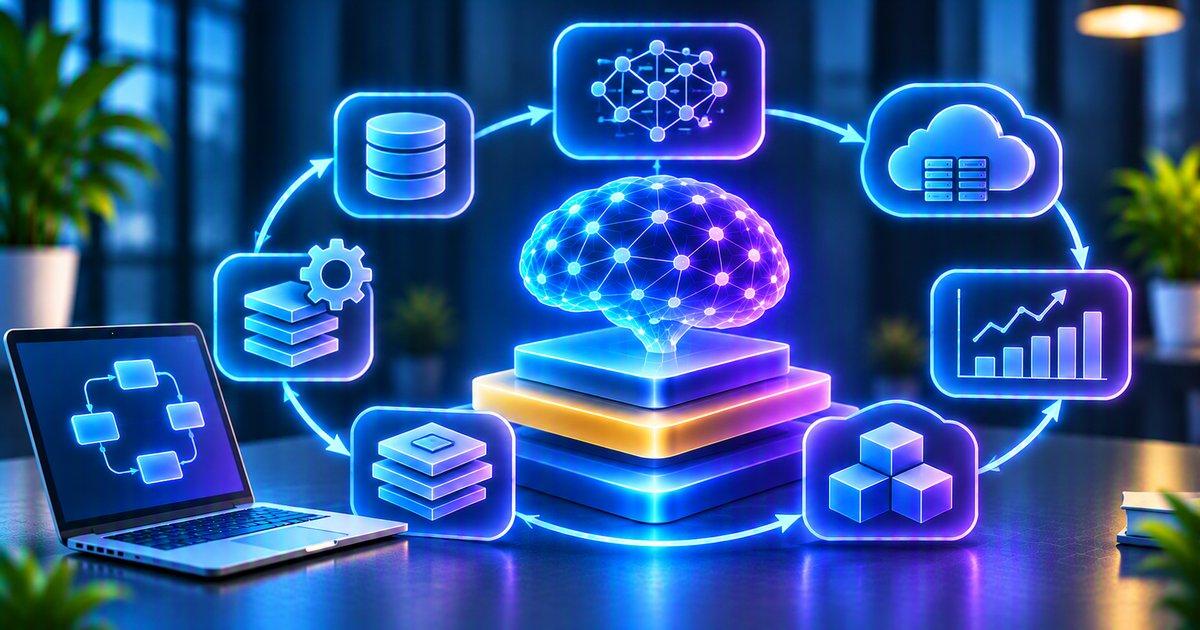
A conventional architecture may contain an application interface, backend services, authentication, databases, data pipelines, model-serving infrastructure, retrieval services, orchestration logic, and monitoring systems. Each component performs a specific responsibility and communicates with the others through defined interfaces.
Consider an AI document-analysis platform. The user uploads a document through a web interface. The backend validates the request, stores the file, and initiates document processing. An extraction service identifies the text and metadata. A retrieval system may identify relevant reference documents. The model analyzes the extracted content and generates a structured response. The backend validates the response and stores the result.
The model is only one stage in this workflow.
If the document-processing service fails, the model receives incomplete information. If the retrieval system returns irrelevant material, the model may generate an incorrect interpretation. If the response validator accepts malformed output, the application may fail when downstream systems attempt to consume it.
This architecture requires engineers to think about contracts between components. Each service needs defined inputs, outputs, failure behavior, authentication requirements, and performance expectations.
It also requires an understanding of dependencies. A model endpoint may be available while a vector database is unavailable. An API may return successfully while delivering incomplete records. A request may be valid but exceed the application's processing deadline.
The system must handle these conditions explicitly rather than assuming that every component will operate perfectly.
Why Better Models Cannot Automatically Fix Poor Data and Architecture
A common misconception in AI development is that a more capable model can compensate for weak infrastructure. In practice, models remain constrained by the quality and relevance of the information they receive.
A model cannot reliably summarize a document that was incorrectly extracted. It cannot provide a current answer if the retrieval system returns an obsolete policy. It cannot calculate an accurate business metric if the underlying database contains inconsistent records.
Data quality problems are particularly important because enterprise AI applications often combine information from multiple systems. These sources may use different schemas, identifiers, timestamps, and definitions. Without a consistent data-processing layer, the model may receive conflicting or incomplete information.
Architecture also determines how models interact with external capabilities. A language model may generate a correct database query, but the application must still execute it with appropriate permissions, validate the result, and handle database errors.
A more capable model can sometimes improve reasoning or instruction following, but it cannot eliminate the need for reliable data contracts, application logic, and operational controls.
This is also why adding more inference-time computation does not solve every AI problem. Additional reasoning can improve some difficult tasks, but it cannot repair missing evidence or an incorrect system state. Engineers can explore this distinction in InterviewNode's article "Test-Time Compute in Machine Learning: Trading More Computation for Better Predictions".
The engineering priority should be to identify the actual source of failure before changing the model. Sometimes the solution is a better model. In many other cases, it is better data processing, retrieval, validation, or application architecture.
The End-to-End Reliability Problem
A production AI application is exposed to failures that do not appear in isolated model evaluations.
External APIs can become unavailable. Database queries can time out. Model providers can impose rate limits. Requests can arrive in unexpected formats. Users can provide ambiguous instructions. Retrieved documents can contain malicious or misleading information.
These problems create an end-to-end reliability challenge.
Suppose an AI application performs five dependent operations, each with a hypothetical success probability of 99%. If all five operations must succeed for the workflow to complete, the probability of complete success is:
[
P(\text{success}) = 0.99^5 \approx 0.951
]
The workflow therefore succeeds approximately 95.1% of the time under the simplified assumption that the failures are independent.
This illustrates why seemingly reliable individual components can produce a less reliable overall system. In real applications, dependencies and correlated failures can make the situation more complicated.
Engineers address this through retries, timeouts, circuit breakers, fallback strategies, validation, graceful degradation, and recovery mechanisms. They also define service-level objectives for the complete application rather than evaluating only the model endpoint.
For example, an AI assistant might fall back to conventional search when the model provider is unavailable. A document-processing workflow might preserve intermediate results so that a failed stage can resume without repeating the entire operation.
The objective is not to eliminate every failure. It is to design the system so that failures are detected, contained, and recovered from without producing unacceptable outcomes.
Key Takeaway
A strong model does not automatically create a strong AI product. Production quality depends on the complete application, including data, infrastructure, integrations, validation, and reliability. Engineers must evaluate models as components within a larger system and optimize the end-to-end outcome rather than focusing exclusively on model benchmarks.
Section 2: The Systems Engineering Foundations Behind Production AI
Data Engineering: Building Reliable Information Pipelines
Data engineering is one of the most important foundations of production AI because models depend on information collected and processed by other systems.
Traditional software applications often operate on structured records with defined schemas. AI applications may need to process structured database entries, event streams, documents, images, audio, and other unstructured sources.
This creates a requirement for robust ingestion and transformation pipelines.
A typical AI data pipeline begins by collecting information from operational systems, APIs, files, databases, or event streams. The data is then validated, cleaned, normalized, transformed, and stored in an appropriate format. Depending on the application, it may also be enriched with metadata, converted into embeddings, or organized into features for machine learning models.
For example, a fraud-detection system may collect transaction events, customer information, device metadata, and historical account behavior. The pipeline must ensure that the information is correctly joined, timestamped, and available to the model without introducing data leakage.
A RAG application has different requirements. It may ingest internal documents, extract their content, divide them into chunks, generate embeddings, and store them in a retrieval index. When the underlying document changes, the system must update the index so that the application does not continue using obsolete information.
Both examples demonstrate that AI performance depends on data infrastructure.
Engineers need to understand schema evolution, data validation, event processing, batch pipelines, streaming architectures, and data lineage. These capabilities become particularly important when applications depend on continuously changing information.
InterviewNode's article "Learned Query Optimization: How Machine Learning Is Changing Database Query Execution" provides additional context on the relationship between database systems and machine learning. Understanding how information is stored, queried, and processed is fundamental to building efficient AI applications.
Backend Engineering: Turning Model Capabilities Into Application Features
A model becomes useful to end users only when it is integrated into an application.
Backend engineering provides the interfaces, business logic, authentication, data access, and execution mechanisms required to connect models with real software products.
Consider an AI-powered travel application. The model may understand a user's request for a business trip, but the backend must retrieve available flights, check hotel inventory, calculate prices, apply booking rules, and execute approved reservations.
The model should not directly control every business operation. Instead, the backend exposes carefully designed APIs that allow the model to request permitted actions.
This separation is important for security and maintainability. Business rules remain within the application, while the model handles language understanding and selected decision-making tasks.
Backend engineers must also consider request validation, asynchronous execution, concurrency, caching, authentication, and rate limiting. AI requests can be longer and more computationally expensive than conventional API calls, particularly when they involve retrieval and multiple tool interactions.
For applications that support long-running tasks, asynchronous job processing becomes especially useful. The backend can accept a request, create a task record, execute the workflow in the background, and notify the user when the result is ready.
The application should preserve execution state so that a failure does not necessarily require restarting the entire task.
This is why strong backend engineering remains essential even when the model itself becomes more capable. AI does not remove the need for application architecture; it introduces new responsibilities within it.
Distributed Systems and AI Infrastructure
As AI applications grow, engineers must manage model inference, data retrieval, application traffic, and external service calls across distributed infrastructure.
A single model endpoint may serve thousands of requests. Each request can involve multiple operations, including authentication, retrieval, inference, tool execution, and response validation.
This creates challenges involving concurrency, resource allocation, throughput, network latency, and fault tolerance.
For example, a company deploying an internal AI assistant to 20,000 employees must account for usage peaks during working hours. If every request triggers multiple model calls and database queries, infrastructure demand can increase rapidly.
Engineers need to understand request queues, horizontal scaling, load balancing, caching, connection pooling, and distributed tracing. They must also plan for rate limits and resource constraints imposed by external model providers.
Inference infrastructure introduces additional considerations. GPU utilization, batch processing, quantization, context length, model size, and KV-cache usage can influence cost and response time.
The architecture may use different models for different tasks. A lightweight model can handle classification or routing, while a more capable model handles complex reasoning. This model-routing strategy can reduce costs without requiring every request to use the most expensive model.
Reliability also requires fallback mechanisms. If a primary model endpoint becomes unavailable, the application may route requests to an approved alternative or switch to a reduced-functionality mode.
These are familiar distributed-systems problems, but AI introduces a more complex workload because inference requests vary significantly in size, duration, and computational requirements.
Model Serving, Deployment, and Lifecycle Management
Training a model is only one stage of the machine learning lifecycle. Once training is complete, the model must be packaged, deployed, monitored, updated, and maintained.
Model serving determines how predictions or generated responses are delivered to applications. The serving layer may expose a REST API, a streaming endpoint, or an internal service interface. It must handle request validation, batching, concurrency, model loading, and resource management.
Deployment strategies also matter. A new model version should not automatically replace an existing production model without evaluation. Teams may use shadow deployments, canary releases, or controlled traffic splitting to compare behavior before expanding usage.
For traditional machine learning, model lifecycle management includes training-data versioning, feature consistency, model artifacts, experiment tracking, and performance monitoring. Generative AI introduces additional concerns such as prompt versioning, context construction, retrieval quality, and provider-specific behavior.
The model itself may also change without the application code changing. A hosted provider may update a model version, modify behavior, or introduce new capabilities. Engineers need to understand how these changes affect production performance.
A robust lifecycle process includes reproducible experiments, versioned artifacts, automated testing, controlled deployment, rollback procedures, and post-deployment monitoring.
The important lesson is that model deployment should be treated as a software release process, not as a one-time upload of a trained artifact.
Key Takeaway
Production AI is built on established systems engineering disciplines. Data engineering ensures reliable information, backend engineering connects models to applications, distributed systems provide scalability and fault tolerance, and lifecycle management controls deployment and updates. These foundations determine whether model capabilities can be delivered consistently to real users.
Section 3: Designing AI Systems That Are Reliable, Observable, and Maintainable
Orchestration and Workflow Design: Connecting Multiple AI Components
Many real-world AI applications require more than one model call. They involve a sequence of operations in which the output of one stage becomes the input to another.
This is where orchestration becomes important.
A workflow-based architecture defines the sequence of operations in application code. For example, a document-processing system might extract text, classify the document, retrieve relevant policies, generate a summary, validate the output, and store the result.
An agent-based architecture gives the model more control over deciding which operations to perform and in what order. The agent may select tools, inspect results, request additional information, and modify its approach when an operation fails.
These approaches are not interchangeable in every situation. A predictable document-processing pipeline may benefit from deterministic workflow orchestration. A research assistant investigating an unfamiliar topic may benefit from more flexible agent behavior.
Anthropic's guidance distinguishes predefined workflows from agents that dynamically direct their own tool usage. It recommends starting with simpler patterns and adding complexity only when it produces measurable improvements.
A well-designed orchestration layer should define execution state, tool permissions, timeouts, retry policies, and stopping conditions. It should also make intermediate results available for validation.
For multi-step applications, engineers should avoid relying entirely on an LLM to enforce business-critical sequencing. Deterministic workflow logic is often more appropriate for approvals, financial transactions, compliance checks, and other operations with strict requirements.
The best architecture combines model-driven flexibility with code-controlled execution boundaries.
Evaluation and Testing: Verifying the Complete AI System
Testing AI applications is more complicated than testing conventional deterministic software because model outputs may vary across requests, even when the input is similar.
However, this does not mean that AI systems cannot be tested systematically.
A production evaluation strategy should operate at multiple levels.
Model-level testing measures the quality of generated outputs. It may include accuracy, relevance, instruction following, hallucination rates, and domain-specific correctness.
Component-level testing examines retrieval, data transformation, tool selection, and structured output validation. For example, a RAG application can be evaluated using retrieval recall and precision, while a tool-calling system can be tested for correct function selection and parameter generation.
Workflow-level testing measures whether the complete application successfully performs the intended task. A coding agent, for example, may be evaluated based on whether it implements the requested change, passes relevant tests, and avoids modifying unrelated components.
Regression testing is especially important. A prompt change, model upgrade, retrieval-index update, or tool-schema modification may improve one task while degrading another.
Teams should maintain representative evaluation datasets and run them before important releases. For applications involving high-impact decisions, human review and domain-expert evaluation should complement automated metrics.
Anthropic's January 2026 guidance on agent evaluations emphasizes that agents are more difficult to evaluate because they operate across multiple turns, call tools, modify state, and adapt to intermediate results. It recommends systematic evaluation throughout the development lifecycle rather than relying on production feedback alone.
For engineers, this means testing the behavior of the entire system rather than treating the model's final response as the only result that matters.
InterviewNode's article "ML Testing for Software Engineers: How to Test Systems That Don't Always Produce the Same Output" provides useful foundations for testing non-deterministic ML applications and designing evaluation strategies that account for variable outputs.
Observability: Understanding What Happens Inside AI Applications
Traditional application monitoring often focuses on request counts, response times, error rates, CPU utilization, and memory consumption. These metrics remain necessary for AI systems, but they do not provide enough information to understand model-driven behavior.
An AI application may return an incorrect answer because the retrieval service selected an irrelevant document. It may call the wrong tool, construct an invalid query, exceed its token budget, or lose an important piece of context during summarization.
Without detailed traces, engineers may incorrectly attribute every failure to the model.
AI observability should capture the sequence of operations involved in a request. Depending on the application, this can include user input, context construction, retrieval queries, selected documents, model versions, tool calls, execution results, token usage, latency, and final outcomes.
For an agentic workflow, tracing should make it possible to reconstruct the sequence of decisions and actions. Engineers should be able to identify which tool was invoked, what arguments were supplied, whether the tool succeeded, and how its result influenced subsequent execution.
Google Cloud's November 2026 guidance on enterprise AI agent observability highlights the need to trace multi-step agent activity, monitor data access, control query spending, and evaluate accuracy before changes reach users.
Observability must also account for privacy. Logging complete prompts and tool outputs can expose confidential information, personal data, or proprietary source code. Production systems should use data minimization, redaction, access controls, and appropriate retention policies.
The objective is to make AI behavior diagnosable without creating unnecessary data-security risks.
Security, Governance, and Operational Controls
AI applications create security challenges because models interact with unstructured information and may be given access to external tools.
A retrieved webpage or document could contain malicious instructions designed to manipulate an AI agent. This is commonly known as prompt injection. If the application does not distinguish trusted instructions from untrusted content, the model may attempt to follow instructions that were never authorized by the system owner.
Tool permissions introduce another concern. An AI assistant that needs to read customer records should not automatically receive permission to delete accounts or modify financial information.
The principle of least privilege should apply to AI applications just as it does to conventional software. Tools should expose only the operations required for a specific task, and authorization should be enforced by backend services rather than relying on the model to follow natural-language instructions.
Sensitive operations should use explicit validation and approval mechanisms. For example, an agent may prepare a payment instruction, but the financial system should independently verify permissions and require the appropriate approval before executing the transaction.
Governance should also cover model versions, data sources, retention policies, audit records, and incident-response procedures.
NIST's AI Risk Management Framework and its Generative AI Profile provide structured guidance for identifying, assessing, and managing AI-related risks throughout the lifecycle of AI systems.
These controls are not separate from engineering. They influence architecture, API design, data access, model selection, testing, and deployment.
Key Takeaway
Reliable AI systems require deliberate orchestration, systematic evaluation, observability, and security controls. Engineers must be able to understand not only what a model produced, but also which data it accessed, which tools it invoked, how the workflow progressed, and whether the final outcome satisfied the application's requirements.
Conclusion: The Model Creates Capability, but the System Creates Value
The rapid progress of machine learning and large language models has changed what software can accomplish. Models can now generate code, interpret documents, reason through complex questions, process multimodal information, and interact with external tools.
However, these capabilities do not automatically translate into successful products.
A production AI application must retrieve reliable information, enforce permissions, execute operations, validate results, handle failures, manage costs, and remain maintainable as its environment changes.
These responsibilities extend far beyond model development. They require data engineering, backend development, distributed systems, infrastructure management, testing, security, observability, and platform engineering.
This is why AI engineering is fundamentally a systems discipline.
The most successful AI engineers will not simply ask which model is the most capable. They will ask what the application must accomplish, which components are required, where failures can occur, how the system should be evaluated, and how it will operate reliably at scale.
The distinction is especially important as organizations move from isolated AI experiments toward enterprise applications and agentic workflows. The complexity increasingly lies in coordinating models, data, tools, and software services within predictable operating boundaries.
Models provide intelligence, but engineering systems turn that intelligence into dependable products. The future of AI engineering belongs to those who can build the complete system, not just optimize the model inside it.
Frequently Asked Questions (FAQs)
1. Why is AI engineering more about systems than models?
AI applications depend on multiple interconnected components, including data pipelines, APIs, databases, model-serving infrastructure, retrieval systems, and monitoring. A strong model cannot compensate for poor data quality, unreliable integrations, or weak security. The complete system determines whether AI capabilities produce useful outcomes in production.
2. What is the difference between AI engineering and machine learning engineering?
Machine learning engineering traditionally focuses on developing, training, evaluating, and deploying machine learning models. AI engineering has a broader scope that can include LLM applications, retrieval, tool orchestration, backend services, distributed infrastructure, security, and system-level evaluation. The disciplines overlap, and their responsibilities vary across organizations.
3. Is model selection still important in AI engineering?
Yes. Model selection affects accuracy, reasoning capability, latency, cost, context capacity, and deployment requirements. However, the best model must be evaluated within the complete application architecture rather than selected solely on benchmark rankings.
4. Why do AI models fail in production despite performing well in benchmarks?
Benchmarks usually evaluate specific capabilities under controlled conditions. Production applications introduce additional variables such as incomplete data, changing user inputs, API failures, retrieval errors, concurrency, latency constraints, and security requirements. These system-level factors can cause failures even when the underlying model performs well.
5. What are the main components of a production AI system?
Common components include data pipelines, databases, model-serving infrastructure, application APIs, retrieval systems, orchestration logic, authentication, monitoring, evaluation, and security controls. The exact architecture depends on the application and its operational requirements.
6. What role does data engineering play in AI engineering?
Data engineering ensures that information is collected, cleaned, validated, transformed, and delivered in a reliable format. AI models depend on this information for training, retrieval, and inference. Poor data quality can undermine model performance regardless of the model's sophistication.
7. Why do AI applications need backend engineering?
Backend services connect models to databases, APIs, authentication systems, and business logic. They validate requests, enforce permissions, execute tools, manage state, and handle errors. Without a reliable backend, model capabilities cannot be safely integrated into real applications.
8. What is the importance of MLOps in production AI?
MLOps provides the processes and infrastructure required to manage model development, versioning, deployment, monitoring, and updates. It helps organizations make model releases reproducible and maintainable. LLMOps extends these practices to generative AI applications and introduces additional requirements for prompts, retrieval, and tool execution.
9. How is AI system reliability measured?
Reliability can be measured through task success rates, availability, latency, error rates, recovery time, and the accuracy of generated outputs. Engineers should also monitor retrieval quality, tool-call correctness, data freshness, and infrastructure health. Evaluation should cover both individual components and complete workflows.
10. What is AI observability?
AI observability is the practice of collecting and analyzing information about how AI applications behave during execution. It includes model inputs and outputs, retrieval activity, tool calls, token usage, latency, errors, and workflow traces. It helps engineers diagnose failures that conventional infrastructure monitoring may not reveal.
11. Do AI engineers need to understand distributed systems?
Yes, particularly when building applications that serve many users or perform multiple operations across external services. Distributed-systems knowledge helps engineers manage concurrency, retries, caching, load balancing, fault tolerance, and resource utilization. These capabilities are important for operating AI applications reliably at scale.
12. Are AI agents making system architecture more complicated?
They can. Agents introduce dynamic tool selection, multi-step execution, persistent state, and additional failure modes. However, not every application needs an agent. Engineers should use deterministic workflows for predictable tasks and introduce agentic behavior only when flexibility provides measurable value.
13. What is the biggest challenge in deploying AI systems at scale?
There is no single universal challenge. Common difficulties include data integration, inference cost, latency, security, evaluation, monitoring, and organizational adoption. The relative importance of each depends on the workload and business environment.
14. What skills should software engineers develop to become AI engineers?
Important skills include Python, API development, databases, data engineering, cloud infrastructure, model integration, retrieval, context engineering, evaluation, and MLOps. Knowledge of distributed systems, security, observability, and workflow orchestration is also valuable.
15. Will AI engineering eventually replace traditional software engineering?
AI engineering is more likely to expand traditional software engineering than replace it. AI systems still depend on databases, APIs, distributed infrastructure, application logic, security, and testing. Engineers will increasingly design software in which AI is an integrated capability rather than an isolated component.