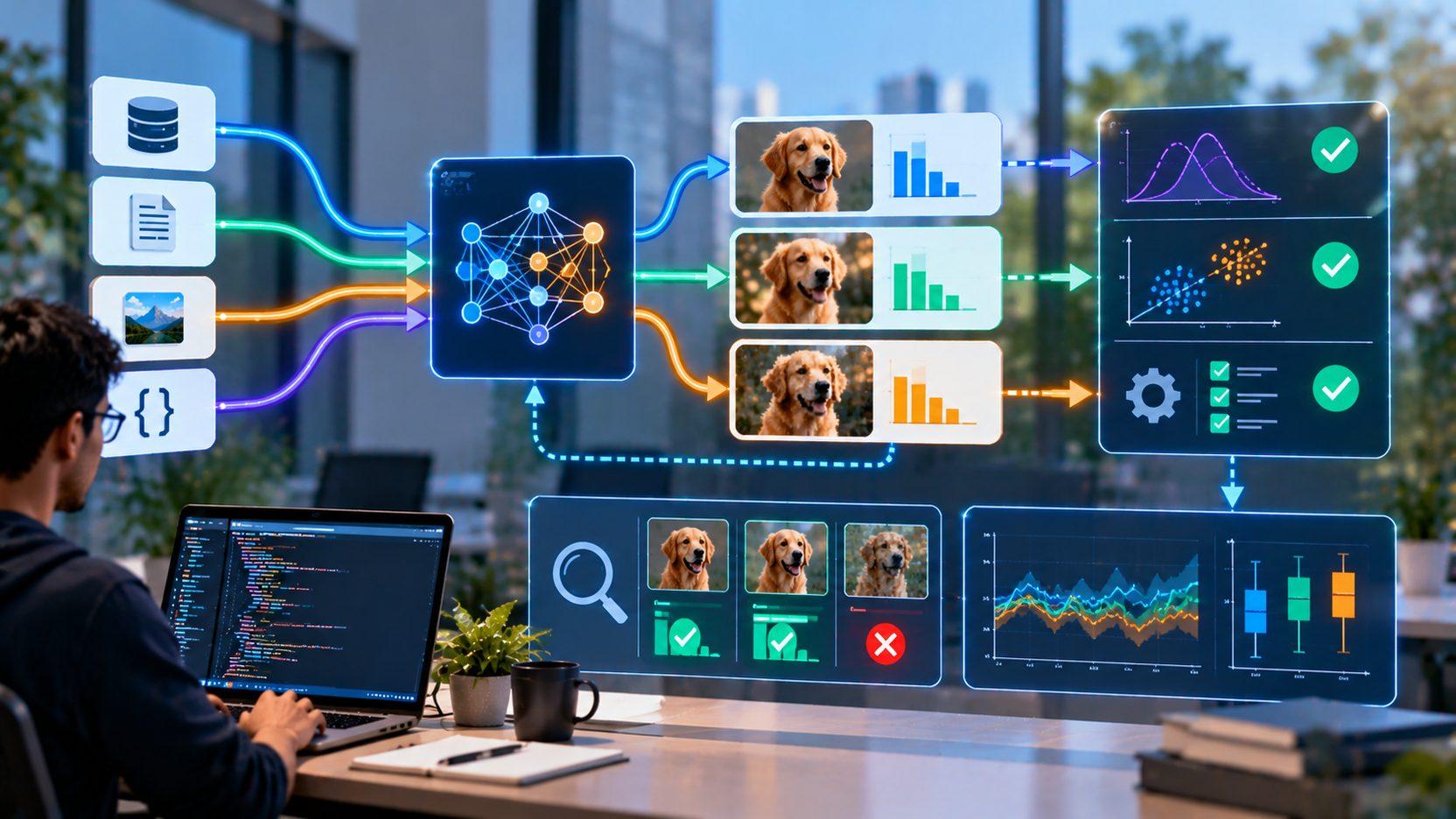

Section 1: Why Offline Performance Does Not Guarantee Production Performance
A machine learning model is usually developed in a controlled environment. Engineers select a dataset, define features, split the data, train the model, tune its parameters, and evaluate performance against a known validation or test set. The resulting metrics provide an important estimate of how well the model should perform.
But production is not a controlled dataset.
Once deployed, a model encounters new users, new events, changing behaviors, incomplete information, infrastructure constraints, evolving business processes, and conditions that may never have appeared during development. As a result, strong offline performance does not guarantee strong production performance.
This gap is one of the central challenges of production machine learning.
Training Data Is Only a Snapshot
A training dataset represents the world during a particular period and under particular conditions. It may contain millions of examples, but it is still a historical snapshot.
Suppose a recommendation model is trained using two years of customer interaction data. The model learns patterns from those historical behaviors, but customer preferences can change after deployment. New products may be introduced, existing products may disappear, and seasonal or cultural trends may alter purchasing behavior.
The same problem occurs in other domains.
A fraud model learns from historical fraud patterns, but attackers adapt. A demand-forecasting model learns from previous market conditions, but economic circumstances change. A customer-support model learns from historical requests, but product changes can create entirely new categories of questions.
This creates a fundamental generalization assumption: the production environment must be sufficiently related to the environment represented by the training data for the learned patterns to remain useful.
When that assumption becomes weaker, model performance can decline even though the model itself has not changed.
This is why a dataset should not be treated as a permanent representation of reality. It is evidence about a particular historical environment.
The Difference Between Offline and Online Evaluation
During development, models are usually evaluated on test datasets that are isolated from training. This provides a controlled measurement of generalization.
Offline evaluation is valuable because it allows teams to compare models efficiently and repeatedly. Engineers can test multiple architectures, features, thresholds, and configurations without exposing users to untested behavior.
However, a test dataset cannot reproduce every condition found in production.
Real users behave differently from static records. They interact with recommendations, respond to pricing, change search queries, abandon workflows, and adapt to system behavior.
A production environment also contains operational conditions that are difficult to replicate completely offline.
For example, a model may perform well on a test set but generate predictions too slowly to satisfy a production latency requirement. A recommendation model may achieve strong offline ranking metrics but fail to increase engagement when users interact with the live product.
This is why organizations need both offline and online evaluation.
Offline evaluation answers:
"How well does the model perform on controlled historical data?"
Online evaluation asks:
"How does the model behave when real users, real systems, and real business processes interact with it?"
The second question is essential because production behavior is influenced by much more than the model's statistical predictions.
Training-Serving Skew
One of the most common technical causes of production failure is training-serving skew.
This occurs when the features provided to the model during production are calculated differently from the features used during training.
Imagine a model trained using a feature representing the number of customer transactions during the previous 30 days. During development, the feature may be calculated from a historical data warehouse.
In production, however, the serving system might accidentally use a different aggregation window, a different timestamp definition, or a different source table.
The model receives a feature with the same name but a different meaning.
This can cause substantial performance degradation.
Training-serving skew can result from differences in:
Feature transformations
Missing-value handling
Encoding
Aggregation windows
Data sources
Time boundaries
Feature freshness
Preventing this problem requires consistent feature definitions and, where possible, shared feature-generation logic between training and production.
Data contracts can provide additional protection by specifying expected schemas, data types, freshness, and other characteristics that production inputs must satisfy.
The important principle is that the production model must receive information that is semantically consistent with what it learned during training.
The Reality of Production Constraints
Production environments introduce constraints that are difficult to capture completely in an offline experiment.
Latency is one example. A model may produce high-quality predictions but require more computation than the application can tolerate. Search and recommendation systems may need predictions within strict response-time budgets.
Availability is another consideration. A model may depend on multiple feature services, databases, APIs, or infrastructure components. If one dependency fails, the prediction service may become unavailable even though the model itself is functioning correctly.
Infrastructure can also affect behavior. Production traffic may fluctuate significantly, creating resource constraints that do not appear during development.
Data freshness matters as well. A model may perform well when evaluated against clean historical data but receive incomplete or stale information in production.
These considerations demonstrate why deployment is not simply the final step after model development. The production environment becomes part of the ML system.
A useful mental model is:
Training data + Model + Features + Infrastructure + Users + Business process = Production behavior
Changing any one of these components can affect the observed outcome.
The transition from prototype to production therefore requires more than demonstrating that a model works on a test dataset. Teams must verify the complete operational system under realistic conditions. "From Proof of Concept to Production: Why Most ML Projects Never Make the Leap" explores this broader engineering gap and why successful experiments often require substantial additional work before they become reliable production systems.
Key Takeaway
Offline evaluation is essential, but it cannot guarantee production success because training data is historical, users behave dynamically, production features can differ from training features, and real systems operate under latency, availability, infrastructure, and freshness constraints. The strongest ML teams treat deployment as the beginning of real-world validation and continuously compare production behavior with the assumptions established during development.
Section 2: How the Real World Changes Model Behavior
Even when a machine learning model is correctly implemented and deployed, the environment around it can change. The input data may evolve, the relationship between inputs and outcomes may shift, users may react to predictions, and rare situations may appear that were absent from training.
These changes can cause a production model to behave differently from its development behavior without any modification to the model itself.
Understanding data drift, concept drift, feedback loops, selection effects, and rare events is therefore essential for explaining why production behavior can diverge from offline expectations.
Data Drift and Concept Drift
One of the most common causes of production degradation is data drift. Data drift occurs when the statistical distribution of production inputs changes relative to the training data.
Imagine a customer model trained using historical purchasing behavior. After deployment, the customer population may change, new products may enter the market, or purchasing patterns may shift. The model continues receiving valid inputs, but those inputs no longer resemble the data it learned from.
Data drift can affect individual features or combinations of features. A change in average transaction value may be relatively harmless, while a major change in customer behavior could significantly affect predictions.
A more serious problem is concept drift. Here, the relationship between inputs and outcomes changes.
Consider a fraud model trained on historical transaction patterns. If fraudsters change their techniques, the same transaction characteristics may no longer carry the same meaning. The model may therefore apply previously useful relationships to circumstances where they are no longer valid.
Concept drift can also emerge when the business itself changes. A pricing model may have learned customer responses under one pricing strategy, while a new strategy changes the relationship between price and demand.
The distinction matters because the appropriate response can differ. A simple input-distribution change may require monitoring, while a fundamental relationship change may require new training data, new features, or even a redesigned model.
User Behavior and Feedback Loops
Production ML systems often influence the people whose behavior generates future data. This creates feedback loops that do not exist in ordinary offline datasets.
Consider a recommendation system. If a product is ranked near the top, users are more likely to see and interact with it. Those interactions then become training data that may cause the system to rank the product even more highly in the future.
The model is therefore influencing the data used to evaluate and improve itself.
Search systems face a similar issue. Highly ranked results receive more clicks because of their position. Those clicks can then be interpreted as evidence that the results are highly relevant, reinforcing the existing ranking.
Pricing systems can create another feedback loop. If an algorithm changes prices based on observed demand, the new price influences customer behavior, which subsequently changes the demand data used by future model updates.
Automated decisions can have similar effects. When a model determines who receives an offer, who receives additional review, or which cases are prioritized, the resulting observations are no longer a neutral representation of the original population.
These feedback loops can cause a production environment to diverge from the historical conditions represented in the training data.
Engineering teams therefore need to distinguish between observed behavior and model-influenced behavior when using production data for evaluation and retraining.
Selection Bias and Missing Outcomes
Another reason production behavior can differ is that the system does not necessarily observe every outcome.
A model may generate predictions for thousands of cases, but only a subset may receive further investigation or intervention. This creates selection effects in the labels eventually collected.
Consider a fraud system that sends only high-risk transactions to investigators. Confirmed fraud labels will therefore be concentrated among cases the model already considered suspicious. The organization may have limited information about fraudulent transactions that the model did not flag.
Similarly, a customer-retention model may recommend offers to only a selected group. The organization then observes outcomes under intervention for some customers but not for others, making it difficult to determine what would have happened under an alternative action.
Delayed labels add another challenge. Some outcomes become known only after weeks or months. A model may appear to perform well in the short term because the organization simply does not yet have enough ground truth to measure errors.
Production evaluation must therefore account for observed versus unobserved behavior, rather than assuming that every prediction produces an immediately available and unbiased label.
Interventions can also affect outcomes. If the model predicts high churn risk and the business responds with a retention offer, the resulting customer behavior may reflect both the original risk and the intervention.
This means production data is not always a passive record of reality. It can be the result of previous model-driven decisions.
Rare and Unexpected Events
Production systems eventually encounter cases that are rare or completely absent from the training data.
These may include new customer behaviors, unusual transactions, emerging fraud strategies, unexpected product interactions, new categories, or extreme operational events.
An out-of-distribution input does not have to contain an obviously invalid value. It may simply represent a combination of otherwise familiar features that the model has rarely encountered.
A model can therefore produce a highly confident prediction for an unfamiliar case.
This is particularly dangerous because confidence does not necessarily indicate correctness when the model operates outside its training distribution.
Long-tail behavior creates another challenge. The common cases represented in the training dataset may account for most observations, while rare cases can account for a disproportionate share of production failures.
For example, a recommendation model may perform well for popular products but behave poorly for new or niche products. A fraud model may recognize common fraud patterns but miss a new strategy. A support classifier may perform well on common requests but struggle with an entirely new product issue.
Production monitoring should therefore examine not only average performance but also edge cases, rare events, and emerging patterns.
Organizations may need human review, anomaly detection, fallback rules, or targeted data collection to handle these situations.
The broader challenge is that real-world ML systems are not passive prediction engines. They operate inside environments where data changes, people react, business processes evolve, and new events emerge.
This is why distribution shift is such an important production concern. "Machine Learning Under Distribution Shift: What Happens When the World Changes" explores how changes in production data and relationships can cause models to behave differently from their training behavior.
Key Takeaway
Production behavior changes when data distributions evolve, input-output relationships shift, users react to model decisions, labels are selectively observed, or rare events emerge outside the training distribution. These effects can create feedback loops and selection bias that make production data fundamentally different from the historical data used to train the model. Reliable ML systems must therefore monitor not only model predictions but also the changing environment and the ways the model itself influences that environment.
Section 3: Diagnosing Why a Production Model Behaves Differently
When a machine learning model behaves differently in production, the first instinct is often to retrain it. That can be the correct response, but it is not necessarily the right starting point. Production degradation can originate from the data pipeline, feature computation, infrastructure, changing user behavior, model assumptions, or the business process surrounding the prediction.
The objective of diagnosis is therefore to answer a more fundamental question:
What changed between development and production, and which change is responsible for the observed behavior?
A disciplined investigation combines data monitoring, model-performance analysis, business metrics, segment-level analysis, and structured root-cause investigation.
Monitoring Data and Features
The first diagnostic layer is the production data itself.
Teams should continuously monitor the characteristics of the information entering the model. Important signals include feature distributions, missing values, schema changes, data freshness, category frequencies, ranges, and unexpected values.
Distribution monitoring can identify whether production inputs have moved away from the conditions represented in training data. For example, a model trained on one customer population may later receive a substantially different population.
However, a detected distribution change does not automatically prove that the model is failing. Engineers need to determine whether the changed feature is actually relevant to model performance.
Missing values can provide an important diagnostic signal. A sudden increase in missing information may indicate an upstream pipeline failure rather than genuine environmental change.
Schema changes can be even more dangerous because they may not immediately cause a system failure. An upstream application might change a field's type, meaning, or calculation while preserving the same field name. The model can continue running while receiving information that no longer has the semantics it learned during training.
Feature freshness should also be monitored. A feature that is technically present but significantly older than expected may cause prediction quality to decline.
These checks help answer the first diagnostic question:
Is the model receiving the same kind of information it was trained to understand?
Monitoring Model Performance
The next layer is actual model performance.
Teams should monitor metrics appropriate to the task. Classification systems may track precision, recall, F1 score, calibration, or other measures. Forecasting systems may monitor prediction error, while ranking systems may track NDCG, MRR, Precision@K, or other ranking metrics.
The important point is to compare current production behavior with an established baseline.
A temporary fluctuation does not necessarily indicate a problem. Teams should look for persistent or material degradation.
Segment-level performance is particularly valuable. A model can maintain stable overall accuracy while becoming significantly worse for a particular customer segment, geography, product category, query type, or operational condition.
Error analysis can expose these patterns. Engineers can examine examples that the model gets wrong and ask whether the failures share common characteristics.
For example, an image model may perform well on common lighting conditions but fail on images from a new camera. A support model may work well for existing products but fail on tickets related to a recently introduced feature.
This makes error analysis an important bridge between aggregate metrics and root-cause investigation.
Connecting Model Metrics to Business Outcomes
Technical performance does not always explain whether the model is actually causing business problems.
A model may maintain stable precision and recall while conversion, revenue, retention, or operational efficiency declines. Conversely, technical performance might decline slightly while the model continues to generate strong business value.
Teams therefore need to connect model metrics to business outcomes.
Consider a recommendation system. Offline ranking quality may remain stable, but customer engagement could decline because the product catalog or user experience has changed.
A fraud model might maintain its statistical performance while investigation costs rise because the organization has fewer analysts available.
A forecasting model could maintain similar numerical error while inventory costs increase because the operational decision process has changed.
This means the diagnostic process needs to examine the entire chain:
Model output → Business decision → Business action → Outcome
A problem that appears to be a model problem may actually originate downstream in the business workflow.
Business KPIs can therefore act as an important diagnostic signal alongside model metrics.
Investigating Model Failures
Once monitoring identifies a meaningful problem, teams need structured root-cause analysis.
The investigation should examine several possible causes:
Data problem: Is the input data incomplete, corrupted, delayed, or changed?
Feature problem: Are production features calculated differently from training features?
Model problem: Has the model's predictive relationship degraded?
Environment problem: Has the population, market, or operating context changed?
Workflow problem: Has the business process surrounding the model changed?
Infrastructure problem: Are latency, availability, or service failures affecting model behavior?
This prevents teams from automatically treating every production issue as a retraining problem.
Segment analysis can help localize the problem. If degradation occurs only for a new geographic region or product category, the organization may need targeted data rather than a complete model replacement.
Root-cause analysis should also compare the current production environment with the original training and validation assumptions.
Teams should ask:
- What assumptions did the model make?
- Which assumptions are no longer true?
- Did the data change?
- Did user behavior change?
- Did the business process change?
- Did the model influence the data now being observed?
Only after these questions are answered should the team determine whether retraining, feature changes, threshold adjustment, model replacement, or process redesign is appropriate.
This diagnostic discipline prevents a common failure mode in production ML: repeatedly retraining models without understanding the reason they are failing.
The broader production lifecycle is closely connected to model retraining decisions. "How ML Teams Decide When to Retrain a Model" examines how teams distinguish meaningful performance degradation from temporary variation and use multiple signals to determine when a new model is actually justified.
Key Takeaway
Diagnosing production ML behavior requires more than checking model accuracy. Teams should investigate data distributions, feature quality, model performance, segment-level errors, business KPIs, infrastructure behavior, and changes in the surrounding workflow. The goal is to identify the actual source of divergence before taking corrective action. Sometimes retraining is appropriate; in other cases, the real solution is fixing data pipelines, updating features, changing thresholds, modifying workflows, or redesigning the model.
Section 4: Designing ML Systems That Behave Reliably in Production
Understanding why a model behaves differently in production is only useful if the organization can respond effectively. The objective is not to force production data to resemble the original training dataset. Real environments will change. Instead, engineering teams should design ML systems that can detect change, learn from reliable feedback, adapt safely, and recover when assumptions fail.
This requires thinking about the deployed model as part of a larger system rather than as an isolated artifact.
Building Strong Feedback Loops
A production ML system should continuously collect information about what happens after predictions are generated.
Continuous evaluation connects predictions with eventual outcomes. A recommendation can be followed by a click or purchase. A fraud prediction can eventually be confirmed or rejected by an investigator. A forecasting prediction can be compared with the actual outcome once it becomes available.
These outcomes provide valuable information about whether the model remains effective.
Human feedback is particularly useful for cases where labels are expensive, delayed, or ambiguous. Analysts can review suspicious cases, experts can validate classifications, and employees can identify examples where the model's recommendation was incorrect.
This feedback should flow back into the data pipeline in a controlled way.
A strong production loop looks like:
Prediction → Outcome → Feedback → Validation → Evaluation → Model update
However, teams must be careful about feedback loops. The model itself may influence which outcomes are observed. For example, a fraud system may investigate only transactions it considers suspicious. The resulting labels may therefore provide incomplete information about cases the model did not flag.
Teams should preserve enough context to understand how data was generated and avoid blindly treating every production outcome as unbiased training information.
Safe Model Updates
When production evidence indicates that a model needs to change, the new version should not automatically replace the existing system.
A champion-challenger approach keeps the current production model as the champion while evaluating a new candidate as the challenger. The challenger must demonstrate meaningful improvement against appropriate evaluation criteria before becoming the new production version.
Shadow testing can provide additional evidence. The new model receives live production inputs but does not control actual decisions. Engineers can compare its predictions, latency, resource consumption, and behavior with the existing model.
A canary deployment provides another safeguard by exposing a small proportion of production traffic to the new model. If performance remains within acceptable limits, the deployment can gradually expand.
These mechanisms are important because production conditions can expose problems that offline evaluation missed.
Rollback is equally important. If the new model causes unexpected degradation, the organization should be able to restore a previously validated version quickly.
Model updates should also preserve lineage. Teams should be able to identify which dataset, features, training configuration, and evaluation results produced each production model.
Designing for Changing Environments
A reliable production system should assume that the world will change.
Robust training can improve generalization by exposing models to diverse populations, time periods, operating conditions, and realistic variations. The goal is to avoid making the model overly dependent on narrow historical patterns.
When the environment genuinely changes, adaptive models and retraining can incorporate newer information. However, retraining should be triggered by evidence rather than performed automatically whenever data changes.
Some applications benefit from incremental or online learning, while others are better served by periodic retraining.
Teams should also maintain fallback systems. If a model encounters unfamiliar inputs, a deterministic rule, simpler model, human reviewer, or previously validated model version can provide a safer alternative.
This concept of graceful degradation is especially valuable in high-impact applications. A production system should not assume that every input can be handled confidently.
The correct response to a significant environment change may also involve more than retraining. Teams may need new features, updated labels, a different architecture, or even a revised problem definition.
The key is to adapt the system and its assumptions, not simply rerun training indefinitely.
Making Production ML a System, Not a Model
The most reliable organizations treat ML as a complete production system.
MLOps provides the infrastructure for automated training, evaluation, deployment, monitoring, versioning, and rollback.
Data governance ensures that the organization understands where production information originates, who owns it, how it is transformed, and what constraints apply to its use.
Model lineage connects production predictions back to the exact model, features, dataset, and training configuration involved. This is essential when investigating incidents or explaining unexpected behavior.
Clear ownership is also necessary. Teams need to know who is responsible for the model, the data pipeline, monitoring, retraining decisions, and production incidents.
Finally, ML systems require continuous improvement. Production feedback should be analyzed regularly rather than only when a major failure occurs.
The resulting lifecycle is:
Build → Validate → Deploy → Observe → Diagnose → Adapt → Revalidate → Improve
This approach recognizes that deployment is not the end of machine learning. It is the point where the model begins interacting with the environment it was designed to understand.
The broader evolution toward production AI platforms makes these capabilities increasingly important. "The Evolution of AI Deployment: From APIs to Intelligent Platforms" examines how modern AI systems are moving toward integrated platforms that manage models, data, infrastructure, monitoring, and intelligent operations.
Key Takeaway
Reliable production ML requires strong feedback loops, controlled model updates, adaptation mechanisms, fallback strategies, monitoring, governance, and clear ownership. The goal is not to make production behave exactly like the training environment. It is to build a system that recognizes when reality has changed, evaluates the impact, adapts safely, and preserves enough lineage and control to recover when things go wrong. In mature ML organizations, the production model is not a finished artifact, it is part of a continuously observed and evolving system.
Conclusion
Machine learning models often behave differently in the real world because production is not a static extension of the development environment. Training data is historical, users react to model outputs, business processes change, new patterns emerge, and production infrastructure introduces constraints that are difficult to reproduce completely offline.
The first lesson is that offline performance is necessary but not sufficient. A model can perform exceptionally well on a carefully prepared test set while struggling with live data that differs from the training distribution. This can happen because of data drift, concept drift, training-serving skew, changing user behavior, or unfamiliar edge cases.
Training-serving consistency is particularly important. A model learns from specific feature definitions and transformations, and those definitions must remain consistent during inference. Differences in aggregation windows, timestamps, preprocessing, data sources, or missing-value handling can cause the production model to receive information that does not match what it learned.
Real-world behavior also introduces feedback loops. Recommendation systems, search engines, pricing models, fraud systems, and other automated decision systems influence the behavior that later becomes training or evaluation data. This means production data is not always a neutral representation of reality. The model can become part of the environment it is trying to predict.
Frequently Asked Questions (FAQs)
1. Why do machine learning models behave differently in production?
Production data, users, business processes, and infrastructure differ from the controlled conditions used during development. Data drift, concept drift, training-serving skew, feedback loops, and unexpected events can all change model behavior.
2. Why does a model perform better offline than in the real world?
Offline evaluation uses historical or curated datasets under controlled conditions. Production contains changing data, real user behavior, operational constraints, missing information, and situations that may not have been represented in the test dataset.
3. What is training-serving skew?
Training-serving skew occurs when the features or transformations used during production inference differ from those used during model training, causing the model to receive information that is inconsistent with what it learned.
4. How does data drift affect production ML models?
Data drift occurs when the distribution of production inputs changes relative to the training data. If the shift affects important features or patterns, model performance can decline.
5. What is concept drift?
Concept drift occurs when the relationship between inputs and outcomes changes. For example, a fraud pattern that was predictive historically may become less useful when attackers change their behavior.
6. How do users change machine learning model behavior?
Users can adapt to recommendations, rankings, prices, fraud controls, or other model-driven decisions. Their responses then influence the future data observed by the system, creating feedback loops.
7. What are feedback loops in production machine learning?
A feedback loop occurs when model predictions influence user or business behavior, and those resulting behaviors become future training or evaluation data. This can reinforce existing model decisions or introduce bias.
8. Why can production data differ from training data?
Production data can change because of new users, products, business processes, market conditions, software changes, new data sources, seasonal effects, or other environmental changes.
9. How should teams diagnose unexpected model behavior?
Teams should examine data distributions, feature calculations, model metrics, segment-level errors, business KPIs, infrastructure, and changes in the surrounding workflow before deciding on corrective action.
10. What role does model monitoring play in production ML?
Monitoring provides visibility into data quality, drift, model performance, latency, prediction behavior, and business outcomes. It helps teams identify problems before they become major production failures.
11. Should production model degradation always trigger retraining?
No. Degradation may result from data-pipeline failures, changing features, business-process changes, threshold problems, or other issues. Teams should identify the root cause before deciding whether retraining is appropriate.
12. How can ML teams test models before full deployment?
Teams can use offline validation, shadow testing, champion-challenger comparisons, canary releases, and controlled online experiments to evaluate a candidate model under increasingly realistic conditions.
13. How can organizations make models robust to changing environments?
Useful approaches include diverse training data, continuous monitoring, robust features, feedback loops, adaptive retraining, online learning where appropriate, fallback strategies, and controlled model updates.
14. Why do business metrics sometimes decline even when model metrics remain stable?
The surrounding business process may change. User behavior, pricing, product design, operational capacity, or downstream interventions can alter the relationship between model predictions and business outcomes.
15. What does it take to build reliable production machine learning systems?
Reliable production ML requires consistent data pipelines, training-serving alignment, monitoring, feedback mechanisms, model lineage, controlled deployment, rollback capabilities, governance, and clear ownership. The model must be treated as part of a continuously evolving production system rather than as a finished artifact.