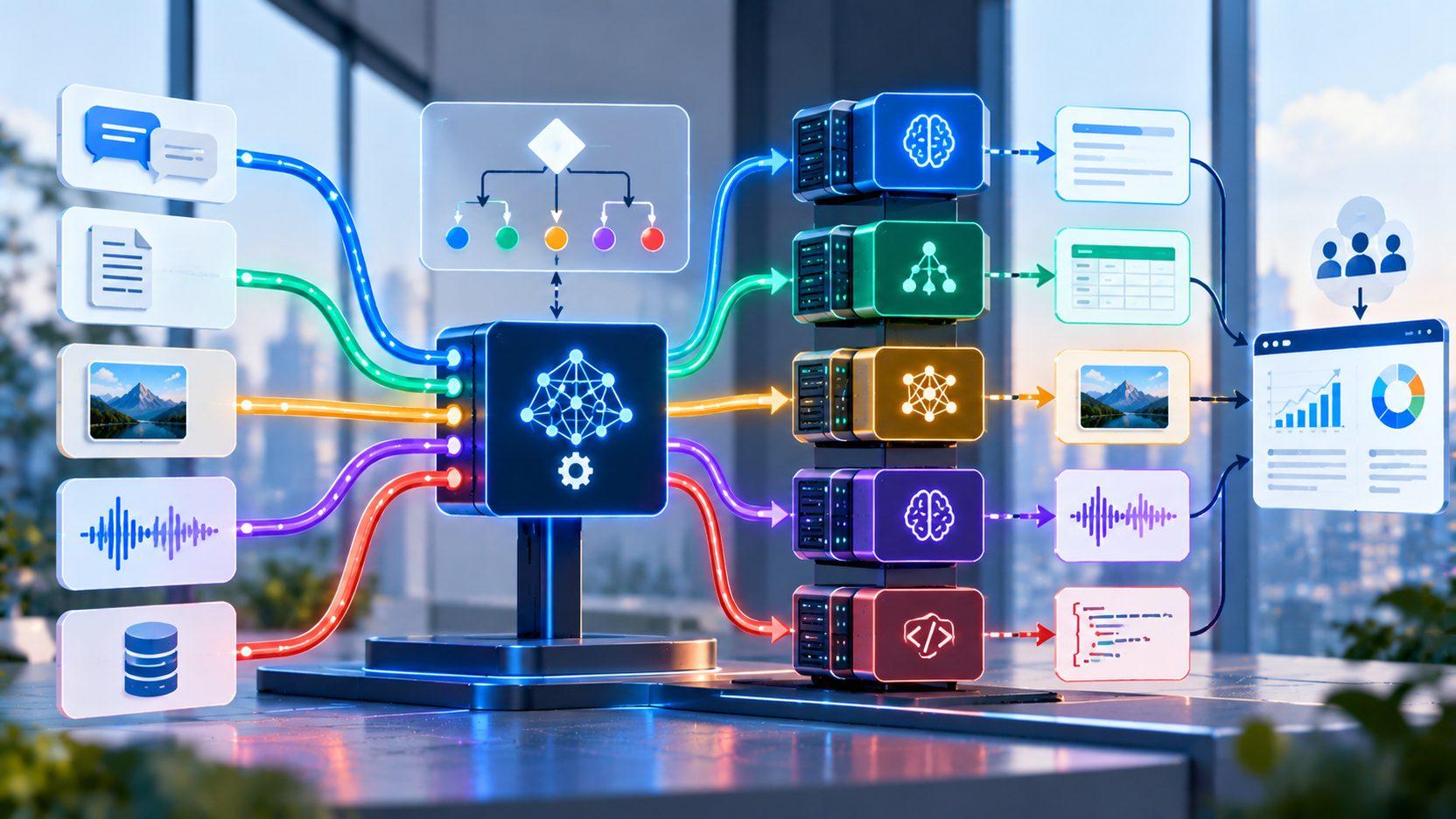

Section 1: Why Prediction APIs Are Different From Traditional APIs
Prediction Responses Are Probabilistic Rather Than Deterministic
Traditional APIs generally expose deterministic business logic, where engineers can define a clear relationship between a request and an expected response. A payment API can validate a transaction according to explicit rules, a user service can retrieve a record by identifier, and an authorization endpoint can determine access according to a predefined policy. Prediction APIs introduce a fundamentally different contract because the response is generated by a statistical model that estimates an outcome from patterns learned from data rather than following a completely explicit set of rules.
A prediction endpoint may return a probability, classification, ranking, recommendation, score, forecast, or embedding rather than a universally correct answer. The same model can also produce different outputs after retraining even when the API schema remains unchanged, which means application teams need to distinguish between interface stability and behavioral stability. A well-designed API should therefore communicate what the prediction represents, what confidence or score semantics mean, and how downstream services should interpret uncertain or borderline results.
This distinction becomes important when predictions trigger business actions because an application should not automatically treat every model response as a guaranteed fact. A fraud score might determine whether a transaction receives additional verification, a recommendation score might influence ranking, and a classification probability might determine whether a workflow is automated or sent for review. The prediction API therefore becomes a decision boundary between probabilistic computation and deterministic application behavior.
Input Validation Must Account for Model Requirements
Traditional API validation often focuses on whether required fields exist, whether values have the correct type, and whether requests satisfy business constraints. ML prediction services require these checks as well, but they also need to protect the model from inputs outside the conditions under which it was designed to operate. A request can be syntactically valid while containing values, categories, feature combinations, or data distributions that the model was never intended to process reliably.
Feature validation therefore becomes an important part of the prediction API contract. Engineers may need to verify numerical ranges, categorical values, dimensionality, missingness, timestamps, sequence lengths, or other feature-specific constraints before invoking inference. These checks can prevent malformed inputs from consuming expensive inference resources and can also reduce the risk of generating predictions from invalid feature representations.
The API architecture should also determine which features are supplied directly by the client and which are retrieved internally by the prediction service. Passing every feature from the application layer can create large, fragile request contracts, while retrieving all features inside the inference service can introduce additional dependencies and latency. A practical architecture often keeps the external request focused on stable business identifiers or relevant context while the serving layer retrieves trusted features from internal systems.
Feature freshness introduces another consideration because some models depend on information that changes rapidly. A prediction endpoint may need recent activity, inventory, account state, or streaming signals, making the timing and source of feature retrieval part of the prediction's correctness. Engineers should therefore treat feature retrieval as part of the API's execution path rather than an implementation detail hidden behind the model.
Model Failures Require More Than HTTP Error Handling
Traditional APIs generally treat failures through familiar mechanisms such as validation errors, unavailable dependencies, timeouts, and server exceptions. Prediction services introduce another category in which the model can remain operational while its output becomes unreliable or inappropriate. A model may receive a valid request, complete inference successfully, and return a response while its predictive quality has degraded because the underlying data distribution has changed.
This makes graceful degradation an important part of prediction API design. Depending on the application, the service might fall back to a simpler model, return a cached result, apply a deterministic business rule, defer the decision, or route the request to another inference service when the preferred path becomes unavailable or exceeds its latency budget. The correct fallback depends on the consequences of incorrect or missing predictions, but the architecture should define this behavior before production incidents occur.
Model versioning introduces another operational concern because changing the model can change application behavior without changing the API schema. Engineers need controlled deployment mechanisms such as version identifiers, canary releases, traffic splitting, and rollback procedures so that behavioral changes can be evaluated before they become the default production path. This makes model lifecycle management part of API reliability rather than a separate concern owned only by the ML team.
The broader reliability principles described in “Failure Modes of Modern AI Systems and How Engineers Prevent Them” apply directly to prediction services because a model can fail through degraded behavior, stale data, unexpected inputs, or unavailable dependencies even when the underlying API infrastructure remains healthy. A production-ready prediction API must therefore manage both conventional service failures and ML-specific behavioral risks.
Key Takeaway
Prediction APIs differ from traditional APIs because they expose probabilistic behavior, depend heavily on validated and appropriately fresh features, can require substantial inference resources, and may degrade without producing conventional application errors. Designing them well requires clear prediction semantics, model-aware input validation, explicit latency and execution patterns, controlled model versioning, and graceful failure handling so that the API remains a reliable software boundary even as the underlying model and production data evolve.
Section 2: Designing the Input and Output Contract for ML APIs
Request Schemas Should Represent Stable Business Inputs
Designing a reliable ML API begins with deciding what the client should actually send to the prediction service because exposing every internal model feature can create a fragile contract that becomes difficult to maintain as the model evolves. A well-designed request usually represents stable business context rather than the complete internal feature vector, allowing the service to retrieve or derive model-specific features behind the API boundary. This separation gives ML teams greater freedom to change feature engineering, preprocessing, or even the model architecture without forcing every downstream application to change its integration.
Request validation should therefore operate at multiple levels because a syntactically valid request can still contain information that is unsuitable for inference. The API should validate required fields, data types, permitted ranges, identifiers, timestamps, and other structural constraints before the request reaches the model-serving layer. Additional validation can check whether the request contains enough information to generate the required features, whether the referenced entities exist, and whether the input falls within supported operational boundaries.
Input contracts should also remain explicit about optional versus required information because ambiguity can produce inconsistent model behavior. A missing feature may have a defined default, may require a lookup from another service, or may make the request impossible to process safely, and the API should distinguish these cases rather than allowing downstream components to infer behavior implicitly. Clear contracts also make testing easier because engineers can define predictable validation behavior before introducing the probabilistic component of the system.
Prediction Responses Need Clear Semantics
A prediction response should communicate enough information for the consuming application to make an appropriate decision without unnecessarily exposing internal model implementation details. Depending on the use case, the response may contain a predicted class, numerical score, probability, ranked results, recommendation set, forecast, or another model-specific output, but each field should have a clearly documented meaning and expected range. Ambiguous outputs can cause downstream services to interpret model results incorrectly even when the model itself is functioning as intended.
Confidence and probability fields require particular care because consumers may assume that a high probability represents a guaranteed likelihood when the model has not been calibrated accordingly. Engineers should define whether a score represents a probability, ranking value, risk score, similarity measurement, or another quantity, and downstream applications should use that value according to its intended semantics. When the model supports uncertainty estimation or confidence thresholds, those concepts can also become part of the response contract when they are necessary for safe decision-making.
Prediction responses can include metadata that supports observability and operational debugging without exposing sensitive implementation details. A response might carry a model version, inference timestamp, request identifier, or routing identifier so engineers can determine which model generated a prediction and correlate the request with logs and traces. This becomes increasingly valuable when several model versions or specialized inference paths operate simultaneously in production.
The response design should also distinguish between a valid prediction and an inability to produce a trustworthy prediction. A service might return a low-confidence result, route the request to a fallback model, or indicate that required features were unavailable, and these states should be represented explicitly rather than hidden behind a generic successful response. Clear semantics allow downstream systems to make safer decisions when the model cannot provide its preferred output.
Versioning Should Protect Application Compatibility
Model APIs need to accommodate the fact that model behavior changes more frequently than conventional business interfaces in many production environments. Retraining can produce a new artifact, feature definitions can evolve, preprocessing can change, and model architectures can be replaced without changing the fundamental business purpose of the endpoint. The API design should therefore allow model evolution without requiring consumers to continuously adapt to internal ML implementation changes.
Model versioning can be represented through explicit identifiers, deployment metadata, headers, routes, or internal service configuration depending on the architecture. The important requirement is traceability because engineers need to determine which model generated a particular prediction when debugging quality regressions, investigating incidents, or comparing outcomes between releases. Version information also makes controlled rollout and rollback significantly easier because the system can identify the exact artifact associated with a prediction.
Backward compatibility becomes especially important when response semantics change. Adding a new optional field is generally easier for consumers to accommodate than changing the meaning or type of an existing field, while replacing an output entirely may require a new API version or carefully managed migration. The model team should therefore preserve stable business semantics at the API boundary even when the underlying implementation changes substantially.
Controlled deployment can complement versioning through canary traffic, shadow evaluation, or model routing, allowing new versions to receive limited exposure before becoming the default. The ideas in “ML Model Routing: How Production Systems Dynamically Choose the Right Model” are relevant here because multiple model versions can coexist while the serving layer determines which version should handle a particular request according to quality, latency, or operational requirements.
Key Takeaway
A strong ML API contract should expose stable business inputs and clearly defined prediction semantics while keeping model-specific feature engineering behind the service boundary. Explicit validation, transparent output meanings, traceable model versions, controlled compatibility, and workload-appropriate synchronous or asynchronous patterns allow prediction services to evolve without forcing application teams to absorb every change in the underlying ML implementation.
Section 3: Prediction Service Architecture and Serving Patterns
Dedicated Inference Services Separate Model Workloads From Business Logic
A production prediction service can be deployed directly inside a backend application or operated as an independent inference service, with the appropriate choice depending on model size, traffic patterns, deployment requirements, and infrastructure constraints. Embedding a lightweight model within an application can minimize network overhead and simplify request handling, but larger models can consume significant memory and compute resources that should not necessarily be coupled to the lifecycle of the main application. Separating inference into an independent service allows teams to scale model workloads independently, deploy model versions without releasing the entire application, and allocate specialized hardware where it provides the greatest benefit.
A dedicated inference service can also centralize model loading, preprocessing, batching, runtime optimization, and observability, creating a consistent execution environment across applications that use the same model. This architecture becomes particularly valuable when multiple backend services require predictions because each application does not need to maintain its own copy of the model-serving logic. However, introducing a network boundary adds communication latency and creates another distributed-system dependency, making timeout management, connection pooling, retries, and service discovery important parts of the architecture.
Model gateways can provide another abstraction by sitting between applications and the underlying model-serving infrastructure. Instead of exposing individual model endpoints directly, the gateway can authenticate requests, validate schemas, select model versions, route traffic, enforce quotas, and provide a consistent API contract. This pattern can simplify application integration when organizations operate several models or model-serving technologies, although the gateway itself must remain lightweight enough that its processing does not consume a significant portion of the prediction latency budget.
The architectural decision should therefore be based on the complete workload rather than model execution in isolation. Teams need to evaluate model resource requirements, application coupling, expected traffic, deployment frequency, hardware needs, and operational ownership so that the serving architecture supports both current requirements and future model evolution.
Feature Retrieval and Caching Shape the Real Inference Path
Prediction services frequently depend on features that are not contained in the incoming API request, making data retrieval an important part of serving architecture. A request may provide a customer identifier or transaction context while the inference service retrieves recent activity, historical aggregates, profile information, or real-time signals from internal data systems. These dependencies can introduce substantial latency, and multiple sequential feature lookups can make a seemingly fast model difficult to serve within a strict response budget.
Engineers can reduce this overhead by precomputing expensive features and storing them in systems optimized for low-latency retrieval. Frequently changing features can be maintained through streaming pipelines, while slowly changing attributes can be refreshed through batch processes, allowing the online inference path to perform relatively simple retrieval rather than expensive transformations. This separation also improves predictability because the critical path contains fewer computationally intensive operations.
Caching can further reduce repeated work when the same predictions, features, embeddings, or intermediate representations are requested frequently. A prediction cache can be particularly effective for workloads with high request repetition, while feature caches can reduce pressure on databases and other upstream systems. Cache freshness and invalidation must remain aligned with model and business requirements because a stale prediction can be more damaging than a slower prediction when the underlying decision context changes quickly.
Model Routing and Serving Resilience Enable Flexible Production Architectures
A prediction service becomes more flexible when it can select among multiple model versions or specialized models according to request characteristics and current system conditions. A lightweight model can handle common requests, while a larger model can process difficult cases, allowing the serving layer to allocate computational resources according to the requirements of each request rather than applying maximum model capacity universally. This architecture can improve cost efficiency and latency while preserving access to higher-quality inference when additional computation is justified.
Routing can also protect availability when one model or serving pool becomes overloaded or unavailable. Requests can be redirected to another model version, fallback model, or compatible inference replica when the primary path exceeds latency thresholds or encounters operational failures. Such mechanisms need carefully defined quality constraints because a fallback that is faster but substantially less accurate may not be appropriate for every business workflow.
Observability ties these serving patterns together because engineers need to understand how requests move through the system and where time and resources are being consumed. Distributed tracing can connect API requests with feature retrieval, model routing, inference execution, and downstream actions, while service metrics can expose queue depth, model latency, throughput, accelerator utilization, cache performance, and error rates. Monitoring should also distinguish individual model performance because aggregate service metrics can hide degradation within a specific model route.
The reliability principles discussed in “Model Cascades: How AI Systems Combine Multiple Models to Reduce Cost” are especially relevant when serving architectures combine multiple inference paths. A well-designed prediction platform should therefore make model execution efficient while also controlling routing, resource allocation, fallbacks, and observability so that increased model sophistication does not create unnecessary operational fragility.
Key Takeaway
Production prediction services require architecture beyond a simple model endpoint because inference depends on application boundaries, feature retrieval, caching, concurrency, batching, autoscaling, routing, and resource isolation. Dedicated inference services can provide independent scaling and model lifecycle control, while efficient feature access, controlled execution, intelligent routing, and end-to-end observability ensure that the serving layer remains responsive, scalable, and reliable as traffic and model complexity increase.
Section 4: Reliability, Observability, and the Future of ML APIs
Prediction Services Need ML-Aware Reliability Controls
A production prediction API must remain dependable even when the model, its data dependencies, or the inference infrastructure behaves unexpectedly, which means conventional service reliability mechanisms need to be extended with ML-specific safeguards. Timeouts, retries, circuit breakers, rate limits, and health checks remain essential, but they do not address situations where the model successfully returns a prediction that is low-confidence, based on stale features, or generated from inputs outside its intended operating range. Reliability engineering therefore needs to consider whether the service is merely available and responsive or whether it is capable of producing predictions that remain appropriate for the application's requirements.
Timeouts are particularly important because inference services can consume significantly different amounts of compute depending on the input, model version, hardware, and current workload. An unbounded inference request can occupy resources long enough to create queues and increase latency for unrelated requests, making carefully defined deadlines part of the API contract. Retries also require caution because repeating an expensive inference request can amplify overload when the underlying problem is resource exhaustion rather than a transient communication failure.
Fallback behavior can prevent a prediction service from becoming a single point of failure when the primary model or one of its dependencies becomes unavailable. Depending on the application, the service can return a cached prediction, use a smaller model, apply deterministic business logic, or defer the decision when the preferred inference path cannot complete safely. The correct fallback should be determined by the consequences of an incorrect prediction rather than by availability alone, because a fast but inappropriate prediction can create greater risk than a delayed decision.
Observability Must Connect API, Data, and Model Behavior
Prediction-service observability needs to extend beyond conventional request metrics because infrastructure health does not necessarily indicate predictive health. Engineers should monitor request volume, error rates, latency, throughput, queue depth, and resource utilization while also tracking model version, prediction distributions, confidence scores, feature freshness, and other signals that can reveal changes in model behavior. Connecting these dimensions makes it possible to determine whether an incident originated in the API layer, feature pipeline, model runtime, infrastructure, or changing production data.
Distributed tracing becomes particularly valuable when prediction requests cross several services before a response is returned. A single request may involve authentication, feature retrieval, preprocessing, model routing, inference, post-processing, and downstream business actions, making it difficult to identify bottlenecks through isolated service metrics. Traces can expose the time spent in each stage and help engineers determine whether model execution is actually responsible for the observed latency.
Model-level observability also requires tracking changes over time because a prediction service can remain operational while its outputs shift significantly. Engineers can monitor the distribution of predicted classes, scores, probabilities, or ranking positions and compare these patterns with established production baselines. Large changes do not automatically prove that the model is failing, but they provide useful signals for investigating upstream data changes, user behavior shifts, or model deployment issues.
The same monitoring framework should connect model performance with business outcomes whenever reliable labels become available. A prediction API may meet its technical service-level objective while the decisions it supports become less effective, making delayed outcome measurement an important part of production evaluation.
ML APIs Will Become Adaptive Intelligent Infrastructure
Prediction APIs are likely to evolve beyond simple request-response wrappers as organizations operate larger collections of models with different capabilities, costs, and latency characteristics. Intelligent serving layers can dynamically select models based on request complexity, confidence, infrastructure utilization, or business priorities, allowing the API to allocate computational resources according to the needs of each prediction. This approach can improve both efficiency and resilience when multiple model variants are available.
Feature retrieval, inference, routing, caching, and monitoring can increasingly become unified platform capabilities rather than independent pieces of application code. A shared ML-serving platform can provide standardized contracts, model registration, routing policies, observability, autoscaling, deployment controls, and fallback behavior while allowing individual product teams to consume predictions through stable interfaces. This abstraction helps organizations manage model complexity centrally without forcing every application team to understand the operational details of each inference environment.
Real-time systems will also push prediction services toward increasingly hardware-aware and latency-conscious architectures. Compact models can support edge inference, while larger models can remain centralized for requests that justify additional computation. Adaptive execution can allow a lightweight model to handle routine cases and escalate difficult requests, creating a serving architecture that balances prediction quality with latency and cost.
The broader trajectory connects with “Inference Optimization for ML Engineers: Reducing Latency Without Sacrificing Model Quality,” because efficient APIs increasingly depend on optimization across the entire serving stack rather than on model execution alone. The future prediction service will therefore behave less like a static endpoint and more like an intelligent infrastructure layer that continuously balances model quality, responsiveness, reliability, and resource efficiency.
Key Takeaway
Reliable ML-driven APIs require more than fast inference because production prediction services must manage timeouts, fallbacks, model versions, observability, deployment risk, changing data, and evolving workloads as part of the same architecture. By combining conventional service reliability with ML-aware monitoring and controlled model lifecycle management, engineers can build prediction APIs that remain dependable even as models change, traffic grows, data evolves, and intelligent routing becomes an increasingly central part of the serving infrastructure.
Conclusion
Building an ML-driven API requires engineers to think beyond the traditional request-response pattern because a prediction service combines conventional software contracts with probabilistic model behavior, data dependencies, computational workloads, and an evolving model lifecycle. The API must remain stable and predictable for application consumers even though the model underneath it may change as new data becomes available, model versions are retrained, and production conditions evolve.
A strong prediction API begins with a clear contract that separates stable business inputs from internal model implementation details. Request schemas should validate both structural correctness and model-specific requirements, while response contracts should clearly define the meaning of predictions, scores, probabilities, rankings, confidence values, and operational metadata. This separation allows ML teams to improve feature engineering and model architecture without forcing downstream applications to change every time the underlying inference implementation changes.
Serving architecture becomes equally important once models enter production. Depending on the workload, inference may be embedded directly within an application or exposed through a dedicated model-serving service that can scale independently and use specialized hardware. Feature retrieval, caching, batching, concurrency, autoscaling, and model routing all influence actual prediction performance, making inference latency an end-to-end systems concern rather than simply a property of the model.
Reliability also needs to account for ML-specific failure modes. A prediction service can return a technically valid response while model quality has deteriorated, features have become stale, or production inputs have moved outside the conditions represented during training. Timeouts, fallbacks, graceful degradation, model versioning, canary releases, and detailed observability therefore become essential components of production ML API design.
The strongest systems connect application monitoring with model-aware observability. Request latency, throughput, errors, resource utilization, model versions, prediction distributions, feature freshness, and model quality should be monitored together so engineers can identify whether a problem originates in application code, data pipelines, inference infrastructure, or model behavior. This integrated approach is especially important when multiple models or routing paths operate simultaneously.
As organizations adopt larger model portfolios, ML APIs will increasingly evolve into intelligent serving layers capable of selecting models, allocating computational resources, and adapting execution according to request complexity and production conditions. Feature management, inference optimization, model routing, deployment controls, and observability will increasingly become shared platform capabilities, allowing application teams to consume predictive functionality through stable interfaces without managing every underlying ML implementation detail.
Ultimately, a production-ready ML API is not simply a trained model exposed through an HTTP endpoint. It is a carefully engineered boundary connecting application logic, data, inference infrastructure, model lifecycle management, and business decisions. When these components are designed together, prediction services can remain scalable, observable, resilient, and adaptable while allowing machine-learning models to evolve without destabilizing the applications that depend on them.
Frequently Asked Questions
1. What is an ML-driven API?
An ML-driven API is a software interface that allows applications to send data or context to a machine-learning service and receive a prediction, score, ranking, recommendation, forecast, embedding, or other model-generated output. The API provides a software contract around the underlying inference process.
2. How is an ML API different from a traditional API?
Traditional APIs typically expose deterministic business logic or data operations, while ML APIs return outputs generated by statistical models. ML APIs therefore need to account for model versioning, prediction uncertainty, feature dependencies, model latency, changing data, and predictive quality in addition to conventional API concerns.
3. Should an ML model run inside the backend application or as a separate service?
The appropriate architecture depends on model size, inference latency, resource requirements, traffic patterns, deployment frequency, and scaling needs. Lightweight models can sometimes run inside an application, while larger or accelerator-dependent models often benefit from independently deployed inference services.
4. What should an ML API request contain?
A request should generally contain stable business context or information that the application legitimately owns rather than exposing every internal model feature. The prediction service can retrieve or derive additional features internally, allowing model and feature implementations to evolve without constantly changing the public API contract.
5. What should an ML API response contain?
The response should clearly define the prediction and its semantics, such as a class, score, probability, ranking, or recommendation. Depending on the use case, it can also include confidence information, model version, request identifiers, timestamps, or status information that helps downstream applications interpret and trace the prediction.
6. Should prediction APIs return confidence scores?
Confidence or uncertainty information can be useful when the consuming application needs to distinguish strong predictions from ambiguous cases. However, engineers should clearly document what the value represents because a model's confidence score should not automatically be interpreted as a calibrated probability of correctness.
7. When should prediction services use synchronous inference?
Synchronous inference is appropriate when the application needs a prediction immediately to complete the current workflow and the model can reliably meet the required latency target. Interactive recommendations, real-time classification, and transaction-time scoring are common examples where synchronous execution can be appropriate.
8. When should ML APIs use asynchronous inference?
Asynchronous inference is useful when prediction can take longer or when the result does not need to be available during the original request. A client can submit a job, receive an identifier, and retrieve the result later, allowing queues and worker processes to handle expensive inference without keeping the original connection open.
9. How do feature pipelines affect ML API performance?
Feature retrieval can consume a significant portion of end-to-end prediction latency, particularly when features must be retrieved from multiple services or computed dynamically. Precomputation, streaming features, low-latency feature stores, and caching can reduce this overhead and make prediction performance more predictable.
10. How can caching improve prediction APIs?
Caching can avoid repeated computation by reusing predictions, features, embeddings, or intermediate results when the underlying information remains sufficiently stable. Cache expiration and invalidation policies must be aligned with the application's freshness requirements so that performance improvements do not produce unacceptable stale predictions.
11. What is model versioning in an ML API?
Model versioning identifies the specific model artifact or model configuration responsible for generating a prediction. This is important because two models can expose the same API schema while producing different outputs, making version traceability essential for debugging, auditing, controlled deployment, and rollback.
12. How should engineers deploy a new model safely?
New models can be evaluated through offline testing and then introduced using approaches such as shadow deployment, canary releases, controlled traffic allocation, or model routing. Engineers can compare predictive quality, latency, resource usage, error behavior, and business outcomes before increasing the candidate model's production traffic.
13. What should happen when an ML prediction service fails?
The appropriate response depends on the business consequences of missing or incorrect predictions. Possible strategies include a fallback model, cached result, deterministic rule, deferred processing, or graceful degradation, with the selected approach designed in advance rather than relying on generic error handling alone.
14. How should engineers monitor an ML-driven API?
Monitoring should combine traditional service metrics such as availability, errors, throughput, latency, queue depth, and resource utilization with ML-specific signals such as model version, prediction distributions, feature freshness, confidence behavior, drift indicators, and model-quality metrics when ground-truth outcomes become available.
15. What makes an ML API production-ready?
A production-ready ML API has a stable contract, strong input validation, traceable model versions, appropriate synchronous or asynchronous execution, scalable serving infrastructure, controlled resource usage, clear fallback behavior, end-to-end observability, and mechanisms for safely deploying and monitoring model changes. It should remain reliable not only when the infrastructure is healthy, but also as models, data, workloads, and production conditions evolve.