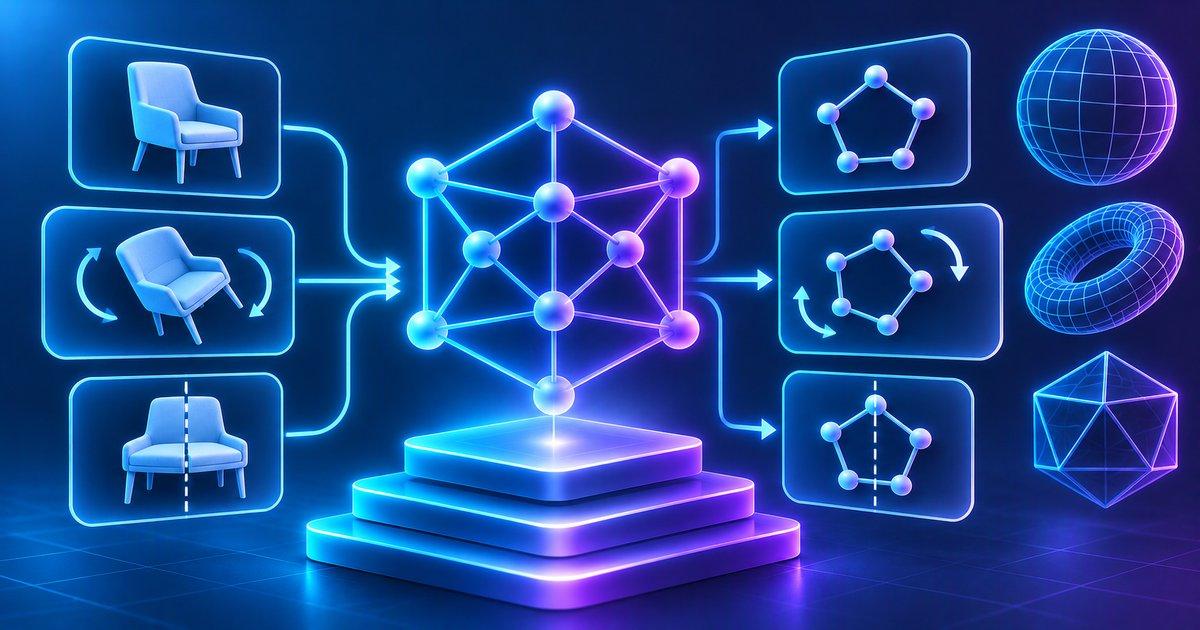
Section 1: Understanding Symmetry, Geometry, and Equivariance in Deep Learning
What Is Equivariance in Machine Learning?
Equivariance describes a relationship between transformations applied to an input and the corresponding transformations observed in a model's output.
Suppose a neural network receives an input (x) and produces an output through a function (f). Let (g) represent a transformation applied to the input, such as a rotation, translation, reflection, or permutation.
A function is equivariant when transforming the input and then applying the model produces the same result as applying the model first and transforming its output accordingly.
Mathematically:
[
f(g \cdot x) = g \cdot f(x)
]
The transformation on the output may differ from the transformation on the input in its mathematical representation. More generally, the relationship can be written as:
[
f(\rho_X(g)x) = \rho_Y(g)f(x)
]
Here, (\rho_X(g)) and (\rho_Y(g)) describe how the transformation acts on the input and output spaces.
This property allows a neural network to maintain consistent relationships between transformed inputs and predictions.
Consider a model that estimates the position of an object in a two-dimensional image. If the image is translated to the right, an equivariant model should produce an output position translated by the corresponding amount. The predicted coordinates change, but they change in a mathematically predictable way.
Now consider a model that classifies whether an image contains a cat. Rotating the image should generally not change the category prediction. In that case, the desired output is invariant rather than equivariant.
The distinction matters because not every machine learning task requires the same transformation behavior.
Equivariance is useful when the output contains geometric or directional information. Invariance is useful when the output should remain unchanged despite a transformation.
The architecture must therefore reflect the mathematical structure of the prediction task rather than assume that every input transformation should produce an identical output.
Invariance Versus Equivariance: Choosing the Correct Mathematical Behavior
Invariance and equivariance are related concepts, but they solve different problems.
An invariant function satisfies:
[
f(g \cdot x) = f(x)
]
The output remains unchanged when the input is transformed.
An equivariant function satisfies:
[
f(g \cdot x) = \rho(g)f(x)
]
The output changes according to a corresponding transformation rule.
Consider a three-dimensional molecule represented by the coordinates of its atoms. If the molecule is rotated or translated in space, its total energy should remain unchanged, assuming the transformation preserves the physical configuration.
A model predicting molecular energy should therefore produce an invariant scalar output.
However, a model predicting atomic forces should produce vector outputs. When the molecule rotates, its force vectors should rotate correspondingly. The force prediction should therefore be equivariant.
This distinction can be summarized through three common output types.
Scalar outputs: Quantities such as energy, temperature, molecular stability scores, and classification probabilities are often invariant under suitable spatial transformations.
Vector outputs: Quantities such as velocity, force, acceleration, and displacement should transform with the coordinate system.
Tensor outputs: Quantities such as stress, strain, and certain physical response properties follow more complex transformation rules.
A model may need to generate multiple output types simultaneously. For example, a molecular dynamics model may predict invariant energy and equivariant atomic forces.
This is why geometric machine learning architectures frequently distinguish between scalar, vector, and higher-order tensor representations.
The mathematical distinction also explains why simply making a model insensitive to rotation is not sufficient for every application. A robotic system that ignores an object's orientation may lose information required to calculate a grasping action. An equivariant system can preserve orientation information while maintaining consistent behavior under coordinate transformations.
The objective is to encode the correct relationship between input and output, not to remove every transformation effect.
Why Conventional CNNs and Neural Networks Need Geometric Inductive Biases
Convolutional neural networks already contain an important geometric property: translation equivariance.
A conventional convolutional layer applies the same filter across different spatial positions. When an image shifts, its feature maps generally shift correspondingly, subject to boundary effects, padding, and other implementation details.
This shared filter structure makes CNNs effective for image processing. The model does not need to learn an entirely different set of filters for every possible object position.
However, standard CNNs do not automatically provide equivalent guarantees for arbitrary rotations, reflections, or three-dimensional transformations.
A model may need to learn similar visual patterns independently for multiple orientations unless those transformations are introduced through augmentation or architectural constraints.
This creates additional learning requirements.
Suppose an object can appear in 16 different orientations. A conventional CNN may need sufficient examples of those orientations to learn reliable representations. If the training dataset contains only a limited number of examples for some orientations, performance may vary.
An equivariant architecture can encode the relevant rotational symmetry directly. Instead of learning unrelated filters for each orientation, it uses structured weight sharing to maintain predictable transformation behavior.
The same principle applies to graph neural networks. A graph should not change its semantic meaning simply because its nodes are assigned different numerical indices. Graph neural networks therefore commonly use permutation-equivariant operations so that reordering the nodes produces correspondingly reordered node-level outputs.
Geometric inductive biases are useful because they reduce the number of arbitrary relationships a model must learn from data.
However, an inductive bias is beneficial only when it matches the real structure of the problem. Enforcing a symmetry that the data does not possess can reduce model accuracy or remove important information.
For a related discussion of how models learn stable features while responding to changing input conditions, explore InterviewNode's “Adaptive ML Systems: How Models Respond When the Environment Changes”. Geometric symmetry is one example of a structured relationship that an ML system can use to generalize beyond the exact examples seen during training.
Key Takeaway
Equivariant neural networks use mathematical symmetry to ensure that transformations in the input produce predictable transformations in the output. Group theory provides the language for describing these transformations, while representation theory helps construct compatible neural network operations. The key architectural decision is whether a task requires invariant predictions, equivariant predictions, or a combination of both.
Section 2: Architectures and Techniques Behind Equivariant Neural Networks
Group Equivariant Convolutional Networks
Group Equivariant Convolutional Networks, commonly called G-CNNs, extend conventional convolutional networks by incorporating additional transformation symmetries into their convolution operations.
Traditional CNNs share filters across spatial positions, providing translation equivariance. G-CNNs generalize this idea to transformation groups that may include rotations and reflections.
The underlying principle is structured weight sharing.
A conventional convolutional network learns filters that detect patterns at different image locations. A group-equivariant convolutional network can also represent how those patterns behave under selected transformations.
For example, a feature detector that recognizes a vertical edge can be related systematically to detectors for rotated versions of that edge. Rather than learning each orientation independently, the architecture uses group-based relationships to share information.
A group convolution can be expressed in a generalized form as:
\int_G f(h)\psi(g^{-1}h),dh
]
Here, (G) is the transformation group, (f) is the input feature function, and (\psi) is a learnable filter defined over the group. The precise implementation depends on the underlying domain and group structure.
The important idea is that convolution is extended from ordinary spatial coordinates to a transformation-aware representation.
Cohen and Welling introduced Group Equivariant Convolutional Networks in 2016. Their work demonstrated how group convolutions can incorporate rotations and reflections into convolutional architectures while exploiting additional weight sharing. Their experiments included rotated MNIST and CIFAR-10 benchmarks.
G-CNNs are useful when the transformation group is known and can be represented efficiently.
However, discrete rotation groups and continuous rotation groups have different computational requirements. A network handling four discrete rotations is generally simpler than one designed to represent arbitrary three-dimensional rotations.
Engineers must also account for boundary effects, discretization, interpolation, and the relationship between the transformation group and the image grid.
SE(3)-Equivariant Networks and Three-Dimensional Geometry
Many scientific and engineering applications operate in three-dimensional space. Molecules, proteins, point clouds, physical particles, and robotic objects all have spatial relationships that should behave consistently under changes in coordinate systems.
SE(3)-equivariant networks are designed to respect three-dimensional rotations and translations.
The group (SE(3)) can be represented by rigid transformations:
[
x' = Rx + t
]
Here, (R) is a proper rotation matrix and (t) is a translation vector.
An SE(3)-equivariant model ensures that its internal features and outputs transform consistently under these operations.
This is particularly useful in point-cloud processing. A point cloud represents an object or environment as a collection of three-dimensional points. The point cloud may be captured from different camera positions or represented using different coordinate origins.
A model that relies on absolute coordinates may struggle when the same object is observed from a different reference frame.
An SE(3)-equivariant architecture can instead learn relationships based on geometric structure, relative positions, and transformation-aware features.
The SE(3)-Transformer extends attention mechanisms to three-dimensional geometric data. It uses equivariant attention to process point clouds and graphs while maintaining predictable behavior under rigid transformations. The original research demonstrated the approach on particle simulations and 3D datasets.
Another important architecture is the Tensor Field Network, which uses geometric features and spherical harmonics to construct rotation- and translation-equivariant operations.
These architectures are particularly relevant when a model must process directional information, such as forces, orientations, and spatial relationships.
The computational cost can be higher than that of conventional networks because the model may need to represent multiple geometric feature types and perform structured tensor operations.
The choice of architecture therefore depends on the required symmetry, output type, accuracy requirements, and available computational resources.
Equivariant Transformers, Tensor Products, and Modern Geometric Architectures
Transformer architectures have become widely used in language, vision, and multimodal machine learning. Their attention mechanism allows models to process relationships between different elements in a sequence or structured input.
However, standard attention does not automatically preserve geometric equivariance.
An equivariant Transformer must ensure that the attention operations, feature transformations, and output projections respect the relevant symmetry group.
SE(3)-Transformers provide one approach by incorporating geometric information into attention. Other architectures, including Equiformer, combine graph attention and equivariant operations for three-dimensional atomistic systems.
A major technical challenge is representing higher-order geometric information.
Scalars transform differently from vectors, and vectors transform differently from higher-order tensors. Equivariant networks must preserve these transformation rules through their linear operations and nonlinearities.
Tensor products provide a way to combine different geometric feature types while maintaining transformation structure.
For example, combining two vector representations can produce scalar and higher-order components. Clebsch–Gordan coefficients provide the mathematical machinery for decomposing tensor products into irreducible representations.
These operations are central to many sophisticated equivariant architectures.
The e3nn library provides a framework for constructing E(3)-equivariant neural networks using geometric tensors, spherical harmonics, and equivariant operations. It supports components that can be combined into more complex architectures, including convolutions and attention mechanisms.
A notable development is the increasing use of equivariant architectures in pretrained models for scientific applications. A 2026 Nature Communications paper introduced an equivariant pretrained Transformer for unified 3D molecular representation learning, demonstrating the use of E(3)-equivariant modeling across multiple molecular and protein-related prediction tasks.
The broader trend is that geometric inductive biases are moving beyond specialized research architectures and becoming components of larger pretrained models.
For a related perspective on efficient model design and resource-aware architecture choices, explore InterviewNode's “Efficient ML: How to Build High-Performance Models With Less Compute”. Equivariant architectures can improve data efficiency, but their computational overhead must be evaluated against the actual benefits they provide.
Key Takeaway
Equivariant neural networks can be implemented through group convolutions, SE(3)-equivariant architectures, geometric graph networks, and equivariant Transformers. Each architecture encodes symmetry differently, with tradeoffs in expressiveness, computational cost, and implementation complexity. Engineers should select the architecture according to the geometry of the input, the transformation behavior of the output, and the operational requirements of the application.
Section 3: Training, Evaluating, and Deploying Equivariant Neural Networks
Preparing Geometric Data and Defining Valid Symmetries
Training an equivariant neural network begins with understanding the geometry of the data.
A conventional image dataset may contain pixel arrays and class labels. A geometric dataset can include coordinates, edges, distances, angles, orientations, vectors, tensors, and other structured information.
For example, a molecular dataset may represent each atom as a node containing an element type and three-dimensional coordinates. Bonds can be represented as edges, while additional features may describe bond type, charge, or molecular environment.
A robotic manipulation dataset may contain point clouds, object poses, joint positions, end-effector coordinates, and action vectors.
The first step is to identify which transformations should preserve the task.
For a molecular energy prediction problem, translating or rotating the entire molecule should not change the predicted energy. For force prediction, the output vectors should rotate along with the molecule.
For a robotic manipulation task, the model may need to transform its predicted action when the coordinate frame changes. However, reflections may not always be physically equivalent because they can reverse handedness or alter the relationship between the robot and its environment.
This means that symmetry selection is a domain-specific engineering decision.
The dataset should also be checked for geometric consistency. Coordinate units must be standardized, missing positions must be handled, and graph relationships must correctly represent the underlying structure.
Training and evaluation splits should avoid leakage between closely related geometric examples. For example, multiple conformations of the same molecule should be considered carefully when constructing evaluation sets, especially if the intended objective is generalization to unseen molecular structures.
The system should also document coordinate conventions, reference frames, and transformation rules. In geometric machine learning, inconsistent coordinate conventions can create errors that are difficult to distinguish from model failures.
Designing Equivariant Loss Functions and Training Objectives
Equivariant neural networks are often trained using conventional supervised learning objectives combined with symmetry-aware constraints.
The task loss depends on the prediction target.
For classification, cross-entropy loss may be appropriate. For scalar regression, mean squared error or other regression losses can be used. For vector prediction, the loss should account for the geometric relationship between predicted and target vectors.
A model can also be evaluated using an equivariance consistency loss.
Suppose the model receives an input (x), and a transformed version (g \cdot x) is generated. The model produces two outputs:
[
y = f(x)
]
[
y_g = f(g \cdot x)
]
The expected transformed output is:
[
\hat{y}_g = \rho_Y(g)y
]
An equivariance error can then be defined as:
\left|
f(g \cdot x)-\rho_Y(g)f(x)
\right|^2
]
This measures how closely the model follows the required transformation relationship.
A combined training objective may be expressed as:
\mathcal{L}{task}
+
\lambda\mathcal{L}{eq}
]
Here, (\mathcal{L}{task}) measures the primary prediction error, while (\mathcal{L}{eq}) penalizes deviations from the expected transformation behavior.
In architectures with exact architectural equivariance, the consistency objective may be unnecessary as a primary training constraint. It can still be useful as a diagnostic test or when numerical approximations introduce small deviations.
The training process must also consider numerical stability. Operations involving spherical harmonics, tensor products, coordinate normalization, and higher-order features can be sensitive to implementation details.
Gradient behavior should be monitored carefully, particularly when models combine geometric transformations with deep message-passing or attention layers.
Training should include checks for equivariance violations at intermediate layers and at the final output. This helps identify errors in coordinate handling, feature transformations, or model implementation before they become difficult to diagnose.
Production Deployment, Monitoring, and Model Maintenance
Deploying an equivariant neural network requires attention to the complete inference pipeline, not just the trained model.
A production system may receive geometric inputs from cameras, sensors, simulations, CAD systems, or scientific data pipelines. These inputs must be converted into the coordinate and feature conventions expected by the model.
The preprocessing layer should validate coordinate dimensions, units, missing values, graph connectivity, and feature types.
The model then generates predictions using its equivariant architecture. The output processing layer converts those predictions into the coordinate frame or application format required by the downstream system.
For example, a robotics application may receive a point cloud in the camera coordinate frame but need to produce a grasp pose in the robot base coordinate frame. The transformation between these coordinate systems must be handled consistently.
Model versioning is also important. Changes to feature definitions, coordinate conventions, model weights, or equivariant operations can affect prediction compatibility.
A production system should record the model version, preprocessing version, coordinate convention, and relevant input metadata for each prediction.
Monitoring should cover both model performance and geometric correctness.
A system can track input coordinate distributions, point-cloud density, graph sizes, prediction magnitudes, latency, memory use, and transformation consistency.
In applications with delayed ground-truth outcomes, model quality can be evaluated when new labels become available. In robotics, for example, task completion and manipulation success may provide operational feedback. In scientific applications, predictions may later be compared with simulations or experimental measurements.
Monitoring is particularly important when the deployment environment changes. A robot may receive data from a new camera, a scientific pipeline may adopt a new coordinate convention, or an application may begin processing larger geometric structures.
For guidance on productionizing ML models beyond experimentation, explore InterviewNode's “From Notebook to Low-Latency Service: The Engineering Journey of a Production ML Model”. The same engineering discipline applies to geometric models, with additional attention required for coordinate transformations and structured feature compatibility.
Key Takeaway
Training and deploying equivariant neural networks requires a consistent geometric data pipeline, task-appropriate loss functions, transformation-based evaluation, and production monitoring. Engineers should measure both prediction accuracy and equivariance error, while benchmarking latency, memory, and computational cost. A mathematically sound architecture still depends on reliable preprocessing and coordinate conventions.
Section 4: Real-World Applications, Limitations, and the Future of Geometric AI
Molecular Modeling, Drug Discovery, and Scientific Machine Learning
Molecular modeling is one of the strongest application areas for equivariant neural networks because molecular structures exist in three-dimensional space and obey physical symmetry relationships.
A molecule can be represented through atoms, bonds, and atomic coordinates. Rotating or translating the entire molecule changes its coordinate representation but does not change its intrinsic physical identity.
A molecular property prediction model should therefore respect the relevant geometric symmetries.
For example, a model predicting molecular energy should produce the same result when the molecular structure is translated or rotated. A model predicting atomic forces should produce vectors that transform consistently with those rotations.
Equivariant graph neural networks can process atoms as nodes and molecular relationships as edges. Their message-passing operations use geometric information to learn interactions between atoms.
This can support molecular property prediction, conformational analysis, force estimation, and molecular dynamics simulations.
The connection to drug discovery is particularly interesting. Predicting molecular interactions and protein-ligand relationships requires understanding three-dimensional structure. Equivariant models can represent geometric relationships more directly than architectures that rely only on generic feature embeddings.
The 2025 PNAS perspective on equivariant neural networks for physics and chemistry explains why translation, rotation, and particle-exchange symmetries are fundamental to many scientific learning problems.
More recently, a 2026 Nature Communications study introduced an equivariant pretrained Transformer for unified 3D molecular representation learning. The model was pretrained across multiple molecular domains and evaluated on tasks involving ligand binding affinity, protein properties, and small-molecule prediction.
Equivariant architectures are also useful in physical simulation. Models can predict particle interactions, system dynamics, forces, and other geometric quantities while respecting the symmetries of the underlying physical problem.
However, predictive performance does not automatically establish physical correctness. Models must still be evaluated against experimental measurements, trusted simulations, and known physical constraints.
Robotics, Autonomous Systems, and 3D Computer Vision
Robotics operates in a world where objects and sensors continuously change position and orientation.
A robot may need to recognize an object from a point cloud, estimate its pose, plan a trajectory, and calculate an action that remains appropriate when the object or camera moves.
Conventional models may require extensive training data covering different spatial configurations. Equivariant architectures can incorporate geometric relationships directly, helping models behave consistently across coordinate transformations.
For example, a robot trained to grasp an object in one orientation should ideally be able to identify a corresponding grasp when the object is rotated.
An SE(3)-equivariant model can process three-dimensional point clouds and produce outputs that transform predictably under rigid movements.
This is useful for robotic manipulation, pose estimation, motion prediction, and geometric control.
A 2025 tutorial survey on SE(3)-equivariant robot learning and control reviews applications across imitation learning, reinforcement learning, visual robotic manipulation, and geometric control. It also discusses the role of symmetry-aware methods in improving robustness and sample efficiency.
In autonomous systems, geometric equivariance can support perception of three-dimensional environments, object relationships, and spatial structures.
For example, a perception model may need to identify a vehicle, pedestrian, or obstacle from different sensor viewpoints. A geometric architecture can help preserve spatial relationships as the coordinate frame changes.
However, the real world includes occlusion, sensor noise, dynamic objects, and incomplete observations. Equivariance alone does not solve these problems. It provides a useful geometric inductive bias that must be combined with robust perception, temporal reasoning, and reliable sensor processing.
Limitations and the Future of Equivariant Neural Networks
Equivariant neural networks provide powerful geometric inductive biases, but they introduce several challenges.
The first is computational complexity.
Some architectures use higher-order representations, spherical harmonics, tensor products, and structured attention operations. These operations can increase memory requirements and inference latency compared with simpler architectures.
The computational cost depends on the group, feature types, representation order, graph size, and implementation. Efficient architectures such as EGNNs demonstrate that geometric equivariance does not always require expensive higher-order representations, but there is no universal cost profile.
The second challenge is choosing the correct symmetry.
An architecture that enforces rotation invariance may be inappropriate when orientation is important to the task. Reflection symmetry may also be invalid in systems where handedness matters.
The third challenge is numerical and implementation complexity. Geometric operations depend on consistent coordinate conventions, stable normalization, and correct transformation rules. Small implementation errors can undermine the intended equivariance.
The fourth challenge is benchmarking. An equivariant architecture should not be compared with a conventional model using only parameter counts or training accuracy. Researchers need to evaluate computational cost, prediction quality, geometric consistency, and generalization under realistic conditions.
The 2024 comparison study by Roos and Kroon highlights the importance of controlling computational budgets when evaluating the flexibility and performance of group-equivariant models.
The field is also moving toward larger pretrained geometric models. The emergence of equivariant Transformers for molecular and protein-related tasks suggests that geometric inductive biases can be combined with large-scale pretraining rather than remaining restricted to specialized networks.
Another promising direction is the combination of equivariant architectures with multimodal models. Future systems may integrate geometric representations with images, text, sensor streams, and physical measurements.
This could support applications such as natural-language-guided robotics, scientific discovery assistants, multimodal medical systems, and simulation-aware AI.
The broader goal is to develop models that do not merely recognize patterns in data but understand the structural relationships governing those patterns.
For organizations deploying these models in production, InterviewNode's “MLOps for Software Engineers: Building, Deploying, and Monitoring Machine Learning Models in Production” provides useful context on the monitoring, deployment, and lifecycle management practices needed to operate advanced ML architectures reliably.
Key Takeaway
Equivariant neural networks have practical applications in molecular modeling, drug discovery, robotics, autonomous systems, medical imaging, and 3D computer vision. Their ability to encode geometric relationships can improve consistency and data efficiency, but computational cost, symmetry selection, and implementation complexity remain important considerations. The future of geometric AI will likely combine equivariant architectures with pretrained models, multimodal learning, and production-scale ML infrastructure.
Conclusion: Building AI Models That Understand the Structure of the World
Traditional neural networks learn relationships from data, but they do not automatically understand the geometric structure of the problems they solve.
An image can be rotated, a molecule can be translated, a point cloud can be viewed from a different coordinate frame, and a robotic object can move through three-dimensional space. These transformations may change the numerical representation of the input without changing the underlying task.
Equivariant neural networks address this challenge by incorporating mathematical symmetry into the architecture.
Through group theory and representation theory, these models learn transformation-aware relationships. Group-equivariant CNNs extend convolutional networks to additional symmetry groups. SE(3)-equivariant models process three-dimensional geometry. EGNNs combine geometric information with graph-based message passing, while equivariant Transformers extend attention mechanisms to structured spatial data.
The result is a family of architectures that can represent geometric relationships more systematically than conventional networks.
However, equivariance is not automatically beneficial for every machine learning problem. The selected symmetry must match the task, and the computational overhead must be justified by measurable improvements in accuracy, consistency, or data efficiency.
Engineers should evaluate both prediction performance and geometric correctness, while paying close attention to coordinate conventions, preprocessing, model compatibility, and deployment monitoring.
As AI systems move deeper into robotics, scientific computing, drug discovery, and three-dimensional perception, understanding geometry will become increasingly important.
Equivariant neural networks represent an important step toward models that do not simply learn from the appearance of data, but also respect the mathematical relationships that govern how the world changes.
Frequently Asked Questions
1. What are equivariant neural networks?
Equivariant neural networks are machine learning architectures designed so that transformations applied to the input produce predictable transformations in the output. They use mathematical symmetry to preserve relationships between transformed versions of the same data.
2. What is the difference between equivariance and invariance?
Equivariance means that the model output changes predictably when the input is transformed. Invariance means that the output remains unchanged. A molecular energy prediction is generally invariant to rotation, while a force prediction should be equivariant.
3. Why are equivariant neural networks important?
They help models learn structured relationships involving rotations, translations, reflections, and permutations. This can improve data efficiency, geometric consistency, and generalization in applications where these transformations are fundamental to the task.
4. What is group theory in equivariant deep learning?
Group theory provides a mathematical framework for describing transformations and their composition. Equivariant neural networks use groups such as rotation groups, translation groups, and Euclidean groups to define how input and output representations should behave.
5. What is the difference between SE(3) and E(3) equivariance?
SE(3) describes three-dimensional rotations and translations, representing proper rigid transformations. E(3) also includes reflections. The distinction matters when orientation and handedness are important to the task.
6. Are conventional CNNs equivariant?
Standard CNNs are generally translation equivariant, subject to boundary and implementation effects. They do not automatically provide exact equivariance to arbitrary rotations or reflections. Group-equivariant CNNs extend convolutional operations to additional transformation groups.
7. What are Group Equivariant Convolutional Networks?
Group Equivariant Convolutional Networks extend traditional convolutional neural networks by incorporating transformation groups such as rotations and reflections. They use structured weight sharing to maintain predictable feature transformations.
8. What are SE(3)-equivariant neural networks used for?
SE(3)-equivariant networks are useful for processing three-dimensional data while respecting rotations and translations. Applications include molecular modeling, protein structure analysis, point-cloud processing, robotics, and physical simulations.
9. What are E(n)-Equivariant Graph Neural Networks?
EGNNs are graph neural networks designed to preserve equivariance under rotations, translations, reflections, and node permutations in Euclidean spaces. They process geometric relationships through message passing and coordinate-aware operations.
10. How do equivariant Transformers work?
Equivariant Transformers incorporate geometric information into attention and feature transformations so that the network preserves the required symmetry relationships. SE(3)-Transformers are an example designed for three-dimensional point clouds and graphs.
11. Do equivariant neural networks require less training data?
They can improve data efficiency by encoding known symmetries directly into the architecture. This reduces the need to learn the same transformation relationship independently from many examples. The actual benefit depends on the task, architecture, and dataset.
12. Are equivariant neural networks computationally expensive?
Some equivariant architectures require additional computation for tensor products, spherical harmonics, higher-order representations, and geometric attention. However, simpler architectures such as EGNNs can achieve useful equivariance with relatively efficient operations.
13. Can equivariant neural networks be used in robotics?
Yes. They can help robotic systems process three-dimensional point clouds, estimate object poses, predict spatial movements, and generate actions that transform consistently when the coordinate frame changes.
14. How are equivariant neural networks evaluated?
They are evaluated using task-specific metrics, geometric consistency tests, equivariance error, generalization to transformed inputs, inference latency, memory usage, and computational cost. A model should be assessed for both predictive accuracy and adherence to its intended symmetry.
15. What is the future of equivariant neural networks?
Future developments are likely to combine equivariant architectures with foundation models, geometric Transformers, multimodal learning, and scientific machine learning. These approaches may support more reliable AI systems for molecular discovery, robotics, 3D perception, and physical simulation.