
Section 1: Understanding Recommendation Systems and Choosing the Right Approach
Recommendation Systems Connect User Behavior With Relevant Items
A recommendation system helps an application identify which products, articles, videos, services, or other items are most likely to be useful to a particular user by analyzing available information about preferences, behavior, and item characteristics. Rather than displaying the same collection to every user, the system estimates relevance for a specific person or context, allowing applications to personalize experiences across e-commerce platforms, streaming services, content feeds, and professional software products. Building such a system requires engineers to understand not only how recommendations are generated but also how user interactions, item metadata, retrieval infrastructure, and product objectives influence the results.
The core recommendation workflow typically begins with collecting information about users and items, including historical interactions, explicit preferences, contextual signals, and item attributes. The system uses these inputs to generate candidate items, evaluates their relevance, applies business constraints, and returns an ordered list through the application's interface or API. This separation between candidate generation and ranking is important because a large catalog may contain millions of items, making it impractical to evaluate every item with an expensive personalization model for every request.
Recommendation quality also depends on understanding what the system is expected to optimize, since predicting whether a user will click an item is not necessarily equivalent to predicting whether the user will purchase it, find it useful, or remain engaged with the application. Engineers should therefore establish the intended outcome before choosing an algorithm, ensuring that the recommendation pipeline supports the actual user experience rather than optimizing a convenient but incomplete metric.
Popularity-Based Recommendations Provide a Practical Baseline
The simplest recommendation systems rank items according to signals such as total views, purchases, ratings, or recent engagement, making popularity-based recommendations useful when an application has limited user history or needs an inexpensive initial implementation. A content platform might display its most frequently read articles, while a marketplace could rank products according to recent purchases, giving users plausible recommendations without requiring a trained personalization model. This approach is easy to implement, explain, and operate because it can often be built using database aggregations or periodic batch-processing jobs.
However, popularity-based recommendations tend to produce similar results for different users, reducing their ability to reflect individual preferences. They can also favor established items over newly introduced content, because items with more historical exposure have more opportunities to accumulate interactions. Engineers can improve the baseline by calculating popularity over recent time windows, incorporating item quality, separating results into meaningful categories, or combining popularity with availability and freshness constraints.
A popularity baseline is valuable even when a more sophisticated model is planned because it provides a reference against which subsequent approaches can be measured. If collaborative filtering or a neural recommendation model cannot consistently improve a well-designed popularity baseline on relevant evaluation metrics, the additional complexity may not be justified. Establishing this baseline early also helps teams distinguish genuine improvements in recommendation quality from changes caused by data collection, catalog composition, or evaluation methodology.
Content-Based and Collaborative Filtering Solve Different Problems
Content-based recommendation systems use item attributes and a user's observed preferences to identify additional items with similar characteristics. A product catalog might contain category, brand, description, and price information, while an article collection may include topics, authors, and textual representations, allowing the system to recommend items whose attributes align with the user's earlier interactions. These systems can be particularly useful when descriptive metadata is available, because a newly introduced item can become recommendable before it accumulates a substantial interaction history.
Collaborative filtering instead learns from patterns in user-item interactions, identifying similarities among users or items based on behaviors such as purchases, ratings, views, or saves. If users who engage with one collection of items also frequently engage with another collection, the system can recommend the latter to users with similar interaction patterns even when the two groups of items have limited descriptive similarity. This approach can uncover preferences that are difficult to infer from item metadata alone, although its effectiveness depends on the quantity and quality of interaction data available.
Both techniques have limitations that affect engineering choices, including the cold-start problem for users or items with limited history, sparse interaction matrices, changing preferences, and potential feedback loops created by previous recommendations. The discussion in “The Cold-Start Problem Beyond Recommendations: How AI Learns With Almost No History” is relevant because recommendation systems need an explicit strategy for making useful decisions when historical interactions are missing or insufficient. In practice, content-based methods, collaborative filtering, and popularity signals can be combined to provide broader coverage than any single technique can deliver.
Key Takeaway
Building a recommendation system starts with understanding the product objective, collecting reliable user and item information, and selecting an approach that matches the available data and operational requirements. By establishing a popularity baseline, evaluating content-based and collaborative-filtering methods, and adding complexity only when measurable improvements justify it, engineers can develop a recommendation architecture that evolves from a simple ranking mechanism into a scalable, personalized production system.
Section 2: Building the Data Pipeline and Generating Recommendation Candidates
Collecting User Interactions and Preparing Recommendation Data
A recommendation system depends on reliable records of how users interact with an application's content, products, or services, making data collection the foundation of its recommendation pipeline. Engineers typically capture events such as clicks, purchases, views, ratings, searches, saves, and impressions, with each event providing different evidence about a user's interests and the items they encounter. Explicit feedback, such as a user submitting a rating, directly communicates a preference, while implicit feedback, such as viewing or purchasing an item, requires the system to infer interest from observed behavior.
These events should be collected through well-defined schemas that preserve essential information, including user identifiers, item identifiers, timestamps, interaction types, and relevant contextual attributes. Reliable event processing must also account for duplicate records, delayed messages, missing identifiers, and changes in event definitions because inaccurate interaction histories can distort recommendations even when the model implementation is correct. Engineers should distinguish between an item being displayed and an item receiving meaningful engagement, since treating every impression as a positive interaction can introduce substantial bias into the training data.
Once collected, interaction data can be transformed into user-item relationships, historical aggregates, and training examples that represent observed preferences. The principles described in “The Journey of a Dataset: From Raw Data to Production ML” are relevant because recommendation quality depends on preserving data meaning throughout ingestion, transformation, feature generation, and model development.
Generating Candidates With Collaborative Filtering and Embeddings
Candidate generation reduces a large catalog to a manageable collection of items that are potentially relevant to a particular user, allowing more sophisticated ranking models to operate on a smaller set. Collaborative filtering provides one approach by identifying relationships between users and items from historical interaction patterns, enabling the system to recommend items that resemble those a user previously engaged with or that similar users found useful. For larger applications, latent-factor models can represent users and items as learned vectors, allowing candidate retrieval through similarity calculations rather than repeatedly scanning every possible item.
Embeddings provide another mechanism for candidate generation by representing users, products, articles, or other entities as numerical vectors that capture useful relationships. A recommendation system can retrieve items whose embeddings are close to a user's representation or current context, making it possible to discover relevant candidates even when the interaction patterns are too complex for simple neighborhood methods. Depending on the application, embeddings may be learned from interaction history, item descriptions, user attributes, or combinations of these signals, with the training approach determining which relationships the resulting representations can capture.
When the catalog becomes very large, engineers can use approximate nearest-neighbor search to find similar vectors without comparing the query against every item. This reduces retrieval cost while introducing trade-offs between recall, index size, memory consumption, and query latency, making candidate generation an important optimization stage rather than a trivial preprocessing operation.
Combining Content Features, Popularity, and Multiple Retrieval Strategies
No single candidate-generation technique performs optimally across every situation, which makes combining complementary retrieval methods a practical strategy for production recommendation systems. Popularity-based retrieval can provide reliable candidates when little personalized information is available, collaborative filtering can identify patterns in user-item interactions, and content-based retrieval can surface items related to a user's observed preferences through attributes such as category, description, brand, or topic.
These methods can operate in parallel, producing candidate sets that are merged, deduplicated, and filtered before being passed to the ranking stage. A product recommendation system, for example, might combine items similar to previous purchases with popular products in the user's preferred categories and candidates discovered through collaborative filtering, providing broader coverage than any single retrieval mechanism could achieve. Engineers must also preserve eligibility constraints, such as product availability, geographic restrictions, content permissions, and previously dismissed items, so that the candidate set contains options the application can actually recommend.
The merging process should consider the overlap between retrieval strategies because several candidate generators may repeatedly return the same popular items while overlooking useful alternatives. Tracking candidate-source contributions, retrieval recall, and catalog coverage helps engineers determine whether each retrieval path introduces meaningful candidates or merely duplicates work performed elsewhere.
Key Takeaway
Recommendation candidate generation combines reliable interaction data, collaborative filtering, embeddings, content-based retrieval, and popularity signals to reduce a large catalog into a useful set of potential recommendations. By maintaining clean event histories, combining complementary retrieval strategies, addressing cold-start conditions, and balancing precomputed candidates with fresh information, engineers can build a scalable retrieval pipeline that gives downstream ranking models strong opportunities to identify relevant items without requiring expensive evaluation across the entire catalog.
Section 3: Ranking, Personalization, and Learning From User Behavior
Ranking Models Determine Which Recommendations Matter Most
Candidate generation identifies potentially relevant items, but a recommendation system must still decide which candidates deserve the highest positions because users typically interact with only a small portion of the available results. Ranking models address this problem by estimating the relevance of each candidate using information about the user, the item, and the context in which the recommendation appears. Engineers can begin with a weighted scoring function that combines popularity, item similarity, historical interactions, and freshness, then introduce machine-learning models when manually defined weights fail to capture more complex relationships.
A ranking model can use features such as previous purchases, viewing duration, category preferences, item attributes, recent clicks, and interactions between users and candidates to estimate the likelihood of a particular outcome. Depending on the application, the prediction target might be a click, purchase, completed video, saved article, or another measurable interaction, making feature selection and target definition important because the model will optimize the behavior represented by its training labels rather than automatically learning the application's broader objective.
Engineers should also distinguish between predicting an individual interaction and optimizing the overall recommendation list, because placing several individually attractive items together may produce a repetitive experience. Ranking strategies can incorporate diversity, freshness, availability, and explicit business constraints to create a more useful collection of recommendations rather than sorting candidates exclusively by one predicted probability. The principles discussed in “Learning to Rank: The Machine Learning Behind Search and Recommendations” are particularly relevant because ranking quality depends on how candidate relationships and user preferences are translated into a meaningful ordering.
Personalization Combines User Preferences With Real-Time Context
Personalization allows a recommendation system to adapt its results to individual users instead of treating historical popularity as a universal indicator of relevance. User profiles can represent long-term interests through purchase history, content preferences, saved items, and recurring behavioral patterns, while session-level features capture recent activity that may indicate a temporary or changing intent. Combining these signals helps the system distinguish between stable preferences and immediate interests, allowing recommendations to evolve as the user's behavior changes.
Contextual features can further improve relevance by incorporating information such as time of day, device type, location when appropriate, current session activity, product availability, and the environment in which the recommendation is displayed. A streaming application might prioritize shorter content during brief sessions, while a shopping application could adjust recommendations according to current inventory or recent product interactions, provided that these contextual signals are available at serving time and can be processed within the latency budget.
Personalization also needs to account for users and items with limited historical information because a new user may not have established preferences and a newly introduced item may lack engagement data. Popularity, content attributes, explicit onboarding preferences, and contextual signals can provide initial recommendations while the system collects enough interaction history to make more individualized predictions. A practical design combines these approaches so that recommendations remain useful during cold-start conditions instead of relying entirely on collaborative signals that do not yet exist.
Evaluate Recommendations Through Offline Metrics and Online Experiments
Recommendation systems need both offline evaluation and online experimentation because neither method alone provides a complete picture of their effectiveness. Offline tests allow engineers to compare candidate models using historical interaction datasets and metrics such as precision at K, recall at K, normalized discounted cumulative gain, and mean average precision, depending on the recommendation task. These measurements help determine whether a model retrieves relevant items and places useful candidates near the top of the list, although historical data may reflect the limitations of an earlier recommendation policy.
Online experiments can complement offline testing by comparing recommendation strategies with real users, allowing teams to measure outcomes such as engagement, conversion, retention, and other application-specific goals. A model that improves offline ranking metrics may not produce better business outcomes if its recommendations increase latency, reduce diversity, or encourage short-term clicks without improving sustained user value. Engineers should therefore define primary and guardrail metrics before an experiment begins and interpret results alongside operational measurements and relevant user segments.
Key Takeaway
Effective recommendation systems combine candidate ranking, personalized context, controlled exploration, and continuous evaluation to deliver useful results rather than simply predicting which items users might click. By balancing long-term preferences with recent behavior, managing feedback loops, and validating model changes through both offline metrics and online experiments, engineers can build recommendation experiences that remain relevant, diverse, and aligned with the application's actual objectives.
Section 4: Deploying and Scaling Recommendation Systems in Production
Designing Recommendation APIs for Reliable Delivery
A production recommendation system must deliver personalized results through an interface that integrates reliably with the existing application, making API design an important part of the serving architecture. A recommendation endpoint might accept a user identifier, current session context, and optional constraints before returning an ordered list of eligible items with associated scores or metadata, while keeping the underlying retrieval and ranking implementation hidden behind a stable contract. This separation allows engineers to update candidate-generation strategies, ranking models, and feature transformations without requiring downstream applications to change every time the recommendation algorithm evolves.
The serving architecture should also reflect the application's response-time requirements because retrieving candidates, loading user features, and ranking items can introduce substantial latency when these operations occur sequentially. Batch-generated recommendations can be stored ahead of time for predictable workloads, while online inference can incorporate recent interactions and contextual signals when personalization needs to reflect current behavior. A hybrid design can combine precomputed candidate lists with lightweight online reranking, preserving fast response times while allowing the system to account for recent activity without recomputing the entire recommendation pipeline for every request.
Optimize Latency Through Caching and Efficient Model Serving
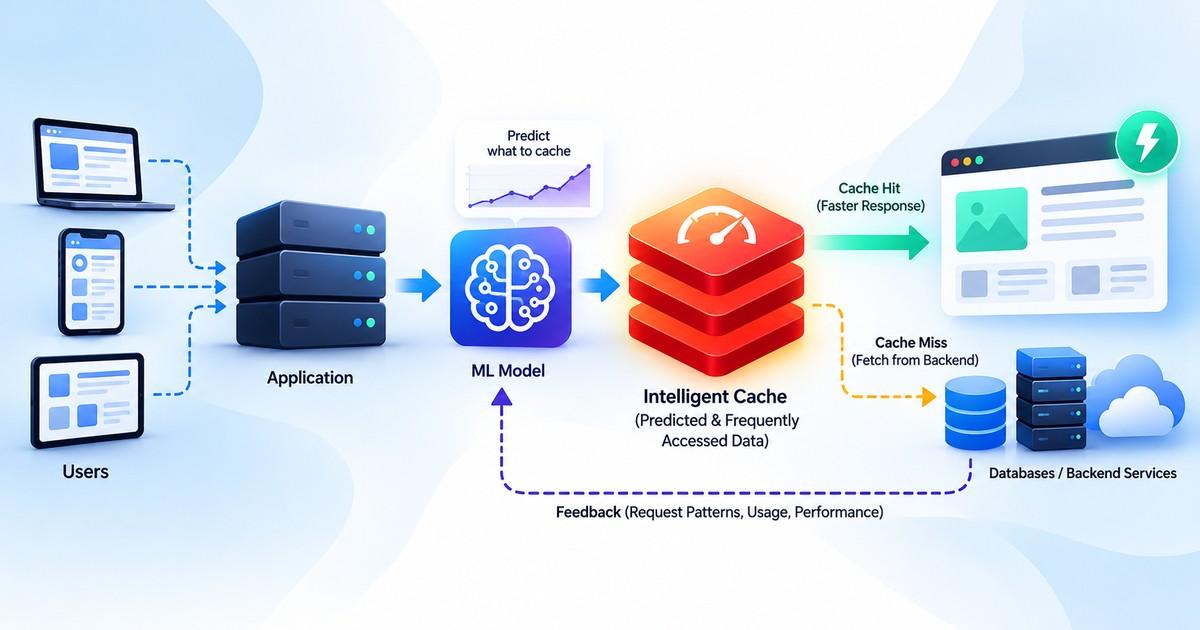
Recommendation services frequently repeat computations across users, sessions, and items, creating opportunities to improve performance through caching and efficient inference infrastructure. Popular items, reusable embeddings, candidate lists, item metadata, and selected user features may be cached when their freshness requirements permit, reducing repeated database queries and expensive model operations during request processing. The principles discussed in “Caching for AI Applications: The Overlooked Technique for Reducing Inference Costs” are particularly relevant because avoiding repeated computation can improve responsiveness while reducing the resources required to serve recommendations at scale.
Caching must nevertheless account for personalization and changing context because a recommendation generated for one user or session may not be appropriate for another, and a previously valid result can become stale when items become unavailable or user preferences change. Engineers should therefore define cache keys, expiration policies, invalidation triggers, and eligibility checks according to the semantics of each cached object, ensuring that performance optimizations do not cause users to receive outdated or inappropriate recommendations.
Inference optimization also becomes important as candidate sets and model complexity increase, because excessive feature retrieval, inefficient ranking operations, or unbounded concurrency can cause latency to rise under production traffic. Engineers can reduce this overhead through efficient candidate generation, controlled batching, optimized runtimes, model compression, and independent scaling of resource-intensive components, while measuring end-to-end latency rather than relying solely on model execution benchmarks.
Maintain Recommendation Quality as Users and Items Change
Recommendation quality can deteriorate when user preferences, catalog composition, or application behavior changes, making continuous monitoring necessary after deployment. Engineers should track ranking quality where labels are available, recommendation coverage, popularity concentration, diversity, freshness, interaction rates, and relevant business outcomes to determine whether the system continues to provide useful results. A recommendation engine that repeatedly serves the same popular items may generate acceptable engagement while gradually reducing discovery, making coverage and diversity important complementary measures rather than relying exclusively on click-through rates.
Cold-start behavior requires particular attention because new users and newly introduced items often lack the historical interactions needed by collaborative filtering models. Content attributes, popularity signals, contextual information, onboarding preferences, and hybrid retrieval can help provide useful recommendations while the system gathers sufficient interaction history, with fallback strategies ensuring that the application remains functional when personalized signals are sparse or unavailable.
Feature freshness also affects model behavior because stale user histories, delayed interaction events, and outdated item metadata can produce recommendations that no longer match current conditions. Engineers should monitor ingestion delays, feature availability, and changes in interaction distributions, while evaluating whether model updates are justified by observed quality degradation rather than retraining automatically after every fluctuation. These practices help distinguish genuine changes in user preferences from pipeline problems that temporarily distort the inputs supplied to the recommendation model.
Key Takeaway
Deploying recommendation systems successfully requires reliable APIs, efficient retrieval and ranking, carefully managed caching, fresh features, scalable serving infrastructure, and continuous evaluation of recommendation quality. By combining batch and online processing where appropriate, supporting users and items with limited history, monitoring relevance and diversity, and introducing model updates through controlled releases, engineers can maintain personalized recommendation experiences that remain responsive, useful, and reliable as application traffic and user behavior evolve.
Conclusion
Building a recommendation system from scratch requires much more than selecting an algorithm that predicts which items a user might like, because a production-ready system must combine behavioral data, candidate generation, ranking, personalization, evaluation, and scalable serving infrastructure. The engineering challenge is to connect these components into a reliable pipeline that delivers useful recommendations while meeting the application's requirements for latency, relevance, coverage, and operational cost.
A practical implementation begins with understanding the product objective and establishing a simple baseline using popularity, explicit preferences, or straightforward item attributes. Content-based filtering and collaborative filtering can then introduce more sophisticated personalization as data becomes available, while embeddings and similarity search can improve candidate generation for applications with large catalogs. Each additional technique should demonstrate measurable value against the established baseline before the architecture becomes more complicated.
Candidate generation and ranking deserve particular attention because they solve different problems within the recommendation pipeline. Candidate generation narrows a potentially enormous catalog to a manageable collection of relevant items, while ranking determines their final order according to user preferences, item characteristics, and contextual signals. Separating these stages allows engineers to use efficient retrieval methods for broad coverage and more computationally intensive models for focused relevance estimation.
Reliable recommendations also depend on the quality and freshness of behavioral data. Clicks, purchases, views, ratings, and other interactions provide useful evidence about user preferences, but these signals can be incomplete or biased by earlier recommendation decisions. Engineers need to handle cold-start conditions, preserve feature consistency, account for changing user behavior, and ensure that feedback loops do not continually reinforce the same popular items at the expense of relevant alternatives.
Production deployment introduces further responsibilities involving recommendation APIs, inference latency, caching, model versioning, monitoring, and controlled experimentation. Offline metrics such as precision at K, recall at K, and normalized discounted cumulative gain can help compare candidate systems, while online experiments reveal whether recommendations improve actual user engagement or business outcomes. Monitoring coverage, diversity, freshness, latency, and resource utilization provides a more complete picture of system effectiveness than relying on a single engagement metric.
Ultimately, a successful recommendation system is not necessarily the one with the most sophisticated model, but the one that delivers meaningful personalization through a reliable and maintainable architecture. By starting with measurable objectives, choosing algorithms according to available data, separating retrieval from ranking, and improving the system through controlled evaluation, engineers can build recommendation experiences that become more useful as user interactions and production requirements evolve.
Frequently Asked Questions
1. What is a recommendation system?
A recommendation system is a software component that identifies and ranks items likely to be relevant to a particular user, context, or activity. Applications use recommendation systems to personalize products, videos, articles, music, search results, and other content based on behavioral data, item attributes, and predicted user preferences.
2. How can engineers build a recommendation system from scratch?
Engineers can begin by defining the product objective, collecting user-item interaction data, establishing a popularity-based baseline, and evaluating simple content-based or collaborative-filtering methods. The system can then evolve through candidate generation, ranking, personalization, API integration, production monitoring, and controlled experimentation as data volume and application requirements grow.
3. What is the difference between content-based filtering and collaborative filtering?
Content-based filtering recommends items whose attributes resemble those associated with a user's previous interests, using information such as categories, descriptions, topics, and product characteristics. Collaborative filtering learns from user-item interactions to identify relationships among users or items, allowing the system to discover recommendations based on behavioral patterns even when explicit content similarity is limited.
4. Why should engineers establish a popularity-based baseline?
A popularity-based baseline provides an inexpensive reference for evaluating whether more sophisticated recommendation techniques deliver meaningful improvements. By comparing personalized models against a simple approach, engineers can determine whether additional complexity improves relevance enough to justify the associated training, serving, monitoring, and maintenance costs.
5. What data is required to build a recommendation system?
Recommendation systems commonly use user identifiers, item identifiers, interaction events, timestamps, and item metadata, with additional information depending on the application. Explicit ratings and preferences can provide direct feedback, while clicks, views, purchases, and saves offer implicit signals that require more careful interpretation.
6. What is the difference between explicit and implicit feedback?
Explicit feedback communicates a user's stated preference, such as a rating, like, or written review, whereas implicit feedback is inferred from observed behavior such as a click, purchase, watch duration, or repeated interaction. Implicit feedback is often available at greater scale, but an interaction does not always indicate satisfaction because user behavior can also reflect curiosity, accidental clicks, or the influence of previous recommendations.
7. What is candidate generation in a recommendation system?
Candidate generation retrieves a manageable set of potentially relevant items from a much larger catalog before detailed ranking takes place. Engineers can use popularity, collaborative filtering, content similarity, embeddings, or multiple retrieval methods to identify candidates efficiently without evaluating every item with an expensive ranking model.
8. How do embeddings improve recommendations?
Embeddings represent users, items, or interactions as numerical vectors that capture useful relationships in a learned representation space. Similarity search can retrieve items whose vectors are close to a user's representation or current context, helping the system identify relevant candidates even when the available behavioral patterns are too complex for simple matching rules.
9. What is the cold-start problem in recommendation systems?
The cold-start problem occurs when a user or item has insufficient interaction history to support reliable personalized recommendations. Engineers can address it through popularity-based candidates, item metadata, contextual signals, onboarding preferences, and hybrid retrieval approaches that provide useful recommendations while additional interaction data is collected.
10. How do recommendation systems rank candidate items?
Ranking models estimate the relevance or expected value of each candidate using features such as user history, item attributes, recent interactions, contextual information, and popularity. Depending on the application, the model may optimize clicks, purchases, engagement, or another target, while business constraints and diversity requirements help shape the final ordered list.
11. How should engineers evaluate recommendation quality?
Offline evaluation can use metrics such as precision at K, recall at K, normalized discounted cumulative gain, and mean average precision to measure retrieval and ranking performance on historical evaluation data. Online experiments can complement these measurements by evaluating engagement, conversion, retention, or other product outcomes, while guardrail metrics ensure that apparent gains do not come at the expense of latency, diversity, or user experience.
12. What is the difference between offline evaluation and online experimentation?
Offline evaluation compares recommendation models using historical datasets without changing the live user experience, making it useful for repeatable comparisons and regression testing. Online experimentation exposes different recommendation strategies to controlled groups of users, helping engineers determine how the models affect actual behavior and business outcomes under production conditions.
13. How do feedback loops affect recommendation systems?
Feedback loops occur when recommendations influence the interactions used to train future models, creating a situation in which the system partly determines the data from which it learns. Items shown more frequently may accumulate more engagement simply because they receive more exposure, so engineers need to consider exposure bias, diversity, exploration, and controlled experimentation when interpreting behavioral signals.
14. How can recommendation systems support real-time personalization?
Real-time personalization combines existing user profiles and precomputed features with recent session activity or contextual signals before generating or adjusting recommendations. Engineers can use streaming pipelines, online feature stores, caching, and lightweight ranking models to incorporate fresh information without exceeding the application's latency budget.
15. What makes a recommendation system production-ready?
A production-ready recommendation system combines reliable behavioral data, effective candidate retrieval, useful ranking, cold-start handling, scalable inference, stable APIs, and monitoring of both technical performance and recommendation quality. Versioned models, controlled deployments, feedback analysis, and ongoing evaluation help engineers maintain relevance and reliability as the catalog, user population, and application requirements change.