Section 1: Why ML Data Pipelines Are Different From Traditional Data Pipelines
Machine Learning Depends on Data Quality Beyond Successful Processing
Traditional data pipelines commonly focus on collecting records, transforming them into usable formats, and delivering them to databases, warehouses, or downstream applications, with correctness often evaluated through schema validation, successful processing, and business rules. ML data pipelines require these capabilities as well, but they must also preserve the statistical properties, relationships, and meaning of the data that influence model behavior. A record can pass every conventional validation check while containing an incorrect label, a misleading feature, or a timestamp that places an event in the wrong historical window, potentially weakening the model without generating an obvious pipeline failure.
Consider an application that collects transaction events for a fraud detection model, where each event may contain an account identifier, transaction amount, timestamp, device information, and transaction outcome. Even when every field has the expected data type, duplicate events can inflate transaction counts, delayed events can distort recent activity features, and incorrectly assigned outcomes can teach the model misleading relationships. Engineers therefore need to validate not only whether records are technically valid but also whether the data represents the events and outcomes accurately enough for the intended learning task.
This distinction makes data validation an ongoing part of the ML lifecycle rather than a one-time ingestion check. Pipeline tests should cover missing values, duplicate records, feature ranges, label distributions, temporal consistency, and unexpected changes in categorical values, while monitoring should identify when these properties change after deployment. The principles discussed in “Data-Centric AI: Why Improving Your Dataset Can Beat Changing Your Model” are particularly relevant because improving data reliability can produce greater predictive benefits than increasing model complexity.
Feature Definitions Become Part of the Model Contract
Traditional data transformations often prepare information for reporting, application workflows, or analytics, whereas ML pipelines must construct features that represent the information a model expects during training and inference. A feature might describe transaction frequency over a rolling window, average purchase value, recent user activity, or the relationship between current behavior and a historical baseline, making its precise definition important to the meaning of the model's input. If different pipeline stages calculate the same feature using inconsistent windows, filters, or aggregation logic, the resulting values can have different meanings even when they share the same field name.
Feature definitions therefore need explicit contracts covering their source data, calculation logic, expected types, freshness requirements, and treatment of missing or invalid values. These contracts become especially important when multiple teams produce application events and consume them through different training and inference pipelines, because an upstream schema change can silently alter downstream features without breaking the pipeline itself. Versioned transformations and automated validation can help detect such changes before they affect model training or production predictions.
The problem extends to temporal correctness because features used to predict an outcome must represent information that would actually have been available at the time the prediction was made. If a training pipeline accidentally includes information generated after the target event, the model may learn from future knowledge that cannot exist during production inference, creating data leakage and misleading evaluation results. Engineers must therefore preserve event timestamps, define valid observation windows, and ensure that feature calculations respect the prediction timeline.
Batch Processing and Streaming Serve Different ML Requirements
ML data pipelines frequently combine batch processing and streaming because different features have different freshness requirements and computational characteristics. Batch pipelines can efficiently process large historical datasets, calculate expensive aggregates, prepare training examples, and rebuild features periodically, while streaming pipelines process incoming events continuously to maintain state that reflects recent activity. The appropriate balance depends on whether the model needs historical context, near-real-time signals, or both during inference.
For example, a recommendation system might use batch processing to calculate long-term user preferences and a streaming pipeline to capture recent clicks, allowing the model to combine stable historical information with changing session behavior. A fraud detection system may similarly rely on historical transaction profiles alongside transaction counts updated continuously, making the freshness of streaming features important to the quality of real-time decisions. Engineers must account for event delays, duplicate messages, out-of-order arrivals, and recovery behavior because a streaming pipeline that processes events inconsistently can produce features that differ from the underlying activity.
Pipeline design must also consider operational costs because continuously processing every event and maintaining every feature in real time can consume substantial infrastructure resources. Some applications benefit from frequent updates, while others can achieve their objectives using scheduled batches or less expensive incremental processing, making workload requirements the basis for choosing an architecture rather than assuming streaming is always superior.
Key Takeaway
ML data pipelines require more than successful ingestion and transformation because data quality, feature semantics, temporal correctness, processing freshness, and training-serving consistency directly influence model behavior. By combining conventional data engineering practices with ML-specific validation, explicit feature contracts, appropriate batch and streaming architectures, and reproducible transformations, engineers can create reliable model-ready data that supports both trustworthy training and consistent production inference.
Section 2: From Event Streams and Raw Records to Model-Ready Features
Event Ingestion Establishes the Foundation for Reliable ML Data
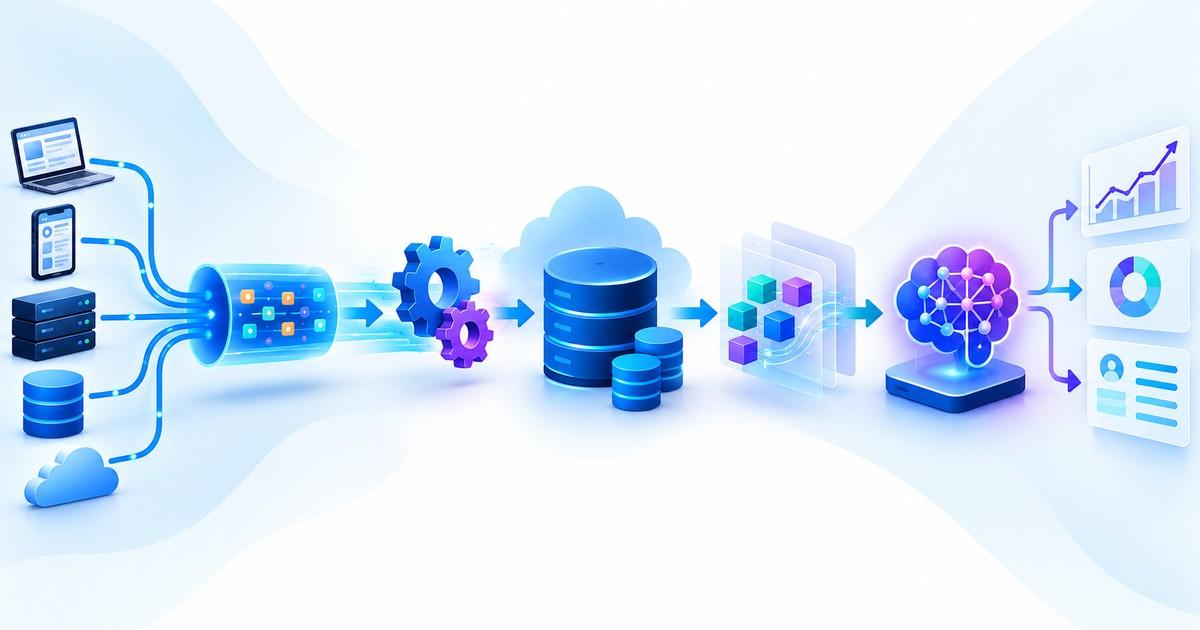
Building model-ready data begins with collecting events and records from the systems that generate information, including application APIs, transactional databases, message queues, user interactions, and infrastructure telemetry. These sources often differ in their schemas, delivery patterns, timestamps, and reliability guarantees, so engineers need an ingestion layer that preserves the meaning of each event while making the data accessible to downstream processing systems. Event streaming platforms can transport continuous changes, while batch ingestion can capture historical records or periodically synchronize information that does not require immediate processing.
Each event should carry enough context to support correct processing, including an event identifier, source information, event timestamp, and relevant entity identifiers where appropriate. These attributes help engineers detect duplicates, reconstruct event order, associate records with the correct entities, and distinguish when something happened from when the pipeline received it. Without this context, delayed messages or repeated deliveries can distort rolling aggregates and historical features, potentially causing the model to learn from inaccurate representations of application behavior.
Schema Validation and Data Cleaning Prevent Silent Failures
After ingestion, raw records need to be validated and normalized before they can be used reliably for feature generation or model training. Engineers should verify required fields, data types, acceptable ranges, timestamp formats, categorical values, and relationships between fields, while identifying missing values, malformed records, duplicates, and inconsistent representations that could affect downstream computations. These checks should run automatically so that unexpected source changes are detected early rather than propagating through the pipeline and silently changing model inputs.
Data cleaning requires explicit rules because different problems need different treatments, and blindly replacing missing values or removing unusual records can distort information that is important for prediction. A missing value may represent an unavailable measurement, an inapplicable field, or a source-system failure, while an extreme value may indicate invalid data or a legitimate rare event. Engineers should therefore preserve relevant quality indicators, apply transformations according to documented requirements, and retain enough information to investigate records that fail validation.
Schema evolution also needs careful handling because existing applications frequently introduce new fields, modify event structures, or change the meaning of previously collected attributes. Versioned schemas, compatibility checks, and data contracts can help pipeline owners coordinate these changes without breaking downstream consumers, following the principles discussed in “The Rise of Data Contracts: Bringing Software Engineering Discipline to ML Data.”
Batch and Streaming Processing Must Handle Imperfect Events
Batch and streaming processing often work together because ML systems need both historical context and timely information from new events. Batch jobs can efficiently calculate large-scale aggregates, build training datasets, and backfill historical features, while streaming processors can update recent activity and maintain state as new events arrive. The combination allows engineers to reuse historical information without forcing every real-time prediction to recalculate expensive features from raw records.
Production event streams rarely arrive in perfect order, however, because network delays, retries, partitions, and temporary outages can cause late or duplicate messages. Pipeline implementations therefore need explicit strategies for deduplication, event-time windows, late-arriving records, replay, and recovery after processing failures. Depending on the use case, the system may revise previously computed aggregates when late data arrives or apply a defined cutoff that balances accuracy with processing latency.
The resulting pipeline should produce features with consistent definitions regardless of whether they were generated during batch training or continuous online processing. By documenting transformation rules, preserving event timestamps, validating outputs, and testing recovery behavior, engineers can transform unreliable raw event streams into model-ready data without allowing ingestion imperfections to become hidden sources of predictive errors.
Key Takeaway
Transforming event streams into model-ready data requires reliable ingestion, schema validation, deliberate data cleaning, well-defined feature engineering, and robust handling of late or duplicate events. Engineers should preserve event context and temporal correctness throughout these stages while coordinating batch and streaming transformations, ensuring that the features delivered to training and inference remain consistent, meaningful, and dependable as upstream applications and data sources evolve.
Section 3: Designing Scalable Pipelines for Training and Real-Time Inference
Separate Training and Inference Workloads Without Duplicating Feature Logic
ML data pipelines typically support two different workloads: training requires large historical datasets for feature generation and model development, while inference needs the relevant features quickly enough to generate predictions within the application's response-time requirements. Batch training can process millions of records through distributed jobs, whereas an online prediction service may have only milliseconds to retrieve features and execute a model, making it impractical to use exactly the same processing strategy for both workloads. Engineers therefore need architectures that accommodate their different execution requirements while preserving consistent feature definitions.
Offline feature pipelines can calculate historical aggregates, join datasets, generate training examples, and store the resulting features in analytical systems, while online pipelines maintain the smaller set of features required for low-latency inference. A recommendation system, for example, may use batch processing to generate long-term user preferences and streaming processing to update recent interactions, allowing training and production inference to access compatible representations without recalculating entire histories during individual requests.
The challenge is preventing these separate execution paths from gradually implementing different interpretations of the same feature. Shared transformation definitions, versioned feature specifications, automated consistency checks, and explicit ownership can reduce this risk, allowing the offline and online paths to differ in their processing infrastructure without changing the meaning of the features consumed by the model.
Choose Storage and Processing Patterns According to Feature Freshness
The architecture for storing and processing ML features should reflect how frequently the underlying information changes and how quickly the model needs to access it. Offline storage systems are well suited to large historical datasets and computationally expensive transformations, while online feature stores or low-latency databases can provide rapid access to features required during inference. Combining these storage patterns allows engineers to keep expensive historical processing outside the critical prediction path while maintaining timely access to information that changes more frequently.
Feature freshness should be defined individually for important signals because not every feature requires the same update frequency. Long-term account characteristics or historical averages may remain useful for relatively long periods, whereas recent transaction counts, inventory status, and live operational measurements may need continuous or frequent updates. Engineers should establish acceptable freshness limits and monitor whether the pipeline meets them, especially when delayed events or processing backlogs can cause online features to diverge from current application state.
Storage design also needs to consider access patterns, data volume, partitioning, and resource limits because a feature system that works well during small-scale development may become expensive or slow under production demand. Partitioning by appropriate entity identifiers or time dimensions can improve retrieval and processing efficiency, while compact feature representations can reduce storage and network overhead. These decisions should be validated against real workloads so that the feature architecture remains scalable without adding unnecessary operational complexity.
Build Resilient Pipelines With Idempotency and Recovery
Distributed data pipelines must tolerate retries, duplicate events, worker failures, and temporary dependency outages because these conditions are common in production environments. Without explicit safeguards, replaying an event can increment an aggregation twice, while restarting a processing job may overwrite recent features with older values or introduce inconsistencies between historical and online datasets. Engineers should therefore design transformations and state updates to be idempotent where possible, ensuring that processing the same event repeatedly does not unintentionally change the intended result.
Reliable recovery also requires preserving enough information to replay events, reconstruct feature values, and investigate processing failures. Checkpoints, event identifiers, processing offsets, versioned outputs, and documented backfill procedures can help teams restore pipeline state after an interruption without silently losing or duplicating important information. The appropriate recovery strategy depends on the processing framework and delivery guarantees, but the pipeline should make its behavior during retries and restarts explicit rather than relying on assumptions about perfect execution.
Orchestration adds another layer because ML pipelines often depend on sequences of ingestion, transformation, validation, feature generation, dataset construction, and model evaluation tasks. Workflow systems can coordinate these dependencies, record execution outcomes, and prevent downstream stages from consuming incomplete outputs, while data-quality gates can stop invalid datasets from progressing into training or serving. These controls connect with “The Reproducibility Crisis in Machine Learning: What Engineering Teams Can Do,” because reproducible pipeline execution and traceable artifacts help engineers explain changes in model behavior and reconstruct the data used by a particular model version.
Key Takeaway
Scalable ML data pipelines separate the processing requirements of historical training from low-latency inference while preserving consistent feature definitions across both paths. By choosing storage and processing patterns according to freshness requirements, building resilient recovery mechanisms, versioning data and transformations, and monitoring feature delivery, engineers can maintain reliable model-ready data as event volumes grow and application requirements evolve.
Section 4: Monitoring, Testing, and Maintaining ML Data Pipelines in Production
Monitor Data Quality and Pipeline Health Continuously
A production ML data pipeline requires continuous monitoring because successful job execution does not guarantee that the resulting data remains suitable for model training or inference. Engineers should track ingestion delays, processing failures, record volumes, missing-value rates, duplicate events, schema violations, feature freshness, and distribution changes to identify problems before they affect downstream predictions. A pipeline can complete successfully while producing incomplete aggregates or incorrectly transformed features, making data-quality indicators essential complements to conventional infrastructure metrics such as CPU utilization, memory consumption, and job duration.
Monitoring should also account for workload-specific expectations because a sudden reduction in event volume might indicate an upstream outage in one application but reflect normal behavior in another. Engineers can establish baselines for expected data arrival rates, processing delays, and feature distributions, then compare current observations against those expectations to identify deviations that warrant investigation. These checks are particularly valuable for streaming systems, where delays, duplicate messages, and out-of-order events can gradually distort feature calculations without necessarily interrupting the pipeline.
Observability should extend across the complete data lifecycle so that engineers can trace a problematic feature back to its source events, transformations, and processing jobs. By connecting ingestion metrics, transformation logs, data lineage, and model versions, teams can distinguish between a genuine change in application behavior and a defect introduced by the data pipeline, reducing the time required to investigate unexpected model performance.
Automate Data Validation and Contract Testing
Automated validation helps prevent corrupted, incomplete, or incompatible data from silently progressing into training and inference, particularly when upstream applications evolve independently from the ML systems that consume their events. Engineers should implement checks for required fields, data types, allowable ranges, categorical values, uniqueness constraints, timestamp consistency, and relationships between features, with validation rules reflecting the actual assumptions made by the model rather than generic definitions of acceptable data. These checks can run during ingestion, after transformations, and before datasets are approved for model training or production feature updates.
Data contracts strengthen this approach by defining explicit agreements between data producers and consumers, including schema compatibility, field semantics, expected update frequency, and ownership of breaking changes. When an application changes an event schema or modifies the meaning of an existing field, automated compatibility checks can identify the potential impact before downstream transformations begin producing incompatible features. The principles discussed in “The Rise of Data Contracts: Bringing Software Engineering Discipline to ML Data” are especially relevant because reliable data interfaces reduce the risk of hidden failures across independently maintained services and pipelines.
Validation policies should distinguish between recoverable data-quality issues and conditions that make continued processing unsafe, because rejecting every imperfect record can discard valuable information while accepting all records can introduce misleading training examples. Engineers can quarantine malformed events, apply documented missing-value treatments, preserve quality indicators, or stop a downstream job when critical assumptions are violated, ensuring that corrective action reflects the consequences of the problem rather than treating every validation failure identically.
Detect Drift, Preserve Reproducibility, and Support Recovery
ML data pipelines must accommodate changing data distributions because user behavior, application functionality, source systems, and operational environments evolve over time. Engineers should compare important feature distributions, category frequencies, missing-value patterns, and statistical summaries against appropriate historical baselines to identify changes that may affect model behavior. However, a distribution shift does not automatically establish that model quality has deteriorated, so pipeline monitoring should help teams investigate meaningful changes and connect them with prediction quality or downstream outcomes where reliable labels are available.
Reproducibility becomes equally important when engineers need to investigate a regression or reconstruct the dataset used by a particular model version. Preserving dataset identifiers, transformation configurations, feature definitions, code versions, event-time rules, and relevant processing metadata allows teams to recreate earlier pipeline outputs and compare them with newer results. This traceability is particularly valuable when retraining produces unexpected changes, because engineers need to determine whether the cause originated in the model, the training data, or an upstream transformation.
Recovery mechanisms should support reliable reprocessing without introducing duplicate events or inconsistent feature values, particularly when pipelines need to backfill historical data after an outage or transformation change. Idempotent operations, checkpoints, versioned outputs, controlled replay, and documented backfill procedures help engineers restore pipeline state while preserving consistency across training datasets and online features, reducing the risk that recovery activity creates a second problem in downstream systems.
Key Takeaway
Reliable ML data pipelines require continuous data-quality monitoring, automated contract validation, drift detection, reproducible processing, and recovery mechanisms that preserve feature consistency under changing production conditions. By integrating these practices into routine software delivery and ML lifecycle management, engineers can maintain trustworthy model-ready data, investigate failures more efficiently, and support evolving applications without allowing hidden data problems to undermine model behavior.
Conclusion
ML data pipelines are a foundational component of production machine-learning systems because the quality of a prediction depends not only on the model but also on how reliably data is collected, transformed, validated, and delivered. For software engineers, building these pipelines requires extending traditional data engineering practices to address feature semantics, temporal correctness, statistical data quality, training-serving consistency, and the changing requirements of production inference.
A reliable pipeline begins with event ingestion that preserves the context needed to process records correctly, including event identifiers, timestamps, schemas, and relevant entity information. Validation and data cleaning protect downstream stages from malformed records, duplicates, missing values, and incompatible schema changes, while feature engineering transforms raw application data into meaningful signals that models can consume. These stages must work together because technically valid records can still produce misleading features when their meaning, timing, or relationships are incorrect.
Architecture becomes especially important when ML systems require both historical training data and fresh production features. Batch processing is effective for large-scale historical transformations and training datasets, while streaming pipelines support continuously updated signals for real-time applications. Combining these approaches allows engineers to balance processing cost, data freshness, and inference latency, provided that feature definitions remain consistent across training and serving environments.
Production reliability also depends on explicit data contracts, automated validation, idempotent processing, versioned transformations, and reproducible recovery procedures. Distributed pipelines must handle duplicate events, late-arriving records, temporary outages, schema evolution, and historical backfills without introducing inconsistent feature values. Monitoring ingestion delays, feature freshness, processing failures, and changes in data distributions helps engineers identify problems before they silently affect model training or prediction quality.
The importance of these practices extends beyond data infrastructure because pipeline failures can appear as model failures when the actual problem originates upstream. A model may experience declining predictive performance because a feature changed meaning, an aggregation became stale, or training and inference began using different transformations. Connecting pipeline observability with model versions, feature definitions, and downstream performance measurements makes these issues easier to investigate and resolve.
Ultimately, effective ML data engineering requires treating data pipelines as versioned, testable, and continuously monitored production systems rather than one-time preparation scripts. By combining reliable event ingestion, deliberate feature engineering, appropriate batch and streaming architectures, consistent training and serving transformations, and disciplined operational controls, engineers can build pipelines that produce trustworthy model-ready data as applications, datasets, and predictive requirements evolve.
Frequently Asked Questions
1. What is an ML data pipeline?
An ML data pipeline is a sequence of processes that collects, validates, transforms, and delivers data for machine-learning training, evaluation, or inference. It can include event ingestion, data cleaning, feature engineering, storage, quality checks, and the mechanisms required to provide consistent model inputs in production.
2. How are ML data pipelines different from traditional data pipelines?
Traditional data pipelines often focus on delivering reliable data for reporting, analytics, or application workflows, whereas ML pipelines must also preserve the statistical and semantic properties that influence model behavior. They need to manage feature definitions, temporal correctness, training-serving consistency, and data-quality changes that can affect predictions without producing conventional processing failures.
3. What is model-ready data?
Model-ready data is data that has been validated, transformed, and represented in the format required by a particular machine-learning task. Depending on the application, it may contain normalized numerical features, encoded categorical variables, historical aggregates, labels, timestamps, or other model inputs produced through documented and reproducible transformations.
4. What role do event streams play in ML data pipelines?
Event streams deliver continuously generated information from applications, transactions, user interactions, and other operational systems. Streaming pipelines process these events as they arrive, enabling the system to maintain recent aggregates and fresh features for workloads such as fraud detection, recommendations, forecasting, and production anomaly detection.
5. What is the difference between batch processing and stream processing?
Batch processing transforms data in scheduled groups and is well suited to historical datasets, large-scale aggregations, training-data preparation, and backfills. Stream processing handles incoming events continuously and is useful when features need frequent updates or predictions depend on recent behavior, with many production architectures combining both approaches.
6. Why is feature engineering important in ML data pipelines?
Feature engineering converts raw records into signals that help a model identify meaningful patterns and relationships. Features such as transaction velocity, rolling averages, interaction counts, historical preferences, and time-based aggregates can improve predictive usefulness, provided their definitions remain consistent with the information available when a prediction is made.
7. How should engineers handle duplicate and late-arriving events?
Engineers should preserve event identifiers and timestamps, use deduplication strategies, and define explicit event-time and processing-time rules. Depending on the use case, the pipeline may revise historical aggregates when late events arrive or apply a documented cutoff, while idempotent processing helps prevent retries and replays from incorrectly counting the same event multiple times.
8. What are data contracts in ML pipelines?
Data contracts define agreements between data producers and consumers concerning schemas, field meanings, data types, update frequency, compatibility, and ownership of changes. They help engineers detect incompatible upstream modifications before those changes propagate into feature transformations, training datasets, or production inference.
9. What is training-serving skew?
Training-serving skew occurs when features or transformations used during production inference differ from those used to prepare model-training data. Differences in encoding, normalization, missing-value handling, aggregation windows, or feature freshness can cause the deployed model to receive inputs with different meanings from those used during development.
10. What is the difference between an offline and an online feature store?
An offline feature store typically supports historical feature access for training, evaluation, and large-scale analysis, while an online feature store provides low-latency feature retrieval for production inference. Using both can support historical reproducibility and real-time prediction, provided their feature definitions remain consistent.
11. How can engineers ensure data quality in ML pipelines?
Engineers can automate schema validation, type checks, allowable-value checks, missing-value monitoring, duplicate detection, freshness checks, statistical distribution monitoring, and feature consistency tests. These validations should run at appropriate pipeline stages so that invalid data can be quarantined, corrected, or prevented from reaching downstream consumers.
12. How should ML data pipelines handle schema evolution?
Schema evolution should be managed through versioned definitions, compatibility checks, documented ownership, and automated tests that evaluate the impact of upstream changes. Compatible additions can often be introduced incrementally, while changes to field meanings or required features may need coordinated updates to downstream transformations and deployed models.
13. Why is idempotency important in data pipelines?
Idempotency helps ensure that processing the same event or operation multiple times does not unintentionally change the intended result. It is particularly useful when distributed pipelines retry failed operations, replay events, recover from outages, or rebuild historical features, because duplicate processing can otherwise distort aggregates and model inputs.
14. How should engineers monitor ML data pipelines in production?
Monitoring should cover ingestion volume, processing latency, event lag, failed jobs, duplicate rates, missing features, schema violations, feature freshness, and changes in data distributions. Connecting these signals with feature versions and downstream model performance helps engineers identify whether a prediction problem originates from the data pipeline or from the model itself.
15. How can engineers build reliable pipelines for real-time ML inference?
Reliable real-time pipelines require efficient event ingestion, lightweight feature retrieval, carefully managed streaming state, validated transformations, and explicit freshness requirements. Engineers should also use bounded processing, idempotent updates, monitoring, recovery procedures, and training-serving consistency tests so that the pipeline can deliver dependable features within the application's latency budget.