Introduction
Artificial intelligence is entering a new phase of evolution. Over the past few years, the industry has focused heavily on building larger foundation models, improving reasoning capabilities, expanding context windows, and developing increasingly capable AI agents. While these advances have transformed what AI systems can accomplish, they have also highlighted an important reality.
A powerful model alone is no longer enough.
Organizations are discovering that the quality of AI outputs depends just as much on the quality of the information provided to the model as it does on the model itself. Even the most advanced Large Language Model can produce inaccurate, incomplete, or inconsistent responses if it lacks the right context.
This realization is driving the emergence of a new engineering discipline: Context Engineering.
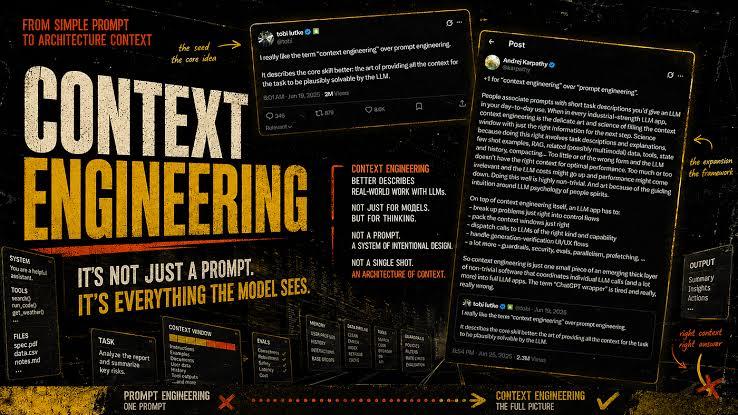
Context Engineering is the practice of designing, managing, and optimizing the information that AI systems receive before generating responses or making decisions. Rather than relying solely on carefully crafted prompts, engineers now focus on building systems that dynamically assemble the most relevant context from multiple sources, including enterprise knowledge bases, user preferences, memory systems, external APIs, retrieval pipelines, structured databases, and real-time business data.
The shift is significant.
In the early days of generative AI, prompt engineering was often considered the primary skill for improving model performance. Engineers experimented with wording, formatting, and instructions to achieve better results.
By 2026, that approach is proving insufficient for production-scale AI systems.
Modern AI applications rarely operate using prompts alone. They rely on Retrieval-Augmented Generation (RAG), long-term memory, vector databases, orchestration frameworks, AI agents, workflow automation, and tool integrations to create rich contextual environments before inference even begins.
In other words, the model is only one component of the system.
Context has become the true differentiator.
This evolution is reshaping the responsibilities of AI engineers.
Instead of focusing exclusively on model training or prompt optimization, engineers are increasingly responsible for designing retrieval architectures, managing knowledge pipelines, optimizing memory systems, integrating external tools, monitoring context quality, and ensuring that AI systems receive accurate, relevant, and timely information.
The implications extend across nearly every AI application.
Enterprise assistants depend on organizational context to answer employee questions accurately. Customer support copilots require access to current documentation and historical interactions. AI coding assistants benefit from understanding existing codebases and project architecture. Autonomous agents need persistent memory and real-time system information to complete complex workflows successfully.
As AI systems become more capable, the quality of context increasingly determines the quality of outcomes.
For machine learning engineers, software engineers, AI architects, and technical leaders, Context Engineering is rapidly becoming one of the most valuable technical skills.
In this article, we'll explore what Context Engineering is, why it matters, how it differs from prompt engineering, and why it is expected to become an essential capability for AI engineers in 2026 and beyond.
Section 1: Why Context Is Becoming More Important Than Prompts
Prompt Engineering Solved an Early AI Problem
When generative AI first became widely available, prompt engineering emerged as one of the most valuable skills in the industry.
Users quickly discovered that carefully structured prompts could significantly improve model performance. Clear instructions, examples, role assignments, formatting guidance, and step-by-step reasoning often produced better responses than simple questions.
This led to widespread experimentation.
Organizations created prompt libraries.
Engineers optimized prompt templates.
Businesses invested in prompt design as a competitive advantage.
For many early AI applications, this approach was highly effective.
However, as AI systems became more sophisticated and organizations began deploying them into production environments, the limitations of prompt engineering became increasingly apparent.
No prompt, regardless of how well written, can provide information the model simply does not possess.
If an enterprise assistant lacks access to current company policies, no amount of prompt optimization can compensate.
If a customer support agent cannot retrieve updated documentation, carefully crafted instructions will not solve the problem.
The challenge shifted.
Instead of asking how to write better prompts, organizations began asking how to provide better context.
Context Determines Response Quality
Modern AI systems rarely operate using isolated prompts.
Instead, they receive carefully assembled contextual information before generating responses.
This context may include previous conversations, retrieved documents, user preferences, organizational policies, project histories, database records, API responses, workflow state, and real-time business information.
The model processes this information alongside the user's request.
The quality of the response therefore depends heavily on the quality of the surrounding context.
Accurate context produces accurate answers.
Incomplete context produces incomplete answers.
Outdated context produces outdated recommendations.
Irrelevant context introduces confusion.
This relationship has become one of the defining principles of production AI.
Organizations increasingly recognize that improving context often produces greater performance gains than replacing models with larger or more expensive alternatives.
As a result, engineering effort is shifting toward building better information pipelines rather than simply deploying larger foundation models.
Modern AI Applications Depend on Context Assembly
One of the biggest differences between consumer chatbots and enterprise AI systems is how context is constructed.
Enterprise applications rarely rely on a single source of information.
Instead, they dynamically assemble context from multiple systems before inference begins.
An enterprise assistant may retrieve company documentation from a vector database, access user preferences from memory storage, query internal APIs for current business data, examine project histories, and incorporate recent conversations into a single contextual package.
Only after this information is assembled does the language model generate a response.
This architectural pattern has become increasingly common because it enables AI systems to operate using current, organization-specific knowledge rather than relying exclusively on static model training.
The growing importance of context assembly is discussed in "The New Architecture Patterns Powering Modern AI Applications," which explains how retrieval systems, orchestration layers, memory architectures, and intelligent workflows are becoming foundational components of production AI systems.
As AI adoption accelerates, assembling high-quality context is becoming one of the most important engineering responsibilities.
Context Engineering Is Becoming a Core AI Discipline
The shift from prompt engineering to context engineering represents a broader change in AI development.
Engineers are no longer optimizing only interactions with models.
They are designing complete information ecosystems.
This involves determining what information should be retrieved, how memories should be managed, when external tools should be invoked, how workflows should be orchestrated, and how context quality should be monitored continuously.
These responsibilities extend far beyond prompt design.
They require expertise in distributed systems, retrieval architectures, vector databases, semantic search, memory management, knowledge engineering, AI observability, and production infrastructure.
As AI applications continue becoming more complex, context engineering is evolving into a distinct discipline within modern AI system design.
Key Takeaway
Context Engineering is emerging as one of the most important skills for AI engineers because modern AI systems depend far more on high-quality contextual information than carefully written prompts alone. By designing retrieval pipelines, memory systems, orchestration frameworks, and dynamic knowledge architectures, engineers enable AI applications to deliver accurate, relevant, and production-ready results. In 2026, understanding how to engineer context will be just as important as understanding how to build models.
Section 2: The Core Components of Context Engineering
Retrieval Systems Form the Foundation of Modern Context
At the heart of every modern AI application is a simple challenge:
How do you ensure the model receives the right information before generating a response?
This is precisely where retrieval systems become essential.
Unlike traditional language models that rely entirely on knowledge acquired during training, modern AI applications retrieve relevant information dynamically from external sources at inference time. These sources may include enterprise documentation, knowledge bases, customer records, APIs, structured databases, internal wikis, project repositories, or business applications.
When a user submits a request, the system does not immediately send it to the language model.
Instead, the request passes through a retrieval layer that searches multiple knowledge sources for information most relevant to the user's query. Only after assembling this information does the model begin generating a response.
This architectural approach dramatically improves response quality.
For example, an AI assistant helping a software engineer can retrieve the latest API documentation, deployment guides, coding standards, and architecture diagrams before answering implementation questions. A customer support assistant can access product documentation, warranty policies, and previous support cases to provide more accurate recommendations.
Without retrieval, the model depends primarily on pre-trained knowledge that may be outdated or incomplete.
With retrieval, responses become significantly more accurate, current, and organization-specific.
As AI applications expand across enterprises, retrieval engineering has become one of the most critical aspects of context engineering.
The objective is no longer simply retrieving information.
It is retrieving the right information quickly, consistently, and with minimal noise.
Memory Systems Extend Context Beyond Individual Conversations
While retrieval provides access to external knowledge, memory enables AI systems to remember information across interactions.
This distinction is important.
Retrieval answers the question, "What information exists?"
Memory answers the question, "What information about this user, project, or workflow should the AI remember?"
Modern AI applications increasingly combine both capabilities.
Memory systems retain persistent information such as user preferences, project histories, communication styles, organizational terminology, previous decisions, and ongoing objectives.
When users return to the application, the AI retrieves these memories alongside external knowledge, allowing responses to remain consistent across weeks or even months.
This dramatically changes the user experience.
Instead of repeatedly explaining ongoing projects, preferred formats, or recurring business requirements, users interact with systems that already understand their working context.
Memory also improves collaboration.
AI assistants can continue long-running initiatives, AI agents can track completed tasks, and enterprise copilots can maintain awareness of evolving business priorities without requiring constant reconfiguration.
As organizations adopt increasingly sophisticated AI workflows, memory has become an essential component of context engineering rather than a separate capability.
Orchestration Determines How Context Is Constructed
One of the most overlooked aspects of context engineering is orchestration.
Modern AI systems rarely obtain context from a single location.
Instead, they gather information from multiple systems simultaneously.
An enterprise assistant may retrieve documents from a vector database, user preferences from memory storage, customer records from a CRM, financial data from internal APIs, workflow status from project management platforms, and security permissions from identity management systems.
Simply retrieving this information is not enough.
The system must determine which information is relevant, eliminate redundant content, prioritize conflicting sources, and organize everything into a coherent context before inference begins.
This process is known as orchestration.
Orchestration acts as the decision-making layer responsible for assembling the final contextual package that reaches the language model.
Well-designed orchestration significantly improves response quality because it reduces irrelevant information while ensuring that the model receives the knowledge necessary for the current task.
The growing importance of orchestration in production AI is explored in "How Companies Build AI Systems That Adapt to Changing User Behavior," which explains how dynamic workflows, retrieval pipelines, memory systems, and adaptive architectures work together to keep enterprise AI applications responsive, personalized, and context-aware.
As AI ecosystems become more interconnected, orchestration is becoming one of the defining skills of modern context engineering.
Context Quality Matters More Than Context Quantity
One of the biggest misconceptions about context engineering is that providing more information automatically improves AI performance.
In practice, excessive context often creates new problems.
Large volumes of irrelevant documentation can distract the model from the user's actual request. Outdated information can introduce inconsistencies. Duplicate documents can reinforce incorrect conclusions. Conflicting sources may reduce response reliability.
Effective context engineering therefore focuses on quality rather than quantity.
Engineers design systems that rank information according to relevance, freshness, credibility, and business importance. They filter redundant content, prioritize authoritative sources, and ensure that only the most valuable information reaches the model.
This approach produces several benefits.
Inference becomes faster because the model processes less unnecessary information. Responses become more accurate because noise is reduced. Infrastructure costs decrease because fewer tokens are consumed. User trust improves because answers remain focused and consistent.
As context windows continue expanding, the temptation to include everything will increase.
The most successful AI engineers, however, will understand that better context does not mean more context.
It means more relevant context.
Key Takeaway
Context engineering is built on four interconnected components: retrieval systems, memory architectures, orchestration frameworks, and context optimization. Together, these capabilities ensure that AI models receive accurate, relevant, and timely information before generating responses. As enterprise AI applications become increasingly sophisticated, engineers who can design high-quality context pipelines will play a critical role in improving accuracy, reducing costs, and creating AI systems that consistently deliver reliable business outcomes.
Section 3: Why Context Engineering Is Becoming the Most Valuable AI Engineering Skill
Context Engineering Is Replacing Prompt Engineering as a Core Competency
For much of the early generative AI era, prompt engineering was considered one of the most valuable technical skills. Engineers experimented with prompt templates, few-shot examples, role assignments, chain-of-thought instructions, and carefully structured formatting to improve model outputs.
These techniques produced meaningful improvements, particularly when working directly with foundation models.
However, production AI systems have evolved far beyond static prompts.
Today's enterprise AI applications rarely depend on a single prompt. Instead, every request passes through multiple stages before reaching the model. Relevant documents are retrieved, user memories are loaded, APIs are queried, workflows are evaluated, permissions are verified, and business rules are applied.
By the time inference begins, the original user prompt often represents only a small portion of the information available to the model.
This shift fundamentally changes the engineer's role.
Rather than asking, "How should I phrase this prompt?", engineers increasingly ask, "What information does the model need to solve this problem accurately?"
That question defines context engineering.
Success now depends on constructing an intelligent environment around the model rather than optimizing the prompt alone.
As organizations deploy AI across mission-critical workflows, the ability to design high-quality contextual systems is becoming a far more valuable capability than prompt optimization in isolation.
Context Engineering Requires Cross-Disciplinary Technical Skills
Unlike prompt engineering, which focuses primarily on interactions with language models, context engineering spans multiple areas of software and machine learning engineering.
Building an effective context pipeline requires understanding how information flows through an AI system from the moment a user submits a request until the final response is generated.
Engineers work with vector databases to perform semantic search, retrieval systems to access enterprise knowledge, memory architectures to maintain persistent context, orchestration frameworks to coordinate multiple services, APIs to gather real-time information, and observability platforms to monitor system performance.
Each component influences the quality of the final output.
A retrieval system that surfaces irrelevant documents weakens response quality. Poor memory management introduces outdated context. Inefficient orchestration increases latency. Inconsistent data pipelines reduce model reliability.
As a result, context engineering requires expertise across several technical domains rather than specialization in a single technology.
This interdisciplinary nature makes it one of the most comprehensive engineering skills emerging within modern AI development.
Organizations increasingly seek engineers capable of designing entire AI ecosystems rather than focusing exclusively on model development.
Context Engineering Improves Both Performance and Cost Efficiency
One of the biggest advantages of well-designed context engineering is that it improves multiple aspects of AI performance simultaneously.
Organizations often assume that improving AI requires deploying larger or more expensive models.
In practice, providing better context frequently produces greater improvements while requiring significantly fewer computational resources.
When models receive relevant, accurate, and well-structured information, they generate better responses with fewer unnecessary reasoning steps. Retrieval becomes more efficient, hallucinations decrease, and user satisfaction improves.
Context quality also affects infrastructure efficiency.
Supplying only the most relevant information reduces token consumption, shortens inference time, and lowers operational costs. Large context windows may appear attractive, but filling them with unnecessary information increases latency and computational expense without improving response quality.
The importance of optimizing information flow throughout production AI systems is explored in "The Cost Crisis in AI: Why Efficiency Is the Next Competitive Advantage," which explains how intelligent system design, efficient retrieval, optimized inference, and resource-aware architectures help organizations improve AI performance while controlling infrastructure costs.
As AI adoption accelerates, context engineering is becoming one of the most effective ways to improve both technical performance and business efficiency.
Context Engineering Will Define the Next Generation of AI Careers
The rapid evolution of AI applications is reshaping the skills employers expect from engineers.
A few years ago, organizations primarily hired machine learning engineers to build, train, and deploy predictive models.
Today, production AI systems are significantly more complex.
Engineers must understand retrieval architectures, semantic search, long-term memory, orchestration frameworks, AI agents, vector databases, observability, governance, distributed systems, and scalable infrastructure.
Context engineering sits at the center of these capabilities.
It connects models with enterprise knowledge.
It integrates AI into business workflows.
It enables intelligent agents to reason using current information.
It ensures AI systems remain personalized, adaptable, and reliable as environments evolve.
As enterprises increasingly adopt AI copilots, autonomous agents, and organization-wide knowledge assistants, engineers capable of designing robust context architectures will become indispensable.
Rather than replacing traditional machine learning expertise, context engineering expands it.
Future AI engineers will not simply build models.
They will build intelligent systems capable of understanding users, adapting to changing environments, and making informed decisions using dynamically assembled context.
Key Takeaway
Context engineering is rapidly becoming one of the defining skills of modern AI engineering because it combines retrieval, memory, orchestration, knowledge management, and production infrastructure into a unified discipline. Organizations are increasingly recognizing that better context often delivers greater improvements than larger models alone. As enterprise AI continues to evolve, engineers who can design intelligent context pipelines will be among the most valuable professionals shaping the future of AI applications.
Section 4: The Future of Context Engineering: Building AI Systems That Think With the Right Information
Context Will Become the Primary Competitive Advantage
Over the past several years, the AI industry has been defined by increasingly capable foundation models.
Organizations competed by adopting larger models, improving reasoning capabilities, and expanding multimodal functionality. While model innovation will continue, the industry is reaching a point where access to powerful models is becoming increasingly widespread.
This changes the nature of competition.
If multiple organizations can access similarly capable models, differentiation shifts elsewhere.
Context becomes the differentiator.
The companies that consistently deliver better AI experiences will not necessarily have exclusive access to superior models. Instead, they will excel at providing those models with accurate, timely, relevant, and organization-specific information.
An enterprise assistant equipped with current business knowledge will often outperform a larger model operating with outdated or incomplete context. A customer support system that understands historical interactions and product documentation will consistently deliver more useful responses than a system relying solely on pretrained knowledge.
This trend is reshaping AI product development.
Organizations are investing less effort in searching for marginally better models and more effort in designing intelligent information architectures that maximize the value of the models they already use.
In the coming years, context quality is likely to become one of the most important measures of AI product maturity.
AI Agents Will Depend on Sophisticated Context Management
The rapid rise of AI agents is making context engineering even more important.
Unlike traditional conversational assistants that answer individual questions, AI agents execute workflows, coordinate software systems, perform research, manage projects, and pursue long-term objectives.
These responsibilities require much more than language generation.
Agents must understand current system state, remember previous actions, retrieve relevant knowledge, evaluate changing priorities, and make decisions based on continuously evolving information.
This creates a significant engineering challenge.
An autonomous procurement agent may need access to purchasing policies, supplier contracts, inventory levels, historical pricing, budget constraints, and organizational approval processes before making recommendations.
A customer success agent may require knowledge of previous conversations, product usage patterns, open support cases, renewal timelines, and account history before responding to a client.
Without well-designed context management, these agents quickly lose effectiveness.
They repeat work, overlook critical information, make inconsistent decisions, and require unnecessary human intervention.
Future AI agents will therefore depend on context engineering as a foundational capability.
Rather than simply retrieving information, they will continuously construct, update, evaluate, and refine contextual knowledge throughout every stage of a workflow.
Governance and Observability Will Become Essential Components of Context Engineering
As AI systems gain access to increasing amounts of organizational knowledge, context engineering must address more than technical performance.
It must also address governance.
Organizations need confidence that AI systems retrieve appropriate information, respect access permissions, protect sensitive data, and provide responses that align with business policies.
This requires strong governance mechanisms integrated directly into context pipelines.
Engineers must ensure that retrieval systems honor user permissions, memory systems manage information responsibly, orchestration frameworks prioritize trusted sources, and monitoring platforms detect context-related issues before they affect users.
Observability also plays a critical role.
Teams need visibility into how context is assembled, which knowledge sources were used, what information influenced responses, and where retrieval failures occurred. This transparency allows organizations to diagnose problems quickly and continuously improve context quality.
The growing importance of governance and observability in production AI is explored in "Building AI Products That Users Trust: Engineering for Transparency and Control," which explains how transparency, governance, observability, and user control are becoming essential architectural principles for enterprise AI systems.
As AI applications become more deeply integrated into business operations, context engineering will increasingly include governance, monitoring, security, and compliance alongside retrieval and memory.
Context Engineers Will Shape the Next Generation of AI Innovation
The evolution of AI is creating an entirely new category of engineering expertise.
In the past, organizations primarily distinguished between software engineers, data engineers, and machine learning engineers.
The future will increasingly include specialists whose primary responsibility is designing intelligent context systems.
These engineers will build retrieval architectures, optimize semantic search, design memory frameworks, orchestrate multi-agent workflows, integrate enterprise knowledge sources, monitor context quality, and ensure AI systems always have the information required to make reliable decisions.
Their work will influence nearly every aspect of AI performance.
Better context improves accuracy.
Better context reduces hallucinations.
Better context lowers inference costs.
Better context increases user trust.
Better context enables autonomous agents to operate more effectively.
As enterprises continue integrating AI into mission-critical operations, context engineering will become one of the most strategically important disciplines in artificial intelligence.
The next generation of AI breakthroughs may not come solely from larger models.
They will come from building systems that consistently provide those models with the right knowledge at the right time.
Key Takeaway
The future of AI will be defined not only by increasingly capable models but by increasingly intelligent context systems. As AI agents become more autonomous and enterprise applications become more complex, context engineering will expand to include retrieval, memory, governance, observability, orchestration, and security. Engineers who master these capabilities will play a central role in building AI systems that are accurate, reliable, scalable, and trusted. In 2026 and beyond, context engineering is poised to become one of the most valuable skills in the entire AI engineering landscape.
Conclusion
Artificial intelligence is entering a new era where success is determined not only by the intelligence of the model but by the quality of the information surrounding it. As organizations move beyond experimental AI projects toward production-grade applications, Context Engineering is emerging as one of the most important disciplines in modern AI development.
The early years of generative AI demonstrated the value of prompt engineering. Carefully designed prompts helped users unlock better performance from Large Language Models and made AI more accessible to developers and businesses alike. However, enterprise AI systems have evolved far beyond simple prompt-response interactions.
Today's AI applications operate within complex ecosystems that include retrieval pipelines, vector databases, memory architectures, orchestration frameworks, external APIs, enterprise knowledge bases, AI agents, and real-time business data. Before a model generates a single token, an entire context pipeline may already have assembled the information required to produce an accurate and relevant response.
This shift fundamentally changes the role of AI engineers.
Rather than focusing exclusively on model optimization or prompt design, engineers are increasingly responsible for ensuring that AI systems receive the right information at the right time. They must design retrieval strategies, manage long-term memory, coordinate multiple data sources, optimize semantic search, monitor context quality, and continuously improve how information flows through intelligent systems.
Context Engineering is therefore becoming a bridge between machine learning and software engineering.
It combines distributed systems, knowledge management, retrieval infrastructure, AI architecture, observability, governance, and production engineering into a single discipline focused on maximizing the effectiveness of AI applications.
Its impact extends far beyond technical performance.
High-quality context reduces hallucinations, improves factual accuracy, lowers inference costs, enhances personalization, enables autonomous agents, and builds greater user trust. Organizations that master context engineering will be able to deploy AI systems that are more reliable, scalable, and aligned with real-world business needs than competitors relying solely on larger foundation models.
The rise of AI agents makes this discipline even more significant.
Agents cannot operate effectively without context. They must understand previous actions, retrieve relevant information, adapt to changing environments, and coordinate complex workflows over extended periods. Context engineering provides the infrastructure that makes these capabilities possible.
Looking ahead, context will become one of the primary differentiators in AI products.
Foundation models will continue improving, but access to advanced models is becoming increasingly democratized. Competitive advantage will increasingly come from how intelligently organizations organize, retrieve, personalize, govern, and deliver contextual information to those models.
For machine learning engineers, AI architects, software engineers, and technical leaders, Context Engineering represents one of the most valuable skills to develop in 2026 and beyond. The future of AI will not belong solely to those who build better models—it will belong to those who build better systems around those models.
Ultimately, AI is only as effective as the context it receives. As intelligent applications become deeply integrated into business operations and everyday life, Context Engineering will become one of the defining disciplines shaping the next generation of artificial intelligence.
Frequently Asked Questions
1. What is Context Engineering?
Context Engineering is the practice of designing, managing, and optimizing the information that AI systems receive before generating responses. It includes retrieval systems, memory architectures, orchestration frameworks, external data integration, and knowledge management.
2. How is Context Engineering different from Prompt Engineering?
Prompt Engineering focuses on writing effective instructions for language models. Context Engineering focuses on ensuring the model receives the most relevant information from multiple sources before inference begins.
3. Why is Context Engineering becoming important in 2026?
Modern AI applications depend on enterprise knowledge, memory systems, retrieval pipelines, and AI agents. Context quality now has a greater impact on AI performance than prompt wording alone.
4. What technologies are commonly used in Context Engineering?
Common technologies include vector databases, Retrieval-Augmented Generation (RAG), embeddings, semantic search, long-term memory systems, orchestration frameworks, APIs, knowledge graphs, and observability platforms.
5. What is Retrieval-Augmented Generation (RAG)?
RAG is an AI architecture that retrieves relevant information from external knowledge sources before passing it to a language model, enabling more accurate and up-to-date responses.
6. Why are vector databases important for Context Engineering?
Vector databases store semantic embeddings that allow AI systems to retrieve information based on meaning rather than exact keyword matching, improving relevance and accuracy.
7. What role does long-term memory play in Context Engineering?
Long-term memory allows AI systems to remember user preferences, project history, previous interactions, and organizational knowledge across multiple sessions, creating more personalized and consistent experiences.
8. What is orchestration in AI systems?
Orchestration coordinates multiple components such as retrieval systems, memory layers, APIs, databases, and AI models to assemble the best possible context before inference.
9. How does Context Engineering improve AI accuracy?
By providing current, relevant, and task-specific information, Context Engineering reduces hallucinations, improves factual correctness, and enables models to generate more reliable responses.
10. Why is Context Engineering important for AI agents?
AI agents perform multi-step tasks over extended periods. They require persistent context, memory, workflow awareness, and real-time information to make effective decisions and complete complex objectives.
11. Does better context reduce AI infrastructure costs?
Yes. Well-designed context pipelines reduce unnecessary token usage, minimize redundant retrieval, improve inference efficiency, and allow smaller models to perform more effectively in many production scenarios.
12. What skills should engineers learn for Context Engineering?
Engineers should develop expertise in Retrieval-Augmented Generation (RAG), vector databases, semantic search, embeddings, distributed systems, APIs, knowledge management, AI orchestration, memory architectures, MLOps, and observability.
13. How does Context Engineering improve enterprise AI applications?
Enterprise AI systems use Context Engineering to combine company documentation, business data, user permissions, workflow information, and historical interactions, allowing AI to generate responses that are accurate, personalized, and aligned with organizational knowledge.
14. Will Context Engineering replace Machine Learning Engineering?
No. Context Engineering complements Machine Learning Engineering. While ML engineers continue building and optimizing models, Context Engineering focuses on designing the surrounding infrastructure that enables those models to perform effectively in real-world production environments.
15. What is the biggest takeaway about Context Engineering?
The biggest takeaway is that the future of AI depends not only on smarter models but also on smarter information systems. Organizations that can retrieve, organize, personalize, and deliver the right context at the right time will build AI applications that are more accurate, scalable, trustworthy, and valuable than those relying on model capability alone.