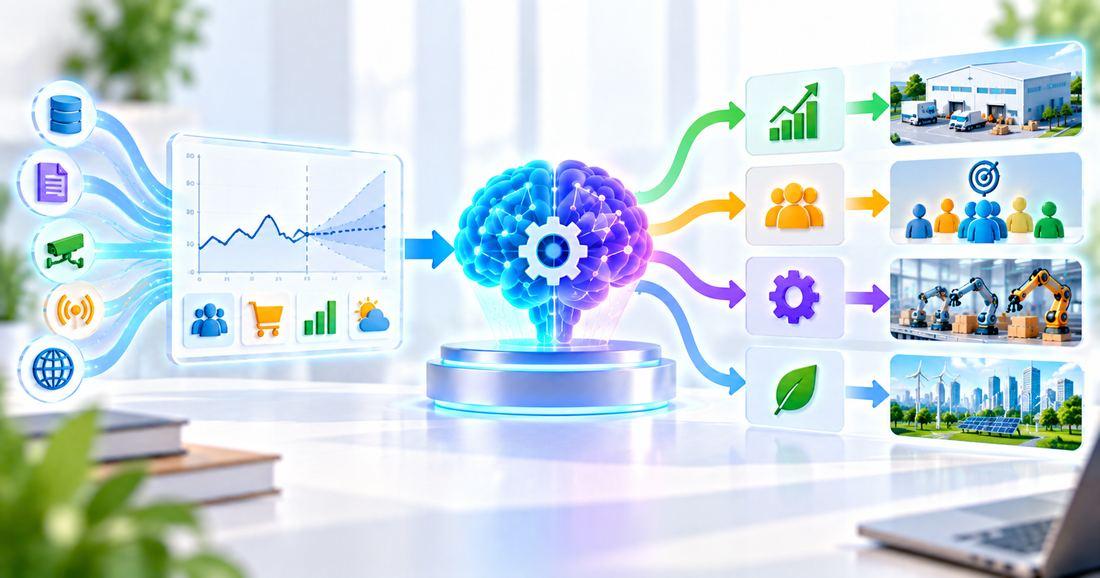
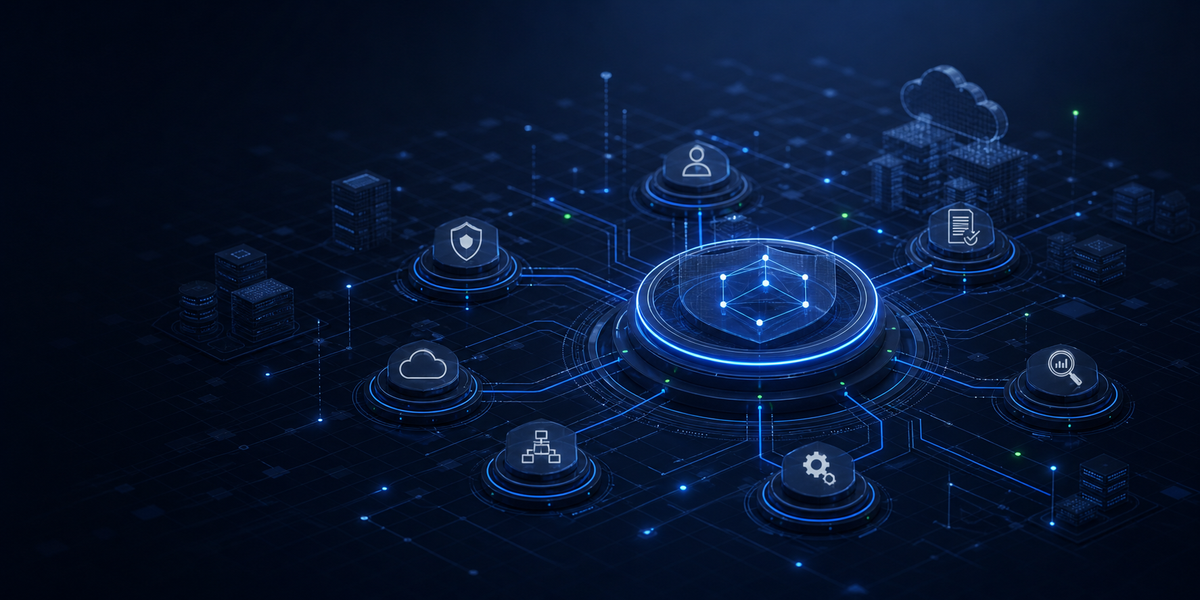
Section 1: Why Enterprise AI Needs a Control Plane
Artificial intelligence has rapidly evolved from isolated proof-of-concept projects into a foundational layer of enterprise software. Just a few years ago, most organizations integrated a single Large Language Model (LLM) into a chatbot or customer support application, treating AI as another API within an existing software architecture. Today, however, enterprises operate significantly more complex AI ecosystems consisting of multiple foundation models, Retrieval-Augmented Generation (RAG) pipelines, AI copilots, autonomous agents, enterprise search platforms, recommendation engines, intelligent workflow automation, and domain-specific AI services. Every new AI capability introduces additional infrastructure, governance requirements, operational dependencies, and security considerations. As AI adoption accelerates across engineering, customer service, finance, healthcare, legal, marketing, and operations, organizations are discovering that managing artificial intelligence has become as important as building AI applications themselves.
This rapid expansion has created a new operational challenge. Engineering teams must determine which AI model should process each request, manage prompt libraries, monitor inference performance, enforce security policies, optimize operational costs, protect enterprise data, ensure regulatory compliance, and coordinate AI deployments across dozens or even hundreds of applications. Without centralized management, AI ecosystems quickly become fragmented. Individual teams often choose different models, duplicate infrastructure, implement inconsistent governance practices, and create disconnected monitoring systems that increase complexity while reducing operational efficiency. Scaling AI therefore requires a new architectural layer capable of coordinating every component of enterprise AI from a single operational platform.
The AI Control Plane addresses this challenge by serving as the centralized intelligence management layer for enterprise AI systems. Rather than allowing each application to independently manage models, prompts, routing decisions, security controls, and monitoring, the control plane provides unified governance, orchestration, observability, policy enforcement, and infrastructure management across the organization. Similar to how Kubernetes became the operational foundation for containerized applications, AI Control Planes are emerging as the operational foundation that enables enterprises to deploy, govern, monitor, and optimize artificial intelligence consistently at scale.
From Individual AI Models to Enterprise AI Ecosystems
The first generation of enterprise AI applications was relatively straightforward. Organizations selected a single language model, integrated it into one application, and managed its configuration independently. Customer support chatbots, document summarization tools, internal knowledge assistants, and content generation platforms typically operated as isolated AI services with limited operational dependencies.
Today's enterprise AI environments are fundamentally different. Organizations increasingly deploy multiple Large Language Models because no single model performs optimally across every workload. Some models excel at software development, others perform better for reasoning, multilingual communication, image understanding, financial analysis, or enterprise search. Engineering teams therefore combine multiple foundation models according to business requirements rather than relying on one universal AI system.
The rapid emergence of AI agents further increases architectural complexity. Autonomous agents retrieve enterprise knowledge, coordinate workflows, interact with APIs, automate business processes, monitor infrastructure, and collaborate with other agents to accomplish sophisticated objectives. Each agent introduces additional routing logic, permissions, orchestration requirements, monitoring, and governance responsibilities that must be managed consistently across the organization.
What Is an AI Control Plane?
An AI Control Plane provides the centralized operational layer responsible for managing every aspect of enterprise AI infrastructure. Instead of embedding governance, routing, monitoring, and policy enforcement directly within individual applications, organizations centralize these responsibilities into a unified platform that serves every AI-enabled workload across the enterprise.
At its core, the control plane enables centralized AI management. Engineering teams register language models, retrieval services, prompt libraries, AI agents, vector databases, orchestration workflows, and deployment environments within a common management platform. Applications consume AI capabilities through standardized interfaces rather than implementing custom integrations independently.
The control plane also provides unified policy enforcement. Security rules, access permissions, data governance policies, Responsible AI standards, model usage guidelines, prompt validation, audit requirements, and compliance controls are defined once and applied consistently across every AI application. This dramatically reduces operational risk while simplifying enterprise AI governance.
Another essential capability is operational visibility. Rather than monitoring each AI application separately, organizations gain centralized insight into model utilization, inference latency, retrieval quality, prompt effectiveness, infrastructure health, operational costs, user activity, and AI performance. Engineering leaders therefore obtain comprehensive visibility across the entire AI ecosystem rather than isolated application metrics.
Perhaps most importantly, AI Control Planes enable enterprise coordination. Multiple engineering teams share AI infrastructure, governance frameworks, prompt repositories, retrieval services, monitoring platforms, and deployment pipelines without duplicating operational effort. The control plane transforms disconnected AI projects into a coordinated enterprise platform capable of supporting long-term organizational growth.
Why AI Infrastructure Is Becoming Platform-Driven
The emergence of AI Control Planes reflects a broader trend toward platform engineering. Rather than asking every engineering team to manage infrastructure independently, organizations increasingly build centralized internal platforms that provide reusable services, standardized workflows, governance frameworks, and operational tooling. Platform engineering has already transformed cloud infrastructure, Kubernetes operations, developer platforms, and internal tooling. AI infrastructure is now following the same evolution.
Many enterprises therefore invest in internal AI platforms that provide standardized access to foundation models, Retrieval-Augmented Generation services, vector databases, AI gateways, observability systems, prompt repositories, and orchestration frameworks. These shared platforms simplify AI adoption because product teams focus on solving business problems rather than repeatedly implementing infrastructure.
These reusable shared services improve engineering efficiency while reducing operational complexity. Authentication, authorization, logging, model routing, inference optimization, monitoring, prompt management, security policies, and deployment pipelines become common enterprise capabilities rather than application-specific implementations. Engineering organizations therefore scale AI more rapidly because infrastructure responsibilities remain centralized.
Ultimately, platform-driven AI architecture enables true enterprise scalability. Organizations can deploy hundreds of AI-powered applications while maintaining consistent governance, operational excellence, security, and cost efficiency because every application relies upon the same centralized control plane rather than independently managing AI infrastructure. As AI adoption continues accelerating, this platform approach becomes essential for supporting sustainable enterprise growth.
The rise of AI Control Planes demonstrates that enterprise AI has entered a new stage of maturity. Organizations are no longer solving isolated AI problems; they are building operational platforms capable of governing thousands of intelligent interactions across products, engineering teams, business functions, and enterprise workflows. Just as cloud computing required orchestration platforms to manage distributed infrastructure, enterprise AI increasingly requires centralized control systems to manage intelligence itself.
Readers interested in understanding why AI platform engineering is becoming a fundamental discipline for modern software organizations should also explore "Why Every Software Team Will Have an AI Engineer by 2030," which examines how enterprise engineering teams are evolving as AI becomes a core organizational capability.
Key Takeaway
Enterprise AI requires a centralized control plane because isolated model integrations cannot support the scale, governance, security, and operational consistency demanded by modern organizations. AI ecosystems built around multiple language models, AI agents, enterprise platforms, and intelligent workflows introduce challenges such as model sprawl, prompt sprawl, fragmented infrastructure, and inconsistent governance. AI Control Planes solve these challenges by providing centralized management, unified policy enforcement, operational visibility, enterprise coordination, and platform-driven AI infrastructure that enables organizations to deploy and manage artificial intelligence reliably at enterprise scale.
Section 2: Core Components of an AI Control Plane
As enterprise AI ecosystems continue expanding, organizations are discovering that deploying powerful language models is only one small part of operating artificial intelligence at scale. The real challenge begins after AI enters production. Multiple engineering teams start integrating different foundation models, Retrieval-Augmented Generation (RAG) pipelines, AI agents, enterprise search platforms, customer-facing copilots, and workflow automation systems. Each application introduces new prompts, inference pipelines, security requirements, governance policies, monitoring dashboards, and operational dependencies. Without centralized coordination, AI infrastructure quickly becomes fragmented, making it difficult to maintain consistency, optimize costs, enforce compliance, or troubleshoot production issues.
The AI Control Plane addresses this complexity by functioning as the centralized operating layer responsible for managing every aspect of enterprise AI. Rather than allowing individual applications to independently manage language models, prompts, routing logic, identity management, and monitoring, the control plane provides shared services that coordinate these responsibilities across the organization. It transforms artificial intelligence from a collection of disconnected deployments into a unified enterprise platform where governance, observability, security, and operational intelligence become standardized capabilities available to every engineering team.
Building an effective AI Control Plane requires several tightly integrated components. Model management ensures applications always use the most appropriate AI model for a given task. Prompt management enables organizations to treat prompts as governed software assets. Security and governance protect sensitive enterprise information while enforcing organizational policies. Finally, observability provides the operational intelligence necessary to monitor, optimize, and continuously improve AI performance across thousands of production interactions. Together, these components establish the operational foundation required for enterprise-scale AI adoption.
Model Management and Intelligent Routing
One of the primary responsibilities of an AI Control Plane is managing an increasingly diverse ecosystem of foundation models. Most enterprises now rely on multi-model orchestration rather than a single language model because different models excel at different workloads. One model may provide superior reasoning, another may specialize in software development, while others perform better for multilingual communication, image understanding, summarization, or domain-specific analysis. Rather than forcing every application to select models independently, the control plane coordinates model usage across the organization.
This begins with model selection. When an AI request enters the platform, the control plane evaluates the characteristics of the request before determining which model is best suited for execution. Customer support conversations may prioritize conversational models with lower inference costs, software engineering assistants may require coding-optimized models, while executive analytics may utilize advanced reasoning models capable of synthesizing large volumes of enterprise information. Centralized model selection improves response quality while ensuring consistent behavior across applications.
As AI adoption grows, organizations must also manage computational resources efficiently through load balancing. Thousands of concurrent AI requests may arrive simultaneously from customer-facing applications, internal developer tools, enterprise search platforms, and autonomous agents. The control plane distributes these workloads intelligently across available inference infrastructure, preventing bottlenecks while maintaining low response latency and high availability.
Equally important is cost optimization. Running advanced foundation models can become expensive when every request automatically uses the largest available model. AI Control Planes analyze request complexity and dynamically select the most cost-effective model capable of satisfying user requirements. Routine summarization tasks may execute using smaller models, while complex reasoning problems utilize larger architectures only when necessary. This intelligent routing significantly reduces enterprise AI costs without compromising user experience.
Observability and Operational Intelligence
Operating enterprise AI successfully requires continuous visibility into system behavior. Traditional infrastructure monitoring alone cannot explain why AI responses deteriorate, retrieval quality declines, costs increase, or user satisfaction changes. Consequently, AI observability has become a core component of every modern AI Control Plane.
Observability begins with comprehensive AI monitoring. Engineering teams track inference latency, model utilization, retrieval performance, prompt execution, API response times, infrastructure health, and AI agent activity across every production workload. These metrics provide operational awareness while enabling rapid diagnosis of system failures.
Organizations also collect extensive usage analytics describing how AI applications are actually used. Analytics reveal which models receive the highest demand, which prompts generate superior outcomes, which departments adopt AI most successfully, and which workflows create the greatest business value. These insights guide future investment while supporting continuous platform optimization.
Engineering leaders rely heavily on performance metrics measuring response quality, retrieval accuracy, hallucination frequency, prompt effectiveness, operational costs, throughput, infrastructure utilization, and user satisfaction. Rather than evaluating models in isolation, AI Control Planes measure complete production workflows, enabling organizations to optimize the entire AI ecosystem rather than individual components.
Ultimately, observability strengthens reliability. Continuous monitoring allows engineering teams to identify operational issues proactively, optimize infrastructure before bottlenecks occur, improve prompt performance through production feedback, and ensure AI applications consistently satisfy enterprise service-level objectives. Reliability transforms AI from an experimental capability into trusted production infrastructure supporting mission-critical business operations.
Together, model management, prompt governance, security, identity management, compliance, and observability form the operational backbone of every successful AI Control Plane. These components enable enterprises to scale artificial intelligence safely while maintaining consistency across multiple engineering teams, business units, and AI applications. As organizations continue integrating AI into every aspect of business, the control plane becomes increasingly essential because it provides the centralized intelligence management layer required to coordinate thousands of AI interactions securely, efficiently, and reliably.
Readers interested in understanding how autonomous AI systems coordinate these operational capabilities should also explore "The Engineering Behind Autonomous AI Workflows," which examines the orchestration architectures and engineering principles powering enterprise AI platforms.
Key Takeaway
The core components of an AI Control Plane provide the operational foundation required to manage enterprise AI at scale. Multi-model orchestration, intelligent routing, prompt libraries, version control, prompt governance, authentication, authorization, data protection, compliance, AI monitoring, usage analytics, performance metrics, and operational reliability collectively enable organizations to deploy artificial intelligence consistently across multiple teams and applications. Enterprises that build robust AI Control Planes gain centralized visibility, stronger governance, lower operational costs, improved security, and the scalability necessary to support the next generation of AI-powered business systems.
Section 3: Building Enterprise AI Operations
As organizations move from isolated AI deployments to enterprise-wide adoption, managing artificial intelligence becomes an operational discipline rather than simply a software engineering task. Deploying a language model into production is only the beginning of an AI application's lifecycle. Once hundreds of AI-powered applications, AI copilots, autonomous agents, Retrieval-Augmented Generation (RAG) pipelines, enterprise search systems, and intelligent workflows begin operating simultaneously, organizations must establish standardized operational processes to ensure these systems remain reliable, secure, scalable, and cost-effective. Without structured operations, AI initiatives quickly become fragmented, resulting in inconsistent deployments, duplicated infrastructure, rising operational costs, governance failures, and reduced developer productivity.
This shift has given rise to Enterprise AI Operations, where engineering teams focus on building the platforms, processes, and governance frameworks that enable artificial intelligence to operate reliably across the entire organization. Similar to how DevOps transformed software delivery and Site Reliability Engineering (SRE) revolutionized infrastructure management, enterprise AI is creating new operational disciplines centered on AI platform engineering, AI operations, governance, and continuous optimization. Rather than treating AI as a collection of independent projects, organizations are increasingly building standardized AI platforms that provide reusable services for model deployment, prompt management, observability, security, orchestration, and governance.
The AI Control Plane serves as the foundation for these operations by centralizing management while enabling engineering teams to deploy AI consistently across multiple business units. It provides the operational capabilities necessary to monitor AI systems, automate deployments, enforce enterprise policies, optimize infrastructure utilization, and measure business outcomes. As artificial intelligence becomes embedded within every enterprise function, operational excellence will increasingly determine whether organizations successfully scale AI or struggle under growing architectural complexity.
AI Platform Engineering
One of the most significant developments supporting enterprise AI adoption is the emergence of AI Platform Engineering. Traditional platform engineering focuses on creating reusable infrastructure that allows development teams to build and deploy software more efficiently. AI Platform Engineering extends this concept by creating centralized AI platforms that provide standardized access to language models, vector databases, Retrieval-Augmented Generation services, prompt repositories, orchestration frameworks, security controls, and observability systems.
These internal AI platforms eliminate the need for individual engineering teams to repeatedly build identical infrastructure. Instead of every product team independently configuring model gateways, authentication, prompt libraries, monitoring dashboards, and retrieval pipelines, organizations provide shared AI services through a centralized platform. Product teams therefore focus on building customer-facing capabilities while the platform team manages the operational complexity behind the scenes.
A major objective of AI Platform Engineering is improving the developer experience. Engineers increasingly expect AI infrastructure to function similarly to cloud platforms, where requesting access to foundation models, deploying AI agents, configuring retrieval pipelines, or enabling observability requires only standardized interfaces rather than extensive infrastructure configuration. Self-service capabilities reduce development time while encouraging consistent engineering practices across multiple teams.
Platform engineering also promotes standardization throughout enterprise AI. Every application benefits from consistent authentication, governance policies, prompt management, deployment pipelines, monitoring frameworks, and infrastructure optimization because these capabilities are implemented centrally rather than independently. Standardization reduces operational risk while accelerating AI adoption across the organization.
Ultimately, AI platforms enable self-service AI, where development teams rapidly experiment, deploy, and scale intelligent applications using centrally managed enterprise infrastructure. This approach dramatically increases engineering productivity while ensuring every AI workload remains aligned with organizational standards for security, governance, and operational reliability.
Measuring Enterprise AI Success
Deploying AI successfully requires organizations to measure outcomes beyond model accuracy alone. Enterprise leaders increasingly evaluate AI initiatives according to their contribution to business performance, engineering productivity, operational efficiency, and customer value. AI Control Planes therefore collect operational intelligence that helps organizations understand whether AI investments generate meaningful organizational impact.
Many organizations begin by tracking AI KPIs including inference latency, response quality, retrieval accuracy, prompt effectiveness, user adoption, AI agent utilization, deployment frequency, hallucination rates, infrastructure availability, and service reliability. These metrics provide visibility into platform performance while supporting continuous engineering improvement.
Another important focus is operational efficiency. AI platforms should reduce repetitive work, accelerate software development, streamline customer support, automate business processes, and improve employee productivity. Measuring efficiency enables organizations to quantify the practical benefits of AI rather than relying solely on technical benchmarks.
Because enterprise AI can consume significant computational resources, cost management becomes equally important. AI Control Planes monitor inference costs, model utilization, infrastructure consumption, retrieval efficiency, and API usage while optimizing workloads through intelligent routing and model selection. These insights help organizations maximize AI capabilities without allowing operational expenses to grow uncontrollably.
Ultimately, organizations evaluate AI according to business value. Successful AI platforms increase customer satisfaction, accelerate product delivery, improve operational resilience, reduce manual effort, support better decision-making, and strengthen competitive advantage. By combining technical metrics with business outcomes, AI Control Planes enable leaders to understand how artificial intelligence contributes to long-term organizational success rather than simply measuring computational performance.
As enterprise AI continues expanding, operations will become one of the defining factors separating successful AI-native organizations from those struggling with fragmented infrastructure and inconsistent deployments. AI Platform Engineering, AI Operations, governance, and business measurement collectively transform artificial intelligence into reliable enterprise infrastructure capable of supporting thousands of intelligent interactions every day. Organizations investing in these operational capabilities today will establish the scalable foundation required for the next generation of AI-powered business systems.
Readers interested in understanding how business strategy and engineering excellence work together within enterprise AI should also explore "The Business of AI: What Every ML Engineer Should Know Beyond Coding," which examines how governance, operations, platform engineering, and business objectives combine to create sustainable AI transformation.
Key Takeaway
Building enterprise AI operations requires much more than deploying language models. AI Platform Engineering, self-service AI platforms, AI Operations, deployment automation, reliability engineering, Responsible AI, policy enforcement, governance, auditability, operational efficiency, cost management, and business value measurement collectively enable organizations to scale artificial intelligence securely and consistently. Enterprises that establish these operational capabilities through a centralized AI Control Plane will be better positioned to manage intelligence as a strategic enterprise platform while accelerating innovation, maintaining governance, and delivering long-term business value.
Section 4: The Future of AI Control Planes
Artificial intelligence is rapidly evolving from a collection of isolated models into an interconnected ecosystem of intelligent services that operate across every layer of the enterprise. Over the past few years, organizations have focused primarily on selecting the most capable Large Language Models, integrating Retrieval-Augmented Generation (RAG), deploying AI copilots, and automating business workflows. While these innovations have significantly expanded enterprise AI capabilities, they have also exposed a new reality: managing intelligence has become more challenging than deploying intelligence. As enterprises adopt multiple foundation models, autonomous AI agents, multimodal systems, real-time enterprise search, and AI-powered decision support, operational complexity grows exponentially. Organizations now require centralized platforms capable of coordinating thousands of AI interactions while maintaining security, governance, reliability, cost efficiency, and operational consistency.
This shift marks the emergence of the AI Control Plane as one of the most critical architectural layers within enterprise AI. Much like operating systems coordinate hardware resources and Kubernetes orchestrates cloud-native applications, AI Control Planes increasingly function as the operating system for enterprise intelligence. They provide a unified environment where models, prompts, AI agents, workflows, governance policies, observability systems, and enterprise knowledge operate together as a coordinated ecosystem rather than disconnected technologies. Instead of focusing solely on deploying AI models, engineering organizations are beginning to design intelligent operational platforms that continuously optimize how artificial intelligence functions across the business.
Future enterprise AI will therefore be defined less by individual model capabilities and more by the sophistication of the operational platforms surrounding them. AI Control Planes will evolve beyond centralized management systems into intelligent orchestration layers capable of optimizing AI behavior autonomously, coordinating specialized AI agents, adapting infrastructure dynamically, and continuously improving enterprise AI performance. Organizations investing in these capabilities today will establish the operational foundation required to manage intelligence reliably as AI becomes embedded within every aspect of modern business.
AI Operating Systems for the Enterprise
The next stage of enterprise AI evolution will see AI Control Planes becoming comprehensive AI operating systems responsible for coordinating every intelligent capability within an organization. Instead of treating language models, Retrieval-Augmented Generation pipelines, AI agents, and enterprise search platforms as separate technologies, organizations will increasingly manage them through unified operational environments that provide centralized configuration, governance, deployment, and monitoring.
These platforms enable unified AI management, where engineering teams configure models, prompts, retrieval pipelines, AI gateways, observability frameworks, vector databases, orchestration workflows, and governance policies from a single interface. Rather than managing dozens of disconnected systems, enterprises gain a centralized operational view of every AI workload across the organization.
As businesses become increasingly AI-native organizations, artificial intelligence will support nearly every business function. Engineering teams will rely on AI-assisted development environments, finance departments will use intelligent forecasting systems, customer service organizations will operate AI-powered support platforms, legal teams will deploy AI document analysis, and executives will interact with enterprise intelligence assistants. AI operating systems provide the shared infrastructure allowing these diverse applications to function consistently while maintaining centralized governance and operational control.
Preparing for AI-Native Operations
As AI becomes a permanent component of enterprise infrastructure, engineering organizations must prepare for an entirely new operational paradigm. Future AI Control Planes require professionals with expertise extending beyond traditional software engineering into AI platform engineering, distributed systems, cloud-native architecture, AI observability, governance, orchestration, security, and enterprise infrastructure management. Engineers capable of combining these disciplines will play a central role in designing and operating enterprise AI platforms.
Organizations must also assess their overall platform maturity. AI adoption should progress through clearly defined stages, beginning with isolated AI experiments before evolving into standardized internal platforms, centralized governance, enterprise-wide orchestration, automated operations, and ultimately intelligent AI operating systems. Mature organizations build reusable AI infrastructure that enables innovation while maintaining security, compliance, and operational consistency across every business unit.
This evolution will significantly influence future enterprise architecture. Rather than embedding AI independently within individual applications, organizations will increasingly centralize AI capabilities behind enterprise AI Control Planes that provide common services for authentication, model management, retrieval, orchestration, governance, monitoring, cost optimization, and intelligent routing. Applications become consumers of shared AI infrastructure rather than owners of isolated AI implementations.
Ultimately, this architectural approach creates sustainable competitive advantage. As foundation models become widely available, organizations will no longer differentiate themselves simply by selecting a particular language model. Competitive advantage will increasingly depend on how effectively they govern, orchestrate, monitor, optimize, and scale AI across the enterprise. Businesses with mature AI Control Planes will deploy new AI capabilities faster, maintain stronger governance, reduce operational costs, improve reliability, and respond more effectively to changing business requirements than competitors operating fragmented AI ecosystems.
Readers interested in understanding how advanced AI research becomes production-ready enterprise infrastructure should also explore "Research to Real-World ML Engineering: Bridging the Gap," which examines how engineering teams transform emerging AI innovations into scalable, governed, and enterprise-ready AI platforms.
Key Takeaway
The future of AI Control Planes extends far beyond centralized model management. AI operating systems, unified enterprise intelligence, agent orchestration, multi-agent systems, autonomous workflows, self-healing infrastructure, automated optimization, adaptive routing, AI platform maturity, and enterprise-scale governance will define the next generation of AI operations. Organizations that invest in intelligent AI Control Planes today will be best positioned to manage thousands of AI interactions securely, efficiently, and consistently while building AI-native enterprises capable of sustaining long-term innovation and competitive advantage.
Conclusion
Artificial intelligence is rapidly becoming one of the most critical layers of enterprise technology, but its long-term success depends on much more than deploying increasingly powerful language models. During the early stages of AI adoption, organizations focused primarily on integrating individual Large Language Models (LLMs) into chatbots, content generation tools, customer support systems, and internal productivity applications. While these isolated implementations demonstrated the enormous potential of generative AI, they also revealed significant operational challenges. As enterprises expanded AI across engineering, finance, healthcare, legal, cybersecurity, operations, and customer experience, they discovered that managing hundreds of models, prompts, AI agents, Retrieval-Augmented Generation (RAG) pipelines, governance policies, security controls, and monitoring systems independently was neither scalable nor sustainable. The operational complexity of enterprise AI quickly became as important as the intelligence of the models themselves.
Throughout this article, we explored why AI Control Planes are emerging as the operational foundation of enterprise AI. Similar to how Kubernetes revolutionized cloud-native infrastructure by centralizing orchestration and management, AI Control Planes provide a unified layer responsible for coordinating every aspect of enterprise intelligence. Rather than allowing engineering teams to manage models, prompts, routing logic, security, observability, and governance independently, the control plane centralizes these responsibilities into a shared platform that delivers consistency, operational visibility, policy enforcement, and scalable infrastructure across the entire organization. This architectural evolution transforms artificial intelligence from isolated application features into a reusable enterprise capability that supports long-term business growth.
We also examined the core building blocks that enable AI Control Planes to operate effectively at scale. Intelligent model management allows organizations to orchestrate multiple foundation models while optimizing routing decisions according to workload requirements, performance expectations, and operational costs. Prompt management introduces version control, testing, evaluation, and governance so prompts become managed software assets rather than scattered implementation details. Enterprise-grade security integrates authentication, authorization, encryption, compliance, and policy enforcement to ensure AI systems protect sensitive business information while satisfying regulatory obligations. AI observability provides comprehensive operational intelligence through monitoring, analytics, performance measurement, reliability engineering, and continuous optimization, enabling organizations to maintain trustworthy AI services as adoption expands across multiple departments.
Frequently Asked Questions (FAQs)
1. What is an AI Control Plane?
An AI Control Plane is a centralized management platform that governs, orchestrates, monitors, secures, and optimizes enterprise AI systems, including language models, AI agents, prompts, workflows, and infrastructure.
2. Why do enterprises need AI Control Planes?
As organizations deploy multiple AI models, AI agents, RAG pipelines, and AI-powered applications, centralized management becomes essential for maintaining governance, security, consistency, observability, operational efficiency, and cost optimization.
3. How does an AI Control Plane manage multiple AI models?
It performs intelligent model routing, workload distribution, load balancing, model selection, version management, and inference optimization to ensure every request is processed by the most appropriate AI model.
4. What is prompt management?
Prompt management involves organizing, versioning, testing, evaluating, governing, and maintaining prompts as reusable enterprise assets, ensuring consistent AI behavior across applications.
5. How does AI governance work?
AI governance establishes policies for model usage, prompt approval, data protection, Responsible AI, compliance, auditing, monitoring, and operational accountability to ensure AI systems operate securely and ethically.
6. What is AI observability?
AI observability is the practice of monitoring AI models, prompts, retrieval pipelines, inference performance, hallucination rates, infrastructure health, user interactions, and operational metrics to maintain reliable AI systems.
7. How do AI Control Planes improve security?
They centralize authentication, authorization, encryption, access control, audit logging, compliance monitoring, and policy enforcement to protect sensitive enterprise information across all AI applications.
8. What is AI platform engineering?
AI platform engineering focuses on building reusable internal platforms that provide shared AI infrastructure, model access, prompt management, observability, security, orchestration, and deployment services for engineering teams.
9. How do enterprises scale AI operations?
Enterprises scale AI operations through centralized AI platforms, automated deployment pipelines, infrastructure orchestration, intelligent routing, AI observability, governance frameworks, and standardized operational processes managed by AI Control Planes.
10. What is multi-model orchestration?
Multi-model orchestration is the process of coordinating multiple AI models, automatically selecting the most suitable model for each workload based on performance, latency, cost, security, and business requirements.
11. How do AI Control Planes reduce AI costs?
AI Control Planes reduce costs through intelligent model routing, workload optimization, infrastructure monitoring, inference optimization, resource allocation, usage analytics, and automated scaling, ensuring organizations use computational resources efficiently.
12. What is AI routing?
AI routing is the capability of dynamically directing requests to the most appropriate language model, AI agent, retrieval system, or enterprise service according to workload characteristics, business context, latency requirements, and operational policies.
13. How do AI Control Planes support AI agents?
AI Control Planes manage AI agents by coordinating agent orchestration, enforcing security policies, monitoring performance, allocating resources, managing workflows, and enabling collaboration across multi-agent systems while maintaining governance and operational visibility.
14. What skills are needed to build AI Control Planes?
Engineers should develop expertise in AI platform engineering, cloud computing, distributed systems, AI orchestration, Large Language Models, Retrieval-Augmented Generation (RAG), vector databases, AI observability, cybersecurity, governance, DevOps, Site Reliability Engineering (SRE), APIs, and enterprise system architecture.
15. What is the future of AI Control Planes?
The future of AI Control Planes lies in becoming intelligent operating systems for enterprise AI. They will manage multi-agent ecosystems, automate infrastructure optimization, support self-healing AI platforms, enable adaptive routing, strengthen governance, improve observability, and coordinate thousands of AI interactions across AI-native organizations, making them a foundational component of next-generation enterprise software.