Section 1: Why Relationships Matter in Machine Learning
Traditional machine learning usually represents information as rows and columns. Each row describes an observation, while each column represents a feature. This approach works extremely well when the important information exists primarily in the attributes of individual entities. But many real-world problems cannot be understood by examining entities independently. Their most useful signals exist in the relationships between entities.
A bank account is connected to transactions, devices, merchants, and other accounts. A customer is connected to products, purchases, support interactions, and other customers. A company is connected to suppliers, subsidiaries, employees, and partners. A cybersecurity system contains networks of users, devices, applications, and communication events. In these situations, the structure of the relationships can reveal patterns that traditional tabular ML may fail to capture.
This is the motivation behind graph machine learning. Graph ML represents entities as nodes and their relationships as edges, allowing models to learn from both individual characteristics and network structure.
From Tables to Graphs
A conventional tabular representation treats each observation as an independent row. Suppose a fraud detection system represents a transaction using features such as transaction amount, time, location, and payment method. Those attributes can provide valuable signals, but they may not reveal relationships connecting the transaction to a broader fraud network.
A graph representation adds another dimension. A transaction can be connected to an account, device, merchant, IP address, geographic location, and other transactions. These relationships can reveal patterns that are difficult to represent using independent rows.
In graph terminology, the entities become nodes, while relationships become edges. Nodes can have attributes such as customer age, account type, or transaction value. Edges can also contain attributes, such as transaction amount, relationship type, timestamp, or frequency.
This makes relationships themselves part of the machine learning input.
Consider two bank accounts with identical transaction characteristics. One account may have relationships with several accounts previously associated with confirmed fraud, while the other has no such connections. A traditional feature-based model might treat them similarly, but a graph-based model can incorporate their different network contexts.
The distinction is important because many real-world systems are inherently relational. The graph is not simply another representation of the same information; it can expose structure that is otherwise difficult to model.
What Traditional ML Can Miss
Traditional ML often assumes that observations can be represented primarily through their own independent attributes. This assumption becomes problematic when the behavior of an entity depends on its relationships with other entities.
One limitation is the loss of relational context. A customer may appear unlikely to churn based on individual behavior, but connections to other customers, products, or support interactions may reveal patterns associated with retention or churn.
Graph structures also capture multi-hop relationships. An entity may not be directly connected to another important entity, but it may be connected through several intermediate nodes.
For example, a cybersecurity system may discover that a suspicious user is connected to a device, which is connected to another device, which communicated with an external system associated with previous attacks. None of these relationships may be obvious when examining individual records independently.
Graphs also capture network effects. The behavior of an entity can be influenced by the entities around it. In social networks, recommendations, information propagation, and user behavior can depend on connected users. In financial networks, fraudulent behavior can involve groups of accounts rather than isolated transactions. In supply chains, disruption at one supplier can affect multiple downstream organizations.
Traditional ML can attempt to represent some of these relationships through manually engineered features, such as number of connections or average transaction amount among connected entities. However, manual features may not capture complex structural patterns.
Graph ML allows models to learn these relational representations more directly.
Understanding Graph Structure
A graph consists primarily of nodes and edges, but real-world graphs can contain additional structural information.
Nodes represent entities such as users, customers, products, accounts, devices, organizations, or documents. Node attributes can provide descriptive information about each entity.
Edges represent relationships between nodes. Depending on the application, an edge could mean a purchase, transaction, communication event, friendship, ownership relationship, supplier relationship, or interaction.
Edges can also have their own attributes. A transaction edge might contain an amount and timestamp. A communication edge could include frequency or duration. These attributes provide additional information about the relationship itself.
Graphs can reveal communities and neighborhoods. A neighborhood consists of nodes directly connected to a particular node, while communities represent groups of nodes that have stronger internal relationships or shared structural characteristics.
These patterns can contain significant predictive information.
For example, a recommendation system may identify users with similar purchasing relationships and use those connections to recommend products. A fraud system may identify clusters of accounts sharing devices, payment instruments, or transaction patterns. A knowledge graph can connect organizations, products, concepts, and documents to support more comprehensive information retrieval.
The graph therefore represents not just what entities are, but how entities interact.
Real-World Problems That Are Naturally Graphs
Many important machine learning applications are inherently graph-shaped.
Fraud detection is one of the most prominent examples. Fraudulent behavior often involves networks of accounts, devices, merchants, payment methods, and transactions. Examining these relationships can reveal coordinated activity that individual transaction features may miss.
Social networks are naturally graphs because users are connected through relationships such as follows, friendships, messages, or group memberships. Graph ML can support recommendations, community detection, content ranking, and network analysis.
Supply chains also form complex graphs. Suppliers, manufacturers, warehouses, logistics providers, and customers are connected through flows of products and dependencies. Graph-based models can help analyze risks and identify the potential impact of disruptions.
Recommendation systems can be represented as graphs connecting users with products, content, or services. The resulting structure can capture similarities and interaction patterns that support more personalized recommendations.
Knowledge graphs represent relationships between concepts, entities, documents, products, and events. They can provide structured context for search, question answering, recommendation, and enterprise intelligence.
The common characteristic across these applications is that the relationships themselves contain information that can improve machine learning.
Graph ML therefore represents a shift from asking only "What features describe this entity?" toward asking "What does this entity's position in the network tell us?"
This shift is especially relevant for modern AI applications that must reason across interconnected information rather than isolated datasets. "Building AI Applications That Think Across Multiple Data Sources" explores the broader challenge of connecting information from diverse sources so AI systems can reason over richer context.
Key Takeaway
Graph machine learning becomes valuable when relationships are part of the predictive signal. Traditional ML focuses primarily on the attributes of individual observations, while graph ML incorporates nodes, edges, neighborhoods, communities, and multi-hop relationships. This makes it especially useful for fraud detection, social networks, supply chains, recommendations, knowledge graphs, and other domains where understanding how entities are connected is as important as understanding the entities themselves.
Section 2: How Graph Neural Networks Learn From Connections
Representing information as a graph is only the first step. The more important question is how a machine learning model can actually learn from that structure. Traditional machine learning models typically process a fixed set of features associated with each observation. Graph Neural Networks (GNNs) operate differently: they allow information to flow between connected nodes so that a node's representation can incorporate both its own attributes and information from its neighborhood.
This capability is known as graph representation learning. Instead of manually defining every useful relationship feature, the model learns representations that capture structural and relational patterns directly from the graph.
Graph Representation Learning
A graph can contain thousands or millions of nodes and edges, making it impractical to represent every possible relationship as a traditional feature. Graph embeddings address this problem by transforming nodes, edges, or entire graphs into numerical vector representations.
A node embedding represents an individual node using a vector that captures information about its attributes and structural context. Two nodes with similar roles or neighborhoods may develop similar embeddings even when their raw attributes differ.
For example, in a recommendation graph, two customers may have different demographic characteristics but interact with many of the same products. Their graph representations can capture this shared behavioral structure.
Edge representations can similarly describe relationships. A transaction, communication event, or customer-product interaction can have its own representation incorporating attributes such as value, frequency, or time.
At a broader level, graph embeddings can represent entire graphs or subgraphs. This can be useful when the objective is to classify networks, compare graph structures, or identify similar organizations, molecules, or interaction patterns.
The major advantage is that graph representation learning captures both feature information and structural information. The resulting representations can then be used by downstream ML systems for classification, ranking, recommendation, anomaly detection, and other tasks.
Message Passing and Neighborhood Aggregation
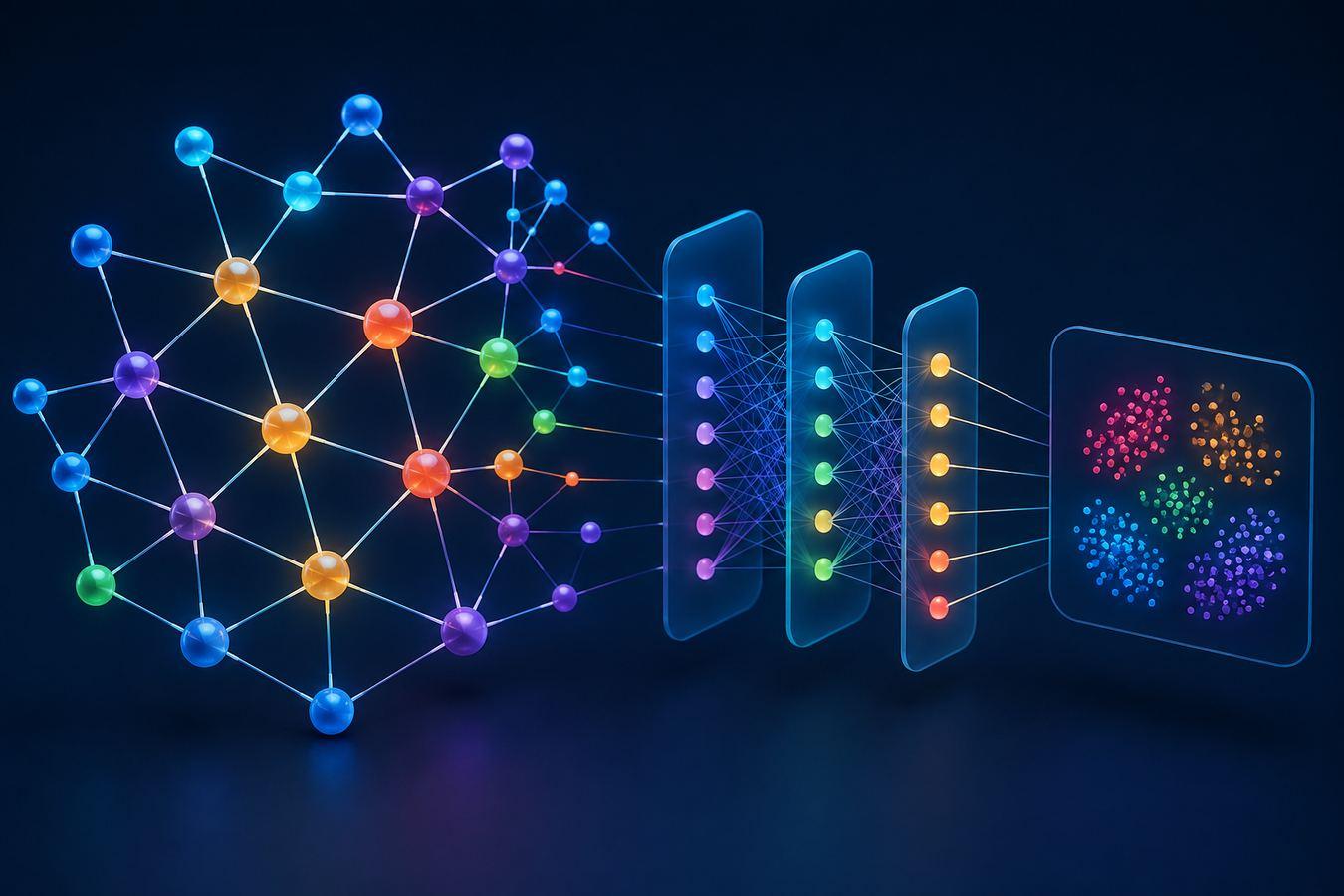
The core mechanism behind many GNNs is message passing. A node does not make its prediction using only its own features. Instead, it receives information from neighboring nodes and incorporates that information into its representation.
Imagine a graph where each node represents a bank account and edges represent transactions. A particular account may have ordinary transaction features, but several of its connected accounts may already exhibit suspicious behavior. Message passing allows information about those neighboring accounts to influence the representation of the target account.
At each layer, a GNN typically performs some form of neighborhood aggregation. Information from neighboring nodes is collected, transformed, and combined with the node's existing representation.
The first layer may capture information from immediate neighbors. Additional layers can extend the receptive field, allowing the model to incorporate information from nodes that are two or more connections away.
This enables multi-hop learning. A node can potentially learn from patterns involving several steps through the network rather than only its directly connected entities.
The challenge is balancing the amount of structural information incorporated. Too little neighborhood information may miss important relationships, while excessive propagation can cause representations of different nodes to become increasingly similar.
Message passing therefore provides a flexible mechanism for learning how local network context influences a node's representation.
Major Graph Neural Network Architectures
Several GNN architectures have been developed to capture graph structure in different ways.
Graph Convolutional Networks (GCNs) apply a convolution-like operation across graph neighbourhoods. Instead of using a regular grid like an image-processing convolution, a GCN aggregates information from connected nodes. This allows the model to combine node attributes with local structural context.
GraphSAGE takes a sampling-based approach to neighbourhood aggregation. Rather than processing every neighbour of every node, GraphSAGE can sample a subset of neighbours and learn aggregation functions. This can improve scalability for large graphs where some nodes have extremely high degrees.
Graph Attention Networks (GATs) introduce attention mechanisms into neighbourhood aggregation. Instead of treating every neighbouring node equally, the model can learn different importance weights for different neighbours. This is useful when some relationships contain more predictive information than others.
For example, in a financial graph, one neighbouring account may provide much stronger evidence of suspicious activity than another. Attention mechanisms can allow the model to focus more heavily on the most relevant relationships.
More recent architectures also include graph transformers, which extend transformer-style attention mechanisms to graph-structured information. These approaches can model richer relationships and longer-range dependencies, although their computational requirements can become significant for very large graphs.
The choice of architecture depends on graph size, structure, task requirements, computational constraints, and the type of relational information available.
Graph Learning Tasks
Graph ML supports several important learning tasks.
Node classification predicts labels for individual nodes. In a fraud network, the objective might be determining whether an account is suspicious. In a social network, it could involve classifying users according to interests or behavioral categories.
Link prediction estimates whether a relationship exists or is likely to form between two nodes. Recommendation systems can use link prediction to identify likely user-product interactions, while knowledge systems can use it to discover potentially missing relationships between entities.
Graph classification predicts a property of an entire graph. This is particularly important in scientific and molecular applications, where each graph may represent a molecule and the objective may be predicting a molecular property.
Graph ML can also support recommendation. A user-product graph can represent interactions between customers and items, while GNNs learn representations that capture both user behavior and product relationships. Recommendations can then be generated using these learned representations.
These tasks demonstrate why graph representation learning is powerful: the same underlying graph can support multiple forms of predictive analysis.
However, graph ML also introduces engineering challenges. Graphs can become extremely large, relationships can change over time, and neighborhood aggregation can become computationally expensive. Training and inference strategies therefore need to account for graph scale and structure.
The principles of data-efficient ML are also relevant. Large graphs may contain millions of nodes, but some relationships may be sparse or noisy. Sampling, feature selection, and careful data construction can significantly influence model performance.
"Machine Learning Under Data Constraints: Building Models When Data Is Limited" provides useful context because graph learning also requires careful consideration of how much information is actually available and how efficiently models can learn from it.
Key Takeaway
Graph Neural Networks learn by combining node attributes with information from connected neighbors. Graph embeddings create numerical representations of entities and relationships, while message passing and neighborhood aggregation allow models to capture local and multi-hop structural patterns. Architectures such as GCNs, GraphSAGE, GATs, and graph transformers provide different approaches to learning from networks. These capabilities support node classification, link prediction, graph classification, and recommendation, making GNNs particularly powerful when relationships themselves contain predictive information.
Section 3: Engineering Graph ML for Real-World Applications
Building a Graph Neural Network that performs well on a research dataset is very different from operating graph machine learning in production. Real-world graphs are large, dynamic, incomplete, and often assembled from multiple enterprise systems. Relationships can appear, disappear, or change meaning over time. Entities may need to be matched across databases, while duplicate or incorrect relationships can introduce misleading signals into the model.
Production graph ML therefore requires much more than selecting a GNN architecture. Engineering teams must build reliable graph construction pipelines, maintain entity and relationship quality, integrate graph models with traditional ML systems, scale training and inference, and evaluate models against realistic production conditions.
Building and Maintaining Graph Data
The first challenge is graph construction. Most organizations do not begin with a ready-made graph. Instead, they build one by extracting entities and relationships from databases, transactions, documents, application events, APIs, or other enterprise systems.
This process requires identifying the relevant entities and determining which interactions should become edges. A customer may be connected to a product through a purchase, while a device may be connected to an account through authentication activity. The definition of these relationships directly affects what the graph can represent.
Entity resolution is particularly important. The same real-world entity may appear under different identifiers across systems. If customer records are not correctly matched, the resulting graph can contain duplicate nodes or missing relationships, reducing the quality of downstream models.
Relationships can also require relationship extraction. In document-heavy environments, organizations may need to identify connections between people, companies, products, concepts, or events from unstructured text before adding them to a knowledge graph.
Real-world graphs are often dynamic graphs. New transactions, connections, events, and entities appear continuously. Existing relationships may become inactive or change characteristics. Graph pipelines must therefore support incremental updates while preserving historical information where time is relevant.
Graph quality should be monitored just as carefully as conventional ML data. Unexpected changes in node counts, edge distributions, relationship types, or graph connectivity can indicate upstream data problems that may affect model behavior.
Combining Graph and Traditional ML
Graph ML does not always need to replace conventional machine learning. In many production systems, the strongest architecture combines graph representations with traditional tabular or behavioral features.
Graph features can capture structural characteristics such as the number of neighbors, transaction-network density, community membership, path statistics, or connections to known risk entities. These features can then be provided to conventional ML models alongside standard attributes.
This creates hybrid models that combine relational and non-relational information. A fraud model, for example, might use transaction amount, timestamp, merchant type, and customer history together with graph-derived information about connected accounts and devices.
Organizations can also use tabular plus graph inputs in more sophisticated architectures. A neural network may process conventional features while a GNN generates relational embeddings, with the representations combined before the final prediction.
Another approach involves ensemble methods, where separate graph and non-graph models make predictions that are subsequently combined. This can be useful when graph structure provides valuable but incomplete information.
Hybrid architectures also provide practical flexibility. Not every prediction requires expensive graph computation. A simple model may handle routine cases, while graph analysis is applied to complex or high-risk cases where relationships provide additional value.
The right architecture depends on the business problem, graph structure, latency requirements, and available infrastructure.
Evaluating Graph-Based Models
Graph ML requires evaluation strategies that reflect both predictive performance and graph dynamics. Standard offline evaluation remains important, but random data splits can sometimes create unrealistic results.
For example, if relationships from the future are accidentally included during training, a model may appear to perform exceptionally well while relying on information that would not have existed at prediction time.
Temporal validation is therefore particularly valuable for dynamic graphs. Training can use historical graph states while evaluation uses later relationships or outcomes. This better represents how the model will operate in production.
For link-prediction problems, teams may use metrics appropriate to ranking and relationship discovery. For node classification, precision, recall, F1 score, calibration, and other classification metrics may be relevant.
Production monitoring should track not only model outputs but also changes in the graph itself. Significant shifts in connectivity, community structure, relationship types, or entity populations can alter model behavior even when the model artifact remains unchanged.
Graph ML also introduces challenges in debugging. A prediction may depend on several connected nodes and multiple message-passing layers. Engineers therefore need sufficient observability to understand which parts of the graph influenced model behavior.
This is why productionization matters so much. A graph model that succeeds in a research environment must eventually become a reliable service with automated data pipelines, deployment controls, monitoring, testing, and clear operational ownership. "From Proof of Concept to Production: Why Most ML Projects Never Make the Leap" explores the broader engineering gap between successful ML experiments and dependable production systems.
Key Takeaway
Production graph ML requires reliable graph construction, entity resolution, dynamic relationship management, hybrid model architectures, scalable training, efficient inference, and graph-aware evaluation. The graph itself becomes a continuously changing data asset that must be monitored and maintained. Successful engineering teams therefore treat graph ML as an end-to-end system involving data infrastructure, model architecture, serving, evaluation, and operations—not simply as a GNN training problem.
Section 4: The Future of Graph AI
Graph machine learning is evolving beyond specialized graph models into a broader form of graph-based intelligence. Organizations increasingly need AI systems that can reason across connected entities, combine structured relationships with unstructured information, and adapt as networks change. This is creating new opportunities to combine graph ML with enterprise knowledge graphs, generative AI, retrieval systems, and autonomous agents.
The key shift is that graphs are becoming more than a representation used during model training. They are increasingly becoming a persistent layer of organizational knowledge and context.
Graphs and Enterprise Intelligence
Large organizations contain enormous numbers of relationships: employees belong to teams, customers use products, suppliers connect to manufacturers, applications depend on services, and documents reference people and concepts. Representing these connections through enterprise knowledge graphs can create a structured view of organizational information.
Traditional enterprise search may locate documents containing a particular concept, while a graph can represent the relationships among the concepts themselves. A product can be linked to customers, support issues, engineers, documentation, suppliers, and related products. This creates opportunities for connected decision-making, where AI systems use relationships as part of the evidence behind recommendations.
Graph-based search can also improve enterprise knowledge retrieval. Instead of simply matching text, a system can use entity relationships to determine which information is connected to a user's question. This can be especially valuable when relevant information is distributed across multiple business systems.
For example, an engineering investigation might require connecting a service, recent deployment, infrastructure component, incident, owner, and relevant documentation. A graph can provide the relationships connecting those entities while other retrieval systems provide detailed content.
This creates a complementary architecture in which graphs provide structure and relationships, while documents and other data sources provide detailed context.
Graph ML and Generative AI
One of the most important emerging directions is combining graph machine learning with generative AI.
Large Language Models are powerful at understanding and generating natural language, but they may struggle to reliably represent complex, changing relationships contained within enterprise data. Knowledge graphs can provide explicit structural information that complements model-generated reasoning.
This creates opportunities for Graph-RAG, where a retrieval system uses graph relationships to identify relevant entities and connections before providing context to a generative model. Instead of retrieving documents only through semantic similarity, the system can follow relationships between entities and retrieve information connected through the graph.
For example, a question about a customer may require retrieving information about its account, products, contracts, support history, related organizations, and previous interactions. Graph-based retrieval can help identify the relevant relationships before an LLM synthesizes the information.
Graph-aware AI agents can take this further. An agent investigating an enterprise problem could use graph traversal to discover related entities, retrieve supporting documentation, query operational systems, and then summarize the findings.
However, graph information must remain accurate and current. A flawed knowledge graph can cause downstream AI systems to reason from incorrect relationships. Graph quality, provenance, access controls, and update processes therefore become critical components of graph-based generative AI.
Building Graph-Native AI Organizations
The growing importance of graph AI will require new organizational capabilities. Companies need graph data infrastructure capable of collecting, resolving, storing, updating, and governing relationships across enterprise systems.
This introduces specialized graph ML engineering skills. Engineers need to understand graph representation, GNN architectures, graph databases, distributed computation, graph sampling, retrieval, and production ML operations.
Evaluation and observability also need to become graph-aware. Teams must monitor not only conventional model metrics but also changes in graph structure, relationship quality, entity populations, and temporal behavior.
Organizations should also consider strategic AI capabilities. Graph technology is most valuable when relationships represent an important source of business information. Companies should identify domains where connected data provides an advantage that cannot easily be captured through isolated tabular or document-based representations.
The future is likely to involve architectures combining several forms of intelligence: graph models for structural learning, vector retrieval for semantic similarity, databases for precise transactional information, knowledge graphs for explicit relationships, and generative models for language-based reasoning.
This convergence will make AI systems increasingly capable of reasoning across connected enterprise environments rather than operating on isolated datasets.
"The Rise of AI Control Planes: Managing Intelligence at Scale" provides relevant perspective on the infrastructure required to coordinate increasingly complex AI components, including models, data, agents, and intelligent workflows.
Key Takeaway
The future of graph AI lies in combining graph learning, enterprise knowledge graphs, generative AI, Graph-RAG, and intelligent agents. Graphs provide an explicit representation of relationships and dependencies, while modern AI models can use that structure to retrieve context, reason over connected information, and support increasingly autonomous workflows. Organizations that build strong graph data infrastructure and graph-native engineering capabilities will be better positioned to turn relationships and networks into a strategic source of AI intelligence.
Conclusion
Graph machine learning represents a fundamental shift in how artificial intelligence can understand data. Traditional machine learning primarily focuses on the attributes of individual observations, but many real-world problems cannot be understood effectively without considering the relationships between entities. Customers interact with products, accounts participate in transactions, users connect with other users, suppliers depend on manufacturers, and systems communicate across infrastructure. In these environments, the network itself contains valuable predictive information.
This is the central value of graph machine learning. By representing entities as nodes and relationships as edges, graph-based systems can incorporate structural information directly into the learning process. A node's characteristics remain important, but its neighborhood, connections, communities, and multi-hop relationships can provide additional context that conventional tabular approaches may overlook.
Graph Neural Networks have made this capability increasingly practical. Through message passing and neighborhood aggregation, GNNs allow representations to incorporate information from connected nodes. Graph Convolutional Networks, GraphSAGE, Graph Attention Networks, and newer graph-based architectures provide different ways to capture relationships and structural patterns. These representations can support node classification, link prediction, graph classification, recommendation, anomaly detection, and other machine learning tasks.
However, successful graph ML requires more than selecting a GNN architecture. The quality of the graph itself is critical. Organizations must construct reliable graphs from multiple data sources, perform entity resolution, identify meaningful relationships, preserve temporal information, and continuously update dynamic networks. Incorrect or incomplete relationships can lead models toward incorrect conclusions just as poor-quality features can damage traditional ML systems.
Frequently Asked Questions (FAQs)
1. What is graph machine learning?
Graph machine learning is a type of machine learning that learns from entities and the relationships connecting them. It represents information using nodes and edges and can use both attributes and network structure to make predictions.
2. How is graph ML different from traditional machine learning?
Traditional ML commonly represents data as independent rows and features. Graph ML incorporates relationships, neighborhoods, communities, and network structure, allowing models to learn from how entities interact with one another.
3. What are nodes and edges in graph machine learning?
Nodes represent entities such as customers, users, products, accounts, or devices. Edges represent relationships or interactions between those entities, such as purchases, transactions, communications, ownership, or connections.
4. What is a Graph Neural Network?
A Graph Neural Network (GNN) is a neural network architecture designed to operate on graph-structured data. GNNs typically allow information to pass between connected nodes so that predictions can incorporate both local attributes and relational context.
5. How do Graph Neural Networks learn from relationships?
GNNs commonly use message passing and neighborhood aggregation. Information from neighboring nodes is collected and combined with a node's own representation, allowing the model to learn structural patterns and multi-hop relationships.
6. What is graph representation learning?
Graph representation learning is the process of transforming nodes, edges, or entire graphs into numerical representations that capture useful attributes and structural relationships.
7. What is a graph embedding?
A graph embedding is a numerical vector representation of a graph, node, or relationship. Embeddings allow machine learning systems to work with structural information in a form suitable for prediction, similarity analysis, recommendation, and other tasks.
8. What is message passing in Graph Neural Networks?
Message passing is the process through which nodes exchange or aggregate information from their neighbors. Repeated message-passing layers allow a model to incorporate information from increasingly larger portions of the graph.
9. What is link prediction?
Link prediction estimates whether a relationship exists or is likely to form between two nodes. It can support applications such as recommendations, fraud analysis, social connections, and knowledge-graph completion.
10. What is node classification?
Node classification predicts a category or label for an individual node based on its attributes and graph context. For example, a financial system could classify accounts according to risk.
11. When should companies use graph machine learning?
Companies should consider graph ML when relationships contain meaningful predictive information that is difficult to capture through independent tabular features. Common applications include fraud detection, recommendation, cybersecurity, supply-chain analysis, and knowledge graphs.
12. How is graph ML used for fraud detection?
Graph ML can identify relationships between accounts, devices, merchants, transactions, and other entities. These connections can reveal coordinated patterns or suspicious network structures that may be difficult to detect when transactions are analyzed independently.
13. What are the challenges of building graph ML systems?
Major challenges include graph construction, entity resolution, data quality, rapidly changing relationships, graph scale, distributed training, inference latency, evaluation, and maintaining consistent graph data in production.
14. How does graph machine learning work with generative AI?
Graph ML and generative AI can be combined by using graphs to provide structured relationships and context while language models generate natural-language responses. Architectures such as Graph-RAG can use graph structure to guide information retrieval and support more context-aware generation.
15. What is the future of graph machine learning?
The future of graph ML includes deeper integration with knowledge graphs, generative AI, Graph-RAG, vector retrieval, and AI agents. These systems will increasingly use network relationships to support connected search, decision-making, anomaly detection, autonomous investigation, and enterprise intelligence.