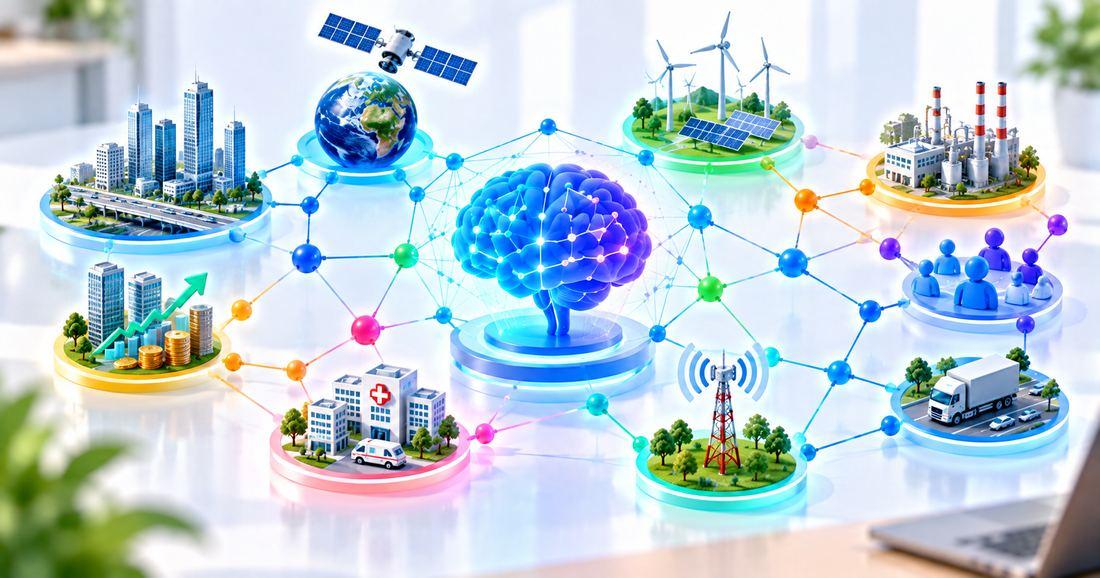
Section 1: Why Complex Networks Require a Different Machine Learning Approach
Many machine learning problems are represented as tables. Each row describes an example, and each column contains a feature that a model can use for prediction. This representation works well when observations can be treated as largely independent. But many real-world systems do not behave that way. People interact with other people, financial accounts transfer money between one another, web pages link to other pages, devices communicate across networks, products are connected through purchasing behavior, and software services depend on other services.
In these environments, the relationships between entities are often as important as the entities themselves.
This creates the need for machine learning approaches that can learn from complex networks, where information is represented through nodes, edges, attributes, and patterns of connectivity rather than through isolated rows and columns.
Understanding the Structure of a Complex Network
A network can be represented as a graph containing nodes and edges. Nodes represent entities, while edges represent relationships between them. A node could represent a customer, user, device, company, website, transaction, or software service. An edge could represent a friendship, payment, communication, dependency, transaction, or link.
The simplicity of this representation hides significant complexity.
Two customers may have identical demographic characteristics but behave very differently because they interact with different groups of customers. Two devices with similar technical specifications may have different failure risks because they communicate with different parts of an infrastructure. Two financial accounts may look normal individually but become suspicious when their transaction relationships form an unusual pattern.
Traditional feature-based machine learning can capture the attributes of individual entities, but it may miss the structural information contained in these relationships.
A graph-based representation allows the model to consider both.
Why Relationships Become Predictive Signals
Connections are not merely metadata attached to an entity. They can contain predictive information.
Consider a fraud-detection system. A transaction amount, location, and timestamp can provide useful signals, but the structure surrounding the transaction may reveal additional evidence. An account connected to several previously flagged accounts may require different treatment from an otherwise identical account with an entirely different transaction neighborhood.
The same principle appears in recommendation systems. A user's individual profile may provide limited information, while the user's relationships with products, categories, and other users can reveal preferences more effectively.
In cybersecurity, an individual device may appear normal when examined independently, while its communication pattern with unusual hosts may reveal a larger attack structure.
The predictive signal can therefore exist between entities, not simply inside them.
This is one of the central ideas explored in “Graph Machine Learning: How AI Learns From Relationships and Networks.” Graph-based machine learning provides a framework for learning from these relationships directly rather than flattening every connection into conventional independent features.
Complex Networks Are Not Always Static
Another challenge is that many networks change over time.
A social network gains and loses connections.
A financial network evolves as transactions occur.
A communication network changes as users and devices interact.
A software dependency graph changes when applications are updated.
This means that the graph itself can become a time-dependent object.
A machine learning model may need to understand not only whether two entities are connected, but when that connection appeared, how frequently it is used, and whether the surrounding network structure is changing.
A connection created five years ago may mean something very different from a connection created five seconds ago.
Temporal information therefore becomes an important component of complex-network learning.
Local Relationships and Global Structure
One reason network-based machine learning is powerful is that useful information can exist at multiple scales.
A node's immediate neighbors may provide local information. A customer's directly connected accounts, for example, may reveal behavioral similarities.
But information can also exist farther away in the network.
A seemingly ordinary account might be indirectly connected to a broader cluster of suspicious entities through several intermediary nodes. Similarly, a software service may appear independent locally while being part of a larger dependency chain that creates operational risk.
Models therefore need mechanisms for understanding both local neighborhoods and broader structural patterns.
This distinguishes network learning from conventional feature engineering, where engineers often decide in advance which neighboring information should be converted into fixed variables.
Heterogeneous Networks Add More Complexity
Not every network contains one type of node or one type of relationship.
An enterprise graph might connect users, devices, applications, documents, teams, and transactions. A healthcare network might contain patients, providers, treatments, medications, and clinical events.
Different node types can have different attributes, while different edge types can carry different meanings.
A connection between a customer and a product is fundamentally different from a connection between two customers.
A dependency between software services differs from a communication event between those services.
Machine learning systems must therefore understand who is connected to whom and what that connection means.
From Independent Examples to Connected Systems
The biggest conceptual change is that the unit of analysis is no longer necessarily an individual record.
The model may need to reason about a node, its neighbors, its position within a larger graph, and the evolution of its relationships over time.
This makes complex-network machine learning useful for problems where interaction itself carries information.
Fraud, recommendations, cybersecurity, supply chains, social behavior, biological systems, and infrastructure monitoring are all examples where the structure of relationships can influence outcomes.
Key Takeaway
Complex networks require a different machine learning approach because relationships between entities can contain as much predictive information as the entities themselves. Graph representations allow models to learn from nodes, edges, neighborhoods, and broader network structure, while temporal and heterogeneous networks introduce additional dimensions of complexity. The key shift is from treating observations as independent examples to understanding them as parts of connected, evolving systems.
Section 2: How Machine Learning Learns From Complex Networks
Once a problem is represented as a network, the next challenge is teaching a machine learning model how to extract useful information from that structure. A conventional model expects features associated with individual examples, but a network contains information in both node attributes and relationships. Machine learning for complex networks therefore requires methods that can transform connectivity into meaningful representations and use those representations for prediction.
The central idea is that an entity should not always be understood independently. Its neighbors, connections, and position within the broader network can provide additional information about its behavior.
Learning Node Representations
One of the foundational approaches is node representation learning, where each node is converted into a numerical embedding. The embedding is designed to capture relevant information about the node's attributes as well as its structural position.
Two nodes with similar characteristics may receive different representations if they occupy very different positions in the network. Conversely, nodes with different attributes may develop related embeddings when their network contexts are similar.
This is useful because downstream machine learning models can then operate on learned representations rather than requiring engineers to manually encode every possible network relationship.
The quality of these representations depends heavily on what the learning process is encouraged to preserve. A model might emphasize neighboring nodes, community structure, connectivity patterns, or relationships between node types.
Message Passing and Graph Neural Networks
One of the most important approaches for learning from graphs is the Graph Neural Network (GNN).
A typical GNN uses a message-passing process in which each node receives information from neighboring nodes and combines that information with its own representation. Multiple layers allow information to propagate across increasingly large portions of the network.
For example, in a fraud-detection graph, an account can learn not only from its own transaction characteristics but also from the representations of connected accounts. After additional message-passing layers, the model can incorporate information from more distant parts of the graph.
This creates a mechanism for learning structural context directly from the network.
Different GNN architectures use different aggregation mechanisms. Graph Convolutional Networks can combine neighboring information through learned transformations, while GraphSAGE uses neighborhood sampling and aggregation to support larger or evolving graphs. Graph Attention Networks introduce attention mechanisms so that the model can learn that some neighbors are more informative than others.
Node, Edge, and Graph-Level Prediction
Complex-network machine learning can operate at different levels of the graph.
Node-level tasks predict properties associated with individual nodes. Examples include identifying fraudulent accounts, classifying users, or predicting whether a device is compromised.
Edge-level tasks focus on relationships. Link prediction can estimate whether two entities are likely to connect, while edge classification can determine the type or legitimacy of an existing relationship.
Graph-level tasks predict properties of an entire network or subgraph. This is useful when the complete structure represents an object, such as a molecular graph or a particular transaction network.
The choice of prediction level influences both the architecture and the training strategy.
Learning Relationships Directly
One major advantage of graph-based approaches is that relationships themselves can become learning targets.
Consider a recommendation system where users are connected to products through interactions. Instead of predicting only user-level preferences, a model can learn which connections are likely to exist in the future.
Similarly, a communication network can be analyzed to identify unusual relationships between devices, while a supply-chain graph can be used to estimate dependencies that may create operational risk.
This allows the model to learn patterns in connectivity rather than treating relationships merely as auxiliary features.
Neighborhood Sampling for Large Graphs
Real-world networks can contain millions or billions of nodes and edges. Propagating information across the complete graph for every training example can become computationally expensive.
Techniques such as neighborhood sampling address this problem by selecting a subset of relevant neighbors during training.
Instead of processing an entire network, the model constructs a manageable local computation graph around the target node.
This makes graph learning more scalable, but it introduces an engineering trade-off. Aggressive sampling can reduce computational cost while potentially omitting important structural information.
The appropriate sampling strategy therefore depends on graph density, task requirements, and the distance at which useful information exists.
Heterogeneous Graph Learning
Many enterprise networks contain multiple node and edge types. A graph may connect customers to products, products to categories, employees to teams, and devices to applications.
A heterogeneous graph model can preserve those distinctions rather than treating every relationship identically.
This allows the model to learn that different edge types carry different meanings and that different node types require different representations.
Such models can be particularly valuable when business processes naturally form multi-relational networks.
Temporal and Dynamic Graphs
Many networks evolve continuously, making time an important part of the representation.
A transaction creates an edge at a specific moment. A user joins a social network at another point. A device begins communicating with a server after a software update.
A temporal graph model can incorporate these changes and learn from how relationships evolve rather than assuming that the network is static.
This is especially useful for fraud detection, cybersecurity, recommendation systems, and operational monitoring, where recent changes in connectivity may be more informative than historical structure.
Choosing the Right Learning Strategy
Graph neural networks are powerful, but they are not automatically the correct solution for every network problem. Simple graph features, community detection, centrality measures, random-walk embeddings, or conventional machine learning models can sometimes provide strong results with less complexity.
This reinforces the principle discussed in “The Hidden Role of Baselines in Successful Machine Learning Projects.” A sophisticated graph model should demonstrate measurable value against meaningful alternatives rather than being selected solely because it is architecturally advanced.
Key Takeaway
Machine learning learns from complex networks by converting nodes, edges, neighborhoods, and evolving relationships into useful representations. Graph neural networks use message passing and aggregation to incorporate structural context, while specialized approaches support link prediction, heterogeneous graphs, large-scale neighborhood sampling, and temporal networks. The right approach depends on the network structure and prediction task, and graph-based models should always be evaluated against strong, simpler baselines.
Section 3: Designing Machine Learning Systems for Complex Networks
Learning from a graph is only one part of building a machine learning system for complex networks. In production, networks are rarely clean, static, or perfectly observed. New nodes appear, relationships change, data can arrive late, and some connections may be missing or incorrect. A graph model that performs well on historical data can therefore behave very differently when exposed to a continuously evolving network.
The engineering challenge is to design a system that can learn from network structure while remaining scalable, robust, and responsive to change.
Graph Construction Determines Model Quality
Before a model can learn from a network, engineers must decide how the graph should be constructed. This may sound like a data-preparation task, but it is effectively a modeling decision.
A fraud graph could connect accounts through transactions, shared devices, IP addresses, or payment instruments. A recommendation graph could connect users to products through views, purchases, or ratings. A cybersecurity graph could connect devices through network communication.
Different definitions of an edge can produce completely different graphs and therefore different model behavior.
An edge can also have direction, weight, timestamp, or type. A payment from Account A to Account B is not necessarily equivalent to the reverse relationship. Ten transactions may convey different information from a single transaction. A connection that occurred yesterday may be more relevant than one created several years ago.
Graph construction must therefore preserve the semantics that matter for the downstream problem.
Scaling to Large and Dynamic Networks
Production networks can become extremely large. Social platforms, financial systems, communication infrastructures, and enterprise dependency graphs may contain millions or billions of relationships.
Processing the full graph during every training step may be computationally impractical.
Engineers can use neighborhood sampling, subgraph training, graph partitioning, or distributed processing to reduce the computational burden. Instead of loading the complete network into memory, the system can retrieve the portion of the graph relevant to a particular training example.
Inference introduces another challenge.
A recommendation system or fraud detector may need predictions in milliseconds while the surrounding graph continues changing. The architecture must therefore separate expensive graph computation from latency-sensitive serving where appropriate.
This is why graph machine learning becomes both a modeling and infrastructure problem.
New Nodes Create the Cold-Start Challenge
Networks constantly gain new entities.
A new customer has no historical interactions. A newly deployed device may have no established communication pattern. A new product may have limited user activity.
These cold-start nodes can be difficult for graph models because neighborhood information may be limited or nonexistent.
Engineers can address this by combining graph structure with node attributes. A new customer may have demographic or account information even before meaningful interactions occur. A new device may have configuration and software metadata.
This allows the system to make initial predictions using available attributes while gradually incorporating graph information as relationships accumulate.
The problem is therefore not simply missing data. It is the temporary absence of network history.
Graph Changes Can Alter Predictions
A model may produce different predictions for the same node as its surrounding network changes.
A previously isolated account may suddenly become connected to several suspicious entities. A software service may acquire a new dependency. A customer may begin interacting with an entirely different category of products.
The model must distinguish meaningful structural changes from ordinary fluctuations.
This creates a monitoring problem similar to distribution shift in conventional machine learning, but with an additional structural dimension. Engineers may need to track changes in degree distributions, neighborhood composition, community structure, edge frequencies, and other graph statistics.
A model can degrade even when individual feature distributions remain relatively stable because the underlying connectivity pattern has changed.
Preventing Information Leakage in Graphs
Graph data introduces unusual forms of leakage.
Suppose a fraud model predicts whether an account will eventually be classified as fraudulent. If the training graph contains relationships that were created after the prediction timestamp, the model may indirectly receive future information.
The problem becomes particularly subtle because the leaked information may not be an explicit feature. It may exist in the structure of the graph itself.
A future transaction, later account connection, or post-event relationship can change the neighborhood used during training.
Temporal graph construction must therefore respect the information available at the exact prediction point.
This is an important production consideration discussed more broadly in “From Experiment to Production: The Decisions That Shape an ML System.” A graph model is production-ready only when its data-generation and validation process accurately reproduces the information that would have been available during real inference.
Robustness Against Noisy and Adversarial Relationships
Not every edge in a real network is meaningful.
Data integration errors can create incorrect connections. Duplicate records can introduce artificial relationships. Users or systems can deliberately create interactions designed to influence a model.
This is especially important in fraud and cybersecurity applications, where adversaries may attempt to manipulate graph structure.
A robust system should therefore evaluate how sensitive predictions are to unusual or corrupted relationships.
Engineers may use edge filtering, confidence weighting, robust training methods, or anomaly detection to reduce the influence of suspicious connections.
The objective is not to assume that every relationship is equally trustworthy.
Interpreting Network-Based Predictions
Graph models can be difficult to interpret because their predictions may depend on information propagated across multiple relationships.
An account may receive a risk prediction partly because of its own behavior and partly because of patterns among its connected entities.
For production use, engineers may need explanations that identify influential neighbors, relationship types, paths, or local graph structures contributing to a prediction.
Interpretability requirements depend on the application, but understanding structural evidence can help engineers debug models and help domain experts validate whether predictions make sense.
Choosing Graph Complexity Carefully
Not every network problem requires a sophisticated GNN.
A simpler solution using graph statistics, manually engineered neighborhood features, or classical machine learning may be easier to train, explain, and deploy.
A GNN becomes more attractive when the relevant signal depends on complex interactions that are difficult to encode manually.
The engineering decision should therefore consider predictive performance, scalability, latency, maintainability, and operational cost rather than model sophistication alone.
Key Takeaway
Production machine learning for complex networks depends on thoughtful graph construction, scalable computation, cold-start handling, continuous adaptation, leakage prevention, robustness, and interpretability. The graph itself is part of the model because changes in relationships can directly change predictions. Successful systems balance the expressive power of graph-based learning with the practical requirements of reliable, scalable deployment.
Section 4: Why Machine Learning for Complex Networks Is Becoming Critical for Modern AI
Connected systems are becoming a defining characteristic of modern technology. Financial transactions form networks, users interact through social platforms, software services depend on one another, devices communicate across infrastructures, and supply chains connect organizations across geographic regions. As these systems become larger and more dynamic, understanding individual entities in isolation becomes increasingly insufficient.
Machine learning for complex networks offers a way to model these relationships directly. Its long-term importance comes from the possibility of building AI systems that understand not only the properties of individual entities, but also how those entities influence and depend on one another.
From Isolated Predictions to System-Level Intelligence
Traditional machine learning often focuses on predicting an outcome for an individual record. A model might determine whether a transaction is suspicious or whether a customer is likely to leave.
In a networked environment, the outcome may depend on the surrounding system.
A transaction could become suspicious because of the broader activity of connected accounts. A service could become operationally risky because of its position within a dependency graph. A product recommendation could depend on patterns formed by groups of users rather than only on one customer's historical behavior.
This changes the role of machine learning.
The model is no longer simply asking, “What does this entity look like?”
It is also asking, “What relationships surround this entity, and what does that structure imply?”
This system-level perspective can help AI models capture patterns that conventional independent-feature approaches may overlook.
Complex Networks Can Reveal Hidden Communities
Many networks naturally form groups.
Customers with similar purchasing behavior may form communities. Fraudulent accounts may organize around shared infrastructure. Scientific researchers may form collaboration clusters. Software components may form dependency groups.
Machine learning can use these structural patterns to discover communities or incorporate them into downstream predictions.
Community structure can provide valuable context because entities within a group may share behavior even when their individual attributes differ.
For example, two accounts may have very different transaction histories but belong to the same structural cluster because they repeatedly interact with the same entities.
This creates opportunities for anomaly detection, recommendation, classification, and risk analysis.
The model can use the structure of the community as an additional source of information.
Network Learning Is Valuable for Anomaly Detection
Anomaly detection becomes particularly interesting when unusual behavior is defined by relationships rather than individual measurements.
A device sending an unusually large number of requests may not be suspicious if similar devices normally behave the same way. However, a device that suddenly creates connections to a set of previously unrelated systems may represent a structurally unusual event.
Similarly, a financial account may have ordinary transaction amounts but exhibit a connectivity pattern that differs significantly from normal accounts.
This distinction between attribute anomalies and structural anomalies creates an important role for graph-based machine learning.
The model can learn what normal connectivity looks like and identify deviations from that structure.
This complements the broader challenges discussed in “How Machine Learning Systems Handle Changing User Behavior,” because behavioral change in a network can manifest through evolving relationships as well as changing individual features.
Graphs Can Improve Recommendations and Search
Recommendation systems are naturally networked.
Users connect to products through clicks, purchases, views, ratings, and other interactions. Products connect to categories, brands, suppliers, and related products.
Representing these interactions as a graph enables machine learning systems to learn from multiple relationship types simultaneously.
A recommendation does not have to depend solely on what one user previously consumed. It can incorporate patterns from similar users, related products, and broader structural neighborhoods.
Search systems can also benefit from graph information.
Documents, entities, websites, users, and concepts can be connected through multiple relationships. Learning from those relationships can help systems understand relevance beyond isolated textual features.
This extends the role of network structure from simple metadata toward an integral component of ranking and retrieval.
Complex Networks Can Support Better Risk Modeling
Many important risks are relational.
Financial risk can propagate through counterparties.
Cybersecurity threats can spread across connected devices.
Supply-chain disruptions can move through supplier dependencies.
Operational failures can propagate across software services.
In these environments, risk cannot always be understood by evaluating every entity separately.
A graph model can potentially identify structural dependencies and estimate how changes in one part of the network affect another.
This creates the possibility of moving from static risk scores toward network-aware risk analysis.
Such systems can be especially useful when the consequences of an event depend on connected components rather than only on the original source.
Dynamic Graphs Create Opportunities for Real-Time Intelligence
Modern networks often evolve continuously.
New transactions are created every second. Devices appear and disappear. Users form new connections. Applications add dependencies. Supply-chain relationships change as orders move through the system.
Machine learning models that can learn from dynamic graphs may therefore provide more current intelligence than models based exclusively on static historical snapshots.
The challenge is computationally demanding because the underlying graph changes continuously.
Systems may need incremental updates, streaming pipelines, temporal embeddings, or periodic retraining depending on the application.
The ability to reason about network evolution could become increasingly important as organizations move toward real-time decision systems.
Network Effects Can Make Small Events Significant
One of the most important characteristics of connected systems is that a small local change can sometimes have broader consequences.
A single compromised device can become connected to additional systems. A supplier failure can affect multiple downstream businesses. A new dependency can introduce unexpected operational coupling.
A model that understands only the local attributes may miss these implications.
A network-aware system can potentially identify pathways through which local events affect larger structures.
This makes complex-network machine learning relevant not only to classification but also to forecasting, simulation, optimization, and decision support.
Graph Learning Will Become Part of Broader AI Infrastructure
The future of network-based machine learning is unlikely to involve isolated graph models.
Instead, graph representations may become one component of broader AI infrastructure.
An enterprise AI system could combine graph embeddings with textual representations, transactional features, time-series signals, and retrieved documents. A cybersecurity platform could combine network topology with logs and endpoint telemetry. A recommendation engine could combine user embeddings, content representations, and interaction graphs.
This creates opportunities for systems in which relationships become one information layer among several.
The broader principle resembles the move toward reusable representations discussed in “The Hidden Role of Baselines in Successful Machine Learning Projects,” where successful ML systems are built by combining appropriate representations and strong evaluation rather than relying on a single technique.
The Future of AI May Be Network-Aware
As software, organizations, devices, and users become more interconnected, network structure will increasingly become part of the information available to AI systems.
The most capable systems may not treat relationships as secondary metadata.
They may treat connectivity as a fundamental representation of the environment.
This could enable models that understand how risk propagates, how communities form, how dependencies evolve, how recommendations emerge, and how actions affecting one entity can influence many others.
The result is a shift from entity-level intelligence toward system-level intelligence.
Key Takeaway
Machine learning for complex networks is becoming increasingly important because many modern problems are driven by relationships, dependencies, communities, and interactions. Network-aware AI can support anomaly detection, recommendations, risk modeling, search, forecasting, and real-time intelligence while capturing structural patterns that isolated models may miss. As connected systems continue to grow, understanding the network itself may become as important as understanding the individual entities within it.
Conclusion
Machine learning for complex networks represents a fundamental shift in how AI systems can understand connected environments. Traditional machine learning often treats each observation as an independent example, but many real-world systems do not behave independently. Customers interact with products, accounts transact with other accounts, devices communicate across networks, applications depend on other services, and organizations operate through interconnected supply chains.
In these environments, the relationships themselves can contain critical predictive information.
Graph-based machine learning provides a way to represent this structure explicitly. Nodes can represent entities, while edges capture relationships, interactions, dependencies, or events. This allows models to learn not only what an entity looks like but also how its surrounding network influences its behavior.
The resulting perspective is particularly valuable for fraud detection, cybersecurity, recommendations, supply-chain analysis, infrastructure monitoring, social networks, and other applications where connectivity matters.
Graph neural networks and related techniques provide mechanisms for learning from neighborhoods and structural context. Message passing allows information to move between connected entities, while node, edge, and graph-level learning support different types of prediction. More specialized approaches can handle heterogeneous relationships, temporal changes, and large-scale graphs.
However, the effectiveness of a graph model depends heavily on how the network is constructed.
An incorrectly defined edge can cause a model to learn the wrong relationship. A missing connection can hide relevant information. A future relationship included in historical training data can create leakage. A rapidly changing network can make a previously useful representation stale.
This means that graph construction, data lineage, temporal validation, and monitoring are central parts of the machine learning system rather than secondary implementation details.
Scalability is another major consideration. Modern networks can contain millions or billions of entities and relationships, making full-graph computation expensive. Sampling, partitioning, distributed processing, and incremental updates can help make graph learning practical, but each introduces engineering trade-offs between computational efficiency and structural information.
Complex networks also create unique challenges around new entities. A newly created account, device, or product may have little interaction history, making its network representation incomplete. Combining graph information with conventional attributes can help address this cold-start problem while the entity gradually develops a richer network context.
Perhaps the most important long-term opportunity is the transition from entity-level intelligence to system-level intelligence.
A traditional model might identify whether a particular device is suspicious. A network-aware system can additionally examine how that device communicates with other systems and whether those relationships resemble known patterns of compromise.
A recommendation model can move beyond individual preferences and learn from relationships among users and products.
A risk model can consider dependencies through which an event might propagate.
A monitoring system can identify structural anomalies that are invisible when each component is analyzed separately.
This ability to reason about relationships makes network-aware machine learning especially relevant as digital systems become increasingly interconnected.
At the same time, graph learning should not automatically replace simpler approaches. Graph statistics, manually engineered neighborhood features, traditional machine learning, and deterministic rules can remain useful when they capture the important structure with less complexity. The appropriate solution depends on the problem, the scale of the network, the available data, and the operational requirements.
The future of machine learning for complex networks is therefore likely to be highly integrated. Graph representations may work alongside text embeddings, images, time-series data, structured features, and retrieval systems to provide AI with a richer understanding of connected environments.
As organizations increasingly operate through interconnected digital and physical systems, the ability to learn from relationships will become an important component of modern AI engineering.
The central lesson is simple: when relationships influence outcomes, the network itself becomes data.
Frequently Asked Questions
1. What is machine learning for complex networks?
Machine learning for complex networks is the use of machine learning techniques to analyze systems represented as networks or graphs. Entities are represented as nodes, while relationships or interactions are represented as edges. Models can then learn from both individual attributes and network structure.
2. What is a graph in machine learning?
A graph is a mathematical representation consisting of nodes and edges. Nodes represent entities such as users, devices, products, or accounts, while edges represent relationships such as transactions, communications, dependencies, or interactions.
3. Why are relationships important in machine learning?
Relationships can contain information that is not present in individual entity attributes. An account may appear normal by itself but become more suspicious when its connections to other accounts or transactions reveal an unusual network pattern.
4. What is a Graph Neural Network?
A Graph Neural Network, or GNN, is a neural network architecture designed to learn from graph-structured data. GNNs typically aggregate information from a node's neighbors so that its representation incorporates both its own attributes and relevant structural context.
5. What is message passing in a GNN?
Message passing is the process through which nodes exchange information with their neighbors during graph learning. A node combines information from its connected neighbors with its own representation, allowing the model to learn from local network structure.
6. What can Graph Neural Networks predict?
GNNs can support node-level, edge-level, and graph-level prediction. Examples include identifying suspicious accounts, predicting whether two entities will connect, classifying relationships, recommending products, and predicting properties of an entire graph.
7. What is link prediction?
Link prediction is a machine learning task that estimates whether a relationship between two entities is likely to exist. It can be used for recommendations, social connections, knowledge graphs, fraud analysis, and other applications involving relationships.
8. What is a heterogeneous graph?
A heterogeneous graph contains multiple types of nodes, edges, or both. For example, an enterprise network might contain customers, products, transactions, employees, and devices, with different relationship types connecting these entities.
9. Why are temporal graphs important?
Many networks change over time. Transactions occur, devices connect and disconnect, users form new relationships, and software dependencies change. Temporal graph models incorporate this evolving structure rather than assuming that the network remains static.
10. How do graph models handle very large networks?
Large graph systems can use techniques such as neighborhood sampling, graph partitioning, subgraph training, distributed computation, and incremental processing. These approaches reduce the amount of graph data that must be processed during each training or inference operation.
11. What is the cold-start problem in graph machine learning?
The cold-start problem occurs when a new entity has little or no network history. A new customer, product, or device may have few connections from which a graph model can learn. Combining graph information with entity attributes can help produce useful initial predictions.
12. Can graph machine learning detect fraud?
Graph machine learning can be used for fraud-related tasks when relationships among accounts, transactions, devices, payment instruments, or other entities provide meaningful signals. Network structure can reveal patterns that may not be visible when transactions are analyzed independently.
13. How is graph machine learning used in cybersecurity?
Cybersecurity systems can represent devices, users, applications, IP addresses, and communication events as connected entities. Machine learning can then analyze network structure to identify unusual relationships, changes in communication patterns, or potentially suspicious subgraphs.
14. What are the biggest challenges in graph machine learning?
Important challenges include graph construction, scalability, changing network structure, missing or noisy relationships, temporal leakage, cold-start entities, interpretability, and maintaining reliable representations as the network evolves.
15. Is graph machine learning always better than traditional machine learning?
No. The value of graph machine learning depends on whether relationships contain meaningful information for the task. Traditional models using carefully engineered features can remain effective when the important network structure can be represented simply. Graph methods become particularly relevant when predictions depend on complex interactions or evolving connectivity.