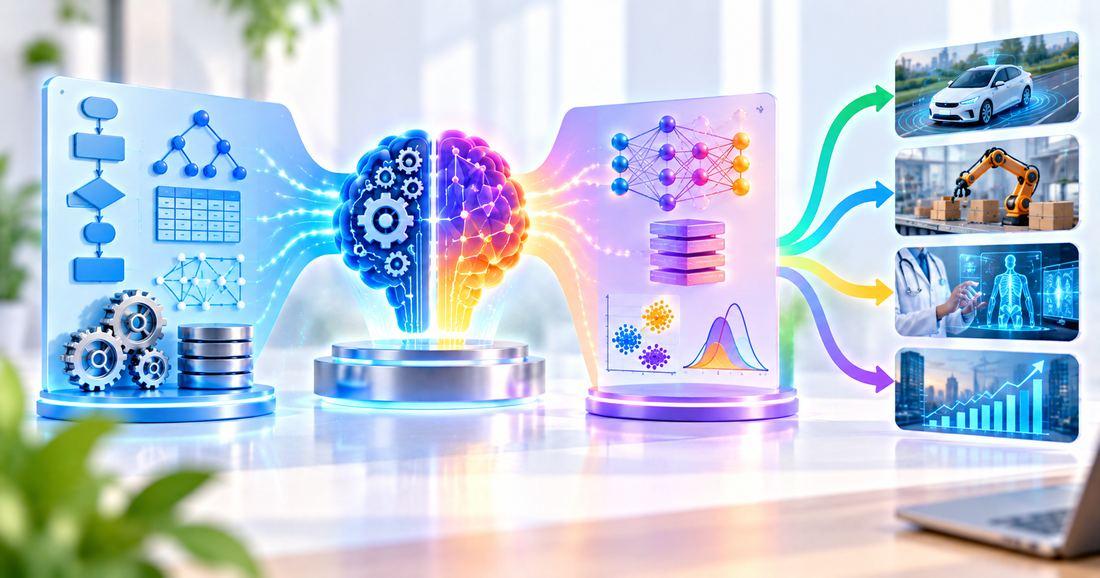
Section 1: Why Modern AI Systems Need Both Machine Learning and Traditional Algorithms
Artificial intelligence is often described as a competition between machine learning and traditional programming. Machine learning systems learn patterns from data, while traditional algorithms follow explicitly defined instructions. In practice, however, many successful AI applications use both approaches because real-world problems rarely consist entirely of patterns or entirely of deterministic rules.
A fraud detection platform, for example, may use machine learning to estimate the probability that a transaction is suspicious while deterministic rules immediately block transactions associated with known compromised credentials. A recommendation engine may predict what a user is likely to prefer while a traditional algorithm ensures that unavailable products are excluded. An autonomous system may rely on machine learning to interpret its surroundings while conventional planning algorithms determine how an action should be executed safely.
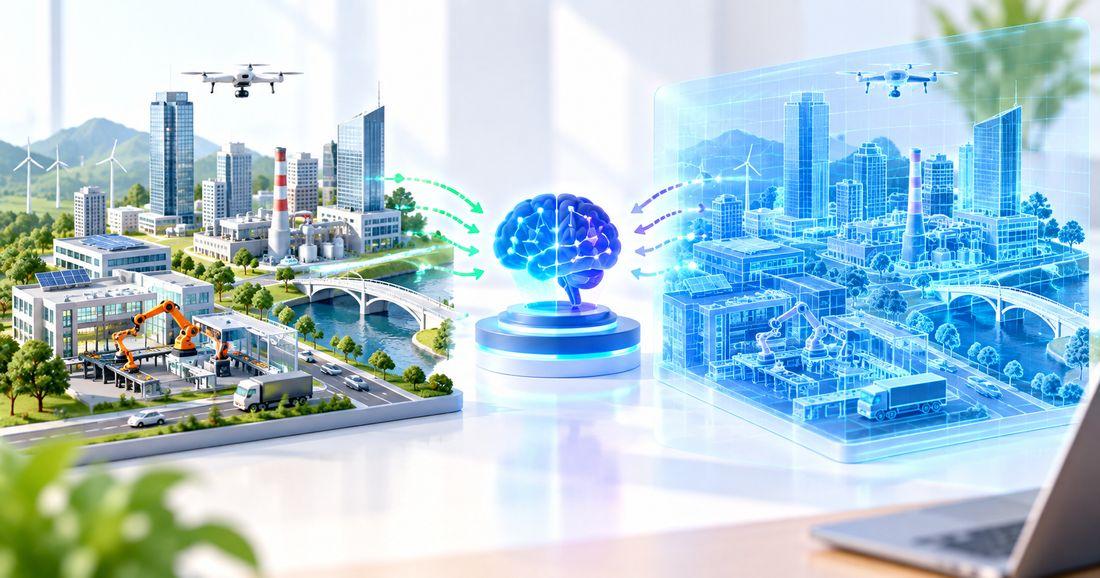
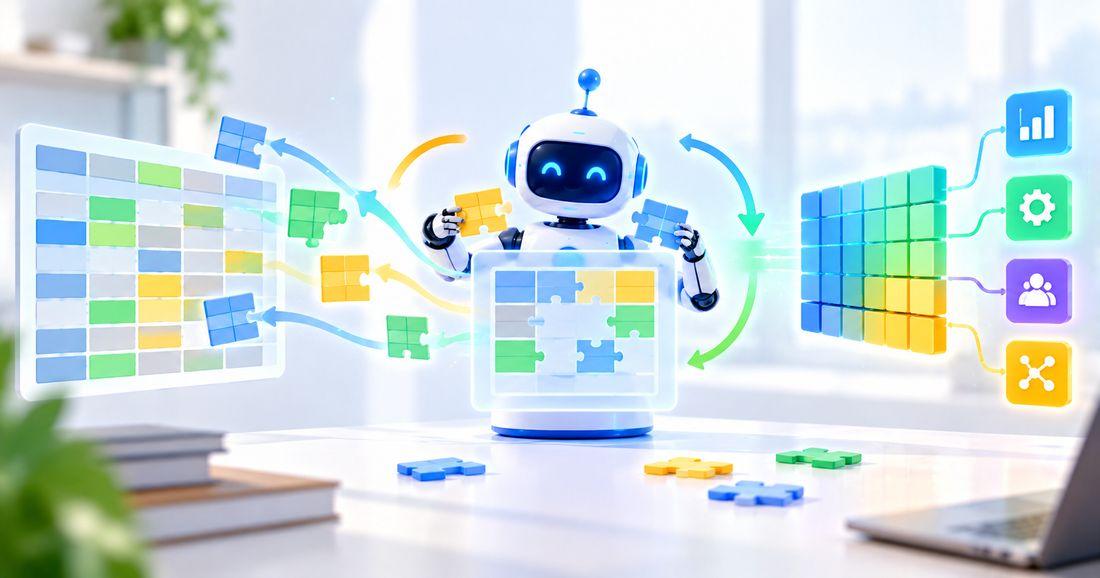
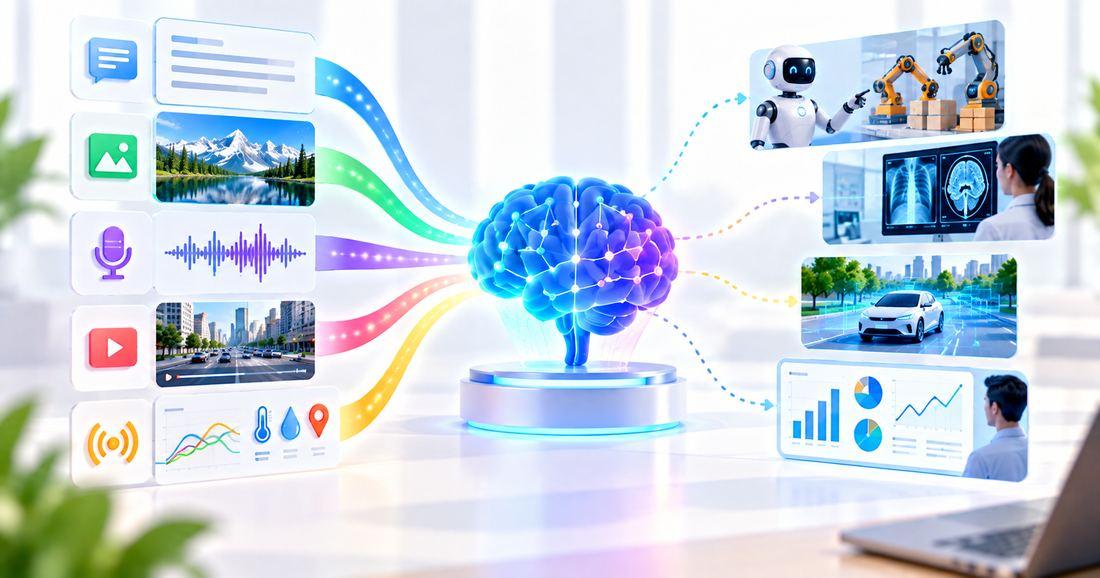
These architectures are examples of Hybrid AI, where learned intelligence and explicitly engineered computation work together.
Machine Learning Is Powerful but Not Universal
Machine learning is particularly effective when patterns are difficult to describe through fixed instructions. Images, language, customer behavior, and complex time-series signals often contain relationships that are impractical to encode manually.
A model can learn those patterns from historical examples and generalize them to new inputs. This capability has enabled major advances in computer vision, speech recognition, natural language processing, recommendation systems, and predictive analytics.
However, machine learning also has limitations.
A learned model is probabilistic. Its behavior can change when its inputs change, and it may produce incorrect predictions when it encounters situations that were poorly represented during training. It may also struggle to enforce precise business constraints unless those constraints are explicitly represented in the system.
Traditional algorithms can provide that missing structure.
Traditional Algorithms Provide Determinism
Traditional algorithms are well suited to problems where the desired behavior can be explicitly defined.
Sorting, shortest-path computation, scheduling, database operations, constraint checking, optimization, and rule evaluation are examples where deterministic methods can be highly efficient and predictable.
Consider an AI system that recommends a delivery route. Machine learning may estimate traffic conditions or delivery times, but a route planner can enforce hard constraints such as vehicle capacity, restricted roads, delivery windows, and legal requirements.
The two approaches therefore solve different parts of the problem.
Machine learning estimates what is likely to happen.
An algorithm determines what is permitted or computationally optimal under defined constraints.
This distinction is fundamental to Hybrid AI.
Rules Can Strengthen Learned Models
Rules are sometimes viewed as outdated because they require engineers to specify behavior manually. In production AI, however, rules can serve as valuable guardrails around probabilistic models.
A machine learning model might classify an incoming transaction as low risk. A deterministic rule can still reject it when the transaction violates an explicit security requirement.
Similarly, an AI assistant might interpret a user's request correctly but still need a workflow engine to verify permissions before performing an operation.
Rules can therefore provide hard boundaries around learned behavior.
This becomes particularly important when certain requirements are non-negotiable. Regulatory conditions, access controls, safety constraints, contractual policies, and operational limits may need deterministic enforcement rather than probabilistic inference.
Optimization and Machine Learning Solve Different Problems
Optimization algorithms are another important component of Hybrid AI.
Machine learning can estimate demand, predict costs, or rank possible choices. Optimization can then use those predictions to determine the best decision subject to constraints.
For example, a forecasting model may predict demand for thousands of products. An optimization algorithm can use those forecasts to determine inventory allocation while respecting warehouse capacity, transportation limits, and service requirements.
In such a system, the machine learning model does not replace optimization.
It supplies better estimates to an optimization process.
This separation can make the overall system easier to reason about because prediction and decision-making are treated as related but distinct problems.
Business Logic Still Matters
Enterprise AI systems operate within real business processes. Those processes contain policies accumulated through regulation, operational experience, contracts, and organizational requirements.
Some of those policies are suitable for machine learning.
Others are better represented explicitly.
For example, a machine learning system may determine that a customer is likely to need support. A traditional workflow can then determine which team is authorized to handle the case, what service-level agreement applies, and which actions require approval.
The AI component provides intelligence.
The surrounding software provides control.
This division is one reason Hybrid AI can be more practical than attempting to make every component adaptive.
It aligns with the principle discussed in “When Machine Learning Should Not Be Used: A Guide to Better Technical Decisions,” where the critical engineering question is whether machine learning is actually the appropriate tool for a particular component of a system.
Hybrid AI Reflects How Complex Systems Actually Work
Most real-world applications already contain combinations of prediction, business logic, optimization, databases, workflows, and deterministic computation.
Hybrid AI formalizes this reality.
Instead of asking whether the entire application should be machine learning-driven, engineers can break the problem into components and determine which parts benefit from learning and which are better handled through explicit algorithms.
This can produce systems that are more controllable, explainable, and operationally practical without giving up the pattern-recognition capabilities of modern machine learning.
The important architectural shift is therefore not from traditional algorithms to machine learning.
It is from single-technique systems to coordinated intelligent systems.
Key Takeaway
Hybrid AI recognizes that machine learning and traditional algorithms solve different classes of problems. Machine learning excels at discovering patterns and making predictions, while rules, optimization, search, and deterministic logic provide control, constraints, and predictable execution. Combining these capabilities allows engineers to build AI systems that are not only intelligent, but also more controllable, reliable, and aligned with real-world operational requirements.
Section 2: How Hybrid AI Combines Learning, Rules, Optimization, and Reasoning
The value of Hybrid AI comes from assigning different responsibilities to different computational approaches. Machine learning can recognize patterns and estimate uncertain outcomes, while traditional algorithms can apply constraints, execute deterministic workflows, search solution spaces, and optimize decisions. The challenge is designing these components so they work together without creating conflicting behavior or unnecessary complexity.
Separating Prediction From Decision-Making
One of the most useful Hybrid AI patterns is separating prediction from decision-making.
A machine learning model may estimate that a customer has a high probability of cancelling a subscription. That prediction does not necessarily determine what the organization should do. A decision layer can consider eligibility rules, available retention offers, customer preferences, and operational constraints before selecting an action.
The same pattern appears in logistics. A machine learning model can predict delivery demand or estimated travel times, while an optimization algorithm determines how vehicles should be allocated.
This separation allows each component to focus on what it does best.
The model handles uncertainty.
The algorithm handles constraints and decisions.
Rules as Guardrails Around Machine Learning
Rules can serve as explicit boundaries around probabilistic predictions.
Suppose a machine learning model evaluates whether a financial transaction appears legitimate. The model can produce a risk score, but deterministic security rules may still reject transactions associated with known compromised credentials or prohibited conditions.
This architecture prevents the learned component from becoming the sole authority.
Rules can also provide override mechanisms when organizations need predictable treatment for specific conditions. A model may recommend an action, while a policy layer verifies whether that action is permitted.
This creates a practical combination of adaptability and control.
The relationship between these approaches reflects the broader question explored in “How ML Teams Choose Between Rules, Statistics, and Machine Learning.” Different parts of a problem can require fundamentally different forms of computation, and selecting the right mechanism is itself an engineering decision.
Machine Learning Can Improve Traditional Algorithms
Hybrid AI does not require machine learning to control traditional algorithms. In many systems, the relationship works in the opposite direction.
A conventional algorithm may already provide the correct optimization framework, but its performance depends on estimates that are difficult to calculate manually.
Machine learning can provide those estimates.
A supply-chain optimizer may use a demand forecasting model to estimate future inventory requirements. A scheduling algorithm may use machine learning to predict processing times. A route planner may consume learned predictions about traffic, delivery duration, or equipment availability.
The traditional algorithm remains responsible for satisfying constraints and finding feasible solutions.
Machine learning simply provides better information.
This is an important distinction because prediction accuracy and decision quality are not always the same thing.
Optimization as the Decision Layer
Optimization is particularly powerful when a system must choose among many possible actions while respecting constraints.
Consider workforce scheduling. Machine learning can predict staffing demand for different time periods. An optimization algorithm can then assign employees while respecting availability, labor requirements, contractual conditions, and coverage targets.
The model does not need to learn every possible scheduling rule.
The optimizer already understands the mathematical structure of the decision problem.
This can produce a cleaner architecture than attempting to encode every constraint into the machine learning model itself.
The same principle applies to inventory planning, resource allocation, portfolio construction, network routing, and production scheduling.
Search and Planning With Learned Guidance
Traditional search algorithms can also work alongside machine learning.
A machine learning model can estimate which options are likely to be promising, while a search or planning algorithm systematically explores the available solution space.
This pattern is useful when the final solution must satisfy explicit requirements.
The learned component can improve efficiency by prioritizing promising candidates, while the algorithm preserves structured exploration and verification.
In complex decision systems, this combination can be more effective than relying entirely on either learned prediction or exhaustive search.
Symbolic Knowledge and Learned Representations
Hybrid AI can also combine machine learning with explicitly represented knowledge.
A neural model may extract meaning from unstructured text or images, while a symbolic component reasons over known entities, relationships, definitions, or constraints.
For example, an enterprise AI system may use a machine learning model to interpret a natural-language request and then use a knowledge graph or rule engine to determine which entities are relevant and which actions are permitted.
This approach is especially valuable when domain knowledge changes independently of model training.
A policy can sometimes be updated in the symbolic layer without retraining the entire model.
Feedback Between Components
The strongest Hybrid AI architectures are often not simple pipelines where one model produces an output and another component accepts it blindly.
Components can provide feedback to one another.
A rule engine may reject an infeasible prediction.
An optimizer may identify that the model's recommendation cannot satisfy operational constraints.
A validation layer may request another prediction when the first result appears uncertain.
This creates a system in which learned and deterministic components interact continuously.
The architecture therefore behaves less like a single model and more like a coordinated decision system.
Choosing the Right Boundary
The hardest design decision is determining exactly where machine learning should stop and traditional computation should begin.
Tasks involving uncertain patterns often benefit from learning. Tasks involving explicit constraints, calculations, deterministic policies, or guaranteed procedures often benefit from traditional algorithms.
The boundary should be based on the nature of the problem rather than enthusiasm for a particular technology.
When the division is well designed, Hybrid AI can provide both adaptability and control.
Key Takeaway
Hybrid AI combines machine learning with rules, optimization, search, planning, and symbolic reasoning by giving each component a clearly defined responsibility. Machine learning can estimate uncertain outcomes, while traditional algorithms enforce constraints, optimize decisions, and provide deterministic control. The most effective architectures create deliberate interactions between these components rather than forcing one technique to solve every part of the problem.
Section 3: Designing Reliable Hybrid AI Systems for Production
Building a Hybrid AI system is not simply a matter of placing a machine learning model in front of a rules engine. Production reliability depends on defining clear boundaries between learned and deterministic components, controlling how information moves between them, and ensuring failures in one layer do not create unsafe behavior.
Define Clear Responsibilities
The first design principle is to give every component a precise responsibility. A machine learning model may classify an input, estimate demand, rank alternatives, or predict a probability. A rules engine can validate whether the output satisfies explicit policies. An optimizer can select the best feasible action, while a workflow engine executes the approved operation.
When responsibilities overlap unnecessarily, debugging becomes difficult. Engineers may not know whether an incorrect outcome originated from the model, a rule, an optimization objective, or an integration layer.
Keep Hard Constraints Outside the Model
Rules that must never be violated are often better enforced explicitly. A machine learning model may estimate which financial action appears appropriate, but account permissions, transaction limits, regulatory requirements, and approval policies should not depend solely on model behavior.
Keeping such constraints outside the learned component provides deterministic protection when the model encounters unfamiliar inputs. A model can propose; a deterministic layer can verify.
Design for Uncertainty
Machine learning outputs contain uncertainty, so a Hybrid AI architecture should make it visible. A model can provide a probability, confidence score, or ranked alternatives. The surrounding system can then determine what happens next.
High-confidence predictions might enter a controlled workflow. Low-confidence results can trigger additional validation, another model, or human review.
This turns uncertainty into an operational signal rather than a metric seen only during evaluation.
Resolve Conflicts Explicitly
Hybrid systems can produce conflicting recommendations. A model may suggest an action that violates a business rule, while an optimizer may find a feasible solution that conflicts with an operational preference.
The system therefore needs a defined precedence mechanism. Hard constraints should be distinguishable from soft preferences, and deterministic safety conditions should not be silently overridden by probabilistic outputs.
Monitor Components Separately
A single accuracy metric is rarely enough for a Hybrid AI application. The machine learning component needs monitoring for drift, prediction distributions, latency, and downstream performance. Rules need monitoring for execution failures and unexpected trigger rates. Optimization components require monitoring of feasibility and solver behavior.
The integration layer also needs observability. A model can remain accurate while a rule changes and alters the final outcome.
This aligns with “Why Machine Learning Models Behave Differently in the Real World,” because production outcomes are shaped by the environment and system surrounding the model, not by the model alone.
Key Takeaway
Reliable Hybrid AI depends on clear responsibilities, explicit constraints, uncertainty handling, conflict-resolution policies, layered monitoring, versioning, integrated testing, and controlled deployment. Machine learning should provide adaptive intelligence where it adds value, while deterministic algorithms continue to manage tasks where predictability and constraints are essential.
Section 4: Why Hybrid AI Could Define the Next Generation of Practical AI
Artificial intelligence is moving from isolated models toward complete systems that must operate within real business, technical, and physical constraints. As organizations deploy AI into workflows involving financial transactions, logistics, software operations, customer interactions, manufacturing, and decision support, the limitations of relying on a single machine learning model become increasingly visible.
A model can predict what is likely to happen, but production systems often need to answer a different question: what should happen next, given the prediction and the constraints surrounding it?
This distinction creates a growing role for Hybrid AI.
From Prediction to Decision
Machine learning is exceptionally useful for estimating uncertain outcomes. It can predict demand, identify patterns, classify content, estimate risk, or rank possible actions.
But prediction alone does not constitute a complete decision system.
A retail model might predict that demand for a product will increase. The business still needs to determine how much inventory to order while considering warehouse capacity, supplier availability, budget, and delivery schedules.
A machine learning model can provide the forecast.
An optimization algorithm can determine the feasible allocation.
This separation creates a stronger architecture because predictions and constraints are handled by mechanisms designed specifically for those responsibilities.
The principle is closely related to “From Prediction to Decision: How Machine Learning Creates Business Value.” Machine learning creates practical value when predictions are incorporated into decisions, workflows, and measurable outcomes rather than evaluated only as standalone model metrics.
Hybrid AI Can Make AI More Controllable
One reason organizations may increasingly adopt Hybrid AI is control.
Machine learning models can produce unexpected outputs when they encounter unfamiliar conditions. Traditional algorithms and explicit rules can provide boundaries around those outputs.
A customer-service model might determine that a particular response is appropriate, while a policy engine prevents the system from exposing restricted information. An AI-powered operations tool may identify a recommended infrastructure change, while a deterministic approval process ensures that high-risk changes require human authorization.
This architecture allows organizations to benefit from machine learning without giving the model unrestricted authority.
The model provides intelligence.
The surrounding system defines the operating boundaries.
Better Adaptation Without Losing Predictability
Traditional systems are predictable but can be difficult to adapt when the environment changes. Machine learning can adapt through retraining but may be harder to control precisely.
Hybrid AI provides a potential middle ground.
The learned component can respond to changing patterns in data, while explicit business rules can remain stable. When a policy changes, engineers may update the rule without retraining the model. When user behavior changes, the model can be updated without rewriting every deterministic workflow.
This separation can make large AI applications easier to maintain because different forms of change can be handled at different architectural layers.
Hybrid AI Can Improve Safety and Reliability
In many applications, the consequences of incorrect predictions are significant.
A model may incorrectly classify an event, underestimate demand, or recommend an inappropriate action. A deterministic validation layer can detect conditions that should never be accepted regardless of the model's confidence.
For example, a machine learning system may recommend an operational action, but a rule can prevent execution when critical system conditions are outside safe limits.
This creates multiple defenses.
The model provides probabilistic intelligence.
The validation layer checks explicit requirements.
The execution layer controls what is actually allowed to happen.
Such layered designs can be particularly valuable when AI is integrated into systems where failures can affect customers, finances, infrastructure, or physical equipment.
The Economics of Hybrid AI
Hybrid architectures can also improve economic efficiency when designed carefully.
Not every request needs the most computationally expensive model. A simple rule can handle deterministic cases, a lightweight model can handle routine predictions, and a more sophisticated model can be reserved for ambiguous cases.
This creates opportunities for intelligent routing.
An application might first check whether an input matches a known deterministic condition. If it does, the system can resolve the case immediately. Otherwise, the machine learning layer can analyze the situation. More complex cases can then be passed to optimization or human review.
Such architectures can reduce unnecessary model inference while preserving advanced capabilities for situations that actually require them.
Hybrid AI and AI Agents
The emergence of AI agents makes Hybrid AI particularly relevant.
An agent may use a language model to interpret a request, but completing the task requires tools, APIs, databases, permissions, validation logic, and workflow systems.
The language model provides flexible interpretation and reasoning.
Traditional software provides reliable execution.
This division is likely to remain important because generating an instruction and safely executing that instruction are fundamentally different problems.
An AI agent that can understand a request but cannot reliably enforce permissions is not production-ready. Hybrid architecture allows reasoning and execution to remain distinct while still working together.
The Future Is Likely to Be Hybrid by Default
As AI systems become more embedded in enterprise software and operational environments, the idea that every component should be learned from data becomes increasingly impractical.
Databases, compilers, schedulers, optimization engines, workflow systems, policy engines, and deterministic algorithms already solve many problems extremely well.
Machine learning adds value where uncertainty, pattern recognition, and adaptation are difficult to program explicitly.
The future therefore may not belong to systems that replace traditional software with AI.
It may belong to systems that embed AI intelligently inside traditional software architectures.
Hybrid AI provides a framework for making that transition without discarding decades of engineering practices around constraints, verification, optimization, and deterministic execution.
Key Takeaway
Hybrid AI could define the next generation of practical AI because it combines the adaptability of machine learning with the control and predictability of traditional algorithms. By separating prediction from decision-making, using rules as guardrails, applying optimization where constraints matter, and integrating learned models into established software architectures, organizations can build AI systems that are more controllable, efficient, and useful in real production environments. The future of AI is therefore likely to be less about replacing traditional algorithms and more about combining them intelligently with learned models.
Conclusion
Hybrid AI represents a practical evolution in how intelligent systems are designed. Rather than treating machine learning as a replacement for traditional algorithms, Hybrid AI combines learned models with rules, optimization, search, symbolic reasoning, workflows, and deterministic software to solve different parts of a problem.
This approach reflects an important reality of production engineering: not every problem requires machine learning.
Machine learning is particularly valuable when the underlying relationship is difficult to define explicitly. It can recognize patterns in images, text, customer behavior, sensor data, and other complex inputs. Traditional algorithms are often better suited to deterministic calculations, hard constraints, optimization, database operations, scheduling, and policies that must be enforced consistently.
The strength of Hybrid AI comes from combining these capabilities deliberately.
A machine learning model can predict demand while an optimization algorithm determines how inventory should be allocated. A language model can interpret a user's request while a rules engine verifies permissions before an action is executed. A fraud model can produce a risk score while deterministic rules enforce known security constraints.
This division creates systems that can benefit from machine learning's adaptability without abandoning the reliability of established computational methods.
The architecture also changes how engineers think about AI system boundaries. Instead of asking whether an entire application should be powered by machine learning, teams can decompose the application into individual responsibilities and determine which mechanism is best for each component.
This is particularly important for complex enterprise environments where business policies, regulatory requirements, operational constraints, and safety conditions cannot always be learned reliably from historical data.
Hybrid AI can also improve efficiency.
A simple rule can resolve a straightforward case without invoking an expensive model. A lightweight model can handle routine situations, while a more sophisticated model can be reserved for ambiguous cases. An optimizer can then select among feasible actions when constraints matter.
This creates an opportunity to use computational resources more selectively.
At the same time, Hybrid AI introduces its own engineering challenges. Multiple components create more dependencies, more possible failure points, and more complex debugging requirements. Teams need to establish clear responsibilities, define precedence between rules and model outputs, monitor each component independently, and maintain versioning across models, rules, data pipelines, optimization configurations, and workflows.
The system must also be evaluated as a whole.
A machine learning model may have excellent predictive performance while the overall application produces poor outcomes because of an incorrect rule, optimization objective, integration error, or stale business policy. Model metrics are therefore only one part of the evaluation framework.
The future of AI is unlikely to be a simple transition from traditional software to entirely learned systems.
Instead, machine learning will increasingly become one component within larger intelligent architectures.
AI agents already illustrate this direction. A model may interpret language and reason about a task, while conventional software handles authentication, API calls, databases, validation, transactions, and execution. The intelligence of the system comes from the combination.
This makes Hybrid AI especially relevant as AI moves deeper into production environments.
The most effective architecture will not necessarily be the one containing the largest model or the greatest amount of automation. It will be the architecture that places learning where uncertainty exists, deterministic logic where guarantees matter, and optimization where constrained decisions must be made.
The central lesson is simple: AI does not need to replace traditional algorithms to become more powerful. It can become more useful by working with them.
Hybrid AI provides a framework for building systems that combine adaptability with control, prediction with decision-making, and learned behavior with explicit engineering knowledge. As organizations move from AI experimentation toward dependable production systems, this combination is likely to become an increasingly important foundation for practical artificial intelligence.
Frequently Asked Questions
1. What is Hybrid AI?
Hybrid AI is an approach that combines machine learning with traditional computational techniques such as rules, optimization, search, symbolic reasoning, and deterministic algorithms. Each component handles the part of the problem for which it is most appropriate.
2. Why combine machine learning with traditional algorithms?
Machine learning is effective at recognizing patterns and handling uncertainty, while traditional algorithms are often better at enforcing constraints, performing deterministic calculations, and executing predictable workflows. Combining them can provide both adaptability and control.
3. Is Hybrid AI the same as traditional rule-based AI?
No. Rule-based AI relies primarily on explicitly programmed logic. Hybrid AI incorporates machine learning alongside rules or other traditional algorithms, allowing the system to combine learned behavior with deterministic reasoning.
4. What role do rules play in Hybrid AI?
Rules can act as guardrails around machine learning models. They can enforce policies, permissions, regulatory conditions, safety requirements, or other constraints that should not depend entirely on probabilistic model behavior.
5. How does optimization work with machine learning?
A machine learning model can provide predictions or estimates, such as demand forecasts or processing times. An optimization algorithm can then use those estimates to select an action while satisfying constraints such as capacity, budget, scheduling, or resource availability.
6. Can Hybrid AI improve model reliability?
It can provide additional control mechanisms around machine learning predictions. Validation rules, constraints, fallback logic, and human review can reduce the consequences of certain model errors. However, overall reliability still depends on how the complete system is designed and tested.
7. What is the difference between prediction and decision-making?
Prediction estimates what is likely to happen or assigns probabilities to possible outcomes. Decision-making determines what action should be taken after considering predictions, constraints, objectives, policies, and available alternatives. Hybrid AI often separates these responsibilities.
8. How is Hybrid AI used in fraud detection?
A machine learning model can identify statistical patterns associated with suspicious transactions and produce a risk score. Traditional rules can independently enforce known restrictions, account limits, or security policies before the final action is taken.
9. How is Hybrid AI used in logistics?
Machine learning can predict demand, delivery times, or traffic conditions, while optimization algorithms determine routes, inventory allocations, or schedules subject to operational constraints.
10. Can Hybrid AI be used with large language models?
Yes. A language model can interpret instructions, summarize information, or generate a proposed action, while deterministic software handles permissions, database operations, API execution, validation, and workflow control.
11. Does Hybrid AI require symbolic AI?
Not necessarily. Symbolic reasoning can be one component of a Hybrid AI architecture, but hybrid systems can also combine machine learning with conventional algorithms, optimization, rules, search, planning, or workflow engines without using a formal symbolic reasoning system.
12. What are the main challenges of Hybrid AI?
Key challenges include defining component responsibilities, resolving conflicts between model predictions and rules, managing dependencies, monitoring system behavior, maintaining version consistency, testing component interactions, and determining where machine learning actually adds sufficient value.
13. Is Hybrid AI more complex than using a single machine learning model?
It can be. Multiple components introduce additional interfaces and dependencies. However, separating responsibilities can also make a system easier to control and maintain when different parts of the problem have fundamentally different requirements.
14. When should traditional algorithms be preferred over machine learning?
Traditional algorithms are often appropriate when the problem has explicit rules, deterministic procedures, mathematical formulations, or hard constraints that can be solved reliably without learning from data. Using machine learning is not automatically beneficial simply because it is available.
15. What is the future of Hybrid AI?
Hybrid AI is likely to become increasingly important as organizations deploy AI into production workflows. Future systems may combine machine learning models, language models, optimization engines, rules, retrieval systems, databases, and workflow software so that learned intelligence and deterministic computation work together as a single operational system.