Section 1: Foundation Model Architectures Will Become More Efficient and Flexible
Beyond Dense Transformers: Sparse and Mixture-of-Experts Architectures
Transformer architectures have been central to modern foundation models because self-attention allows models to process relationships between tokens across a sequence. However, increasing model size creates significant computational and memory requirements.
A conventional dense transformer activates most of its relevant parameters for every input token. As model capacity grows, the computational cost of inference can become substantial.
Mixture-of-Experts (MoE) architectures offer a different approach. Instead of activating every parameter for every token, an MoE model contains multiple specialized expert networks and a routing mechanism that selects a subset of experts for each token.
A simplified MoE architecture contains three major components: a collection of expert networks, a gating or routing function, and a mechanism that combines the outputs of selected experts.
The routing mechanism determines which experts should process a particular input. Consequently, a model can contain a large number of total parameters while activating only a smaller subset during a forward pass.
This creates a distinction between total parameter count and active parameters.
For example, a hypothetical MoE model may contain 200 billion total parameters but activate only 20 billion parameters for a particular token. The model retains substantial representational capacity without requiring every expert to participate in every computation.
However, sparse activation does not automatically make a model inexpensive. Expert placement, communication between devices, routing balance, and memory management introduce additional engineering complexity.
In distributed deployments, tokens may need to move between GPUs depending on which experts are selected. This can create all-to-all communication overhead and uneven workload distribution if some experts receive significantly more traffic than others.
Engineers therefore need to consider both the model architecture and the hardware environment in which it operates.
MoE architectures are likely to remain an important design option because they offer a way to balance model capacity and active computation. However, dense transformers will continue to be relevant where predictable execution, simpler deployment, or specialized hardware efficiency makes them preferable.
The future is more likely to involve a mixture of architectural approaches than the complete replacement of dense transformers.
Hybrid Architectures: Combining Transformers With State-Space Models
Another important research direction involves combining transformer architectures with alternative sequence-processing mechanisms.
Transformers are powerful, but standard attention mechanisms can create substantial computational and memory costs as context length increases. For long sequences, attention-related computation and key-value cache requirements become important deployment constraints.
State-space models (SSMs) provide an alternative approach to sequence modeling. Architectures such as Mamba use structured state representations to process sequential information without relying on conventional full attention at every position.
The basic idea is to maintain and update a hidden state as the model processes a sequence. Rather than explicitly computing interactions between every pair of tokens, the architecture uses a structured mechanism to propagate information over time.
This can improve computational efficiency for certain sequence-processing workloads.
Hybrid architectures combine the strengths of multiple approaches. A model might use attention layers where explicit long-range interaction is valuable while using state-space or recurrent components to process other portions of the sequence more efficiently.
The motivation is not simply to reduce computation. Engineers also want to preserve reasoning quality, contextual understanding, and the ability to retrieve information from earlier parts of a sequence.
Hybrid architectures are especially interesting for workloads involving long documents, continuous data streams, and time-series information.
However, their practical advantages depend on the architecture, training process, hardware implementation, and task. A more efficient theoretical complexity does not automatically translate into better end-to-end performance on every accelerator.
Engineers should therefore expect architectural experimentation rather than a single successor to the transformer.
Attention Optimization and the Economics of Long Context
Long-context processing is becoming an increasingly important capability for foundation models.
A model that can process large amounts of contextual information may be useful for analyzing extensive code repositories, reviewing legal documents, understanding long conversations, and processing large collections of technical records.
However, context length creates substantial engineering challenges.
In standard transformer attention, the computational requirements of processing a sequence can grow quadratically with sequence length under conventional full-attention implementations. During autoregressive generation, the key-value cache also grows as additional tokens are processed.
Several architectural and systems-level techniques help address these limitations.
Grouped-query attention reduces the number of key-value heads relative to query heads, lowering the memory requirements of the KV cache. Multi-query attention takes this idea further by sharing key-value representations across query heads.
Sliding-window attention restricts attention to a local region of the sequence, reducing the number of interactions that must be computed. Some architectures combine local attention with selected global attention layers to preserve longer-range information.
Paged attention and related memory-management techniques improve how inference servers allocate and reuse KV-cache memory across concurrent requests.
These improvements matter because context length is not only a model capability. It is also an infrastructure cost.
An application that accepts a million-token context does not necessarily need to send a million tokens with every request. Engineers must decide which information is relevant, how it should be represented, and whether retrieval or persistent memory is more efficient than repeatedly passing large contexts.
A strong production architecture may combine context-window capabilities with document retrieval, summarization, structured memory, and selective context injection.
This is particularly important for applications that need to maintain information across multiple sessions or process continuously changing data.
Smaller, Specialized, and Efficient Foundation Models
The assumption that larger models are always better is becoming increasingly difficult to justify in production engineering.
A large general-purpose model may perform well across many tasks, but it can be expensive to host, slow to serve, and unnecessarily complex for narrow application requirements.
Smaller foundation models offer an alternative.
A compact model trained or adapted for a particular domain may perform sufficiently well for tasks such as classification, information extraction, document routing, code completion, or structured response generation.
Techniques such as knowledge distillation, quantization, parameter-efficient fine-tuning, and careful data curation help reduce deployment requirements.
Knowledge distillation transfers behavior from a larger teacher model to a smaller student model. Quantization reduces numerical precision to decrease memory and computational requirements. Parameter-efficient fine-tuning methods, including LoRA, update a relatively small number of additional parameters rather than retraining the entire model.
Microsoft's Phi-4-reasoning-vision-15B technical report provides a useful example of this direction. It describes an open-weight multimodal reasoning model designed to balance capability and computational efficiency through architecture choices, data curation, and training methodology. The report also discusses performance on scientific reasoning and user-interface understanding tasks.
For engineers, this suggests that model selection will increasingly become a workload optimization problem.
A large model may handle complex reasoning, while smaller models process simpler requests. A routing layer can decide which model should receive each task based on complexity, latency requirements, and expected cost.
This approach can improve system economics without requiring every request to use the most computationally expensive model available.
Key Takeaway
The next generation of foundation models will likely involve greater architectural diversity. Sparse MoE models, transformer-state-space hybrids, optimized attention mechanisms, and smaller specialized models offer different ways to balance capacity, inference cost, and performance. Engineers should focus on understanding the computational characteristics of these architectures rather than assuming that parameter count alone determines model quality. For additional context on compute-efficient architectures, explore "Efficient ML: How to Build High-Performance Models With Less Compute".
Section 2: Multimodal Intelligence Will Become a Core Foundation Model Capability
From Language Models to Native Multimodal Models
Early large language models primarily processed text. Image and audio capabilities were often introduced through separate encoders, adapters, or additional processing components.
This approach allowed developers to build useful multimodal applications, but it could also create limitations in how information from different modalities was represented and integrated.
The next generation of foundation models is moving toward increasingly unified multimodal processing.
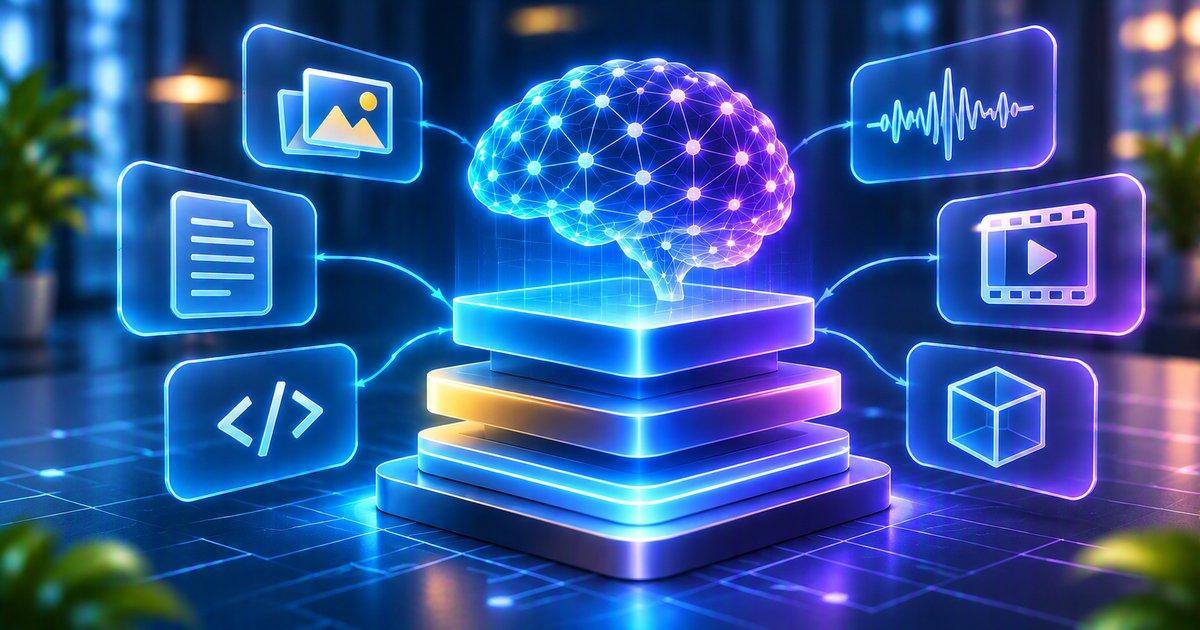
A multimodal model can accept different forms of input, including text, images, audio, and video. Depending on its architecture, it may also generate outputs across multiple modalities.
Native multimodal modeling attempts to integrate these capabilities more deeply into the model's architecture and training process rather than treating every modality as an independent add-on.
This matters because real-world information rarely arrives in a single format.
A software engineer debugging a user-interface issue may need to provide a screenshot, a written description, and an application log. A healthcare research application may need to interpret text alongside medical images and structured patient information. A robotics system may need to process camera input, sensor readings, and natural-language instructions.
A model that can reason across these inputs may provide a more unified interface for complex applications.
However, multimodal integration introduces challenges involving representation alignment, synchronization, data quality, and cross-modal reasoning.
The model must understand how different input types relate to one another. Recognizing an object in an image is not the same as understanding how it relates to a spoken instruction or a sequence of events in a video.
Engineers should therefore evaluate multimodal models based on cross-modal task performance rather than assuming that support for multiple input formats guarantees integrated understanding.
Real-Time Audio and Video Understanding
Audio and video are particularly important areas of multimodal development because they introduce temporal information.
An image represents a visual state at a particular moment. Video contains a sequence of states, while audio contains time-dependent signals, speech, environmental sounds, and other acoustic information.
A model that processes video effectively needs to understand more than individual frames. It may need to identify actions, track objects, recognize changes, and interpret relationships between events.
Similarly, audio applications may need to perform speech recognition, speaker identification, language understanding, emotion-sensitive interaction, and speech generation.
Real-time multimodal systems introduce additional engineering requirements.
A video-processing application may receive a continuous stream of frames. Processing every frame at full resolution can be expensive, so the system may need frame sampling, adaptive resolution, event detection, and selective processing.
An audio assistant must manage streaming input, partial transcription, turn-taking, interruptions, and low-latency response generation.
Synchronization is another major challenge. The model must relate information from different modalities that occurs at corresponding points in time.
Consider a real-time technical support assistant that watches a user share their screen while explaining a software problem. The system needs to connect spoken instructions with visual changes, identify relevant interface elements, and maintain the relationship between earlier and later events.
This is more complex than separately generating a transcript and describing screenshots.
Native multimodal architectures and improved temporal reasoning could make such applications more capable, but reliable real-time deployment will still depend on streaming infrastructure, buffering, synchronization, and efficient inference.
Vision-Language-Action Models and the Move Toward Embodied AI
Multimodal foundation models are also expanding beyond perception and text generation toward systems that interact with physical or digital environments.
Vision-language-action (VLA) models connect visual observations and language instructions with actions.
A traditional vision-language model might identify objects in an image or describe a scene. A VLA model aims to use visual and language information to determine what action should be taken.
For example, a robotic system might receive the instruction to pick up a particular object. It must interpret the scene, identify the object, understand spatial relationships, and generate appropriate movement commands.
Similar principles apply to digital environments. An AI system interacting with a graphical user interface may need to understand screenshots, identify controls, click buttons, enter information, and verify whether an operation succeeded.
This direction creates a bridge between foundation models and autonomous systems.
However, action generation introduces safety requirements that are less prominent in ordinary text generation.
A generated explanation can be reviewed before being used. A physical robot or autonomous software agent may execute an action that changes the environment immediately.
Engineers must therefore separate perception, planning, action authorization, and execution. They should also implement safety constraints, state validation, and recovery mechanisms.
Research on vision-language-action systems is progressing, but broad general-purpose embodied intelligence remains a difficult research problem. Reliable action execution requires more than recognizing objects and following instructions.
World Models: Learning How Environments Change
A world model is a learned representation of an environment that supports predicting how that environment may evolve.
Rather than simply identifying what is present in an input, a world model attempts to represent relationships between states and predict possible future states.
This is particularly relevant to robotics, autonomous navigation, simulation, and planning.
Imagine an autonomous vehicle approaching an intersection. The system needs to interpret the current road scene, but it must also reason about how nearby vehicles, pedestrians, and traffic conditions may change.
A predictive representation of the environment can help the system evaluate possible actions before executing them.
One research direction involves joint-embedding predictive architectures, or JEPA-style models. These approaches learn representations that predict aspects of future or missing information in an embedding space rather than necessarily reconstructing every detail of the original input.
This can reduce the need to model irrelevant low-level details when the task is focused on understanding meaningful structure.
Meta's JEPA research, including V-JEPA work, illustrates efforts to learn representations from visual information and predict aspects of the world without relying exclusively on conventional generative reconstruction.
However, world models should not be confused with fully reliable physical simulators. Their predictions are learned approximations, and errors can become significant when the environment differs from training conditions.
For engineers, world models represent an important research direction because they may support planning, simulation, and decision-making systems. Their practical value will depend on predictive accuracy, uncertainty estimation, and safe integration with downstream control systems.
Key Takeaway
Foundation models are moving beyond text toward systems that understand and generate information across images, audio, video, and action-oriented environments. Native multimodal architectures, temporal reasoning, vision-language-action models, and world models could enable more sophisticated applications. However, cross-modal consistency, synchronization, uncertainty, and action safety remain important engineering challenges. The most useful systems will combine multimodal capabilities with carefully designed application infrastructure. For a deeper look at real-time data and model interaction, read "Streaming Machine Learning: Building Models That Learn From Data in Real Time".
Section 3: Reasoning, Test-Time Compute, and Agentic Capabilities Will Redefine Model Usage
Reasoning Models and the Shift Toward Inference-Time Computation
Traditional language model inference generally involves generating a response token by token based on the model's learned parameters and supplied context.
Reasoning-oriented models introduce additional computation during inference to improve performance on tasks that require multi-step problem solving.
Instead of immediately producing an answer, the system may allocate additional computation to analyze a problem, explore intermediate steps, verify candidate solutions, or evaluate alternative approaches.
This is commonly described as test-time compute or inference-time scaling.
The underlying idea is that some problems benefit from spending more computation during inference rather than relying entirely on additional model parameters or training data.
For example, a model answering a simple factual question may require only a short generation process. A model solving a complex mathematical problem may benefit from additional reasoning steps, candidate generation, or verification.
This introduces an important trade-off.
Additional inference-time computation can improve performance on certain difficult tasks, but it increases latency and computational cost. It may also produce diminishing returns when the model continues reasoning without gaining useful information.
Engineers need to determine when additional reasoning is justified.
A production application could use a lightweight model for simple requests and route complex requests to a reasoning-capable model. Another approach is to use a verification step only when the initial response has low confidence or when the task has a high cost of error.
The Stanford AI Index 2026 highlights the rapid improvement of reasoning-related benchmark performance, while also noting that evaluation benchmarks can become saturated quickly. This makes it important to measure real application performance rather than treating benchmark results as universal evidence of reasoning ability.
Search, Verification, and Deliberate Problem Solving
More advanced reasoning systems may combine internal computation with external search and verification.
A model can generate several candidate solutions, compare them, use tools to validate intermediate results, and select an output that satisfies the task requirements.
This is particularly useful in domains where correctness can be checked.
For example, a coding assistant can generate a solution, execute unit tests, inspect failures, modify the code, and repeat the process. A mathematical reasoning system can use symbolic tools or numerical calculations to verify intermediate results.
The model is no longer relying exclusively on its next-token predictions. It is participating in a larger computational process.
Search-based methods and verifier-guided generation can improve the reliability of some reasoning tasks, but they introduce additional complexity.
The system needs a reliable way to determine whether a candidate solution is valid. If the verifier is weak or shares the same blind spots as the generator, the process may repeatedly select incorrect answers.
There is also a resource-management problem. Generating and checking multiple candidates increases compute consumption.
Engineers must decide how many candidates to explore, when to stop, which verification tools to use, and how to handle cases where no candidate satisfies the required criteria.
The future of reasoning systems will therefore involve not only better model architectures but also more sophisticated orchestration and evaluation strategies.
Foundation Models Will Become More Capable Agents
An AI agent uses a model to interpret objectives, plan actions, interact with tools, and respond to the results of those interactions.
This changes the role of the foundation model.
Instead of generating a single response, an agent may execute a sequence of operations. It can inspect a repository, query a database, search documentation, call APIs, run code, and update its plan based on the results.
Consider an AI engineering assistant asked to investigate a production error.
A basic chatbot might explain the likely cause based on a pasted log. An agentic system could retrieve the relevant logs, inspect recent deployments, search the codebase, identify related changes, run diagnostic commands in a controlled environment, and prepare a proposed fix.
The foundation model supplies reasoning and decision-making capabilities, while the agent framework manages tools, state, permissions, and execution.
Future foundation models are likely to improve their ability to follow structured tool interfaces, maintain task context, and coordinate multi-step workflows.
However, agentic capabilities are not determined by the model alone.
The surrounding system must manage tool schemas, authorization, memory, execution environments, retries, and state transitions. An unreliable tool integration can cause an otherwise capable model to fail.
Engineers should therefore treat an agent as a distributed software system with a model-driven control component rather than assuming that a stronger language model automatically produces a reliable autonomous application.
Long-Horizon Planning, Memory, and Multi-Agent Collaboration
As AI agents handle more complex tasks, their ability to maintain context over longer workflows becomes increasingly important.
A task may involve dozens of steps, multiple external tools, and decisions made across different stages. Relying exclusively on a single context window can become inefficient or unreliable.
Memory systems provide one approach.
Short-term memory maintains information relevant to the current task. Long-term memory stores selected information that may be useful across sessions. External knowledge stores and databases can preserve structured records, task history, and application state.
However, memory introduces difficult design questions.
The system must determine what information should be retained, when it should be updated, how conflicting information should be resolved, and which users or processes can access it.
A second development is multi-agent collaboration.
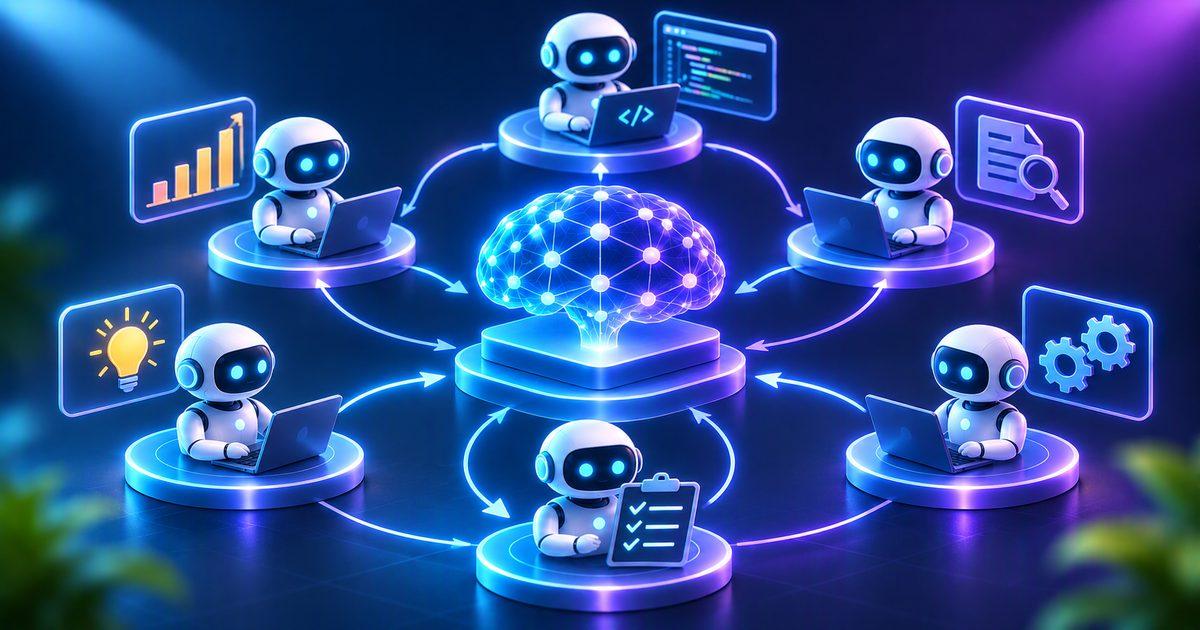
Instead of assigning an entire task to one agent, a system may divide the work among specialized agents. One agent might research a problem, another might implement code, and another might review the resulting changes.
This can improve task organization when the work is naturally separable. However, multiple agents introduce communication overhead, duplicated work, coordination failures, and additional inference costs.
A poorly designed multi-agent architecture can become more expensive and less reliable than a single-agent workflow.
The system must define responsibilities, establish clear communication protocols, manage shared state, and determine when an agent's output requires independent verification.
Research into agentic AI increasingly identifies long-horizon reliability, adversarial robustness, continual learning, and governance as unresolved challenges. These limitations are important because the ability to perform several successful tool calls does not automatically establish reliable autonomous behavior over extended tasks.
Key Takeaway
The next generation of foundation models will increasingly support reasoning-intensive and action-oriented applications. Test-time compute, search and verification, tool use, persistent memory, and multi-agent orchestration will expand what models can accomplish. However, additional reasoning and autonomy create new costs and failure modes. Engineers must design systems that control computation, validate actions, maintain state, and measure task completion rather than relying on model capability claims alone. For further reading on inference-time scaling, explore "Test-Time Compute in Machine Learning: Trading More Computation for Better Predictions".
Conclusion: The Future Belongs to Engineers Who Understand the Entire AI System
Foundation models are entering a phase in which progress will be driven by several connected areas of innovation rather than a single architectural breakthrough.
Sparse architectures and hybrid sequence models may improve computational efficiency. Native multimodal systems will make it easier to build applications that understand and generate information across different input types. Reasoning-oriented models will allocate additional computation to difficult problems, while agentic capabilities will allow models to interact with external tools and execute multi-step workflows.
At the same time, smaller specialized models and open-weight ecosystems will give organizations more options for deployment and customization.
These developments will create new opportunities, but they will also introduce engineering challenges involving inference cost, context management, distributed execution, data quality, security, evaluation, and reliability.
The most important lesson is that a foundation model should not be evaluated independently of the system in which it operates.
A powerful model can still produce an unreliable application if it receives incorrect data, uses poorly designed tools, operates without sufficient authorization, or cannot recover from infrastructure failures.
For software engineers and ML engineers, this means the value of understanding foundation models will increasingly come from knowing how to integrate them into complete production systems.
The next generation of AI will not be defined only by models that generate better answers. It will also be defined by systems that can understand multiple forms of information, reason through complex tasks, interact with the world, and operate within measurable engineering constraints.
Engineers who combine knowledge of model architectures with strong systems engineering fundamentals will be well positioned to build that future.
Frequently Asked Questions (FAQs)
1. What are foundation models?
Foundation models are large models pretrained on broad datasets that can be adapted to perform multiple downstream tasks. They can support applications such as language generation, image understanding, code generation, audio processing, and multimodal reasoning.
2. What is the next generation of foundation models expected to look like?
Future foundation models are expected to become more multimodal, computationally efficient, and capable of complex reasoning and tool use. Architectural diversity, specialized models, and improved inference techniques will also play important roles.
3. Will transformers be replaced by new AI architectures?
Transformers are likely to remain important because of their performance, ecosystem, and established training infrastructure. However, state-space models, recurrent architectures, sparse MoE systems, and hybrid designs may become increasingly important for specific workloads.
4. What are Mixture-of-Experts models?
Mixture-of-Experts models contain multiple specialized neural networks and a routing mechanism that activates a subset of experts for each input. This allows models to maintain substantial total parameter capacity while using fewer active parameters for individual computations.
5. What are multimodal foundation models?
Multimodal foundation models process information from multiple modalities, such as text, images, audio, and video. Some can also generate outputs across these modalities, supporting more complex applications that combine different types of information.
6. What is the difference between a multimodal model and a native multimodal model?
A multimodal model can work with multiple information types, sometimes using separate encoders and integration layers. A native multimodal model aims to integrate different modalities more directly into its architecture and training process.
7. What is test-time compute in AI?
Test-time compute refers to allocating additional computation during inference to improve performance on difficult tasks. Techniques may include extended reasoning, search, candidate generation, and verification.
8. How will AI agents influence foundation model development?
AI agents use foundation models to plan tasks, interact with external tools, and execute sequences of actions. Better tool use, memory management, and reasoning capabilities may make foundation models more useful in software development, research, and enterprise workflows.
9. What are world models in artificial intelligence?
World models are learned representations of environments that help systems predict how those environments may change. They are relevant to robotics, autonomous systems, planning, and simulation, although their predictions remain subject to model limitations.
10. Will smaller foundation models become more important?
Yes. Smaller models can offer lower inference costs, reduced hardware requirements, and easier deployment. They are particularly useful for specialized tasks where a large general-purpose model is unnecessary.
11. What are open-weight foundation models?
Open-weight foundation models make trained model parameters available for external use, subject to their licenses. They can support self-hosting, customization, and greater deployment control, but open weights do not necessarily imply that training data and all development artifacts are publicly available.
12. How will foundation models change software engineering?
Foundation models may increasingly assist with code generation, debugging, testing, documentation, repository analysis, and multi-step development workflows. Engineers will still need to validate outputs, manage security, and maintain architectural control.
13. What infrastructure is required to deploy advanced foundation models?
Production deployments may require GPU infrastructure, model-serving systems, distributed request scheduling, caching, data pipelines, retrieval services, observability, security controls, and evaluation frameworks. The exact requirements depend on model size, workload, and application complexity.
14. What skills should ML engineers develop to work with next-generation foundation models?
Important skills include transformer architectures, multimodal learning, inference optimization, GPU computing, distributed systems, model evaluation, data engineering, MLOps, and AI security. Practical experience deploying complete AI applications is particularly valuable.
15. Will one foundation model eventually handle every AI task?
A single model may become capable of handling a broader range of tasks, but specialized models will remain useful because different applications have different performance, latency, cost, and compliance requirements. Hybrid architectures that combine multiple models and tools may be more practical than relying on one universal model.