Section 1: Why General-Purpose AI Models Have Practical Limits
Broad Knowledge Does Not Always Produce Specialized Expertise
Large Language Models have demonstrated extraordinary versatility.
They can answer questions, generate software code, summarize documents, translate languages, explain scientific concepts, write marketing content, and perform thousands of other tasks from a single interface.
This versatility explains why foundation models have become central to modern AI applications.
However, versatility does not automatically translate into deep expertise.
A model trained on broad internet-scale datasets develops general knowledge across many subjects, but enterprise environments often demand highly specialized understanding that extends far beyond publicly available information.
Consider a healthcare organization.
Doctors expect AI systems to understand clinical terminology, treatment guidelines, diagnostic procedures, pharmaceutical interactions, and evolving medical research. Accuracy is essential because incorrect recommendations may affect patient care.
Similarly, financial institutions require AI capable of interpreting regulatory documents, analyzing complex financial statements, detecting fraudulent activity, and understanding industry-specific terminology with exceptional precision.
Legal organizations expect AI to reason about contracts, statutes, jurisdiction-specific regulations, and legal precedents without introducing inaccuracies.
These specialized requirements expose the limitations of relying solely on broad, general-purpose models.
Organizations increasingly recognize that domain expertise requires more than large training datasets.
It requires specialized knowledge integrated directly into the AI system.
Enterprise Knowledge Changes Faster Than Foundation Models
Another challenge facing general-purpose AI models is the speed at which business knowledge evolves.
Foundation models are trained periodically.
Enterprise knowledge changes continuously.
Internal documentation is updated.
Company policies evolve.
Products change.
Pricing models are revised.
Compliance requirements shift.
Engineering documentation expands.
Customer information grows daily.
Retraining a large foundation model every time organizational knowledge changes would be prohibitively expensive and operationally impractical.
Instead, enterprises increasingly build domain-specific AI systems capable of retrieving current information directly from organizational knowledge sources during inference.
This allows AI applications to provide accurate, up-to-date responses without requiring constant retraining.
As organizations accumulate increasing amounts of proprietary knowledge, integrating live enterprise information has become significantly more valuable than relying solely on static pretrained knowledge.
Different Industries Have Different Performance Requirements
Not every AI application is evaluated using the same criteria.
A creative writing assistant prioritizes fluency and creativity.
A medical diagnostic assistant prioritizes accuracy and evidence.
A financial compliance system emphasizes consistency and auditability.
A cybersecurity assistant focuses on rapid threat detection.
An industrial monitoring platform prioritizes low latency and operational reliability.
Because these objectives differ substantially, organizations increasingly optimize AI systems for their specific environments rather than expecting one model to satisfy every requirement equally well.
This specialization also extends to infrastructure.
Some applications require real-time inference measured in milliseconds.
Others prioritize deep reasoning over response speed.
Certain enterprise systems operate entirely within private cloud environments due to regulatory constraints, while others leverage public cloud infrastructure to maximize scalability.
The growing diversity of enterprise AI workloads has made specialized models and tailored deployment architectures increasingly attractive.
AI Engineering Is Moving Toward Model Ecosystems
Rather than replacing general-purpose foundation models, domain-specific AI extends their capabilities.
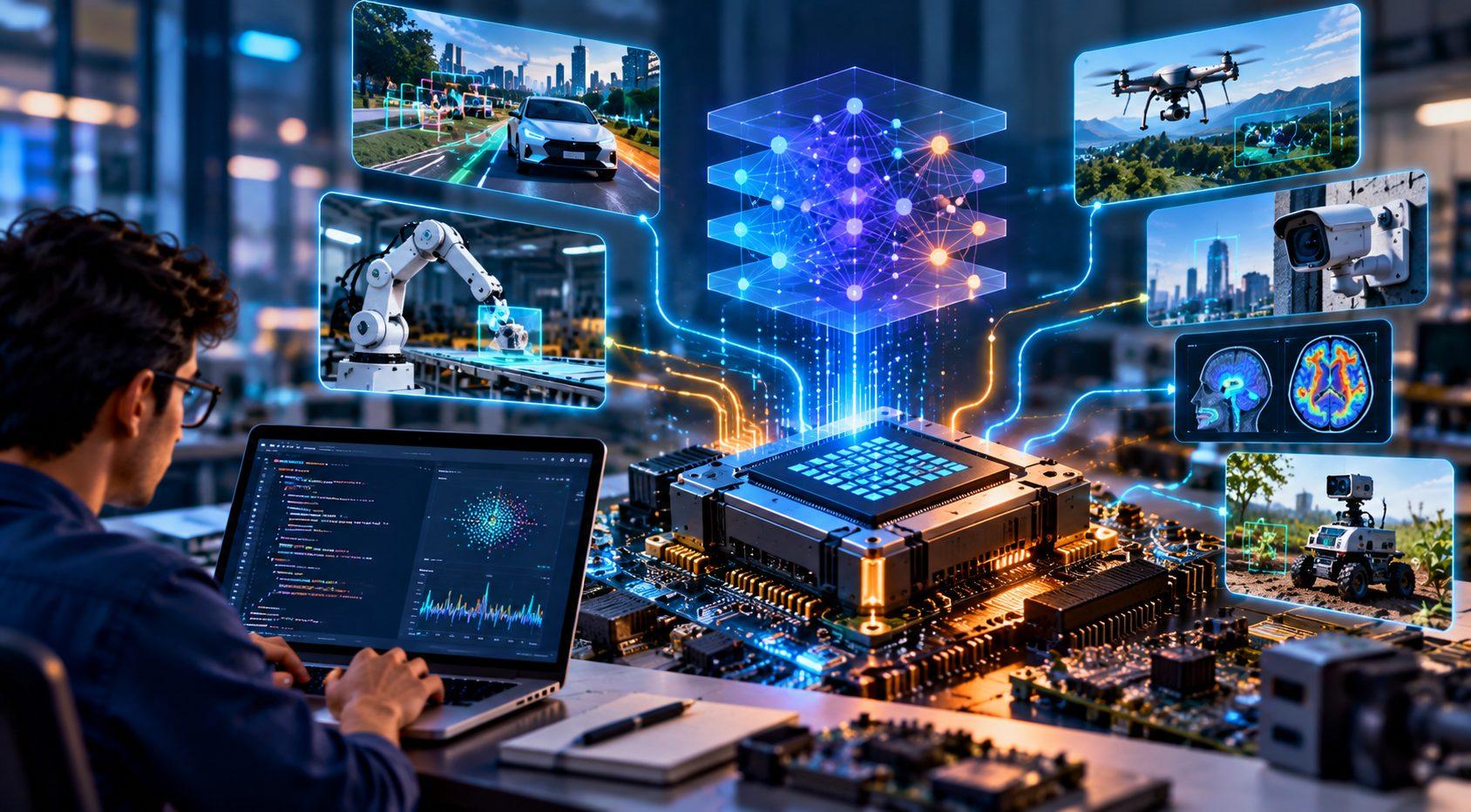
Modern enterprise architectures increasingly combine multiple specialized models into unified AI ecosystems.
A customer support platform may use one model optimized for conversational interactions, another specialized in enterprise knowledge retrieval, and a third responsible for document analysis.
A healthcare platform may combine language models with medical imaging systems and clinical decision-support models.
A software engineering platform may integrate coding models, documentation assistants, testing agents, and security analysis systems into a coordinated workflow.
The importance of designing AI systems around specialized architectures rather than relying on a single universal model is explored in "The New Architecture Patterns Powering Modern AI Applications," which explains how retrieval systems, orchestration frameworks, AI agents, memory architectures, and specialized services are reshaping enterprise AI design.
As enterprise AI continues evolving, the future belongs not to one universal model but to intelligent ecosystems where specialized models collaborate to solve complex real-world problems more effectively.
Key Takeaway
General-purpose AI models provide remarkable versatility, but enterprise applications increasingly require specialized expertise, continuously updated knowledge, industry-specific reasoning, and tailored performance characteristics. As organizations deploy AI across healthcare, finance, legal services, manufacturing, and other specialized domains, domain-specific AI models are becoming essential for delivering higher accuracy, stronger compliance, and greater business value. Modern AI engineering is therefore shifting from building one powerful model to designing intelligent ecosystems of specialized AI systems.
Section 2: How Domain-Specific AI Models Deliver Better Business Results
Specialized Training Produces Higher Accuracy
One of the primary reasons organizations are investing in domain-specific AI models is the significant improvement in accuracy they can achieve within specialized environments.
General-purpose models are trained on broad datasets that cover a wide range of topics. This broad exposure enables them to answer diverse questions, but it also limits how deeply they understand the terminology, workflows, regulations, and context of individual industries.
Domain-specific models are different.
They are optimized using specialized knowledge that reflects the language and operational requirements of a particular field.
For example, an AI model developed for healthcare understands medical terminology, clinical documentation, pharmaceutical interactions, and diagnostic procedures far better than a general-purpose assistant.
Similarly, financial AI systems recognize accounting terminology, regulatory reporting standards, fraud detection patterns, and investment concepts that rarely appear in consumer-oriented applications.
Legal AI models understand contracts, statutory language, case law, and legal reasoning with far greater precision than models trained primarily on general internet content.
This specialization enables organizations to reduce hallucinations, improve response quality, and increase confidence in AI-generated outputs.
Rather than attempting to answer every question equally well, domain-specific models focus on becoming exceptionally capable within clearly defined business domains.
Enterprise AI Benefits From Industry Knowledge
Every organization possesses valuable knowledge that is unavailable in public datasets.
Engineering documentation.
Internal policies.
Technical specifications.
Customer support procedures.
Financial reports.
Product roadmaps.
Compliance documentation.
Operational playbooks.
These resources often contain the information employees need most frequently.
General-purpose foundation models typically have no access to this proprietary knowledge.
Domain-specific AI systems bridge this gap by combining specialized models with enterprise knowledge repositories.
Instead of relying solely on pretraining, these systems retrieve relevant organizational information at the moment a user submits a request.
This approach enables AI applications to provide responses that reflect current business processes, internal terminology, organizational policies, and company-specific expertise.
For example, an AI assistant supporting software engineers can retrieve the latest API documentation before generating implementation guidance.
An HR assistant can access updated employee policies before answering questions about benefits.
A customer support assistant can retrieve the newest troubleshooting documentation before responding to customer inquiries.
This ability to combine specialized reasoning with continuously updated enterprise knowledge significantly improves both response quality and operational usefulness.
Organizations increasingly recognize that the most valuable AI systems are those capable of understanding not only their industry but also their own business.
Specialized Models Improve Security and Regulatory Compliance
Many industries operate under strict regulatory requirements that influence how artificial intelligence can be deployed.
Healthcare organizations must protect patient information.
Financial institutions manage confidential transaction data.
Legal firms handle privileged documents.
Government agencies process sensitive public records.
General-purpose AI systems may not always satisfy these regulatory expectations without additional safeguards.
Domain-specific AI platforms are often designed with governance, security, and compliance integrated into their architecture.
Organizations can deploy models within private cloud environments, restrict access using role-based permissions, maintain comprehensive audit logs, and implement policies that ensure sensitive information remains protected.
Specialized evaluation processes further improve reliability.
Rather than measuring performance using general language benchmarks, organizations evaluate models against industry-specific datasets and business scenarios that reflect real operational requirements.
For example, a healthcare organization may validate an AI system using clinical case studies, while a financial institution evaluates fraud detection accuracy and regulatory consistency.
These specialized evaluation frameworks provide greater confidence that AI systems perform reliably within their intended environments.
The growing importance of building trustworthy enterprise AI systems is explored in "Building AI Products That Users Trust: Engineering for Transparency and Control," which explains how governance, security, explainability, observability, and user controls enable organizations to deploy AI responsibly across regulated industries.
As enterprise adoption continues growing, security and compliance are becoming equally important as model intelligence.
Domain-Specific AI Delivers Better Return on Investment
Ultimately, organizations adopt artificial intelligence to create measurable business value.
Higher employee productivity.
Faster decision-making.
Improved customer satisfaction.
Reduced operational costs.
Greater automation.
More reliable business processes.
Domain-specific AI models often outperform general-purpose systems because they are optimized for these specific outcomes.
Employees spend less time correcting inaccurate responses.
Customer support agents resolve cases more efficiently.
Financial analysts receive more precise insights.
Healthcare professionals access relevant clinical information more quickly.
Legal teams review contracts with greater confidence.
Engineering teams retrieve technical knowledge without searching through multiple documentation systems.
These improvements accumulate across thousands of daily interactions, producing substantial operational benefits over time.
Organizations also reduce costs by deploying smaller specialized models where appropriate instead of relying exclusively on the largest and most expensive foundation models for every request.
By matching the right model to the right task, enterprises improve both performance and infrastructure efficiency.
This combination of higher accuracy, improved compliance, faster workflows, and lower operational costs explains why domain-specific AI is becoming an increasingly attractive investment for organizations across virtually every industry.
Key Takeaway
Domain-specific AI models deliver superior business outcomes by combining specialized industry expertise with enterprise knowledge, regulatory compliance, and optimized deployment strategies. Rather than attempting to solve every problem with a single general-purpose model, organizations are building AI systems tailored to their unique business environments. This approach improves accuracy, strengthens security, reduces operational costs, and enables enterprises to realize significantly greater value from their AI investments.
Section 3: How AI Engineers Build and Deploy Domain-Specific AI Models
Retrieval-Augmented Generation Is Replacing Traditional Fine-Tuning for Many Enterprise Applications
When organizations first began adopting Large Language Models, many assumed that fine-tuning was the primary method for adapting AI to specialized industries.
While fine-tuning remains valuable for certain use cases, enterprise AI development has increasingly shifted toward Retrieval-Augmented Generation (RAG) because it provides a more flexible and scalable approach to incorporating domain-specific knowledge.
Instead of permanently modifying the model's parameters, RAG enables AI systems to retrieve relevant information from external knowledge sources immediately before generating a response.
This approach offers several advantages.
Enterprise knowledge changes continuously.
Policies are updated.
Engineering documentation evolves.
Legal regulations change.
Financial procedures are revised.
Medical research advances.
Retraining or fine-tuning a model every time this information changes would be expensive, time-consuming, and operationally impractical.
With RAG, organizations simply update their knowledge repositories while the AI system automatically retrieves the latest information during inference.
This allows AI applications to remain current without requiring constant model retraining.
For many enterprises, this architecture has become the preferred approach for building specialized AI systems because it combines the reasoning capabilities of foundation models with continuously updated business knowledge.
Multiple Specialized Models Are Replacing Single Universal Models
Another major trend shaping enterprise AI is the move toward model orchestration.
Rather than expecting one model to solve every problem, organizations increasingly deploy multiple specialized models working together within a unified architecture.
For example, an enterprise customer support platform may use one model optimized for conversational responses, another model specialized in document retrieval, and a third model responsible for summarizing customer interaction history.
Similarly, a healthcare organization might combine a medical language model, a medical imaging model, and a clinical knowledge retrieval system to support physicians during diagnosis.
Financial institutions frequently integrate separate models for fraud detection, financial document analysis, customer support, and regulatory reporting.
Software development platforms often combine coding assistants, documentation retrieval systems, code review models, testing agents, and security analysis services.
Each specialized model focuses on the tasks it performs best.
An orchestration layer determines which model should process each request based on the user's objective, available enterprise data, regulatory requirements, latency expectations, and operational constraints.
This architecture allows organizations to achieve significantly better performance than relying on a single general-purpose model for every workload.
It also provides greater flexibility because individual models can be upgraded independently without redesigning the entire AI platform.
Evaluation Has Become Domain-Specific Rather Than Benchmark-Driven
Traditional AI evaluation often focused on standardized benchmark datasets that measured language understanding, reasoning ability, or predictive accuracy.
While these benchmarks remain useful for comparing general model capabilities, they rarely reflect how AI performs within specialized business environments.
Organizations now evaluate AI systems using domain-specific criteria that directly measure business performance.
Healthcare organizations assess whether AI provides clinically accurate recommendations while complying with medical guidelines.
Financial institutions evaluate fraud detection rates, regulatory consistency, and risk assessment accuracy.
Legal organizations measure contract analysis quality, legal reasoning, and document summarization performance.
Manufacturers evaluate predictive maintenance accuracy, operational reliability, and production optimization outcomes.
These evaluation processes extend beyond technical metrics.
Organizations also measure latency, infrastructure costs, employee adoption, workflow completion rates, customer satisfaction, and operational efficiency.
The objective is no longer simply building an intelligent model.
The objective is building an AI system that consistently improves business outcomes.
The importance of evaluating AI systems using production-focused metrics is explored in "What Happens When AI Systems Fail? Lessons from Real Production Incidents," which explains how reliability engineering, production monitoring, evaluation pipelines, observability, and continuous validation help organizations ensure AI systems perform consistently in real-world environments.
As enterprise AI matures, business-oriented evaluation is becoming just as important as model accuracy.
Domain Expertise Is Becoming a Competitive Advantage for AI Engineers
The rise of specialized AI models is also transforming the skills employers seek in AI engineers.
Previously, many AI roles emphasized general machine learning knowledge.
Today, organizations increasingly value engineers who understand both artificial intelligence and the industries in which those systems operate.
An engineer building AI for healthcare benefits from understanding clinical workflows.
Someone developing financial AI gains an advantage by understanding accounting processes, regulatory frameworks, and fraud detection techniques.
Engineers working in cybersecurity, manufacturing, retail, education, or legal technology similarly become more effective when they understand the business environments they support.
This combination of technical expertise and domain knowledge enables engineers to design AI systems that integrate naturally into existing workflows while addressing practical operational challenges.
It also improves communication with subject matter experts, business stakeholders, and end users throughout the development process.
As artificial intelligence expands into increasingly specialized industries, domain expertise is becoming a powerful differentiator.
Future AI engineers will not simply build intelligent models.
They will build intelligent systems tailored to solve the unique challenges of specific industries, organizations, and business functions.
Key Takeaway
The development of domain-specific AI models is changing how enterprise AI systems are engineered. Organizations increasingly rely on Retrieval-Augmented Generation, model orchestration, domain-specific evaluation, and specialized business knowledge to create AI applications that outperform general-purpose models within targeted industries. For AI engineers, combining strong technical skills with industry expertise is becoming one of the most valuable capabilities as enterprises continue adopting specialized AI solutions at scale.
Section 4: The Future of Domain-Specific AI: From General Intelligence to Specialized AI Ecosystems
Organizations Will Deploy AI Model Ecosystems Instead of Individual Models
The future of enterprise artificial intelligence is unlikely to be dominated by a single universal model.
Instead, organizations are moving toward intelligent ecosystems where multiple specialized models collaborate to solve complex business problems.
This shift mirrors the evolution of traditional software architecture.
Modern enterprise applications rarely rely on one large application to perform every function. Instead, they use distributed services, APIs, databases, authentication platforms, analytics systems, and monitoring tools that work together seamlessly.
Artificial intelligence is following a similar path.
Future enterprise AI platforms will include specialized reasoning models, coding assistants, document analysis models, speech recognition systems, computer vision models, recommendation engines, and workflow automation agents operating within the same environment.
An enterprise support platform, for example, may use one model to retrieve knowledge from internal documentation, another to summarize historical customer interactions, another to generate accurate responses, and another to evaluate response quality before information reaches the customer.
Similarly, a healthcare platform may coordinate medical language models, diagnostic imaging systems, electronic health record retrieval services, and clinical decision-support engines to assist physicians during patient care.
Rather than asking one model to excel at everything, organizations will increasingly build AI ecosystems where each model contributes specialized expertise.
This architectural approach provides greater flexibility, higher accuracy, improved scalability, and easier long-term maintenance.
Smaller Specialized Models Will Become Increasingly Important
Much of the attention surrounding artificial intelligence has focused on increasingly larger foundation models.
However, enterprise adoption is revealing that larger models are not always the most practical solution.
Many business tasks do not require massive general-purpose reasoning capabilities.
Instead, they require fast, accurate responses within a narrowly defined domain.
Smaller specialized models offer several advantages in these situations.
They often deliver lower inference latency.
Infrastructure costs are significantly reduced.
Deployment becomes easier across cloud, on-premises, and edge environments.
Security improves because organizations can maintain greater control over proprietary models.
Performance also benefits because specialized models focus on limited problem spaces rather than attempting to solve every possible task.
For example, a manufacturing company may deploy a compact model trained specifically for predictive maintenance.
A financial institution may use specialized models for fraud detection and regulatory document analysis.
A software company may deploy coding models optimized exclusively for its internal development standards.
This trend is encouraging organizations to select models based on business requirements rather than simply choosing the largest available foundation model.
As inference costs continue becoming an important operational consideration, specialized models are expected to play an increasingly significant role in enterprise AI architectures.
AI Engineers Will Become Domain Experts as Well as Technical Experts
The rise of domain-specific AI is changing what it means to be an AI engineer.
Technical expertise alone is no longer sufficient for building high-value enterprise AI systems.
Organizations increasingly need engineers who understand the industries they serve.
Healthcare AI engineers benefit from understanding clinical workflows and medical regulations.
Financial AI engineers need familiarity with compliance, accounting principles, fraud prevention, and risk management.
Legal AI engineers work with contracts, regulatory frameworks, and legal reasoning.
Manufacturing AI engineers understand production systems, predictive maintenance, quality assurance, and industrial automation.
This combination of engineering expertise and industry knowledge enables AI professionals to design systems that integrate naturally into existing business processes while addressing practical operational challenges.
The importance of combining technical excellence with domain understanding is explored in "How Fortune 500 Companies Are Deploying AI at Enterprise Scale," which explains how successful enterprise AI initiatives combine specialized industry knowledge, scalable architecture, governance, retrieval systems, and production engineering to create business-ready AI solutions.
As AI adoption expands across every sector of the economy, engineers who understand both technology and business domains will become increasingly valuable.
Domain-Specific AI Will Drive the Next Wave of Enterprise Innovation
Artificial intelligence is entering a new stage of maturity.
The first generation focused on demonstrating what foundation models could accomplish.
The next generation is focused on applying those capabilities to solve highly specialized business problems.
Organizations are investing less effort in finding one model that performs every task and more effort in building intelligent systems optimized for their unique industries, customers, and operational requirements.
This transformation will accelerate innovation across virtually every sector.
Healthcare organizations will deploy AI systems that improve patient care while complying with strict regulatory standards.
Financial institutions will automate increasingly sophisticated risk analysis and compliance workflows.
Manufacturers will optimize production through specialized predictive intelligence.
Retailers will personalize customer experiences using domain-specific recommendation systems.
Software companies will build increasingly intelligent development platforms powered by specialized coding models and autonomous engineering agents.
Rather than reducing the importance of foundation models, this evolution expands their role.
Foundation models become the reasoning engines within larger AI ecosystems that combine enterprise knowledge, specialized models, orchestration frameworks, business workflows, and human expertise.
For AI engineers, this creates one of the most exciting opportunities of the coming decade.
Building intelligent systems will no longer mean selecting the best model.
It will mean designing complete AI ecosystems where specialized models collaborate to deliver secure, scalable, and highly accurate solutions tailored to the unique needs of every organization.
Key Takeaway
The future of artificial intelligence belongs to domain-specific AI ecosystems rather than universal models. Enterprises will increasingly combine specialized models, Retrieval-Augmented Generation, orchestration frameworks, and industry knowledge to build intelligent systems optimized for specific business challenges. As this transformation accelerates, AI engineers who understand both advanced engineering principles and domain expertise will play a central role in shaping the next generation of enterprise AI innovation.
Conclusion
The era of relying on a single AI model to solve every problem is rapidly coming to an end.
While general-purpose foundation models have transformed artificial intelligence by making advanced reasoning and language understanding widely accessible, enterprise adoption has revealed that broad capability alone is not enough for many real-world applications. Businesses increasingly require AI systems that understand their industries, their customers, their internal knowledge, and their unique operational requirements.
This has given rise to one of the most important trends shaping the future of artificial intelligence: domain-specific AI models.
Rather than attempting to create one universal intelligence capable of performing every task equally well, organizations are building specialized AI systems optimized for particular industries, business functions, and enterprise workflows. Healthcare providers deploy models that understand clinical terminology and medical regulations. Financial institutions rely on models designed for fraud detection, compliance, and financial analysis. Legal organizations use AI trained for contract review and legal reasoning. Manufacturing companies implement models focused on predictive maintenance, quality assurance, and industrial automation.
These specialized systems consistently deliver higher accuracy because they are designed around the unique challenges of their respective domains.
Another major reason for this shift is the growing importance of enterprise knowledge.
Organizations generate enormous volumes of proprietary information that changes continuously. Product documentation evolves, policies are updated, regulations change, engineering knowledge expands, and customer information grows daily. Rather than relying exclusively on static pretrained knowledge, modern AI systems increasingly combine specialized models with Retrieval-Augmented Generation (RAG), enterprise search, vector databases, and knowledge management platforms to provide accurate, up-to-date responses.
This evolution is also transforming AI engineering.
Modern AI engineers are no longer responsible for selecting a single model and deploying it into production. Instead, they design intelligent ecosystems that combine multiple specialized models, orchestration frameworks, enterprise APIs, long-term memory, observability platforms, governance systems, and cloud-native infrastructure into unified architectures capable of supporting complex business operations.
As these ecosystems become increasingly sophisticated, AI engineering itself is becoming more multidisciplinary.
Success now requires expertise in software engineering, distributed systems, cloud computing, AI infrastructure, enterprise architecture, security, data engineering, and increasingly, industry-specific knowledge.
This combination of technical and domain expertise enables engineers to build AI applications that integrate naturally into business workflows while delivering measurable operational improvements.
Looking ahead, domain-specific AI is expected to become the dominant approach for enterprise artificial intelligence.
General-purpose foundation models will continue serving as powerful reasoning engines, but they will increasingly operate within larger ecosystems composed of specialized models optimized for individual tasks. Organizations will select models based on business objectives, regulatory requirements, performance expectations, and infrastructure constraints rather than assuming one model can perform every function equally well.
Ultimately, the future of artificial intelligence is not about building one model that knows everything.
It is about building intelligent systems where specialized models collaborate seamlessly, each contributing unique expertise to solve complex business challenges more accurately, efficiently, and responsibly.
For AI engineers and organizations alike, understanding this shift will be essential to building the next generation of enterprise AI applications.
Frequently Asked Questions
1. What is a domain-specific AI model?
A domain-specific AI model is an artificial intelligence system optimized for a particular industry, business function, or technical domain. These models are designed to understand specialized terminology, workflows, regulations, and knowledge that general-purpose AI models may not fully capture.
2. Why are domain-specific AI models becoming more popular?
Organizations need higher accuracy, stronger regulatory compliance, better contextual understanding, and improved business outcomes. Specialized models provide deeper expertise within specific domains than general-purpose models.
3. How are domain-specific models different from general-purpose foundation models?
General-purpose models are trained to perform a wide variety of tasks across many subjects. Domain-specific models focus on a narrower area of expertise, allowing them to deliver more precise and reliable results within that domain.
4. What industries benefit most from domain-specific AI?
Healthcare, finance, legal services, manufacturing, cybersecurity, insurance, retail, education, telecommunications, pharmaceuticals, logistics, and government are among the industries seeing significant value from specialized AI models.
5. Do domain-specific AI models replace Large Language Models (LLMs)?
No. In most enterprise environments, domain-specific AI models complement foundation models. Organizations often combine general-purpose reasoning models with specialized models, Retrieval-Augmented Generation (RAG), and enterprise knowledge systems to create more effective AI solutions.
6. What role does Retrieval-Augmented Generation (RAG) play in domain-specific AI?
RAG enables AI systems to retrieve relevant information from enterprise knowledge sources before generating responses. This allows specialized AI applications to provide accurate, current, and organization-specific information without requiring constant model retraining.
7. Is fine-tuning still important for domain-specific AI?
Yes, but it is not always the preferred approach. Many organizations combine foundation models with Retrieval-Augmented Generation rather than relying exclusively on fine-tuning because enterprise knowledge changes frequently and retrieval-based architectures are easier to maintain.
8. Why are multiple AI models often better than one large model?
Different models can specialize in different tasks such as reasoning, coding, document analysis, computer vision, or retrieval. Orchestrating multiple specialized models often produces better accuracy, lower costs, and greater flexibility than relying on a single model for every task.
9. How do organizations evaluate domain-specific AI models?
Organizations evaluate these models using industry-specific datasets, business workflows, production metrics, regulatory requirements, user feedback, latency, reliability, operational cost, and measurable business outcomes rather than relying solely on general AI benchmarks.
10. What skills should AI engineers learn for domain-specific AI?
AI engineers should understand Large Language Models, Retrieval-Augmented Generation (RAG), vector databases, enterprise search, AI orchestration, cloud infrastructure, MLOps, AI observability, system design, security, and the business domain in which the AI system will operate.
11. Are smaller specialized AI models replacing larger foundation models?
Not entirely. Smaller specialized models are increasingly used for focused business tasks because they often provide lower latency, lower infrastructure costs, and better domain performance. However, they typically work alongside larger foundation models rather than replacing them completely.
12. How does domain expertise improve AI engineering?
Engineers who understand an industry's workflows, terminology, regulations, and operational challenges can design AI systems that integrate more effectively into business processes and deliver more accurate, practical solutions.
13. Will every company eventually build its own AI model?
Not necessarily. Many organizations will continue using commercial foundation models while customizing them with enterprise knowledge, Retrieval-Augmented Generation, specialized workflows, and industry-specific integrations rather than training entirely new models from scratch.
14. What does the future of enterprise AI look like?
Enterprise AI is expected to evolve into intelligent ecosystems where multiple specialized models, AI agents, enterprise knowledge systems, orchestration platforms, and cloud infrastructure work together to automate increasingly complex business processes while maintaining security, governance, and reliability.
15. What is the biggest lesson from the rise of domain-specific AI models?
The most important lesson is that successful enterprise AI is no longer about finding one model that performs every task. It is about selecting the right combination of specialized models, enterprise knowledge, engineering architecture, and business context to solve specific problems with greater accuracy, efficiency, and measurable business value.