Section 1: Understanding Software Failure Risk and the Data Behind It
Why Traditional Software Maintenance Struggles to Identify Future Risks
Traditional software maintenance is primarily organized around known problems. Developers respond to bug reports, production incidents, security vulnerabilities, failed tests, performance regressions, and customer complaints. These activities are necessary, but they often identify problems after their underlying conditions have already developed.
Consider a payment processing application containing several hundred modules. One module handles transaction validation and has been modified repeatedly over the previous six months. Another module manages user profile preferences and has remained relatively stable. Both modules may pass their existing automated tests, but their future maintenance risks are not necessarily equivalent.
The payment module may have several risk indicators: frequent changes, multiple contributors, complicated conditional logic, dependencies on external payment providers, and a history of production defects. The profile module may have fewer changes, limited dependencies, and a stable test history.
Traditional code quality tools can measure some of these characteristics. Static analyzers identify suspicious patterns, linters enforce coding standards, and test coverage tools reveal untested execution paths. However, these tools generally evaluate code against predefined rules or current test conditions. They do not automatically estimate the probability that a particular component will introduce a defect in the next development cycle.
Predictive maintenance introduces a historical and probabilistic perspective. It examines how software components have evolved and compares their characteristics with patterns associated with previously observed defects or failures.
For example, a model may learn that files with unusually high code churn, repeated bug-fixing commits, large dependency changes, and low test coverage have historically been more likely to contain defects in a particular repository. When a similar pattern appears in a new change, the system can assign an elevated risk score.
This changes the maintenance question from "Which components are currently broken?" to "Which components show patterns associated with future maintenance problems?"
There is an important distinction between identifying a risk and establishing its cause. A frequently modified file is not automatically poorly engineered. It may simply implement a business capability that changes frequently. Similarly, a large module is not necessarily defective. Predictions should therefore be interpreted as signals for investigation rather than definitive judgments about code quality.
A practical predictive maintenance system combines historical evidence, engineering judgment, and continuous feedback. It helps developers investigate the most concerning areas before those concerns become production incidents.
Code Churn, Change Frequency, and Repository History as Risk Signals
One of the most useful sources of predictive maintenance data is version control history.
Git repositories contain more than the current version of an application. They preserve information about how the codebase changes, which files are modified, how frequently changes occur, and how those modifications relate to previous defects.
Code churn measures the volume of code added, modified, or deleted over a particular period. A component with consistently high churn may deserve closer examination, particularly when its changes frequently introduce regressions.
A basic churn calculation can be expressed as:
[
Churn = LinesAdded + LinesDeleted
]
A more detailed implementation may separately track additions, deletions, modifications, and the number of commits affecting each file.
Change frequency provides another useful signal. A file modified 30 times in a month may have a different maintenance profile from a file modified twice during the same period. Revision count, number of distinct contributors, average change size, and the time between modifications can help characterize that behavior.
For example, imagine a service responsible for processing customer transactions. During the previous quarter, the service experienced a substantial increase in modifications. Several changes were followed by emergency patches, and multiple developers modified the same functions. A predictive model could identify this combination as a pattern associated with elevated defect risk.
Other useful repository metrics include:
File age: How long a component has existed without major restructuring or replacement.
Revision history: How many times the file or module has been modified.
Contributor concentration: Whether maintenance knowledge is concentrated among a small number of developers.
Change dispersion: Whether a single change frequently modifies many unrelated files or modules.
Defect-fix history: Whether previous changes to the component were followed by bug fixes or rollback activity.
Change size: Whether large commits are more frequently associated with defects in the repository's historical data.
These signals should be interpreted together. High churn may indicate an actively developed feature rather than a problematic component. High contributor concentration may reflect domain expertise rather than an organizational weakness. Their predictive value depends on the surrounding context and historical outcomes.
Research analyzing millions of commits across heterogeneous open-source repositories has examined process metrics such as churn, file age, revision frequency, and change dispersion as indicators for defect prediction. This illustrates how repository history can provide useful signals beyond conventional code complexity measurements.
For engineering teams, the practical benefit is the ability to identify components whose development history suggests that additional testing, review, or refactoring may be appropriate.
Technical Debt, Dependency Complexity, and Architectural Risk
Not every software failure begins with a coding mistake. Some failures emerge because the architecture becomes increasingly difficult to change safely.
Technical debt accumulates when engineering teams choose short-term implementation compromises that create additional maintenance costs later. These compromises may include duplicated logic, tightly coupled modules, undocumented interfaces, outdated dependencies, incomplete tests, and complex conditional structures.
Technical debt is difficult to measure because it does not have a single universal definition or numerical representation. Predictive maintenance systems therefore need to approximate it through observable engineering indicators.
For example, a module with high cyclomatic complexity, limited test coverage, numerous dependencies, and frequent defect-related changes may deserve a higher maintenance risk score than a smaller, well-tested component.
Dependency complexity is particularly important in modern distributed applications. A service may depend on several internal APIs, external libraries, databases, message brokers, and infrastructure services. Changes to one dependency can introduce compatibility issues elsewhere.
A dependency graph can represent these relationships:
[
G = (V,E)
]
Here, (V) represents software components, while (E) represents dependency relationships between them.
Graph analysis can identify components with high connectivity, centrality, or dependency depth. A highly connected component may have a larger potential impact when it fails because many other components depend on its behavior.
For example, an authentication service may be relatively small but highly connected across an application. A defect in that service could affect user access, transaction processing, administrative workflows, and other critical functions. A predictive system should therefore distinguish between the probability of failure and the potential impact of failure.
This distinction leads to a more useful risk model:
[
Risk = P(Failure) \times Impact(Failure)
]
The probability component estimates how likely a failure may be. The impact component estimates the consequences if that failure occurs.
Engineering teams can use static analysis results, dependency manifests, architecture metadata, test reports, and historical incident records to construct these features.
Predictive maintenance becomes particularly valuable when it combines component-level defect probability with architectural importance. This allows teams to prioritize a moderately risky but business-critical service over a low-impact utility module with a similar prediction score.
For a deeper understanding of how machine learning can be applied to the engineering of interconnected data and software systems, explore InterviewNode's “Learned Query Optimization: How Machine Learning Is Changing Database Query Execution”. The underlying engineering lesson is that learned decisions must account for system behavior and operational consequences, not simply optimize an isolated metric.
Key Takeaway
Predictive software maintenance begins with understanding how software changes and how failures develop over time. Repository history, code churn, dependency relationships, technical debt indicators, and production records can reveal patterns that conventional reactive maintenance may overlook. However, meaningful predictions require carefully defined labels, reliable data integration, and an understanding of the difference between defect probability and business impact.
Section 2: Designing a Predictive Software Maintenance Architecture
Building the Data Collection and Feature Engineering Pipeline
A production-ready predictive maintenance platform requires more than a trained machine learning model. It needs a reliable data pipeline that collects engineering information, transforms it into usable features, and maintains a consistent relationship between predictions and software versions.
The architecture generally begins with data ingestion.
Git repositories provide commit history, file-level modifications, pull request information, and branch metadata. CI/CD platforms provide build results, test outcomes, and deployment records. Issue trackers provide defect reports and resolution information. Static analysis tools provide complexity measures, code smells, and maintainability indicators. Observability platforms provide service errors, latency, and incident records.
These sources can be collected through APIs, scheduled extraction jobs, event streams, or platform integrations.
The next stage is data normalization. Engineering organizations frequently use different naming conventions across repositories and development tools. A module may be identified by a file path in Git, a service name in the deployment platform, and a component identifier in the issue tracker.
A consistent component registry helps establish these relationships.
Once records are connected, feature engineering transforms raw data into model inputs.
A component-level feature vector might contain:
[
X = [C,F,A,D,T,H,S]
]
Where:
- (C) represents code churn.
- (F) represents change frequency.
- (A) represents component age.
- (D) represents dependency complexity.
- (T) represents test coverage or testing signals.
- (H) represents historical defect information.
- (S) represents static analysis and complexity indicators.
The exact feature set should depend on the repository and the prediction target. A model predicting risky commits may emphasize change size, modified files, and previous defect history. A model predicting service incidents may require deployment frequency, dependency availability, operational error rates, and latency trends.
Feature engineering must also account for time. If a model predicts risk at the time a pull request is submitted, it should not receive test results generated after that pull request has been executed.
A feature store can help manage reusable, versioned features across training and inference workflows. It also helps maintain consistency between the features used during model development and those generated by the production prediction service.
The pipeline should record data provenance, feature definitions, extraction timestamps, and model input versions. Without this information, engineers may struggle to reproduce a prediction or understand why a risk score changed between releases.
For organizations building larger ML data platforms, InterviewNode's “ML Data Pipelines for Software Engineers: From Event Streams to Model-Ready Data” provides relevant context on transforming raw engineering events into structured data suitable for machine learning workflows.
Model Training, Temporal Validation, and Risk Score Calibration
Once the feature pipeline is established, the next step is model training and evaluation.
A common mistake in software defect prediction is randomly splitting historical records into training and test sets without considering their timestamps.
Software development is sequential. A model deployed in January cannot use information from commits submitted in March. If training and evaluation data are mixed randomly, the model may indirectly learn from future engineering behavior.
A more realistic approach is temporal validation.
For example, an organization may train the model using repository data from January through June, validate it on July and August, and evaluate it on September. This simulates the conditions under which the model would operate in production.
Rolling-window validation can provide additional evidence. The training period advances over time, and each evaluation window represents a future period relative to its training data.
Class imbalance must also be addressed. In most repositories, the majority of changes do not introduce confirmed defects. A model that predicts every change as safe may achieve high overall accuracy while identifying almost none of the genuinely risky changes.
This makes accuracy an insufficient evaluation metric.
Precision measures how many predicted risky cases were actually associated with the target outcome:
[
Precision = \frac{TP}{TP+FP}
]
Recall measures how many actual risky cases were successfully identified:
[
Recall = \frac{TP}{TP+FN}
]
Here, (TP) represents true positives, (FP) false positives, and (FN) false negatives.
The appropriate balance depends on the operational cost of mistakes. A system that automatically blocks releases may require high precision to avoid disrupting delivery. A system that recommends additional testing may prioritize recall because missing a high-risk change could be more expensive than reviewing a few unnecessary alerts.
Precision-recall curves are often more informative than accuracy or ROC-AUC alone when positive cases are rare.
Calibration is another important requirement. If a model assigns a 70% risk probability to a group of changes, approximately 70% of those cases should experience the defined outcome over the relevant evaluation population and time horizon, subject to statistical uncertainty.
A calibrated probability is more useful than an arbitrary score because it can support operational decisions and cost-based prioritization.
Organizations should also compare performance across repositories, programming languages, teams, and component types. A model that performs well on one mature Java repository may not generalize to a newly created Python microservice.
The goal is not to produce an impressive offline metric. It is to establish that the model provides reliable information under realistic development conditions.
Integrating Risk Predictions Into CI/CD and Developer Workflows
A predictive maintenance model creates value only when its output influences engineering decisions.
The most practical integration point is the existing development workflow. Rather than asking developers to visit a separate analytics dashboard, predictive risk information can be presented within pull requests, code review systems, CI/CD pipelines, and engineering dashboards.
Consider a typical workflow.
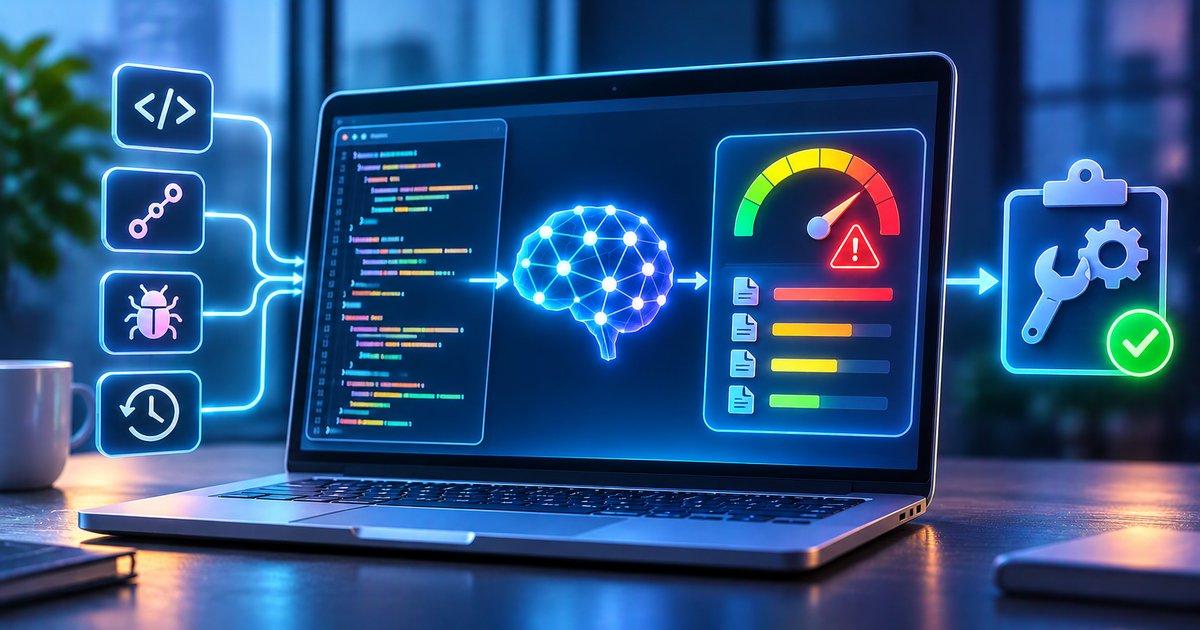
A developer submits a pull request. The CI pipeline collects the change metadata and generates the feature set. The prediction service evaluates the change and returns a risk estimate. The platform then displays the result alongside the existing build and test information.
A useful prediction should include more than a numerical score. It should communicate the affected components, relevant risk indicators, confidence limitations, and recommended actions.
For example, a notification might indicate that a change has elevated predicted defect risk because it modifies a historically defect-prone module, introduces a broad dependency change, and has limited regression test coverage.
The recommended action might be to run additional integration tests, request review from a domain owner, or verify compatibility with dependent services.
The prediction service should return structured information, such as:
{
"component": "payment-service",
"risk_level": "high",
"predicted_probability": 0.78,
"prediction_target": "defect_within_30_days",
"risk_factors": [
"high_recent_code_churn",
"multiple_dependency_changes",
"low_regression_test_coverage"
],
"recommended_action": "additional_integration_testing"
}
The value of this response is that it makes the prediction actionable. Developers can see why the system raised a concern rather than receiving an unexplained warning.
The workflow should remain proportionate. A high-risk prediction does not necessarily mean a pull request should be rejected. It may indicate that additional validation is appropriate.
Automatic blocking should be introduced only when an organization has strong evidence that the model is reliable for that particular decision and the consequences of false positives are understood.
Predictive risk can also influence release planning. Engineering managers may use aggregate component risk to identify areas requiring maintenance investment before a major release. SRE teams may combine code-risk predictions with operational signals to prioritize service reliability reviews.
For example, a service with increasing defect probability and a history of deployment-related incidents may deserve a more conservative release strategy than a stable service with similar business importance.
This creates a feedback loop between development activity and maintenance planning.
Key Takeaway
A predictive maintenance platform needs a complete engineering architecture: data ingestion, feature engineering, temporal model validation, CI/CD integration, and continuous monitoring. Predictions become valuable when they appear in existing workflows and lead to proportionate actions such as additional testing, deeper reviews, or planned refactoring. Model performance must be measured continuously because software development patterns and failure behavior evolve over time.
Section 3: Real-World Applications, Challenges, and the Future of Predictive Software Maintenance
Identifying High-Risk Microservices and Critical Application Components
Predictive software maintenance is especially useful in distributed applications where a failure in one service can affect multiple downstream systems.
Microservice architectures create independent deployment units, but they also introduce complex dependency relationships. A service may depend on several APIs, databases, message queues, authentication systems, and external providers.
Monitoring each service independently does not always reveal the broader maintenance risk associated with its dependencies.
A predictive maintenance platform can combine repository-level features with service-level operational data. It can analyze code churn, dependency updates, defect history, deployment frequency, test coverage, and historical incident patterns to estimate which services deserve additional attention.
Consider an e-commerce platform containing product catalog, customer identity, inventory, payment, and order management services.
The payment service may have moderate code complexity but high business criticality. It may also experience frequent changes because of payment provider integrations and regulatory requirements.
A predictive system could identify this service as a priority for additional testing because it combines high change activity with a significant business impact.
The inventory service may have a different risk profile. Its code may be relatively stable, but its dependency on an external warehouse API may create operational vulnerability. A model incorporating deployment history and production telemetry may identify abnormal error patterns before they develop into larger customer-facing problems.
This illustrates why predictive maintenance should evaluate both software change risk and operational risk.
The resulting output can support several engineering decisions. Teams may increase regression testing for high-risk services, introduce additional deployment verification, review dependency compatibility, or schedule architectural improvements.
However, a model should not interpret service criticality as evidence of failure probability. Criticality determines the consequences of failure, while prediction models estimate the likelihood of the defined event. Keeping these dimensions separate produces more useful prioritization.
Predicting Maintenance Risk in Legacy Codebases
Legacy systems are particularly challenging because they often contain limited documentation, outdated dependencies, complex business logic, and insufficient automated testing.
In some organizations, critical business processes depend on software that has evolved over many years. Replacing such systems may be expensive or operationally risky, so engineering teams must maintain them while gradually improving their architecture.
Predictive maintenance can help identify which parts of a legacy codebase deserve attention first.
A model may analyze modification frequency, defect history, complexity, dependency depth, test coverage, and the concentration of maintenance knowledge.
For example, an older module may have remained largely unchanged for several years. Another module may have experienced repeated emergency patches, frequent modifications, and a growing number of dependencies.
The second module may represent a higher maintenance concern, even though both are technically considered legacy code.
A useful strategy is to combine predictive risk scores with a technical debt inventory. Components with high estimated defect probability and high business impact can be prioritized for refactoring. Components with moderate risk but weak test coverage may first receive characterization tests to establish existing behavior.
Predictive systems can also support modernization planning. Before migrating a legacy module to a new framework, teams can examine historical defect patterns and dependency relationships to determine where additional validation is necessary.
However, legacy code presents a data challenge. Historical defects may have been poorly documented, and older source control records may not contain consistent commit metadata. The model should therefore communicate uncertainty when the underlying evidence is incomplete.
The objective is not to label an entire legacy application as unsafe. It is to identify specific components where preventive maintenance is likely to provide the greatest engineering benefit.
The Future: AI-Assisted Maintenance Planning and Self-Improving Engineering Systems
The next stage of predictive software maintenance will likely involve combining repository intelligence, operational telemetry, code understanding, and automated engineering assistance.
Current predictive systems typically estimate the risk of a component or change. More advanced systems can connect that estimate to a broader maintenance workflow.
For example, a model may identify a high-risk module and provide the evidence behind its prediction. A code analysis system can then inspect the affected functions, identify dependency relationships, and suggest additional test cases. An engineering assistant may summarize relevant historical defects and propose a maintenance investigation for the responsible team.
These capabilities could make maintenance planning more continuous.
Instead of conducting technical debt reviews only during quarterly planning, engineering teams could maintain an evolving view of component health. Repository changes, test results, incident reports, and dependency updates would continuously update the maintenance risk profile.
AI-assisted code analysis may also improve the quality of explanations. A system could connect a risky change to the affected interfaces, previous regressions, and missing test scenarios. However, generated explanations must be verified against source code and actual system behavior.
Another important development is the integration of predictive maintenance with software reliability engineering. Risk estimates can be combined with service-level indicators, error budgets, incident severity, and deployment information.
This enables teams to prioritize maintenance based on both the likelihood and consequences of failure.
For example, a component with moderate predicted defect probability but a direct dependency on a critical transaction workflow may deserve more attention than a component with higher predicted risk but limited business impact.
The future may also include more adaptive models that learn from changing repository behavior. Such systems could update their baselines as applications evolve, while retaining strict controls over model validation and deployment.
Nevertheless, fully autonomous software maintenance should not be treated as an immediate or universal outcome. A model may recommend a refactoring, but only engineers can assess its architectural implications, business constraints, and compatibility requirements. Automated systems can assist with prioritization and analysis, while code ownership, review, and release accountability remain essential.
The most valuable predictive maintenance platforms will not simply identify code that might fail. They will help engineering teams understand why a component is risky, what action is appropriate, and whether that action actually reduces future maintenance problems.
Turning predictive maintenance into a dependable engineering capability also requires disciplined deployment, monitoring, and continuous improvement of the underlying machine learning infrastructure. Teams must manage model versions, automate retraining workflows, monitor prediction quality, and ensure that risk scores remain reliable as applications evolve. These practices align closely with InterviewNode's "MLOps for Software Engineers: Building, Deploying, and Monitoring Machine Learning Models in Production", which explores the operational foundations required to run machine learning systems reliably in production.
Key Takeaway
Predictive software maintenance can improve reliability across microservices, legacy applications, and large engineering organizations. Its success depends on more than model accuracy: teams must manage data quality, class imbalance, false positives, explainability, and developer trust. The future lies in connecting risk prediction to practical maintenance workflows, enabling engineering organizations to make preventive decisions before software problems become expensive incidents.
Conclusion: Building Software That Is Easier to Maintain Before It Becomes Difficult to Change
Software maintenance has traditionally been driven by defects, incidents, and operational failures. Although reactive engineering remains necessary, it is not sufficient for increasingly complex applications with distributed dependencies, frequent deployments, and large development teams.
Predictive software maintenance provides a way to identify emerging risks before they become serious problems. By analyzing repository history, code churn, dependency complexity, testing behavior, defect records, and operational telemetry, machine learning models can estimate which components and changes deserve additional engineering attention.
Supervised learning can identify defect-prone modules, deep learning can analyze code semantics and structural relationships, just-in-time prediction can evaluate changes before integration, and unsupervised learning can identify unusual maintenance patterns.
However, the effectiveness of these approaches depends on sound engineering foundations. Training datasets must use reliable labels, features must reflect information available at prediction time, validation must respect chronological order, and evaluation must account for class imbalance.
Organizations should begin with a clearly defined prediction objective rather than attempting to build a universal software failure prediction model. A focused implementation might predict risky commits in a single repository, identify modules with elevated defect probability, or prioritize services for additional regression testing.
Once the model demonstrates value, it can be integrated into CI/CD pipelines, code review systems, maintenance dashboards, and engineering planning processes.
The broader opportunity is to move software maintenance from a predominantly reactive activity toward a continuous, evidence-based engineering discipline.
Machine learning cannot guarantee that a codebase will remain defect-free. It can, however, help engineering teams recognize warning signals earlier, allocate maintenance resources more effectively, and make better decisions about where reliability improvements will have the greatest impact.
Frequently Asked Questions
1. What is predictive software maintenance?
Predictive software maintenance uses machine learning, statistical analysis, and software engineering data to estimate which components, code changes, or services may experience future defects or maintenance problems. It helps engineering teams identify risks before they develop into production incidents.
2. How does machine learning predict software failures?
Machine learning models analyze historical repository data, code changes, defect reports, test outcomes, dependency information, and operational telemetry. They learn patterns associated with previously observed failures and use those patterns to estimate the risk of future problems.
3. What is software defect prediction?
Software defect prediction is the process of estimating which software files, modules, commits, or components are more likely to contain or introduce defects. It is one of the main applications of predictive software maintenance.
4. What data is required to build a predictive maintenance model?
Useful data includes Git commit history, code churn, file complexity, dependency relationships, test coverage, defect reports, pull request metadata, CI/CD results, deployment history, and production incident records. The exact data requirements depend on the prediction target.
5. Which machine learning algorithms are used for software defect prediction?
Common algorithms include logistic regression, decision trees, random forests, gradient boosting, support vector machines, neural networks, and transformer-based code models. Isolation forests and clustering algorithms can also help identify unusual maintenance patterns.
6. Can machine learning identify risky code before deployment?
Yes. Just-in-time defect prediction models can analyze pull requests and commits before they are merged or deployed. They can use change size, affected files, historical defect patterns, dependency changes, and other available features to estimate risk.
7. What is code churn, and why is it important?
Code churn measures how much code is added, modified, or deleted over a period. High or unusual churn can indicate frequently changing components that may deserve additional review, although it does not automatically mean that the code is defective.
8. How does predictive maintenance differ from traditional static code analysis?
Static analysis checks code against predefined rules and patterns, while predictive maintenance uses historical and contextual data to estimate future risk. The two approaches are complementary: static analysis identifies known issues, while predictive models can prioritize areas that deserve further investigation.
9. Can predictive software maintenance identify technical debt?
It can help identify indicators associated with technical debt, including complex modules, frequent modifications, duplicated code, limited test coverage, and complicated dependencies. However, technical debt is multidimensional and cannot be measured accurately through a single prediction score.
10. How accurate are machine learning models for software defect prediction?
Accuracy varies according to data quality, repository characteristics, prediction target, class imbalance, and validation methodology. Engineering teams should evaluate precision, recall, precision-recall curves, calibration, and performance on future time periods rather than relying only on overall accuracy.
11. What is just-in-time defect prediction?
Just-in-time defect prediction evaluates individual code changes, commits, or pull requests to estimate whether they may introduce defects. It allows development teams to identify risky changes earlier in the software development lifecycle.
12. How can predictive maintenance be integrated into CI/CD pipelines?
A prediction service can receive code-change metadata during a CI/CD workflow, generate relevant features, and return a risk estimate. The pipeline can use this information to recommend additional tests, request expert review, or trigger further validation.
13. What are the biggest challenges in predictive software maintenance?
Major challenges include incomplete defect labels, class imbalance, temporal data leakage, false positives, model drift, limited cross-project generalization, and insufficient interpretability. Developer trust and workflow integration are also important for successful adoption.
14. Can predictive maintenance help maintain legacy software?
Yes. It can help identify legacy modules with frequent defect fixes, high complexity, limited test coverage, and extensive dependencies. Teams can use these insights to prioritize refactoring, improve testing, and plan modernization efforts.
15. Will AI replace software engineers in software maintenance?
No. AI and machine learning can help identify risks, summarize historical patterns, prioritize maintenance work, and recommend additional tests. Engineers remain responsible for understanding business requirements, evaluating architectural tradeoffs, validating recommendations, and approving changes.