
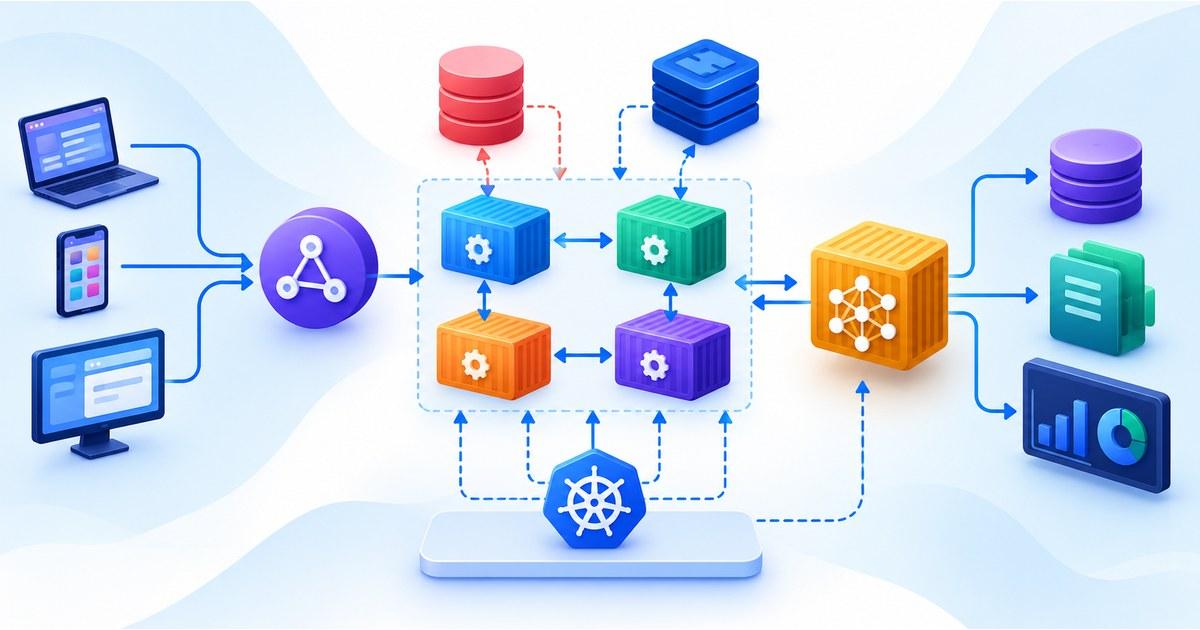
Section 1: Why ML-Enabled Microservices Require Different Architectural Decisions
Predictive Behavior Changes Traditional Service Boundaries
Traditional microservices typically expose well-defined business operations, such as retrieving customer records, validating payments, updating inventory, or processing orders, with application logic determining how requests should be handled. ML-enabled microservices introduce a different computational responsibility because they generate predictions from learned patterns rather than relying exclusively on explicitly programmed rules. A recommendation service, for example, may return different rankings as user behavior changes and models are retrained, making its operational contract more complex than that of a conventional service that retrieves a specific database record.
This difference affects service design because a model's behavior can change without its API schema changing, while prediction quality depends on data characteristics that may evolve independently of application code. Engineers must therefore consider model versions, feature availability, inference latency, and predictive quality when defining service boundaries, ensuring that downstream applications can consume predictions without depending on the internal implementation of the model. A well-designed ML microservice encapsulates model execution and its associated preprocessing while exposing stable business-facing interfaces that allow the model to evolve without forcing unrelated services to change.
Service boundaries should also reflect ownership of data and decisions because embedding model-specific logic across multiple services can create duplicated transformations and inconsistent predictions. Keeping inference responsibilities behind explicit interfaces makes it easier to update models, monitor their behavior, and compare alternative implementations, while preserving the separation between predictive computation and deterministic business rules.
Inference Workloads Need Different Resource Management
ML inference can impose substantially different resource requirements from conventional backend operations because models may consume large amounts of memory, CPU, GPU capacity, or specialized accelerator resources. A lightweight classification model may execute efficiently within an existing application service, whereas a large neural network may require dedicated hardware and independent scaling to maintain acceptable response times. Treating both workloads identically can cause resource contention, inefficient infrastructure allocation, and unexpected latency across services that share the same deployment environment.
Independent model-serving services can isolate computationally intensive inference from business-critical application logic, allowing engineers to scale prediction capacity according to model demand rather than scaling the entire application. This separation also supports independent model deployment and runtime optimization, although it introduces additional network communication, service discovery, failure handling, and operational overhead. The appropriate architecture therefore depends on the model's computational profile, expected traffic, latency requirements, deployment frequency, and the organization's ability to operate another distributed service reliably.
Resource allocation must also account for workload variability because inference performance can deteriorate when concurrent requests compete for memory or accelerator capacity. Engineers should benchmark realistic input sizes and traffic patterns, establish concurrency limits, and monitor tail latency alongside throughput so that high utilization does not unexpectedly destabilize the application. These considerations connect with “ML for Real-Time Systems: Engineering Models Under Strict Latency Constraints,” because inference performance depends on the complete execution environment rather than model speed alone.
Data Dependencies Become Part of the Microservice Architecture
ML-enabled services frequently depend on features assembled from multiple sources, including application databases, event streams, user histories, transaction records, and external systems. Retrieving these features during a prediction request can introduce additional latency and failure points, making it important to determine which transformations belong within the inference service and which should be handled by dedicated feature pipelines. A fraud detection service, for example, may require recent transaction counts alongside historical account characteristics, meaning that reliable predictions depend on both timely streaming features and stable historical data.
Data contracts become particularly important when these features are produced by independently deployed services because an upstream schema change can alter model inputs without causing an obvious application failure. Engineers should establish explicit definitions for feature types, meanings, freshness requirements, and missing-value behavior, while ensuring that training and serving pipelines apply compatible transformations. Without these safeguards, a model may receive valid-looking but semantically inconsistent inputs, producing degraded predictions even while every dependent service remains operational.
The architecture should also balance real-time feature retrieval against precomputation because querying multiple systems synchronously can make the prediction path unnecessarily expensive. Features that change infrequently can often be calculated in advance, while rapidly changing signals may require streaming updates or low-latency retrieval.
Key Takeaway
ML-enabled microservices require architectural decisions that account for predictive behavior, specialized inference resources, feature dependencies, and model-specific failure modes alongside conventional distributed-system requirements. By defining stable service contracts, isolating resource-intensive workloads where appropriate, maintaining consistent feature pipelines, and building model-aware reliability controls, engineers can integrate machine-learning capabilities without sacrificing the scalability, maintainability, and reliability expected from a well-designed microservices architecture.
Section 2: Choosing the Right Architecture Patterns for ML Services
Dedicated Model-Serving Services Separate Inference From Business Logic
One of the most important architectural decisions when introducing machine learning into a microservices environment is determining whether inference should execute inside an existing service or through an independently deployed model-serving component. Embedding a lightweight model within an application can reduce network overhead and simplify request handling, particularly when the model requires limited computational resources and changes infrequently. However, when models require specialized hardware, consume substantial memory, or need independent release schedules, dedicated inference services can provide better resource isolation and operational flexibility.
A model-serving service can encapsulate model loading, input validation, preprocessing, inference execution, and response formatting behind a stable API contract, allowing several application services to access the same predictive capability without maintaining duplicated implementations. This separation also enables ML teams to upgrade models or optimize inference runtimes independently from business logic, although the additional network boundary introduces latency, availability dependencies, and the need for explicit timeout and failure-handling policies.
Engineers should select this pattern according to the model's computational requirements, request volume, deployment frequency, and reliability constraints rather than assuming every model requires its own microservice. These considerations align with “Building ML-Driven APIs: Design Patterns for Prediction Services,” because the serving interface and deployment architecture should reflect how predictions are consumed by the wider application.
Synchronous and Asynchronous Inference Serve Different Workloads
Synchronous inference is appropriate when an application needs a prediction before completing the current request, as occurs with transaction risk scoring, interactive recommendations, or real-time classification. In this architecture, the application sends a request to the inference service and waits for the result, making model execution, feature retrieval, network communication, and downstream processing part of the request's latency budget. Engineers must therefore control timeouts, concurrency, and dependency behavior so that a slow prediction does not unnecessarily delay the entire application workflow.
Asynchronous inference provides an alternative for workloads in which predictions can be generated after the original request, such as document classification, bulk scoring, periodic forecasting, or expensive enrichment tasks. The application submits a job through a queue or job-management service, receives an identifier, and retrieves the result when processing completes, allowing worker pools to scale independently and absorb traffic bursts without forcing clients to wait for expensive computation.
A hybrid approach can support applications that require an immediate response while benefiting from more comprehensive analysis later, with a lightweight model producing an initial prediction synchronously and a larger model refining the result asynchronously. The appropriate pattern depends on user expectations, processing costs, and the consequences of delayed predictions, making workload requirements the primary factor in selecting the communication model.
API Gateways, Model Gateways, and Feature Services Coordinate Requests
API gateways provide a familiar entry point for authentication, request validation, rate limiting, and routing, but ML-enabled architectures may also benefit from a model gateway that understands the available models and their operational characteristics. Such a gateway can direct requests to compatible model versions, enforce inference policies, distribute traffic across serving replicas, and expose consistent interfaces to consuming services without requiring each application to manage the details of individual inference backends.
Feature services can complement this design by providing low-latency access to the data required for model inference, allowing application services to supply stable business identifiers while the feature layer retrieves or calculates the necessary inputs. This separation reduces duplicated feature logic across services, although synchronous retrieval of multiple features can increase latency and create additional availability dependencies, making precomputation, caching, and careful feature selection important architectural considerations.
These components should remain independently justified because adding gateways and feature services introduces operational complexity that may not be worthwhile for a small application with only one lightweight model. Engineers should establish clear ownership boundaries and measure the impact of each network hop, ensuring that architectural abstractions improve reuse, governance, or resource management without unnecessarily extending the prediction path.
Key Takeaway
Choosing the right ML microservices architecture requires matching service boundaries and communication patterns to the model's computational needs, latency requirements, data dependencies, and operational responsibilities. Dedicated inference services, synchronous or asynchronous execution, gateways, feature services, event-driven processing, and model routing can provide complementary benefits, but each pattern should be introduced only when its measurable advantages justify the additional complexity.
Section 3: Managing Data Flow, Reliability, and Communication Between ML Services
Maintain Consistent Feature Contracts Across Services
ML-enabled microservices frequently depend on features produced by multiple applications, databases, and streaming pipelines, making reliable data contracts essential for maintaining consistent prediction behavior across service boundaries. A feature service may supply customer attributes, a transaction service may provide recent activity, and a model-serving service may combine these inputs to generate a risk score, with each dependency introducing assumptions about data types, field meanings, freshness, and availability. Engineers should define explicit contracts for these interfaces so that upstream services can evolve independently without silently changing the information consumed by downstream models.
Training-serving consistency requires additional attention because the transformations applied during model development must remain compatible with those executed in production. When training and inference services independently implement normalization, categorical encoding, or time-window aggregation, differences can emerge even when both systems accept identical schemas, potentially degrading predictions without generating conventional service errors. Versioned feature definitions, shared transformation logic, schema validation, and automated consistency tests help prevent these discrepancies, while the principles described in “The Rise of Data Contracts: Bringing Software Engineering Discipline to ML Data” provide a useful foundation for managing compatibility across independently deployed components.
Prevent Failures From Cascading Across Service Boundaries
Distributed ML architectures introduce failure modes in which a slow or unavailable inference service can affect multiple application services, especially when predictions are required synchronously to complete a user request. An application that waits indefinitely for model inference can exhaust its request-handling capacity, while aggressive retries can amplify load on an already overloaded service, making bounded timeouts, controlled retries, circuit breakers, and concurrency limits important safeguards. Engineers should define these policies according to the latency requirements and business consequences of each prediction workflow rather than applying identical failure handling to every ML dependency.
Fallback behavior should also reflect the nature of the decision because a simpler model, cached result, deterministic rule, or deferred process may be suitable in some situations but inappropriate in others. A recommendation service might display popularity-based results when its personalization model becomes unavailable, while a high-risk transaction workflow may require additional verification instead of automatically proceeding without a reliable risk assessment. These decisions should be designed before production deployment so that infrastructure failures do not force downstream applications to invent their own interpretation of missing or delayed predictions.
Control Data Flow, Latency, and Resource Contention
ML microservices often perform several operations for each prediction, including feature retrieval, preprocessing, inference, post-processing, and communication with downstream services, making the entire request path important to performance. Sequentially retrieving features from multiple services can introduce unnecessary network delays, while sharing limited CPU, memory, or accelerator resources across unrelated workloads can increase queueing and tail latency. Engineers can reduce these costs through parallel retrieval of independent features, precomputation of expensive transformations, appropriate caching, and separate scaling of components with different resource requirements.
Batch and streaming pipelines should be integrated according to the freshness requirements of the model because historical aggregates can often be calculated ahead of time, whereas rapidly changing signals may require continuous updates. Using precomputed features for stable attributes and low-latency retrieval for recent activity can reduce synchronous dependencies without sacrificing the timeliness needed for relevant predictions. The architecture must still preserve explicit freshness and invalidation rules because caching stale features may produce incorrect model outputs even when response times improve.
Key Takeaway
Reliable ML microservices depend on consistent feature contracts, controlled communication, explicit failure handling, efficient data flow, and coordinated model lifecycle management across independently deployed components. By isolating failures, preserving training-serving consistency, monitoring the complete prediction path, and controlling version compatibility and resource contention, engineers can build distributed ML architectures that remain scalable and dependable without allowing a single unreliable service to compromise the wider application.
Section 4: Deploying, Scaling, and Operating ML Microservices in Production
Containerization and Independent Scaling of Model Services
Deploying ML-enabled microservices in production requires infrastructure that can accommodate the distinct computational demands of model inference, feature processing, data retrieval, and conventional application logic without forcing every component to scale together. Containerization provides a consistent packaging mechanism for model-serving code, runtime dependencies, configuration, and supporting libraries, helping engineering teams reduce differences between development, testing, and production environments. However, packaging a model inside a container does not automatically guarantee reproducible predictions, since model artifacts, preprocessing components, runtime versions, hardware capabilities, and configuration settings must also be controlled throughout deployment.
Independent scaling becomes particularly important when inference workloads have resource requirements that differ significantly from those of surrounding application services. A lightweight classification model may run efficiently on CPU-based instances, whereas a computationally intensive neural network may benefit from GPU acceleration, larger memory allocations, or specialized inference runtimes. Engineers should therefore measure CPU utilization, memory consumption, accelerator utilization, request concurrency, and queueing behavior before selecting deployment configurations, ensuring that resource allocation reflects actual workload characteristics rather than assumptions about model complexity.
Autoscaling policies should account for inference demand and service performance instead of relying exclusively on average CPU utilization, because a service can experience increasing request queues or deteriorating tail latency before its overall resource utilization reaches a conventional threshold. Metrics such as requests per second, queue depth, concurrent inference requests, and prediction latency can provide more direct signals for scaling decisions, although the appropriate indicators depend on the serving architecture and infrastructure platform. These decisions connect closely with the principles explored in “Resource-Aware Machine Learning: Designing Models Around Compute and Energy Limits,” where computational constraints influence how ML workloads should be designed and operated.
Model Lifecycle Management, CI/CD, and Controlled Releases
Production deployment should treat model artifacts as versioned release components that move through a controlled lifecycle, rather than as files that developers manually replace inside running services. A dependable release process records the model artifact, associated code revision, preprocessing definitions, dependency versions, evaluation results, and configuration required to reproduce or investigate a deployment. By connecting these components to an automated CI/CD pipeline, teams can validate service interfaces, execute regression tests, check artifact compatibility, and confirm deployment readiness before directing production traffic to a new model version.
Model releases also require evaluation criteria that extend beyond conventional software correctness because a successfully deployed artifact can still produce predictions that are less accurate, poorly calibrated, or unsuitable for the current workload. Automated validation should therefore combine infrastructure checks with model-specific acceptance criteria, using representative evaluation datasets and relevant business metrics to determine whether a candidate model satisfies release requirements. Where practical, shadow deployments can evaluate a candidate against production requests without exposing users to its predictions, while canary releases allow teams to increase traffic gradually as evidence accumulates about service reliability and prediction quality.
Rollback mechanisms should restore a known-good configuration when a new release violates operational or model-quality thresholds, with the deployment system preserving enough information to identify which artifact and configuration were active when a problem occurred. Since the compatibility of feature definitions and preprocessing logic matters as much as the model binary itself, rollback planning should include these dependencies rather than assuming that reverting a single container image will restore the previous behavior.
Production Monitoring for Model Quality and Service Reliability
Monitoring ML microservices requires teams to observe both conventional service health and the quality of the predictions produced by those services, because infrastructure metrics alone cannot reveal every form of model degradation. Latency, throughput, error rates, timeouts, queue depth, and resource utilization help identify operational problems, while input-feature distributions, missing-value rates, prediction distributions, and delayed outcome measurements provide evidence about changes in model behavior. Bringing these signals together allows engineers to investigate situations in which the serving infrastructure remains healthy even as the usefulness of its predictions deteriorates.
Monitoring strategies should also reflect the availability and timing of ground-truth labels, since many production predictions cannot be evaluated immediately after they are generated. When labels arrive later, teams can initially track input and prediction characteristics, validate data quality, and investigate substantial deviations from established baselines before evaluating model performance once the corresponding outcomes become available. These indicators must be interpreted carefully because distribution changes do not automatically mean that a model has become inaccurate, just as stable input distributions do not guarantee that prediction quality remains acceptable.
Operational alerts should distinguish actionable incidents from expected workload fluctuations by using service-level objectives, calibrated thresholds, and context appropriate to each prediction workflow. For example, a sudden increase in inference timeouts may require immediate intervention, whereas gradual changes in feature distributions may warrant investigation before any automated retraining or rollback decision is made.
Key Takeaway
Production-ready ML microservices require coordinated decisions across containerization, independent scaling, model lifecycle management, continuous deployment, quality monitoring, and cost optimization. By versioning model artifacts and their dependencies, validating releases through controlled deployment strategies, monitoring both service reliability and prediction behavior, and measuring end-to-end infrastructure costs, engineering teams can operate ML services that remain scalable, observable, and maintainable as demand and model requirements evolve.
Conclusion: Building Reliable and Scalable ML-Enabled Microservices
Designing ML-enabled microservices requires software engineers to rethink several conventional architectural decisions because machine learning introduces probabilistic outputs, specialized computational requirements, data dependencies, and model-specific failure modes into distributed applications. While traditional microservices primarily execute predefined business logic, ML services must also manage model artifacts, feature transformations, inference workloads, and prediction quality throughout their operational lifecycle. A successful architecture therefore depends on more than deploying a trained model behind an API; it requires clear service boundaries, reliable data contracts, well-defined communication patterns, and operational controls that preserve system behavior as individual components evolve.
Choosing an appropriate architecture begins with identifying the requirements of the prediction workflow, including latency expectations, prediction frequency, feature freshness, model complexity, and the consequences of an incorrect or unavailable prediction. Dedicated model-serving services can isolate inference workloads from conventional application logic, while asynchronous processing can support workloads that do not require an immediate response. Feature services, API gateways, event-driven pipelines, and model-routing components can further improve modularity when their responsibilities are clearly defined, although unnecessary service boundaries can introduce additional network latency, deployment complexity, and monitoring overhead.
Production reliability depends on maintaining consistent data contracts between training and serving systems, controlling dependencies between services, and designing explicit responses to timeouts, unavailable models, and stale features. Engineers must also establish reproducible model deployment workflows, version model artifacts and their dependencies, and monitor both conventional service metrics and indicators of prediction quality. These practices allow teams to distinguish infrastructure failures from data-quality issues or genuine model degradation, making it easier to diagnose problems and implement targeted improvements without destabilizing the entire application.
Scaling and optimization should follow measured production behavior rather than assumptions about model requirements. Containerization, workload-specific autoscaling, caching, batching, quantization, and model routing can improve resource utilization when they are compatible with accuracy and latency objectives. However, the complete cost of an ML microservice includes feature retrieval, preprocessing, networking, monitoring, and operational maintenance, so optimization decisions should account for the entire prediction pipeline rather than inference compute alone.
For software engineers building ML-enabled applications, the most effective approach is to begin with a clear business requirement, establish explicit service contracts, and introduce only the architectural components needed to meet measurable operational objectives. As the application grows, versioned deployments, end-to-end observability, fault isolation, and continuous performance evaluation provide the foundation for evolving the system safely. By combining established distributed-systems principles with disciplined model lifecycle management, engineering teams can build ML-enabled microservices that are scalable, maintainable, cost-conscious, and dependable in real-world production environments.
Frequently Asked Questions
1. What Are ML-Enabled Microservices?
ML-enabled microservices are independently deployable software services that use machine learning models to perform prediction, classification, ranking, recommendation, anomaly detection, or other data-driven tasks. They typically expose predictions through APIs or asynchronous processing interfaces and integrate with application services, feature pipelines, and data infrastructure to support intelligent functionality within a larger application.
2. How Are ML Microservices Different From Traditional Microservices?
Traditional microservices primarily execute explicitly defined business rules, whereas ML microservices use trained models to generate predictions from input data. Consequently, ML services must account for model artifacts, feature transformations, training-serving consistency, prediction quality, data drift, and model versioning in addition to conventional software concerns such as API compatibility, latency, availability, and fault isolation.
3. Should a Machine Learning Model Run Inside an Existing Microservice or in a Dedicated Model-Serving Service?
The decision depends on workload complexity, scaling requirements, latency constraints, and the need to reuse the model across multiple applications. Embedding a lightweight model inside an existing service can reduce network overhead and architectural complexity, while a dedicated model-serving service provides greater flexibility for independent deployment, resource allocation, and model version management when inference has distinct operational requirements.
4. When Should Engineers Use Synchronous Versus Asynchronous ML Inference?
Synchronous inference is appropriate when an application needs a prediction before completing a request, such as generating an immediate recommendation or evaluating a transaction. Asynchronous inference is better suited to bulk scoring, large-scale document processing, background enrichment, and other workloads where results can be delivered later, although it requires additional coordination for job status, event processing, retries, and result retrieval.
5. What Is the Role of a Feature Service in an ML Microservices Architecture?
A feature service provides consistent access to data transformations and model inputs required for prediction, helping multiple models and applications reuse common feature definitions. By centralizing feature computation or retrieval, it can reduce duplication and support training-serving consistency, provided that the architecture also defines freshness requirements, schema compatibility, access controls, and appropriate failure-handling behavior.
6. How Can Engineers Prevent Training-Serving Skew in ML Microservices?
Training-serving skew can be reduced by reusing compatible feature transformations, versioning feature definitions, validating input schemas, and testing whether training and inference pipelines produce equivalent values for the same inputs. Maintaining shared transformation logic where practical and recording the versions of preprocessing components alongside model artifacts also makes discrepancies easier to identify when models are deployed or updated.
7. How Should ML Microservices Handle Model-Serving Failures?
Failure handling should begin with bounded timeouts, controlled retries, circuit breakers, and resource limits that prevent one unavailable service from exhausting the capacity of its consumers. Depending on the business risk, an application may use a cached result, fall back to a simpler model, apply deterministic rules, defer processing, or reject a request for additional verification, with the fallback policy explicitly defined for each workflow.
8. How Can Engineers Reduce Latency in ML Microservices?
Engineers can reduce end-to-end latency by profiling the complete prediction path, optimizing expensive preprocessing, retrieving independent features concurrently, and minimizing unnecessary service-to-service communication. Additional techniques include caching suitable results, batching requests when latency requirements permit, selecting efficient inference runtimes, and routing workloads to appropriately configured compute resources, with improvements validated against representative production traffic.
9. How Should ML Microservices Be Scaled Independently?
ML microservices should be scaled according to their individual workload and resource characteristics, using signals such as request volume, concurrency, queue depth, latency, CPU utilization, memory pressure, and accelerator utilization. Independent scaling allows a resource-intensive inference service to receive additional compute capacity without unnecessarily scaling unrelated application services, although autoscaling policies must account for model-loading time, startup overhead, and available hardware capacity.
10. What Is the Best Deployment Strategy for ML Microservices?
A dependable deployment strategy combines containerized services, versioned model artifacts, automated validation, and controlled traffic management. Teams can use shadow deployments to evaluate candidate models without serving their predictions to users, followed by canary releases that gradually increase traffic when operational and model-quality metrics remain within acceptable limits, while maintaining a tested rollback path for unsuccessful releases.
11. Which Metrics Should Engineers Monitor in Production ML Microservices?
Production monitoring should combine conventional service metrics, including latency percentiles, throughput, error rates, timeouts, queue depth, and resource utilization, with ML-specific indicators such as input-data quality, missing-feature rates, prediction distributions, and delayed model-performance measurements. The exact metrics depend on the application, but connecting them through distributed traces and model-version metadata helps engineers investigate issues across the complete prediction pipeline.
12. What Is the Difference Between Data Drift and Model Performance Degradation?
Data drift refers to changes in the characteristics or distribution of production inputs compared with a reference dataset, whereas model performance degradation refers to a decline in predictive effectiveness measured against relevant outcomes. The two can be related, but they are not identical because input distributions may change without harming predictions, and model quality can decline for reasons that are not immediately visible through basic distribution monitoring.
13. How Can Engineers Reduce the Cost of ML Microservices?
Cost optimization begins with measuring the complete serving workflow, including compute, feature retrieval, preprocessing, network communication, storage, observability, and idle infrastructure. Engineers can then evaluate caching, efficient model architectures, batching, quantization, independent autoscaling, and model routing to reduce unnecessary resource consumption, while checking that each optimization preserves acceptable prediction quality and application responsiveness.
14. What Role Does CI/CD Play in ML Microservices?
CI/CD automates the validation and deployment of application code, inference components, and associated model artifacts, helping teams deliver changes consistently and safely. An ML-aware pipeline should validate API compatibility, dependencies, feature schemas, inference behavior, and relevant model-quality criteria before release, while preserving artifact provenance, deployment records, and rollback mechanisms for investigating or reversing problematic changes.
15. What Are the Most Important Best Practices for Designing ML-Enabled Microservices?
The most important practices include defining service boundaries around clear responsibilities, maintaining versioned data contracts, preserving training-serving consistency, selecting synchronous or asynchronous inference according to workload needs, and isolating failures through explicit resilience policies. Production systems should also use controlled model releases, end-to-end observability, workload-specific scaling, and cost-aware optimization, with every architectural decision evaluated against measurable business requirements and operational constraints.