Section 1: Understanding Network Congestion and the Foundations of Predictive Traffic Engineering
What Is Network Congestion, and Why Does It Matter?
Network congestion occurs when the volume of traffic competing for network resources approaches or exceeds the available capacity of those resources. This can happen across physical network links, router interfaces, switching fabrics, virtual network paths, and mobile communication infrastructure. When incoming traffic cannot be processed or forwarded at the required rate, packets begin accumulating in buffers, queues become longer, and network performance starts deteriorating.
Consider a cloud application that experiences a sudden increase in user activity during a product launch. Thousands of clients may simultaneously send requests to application servers, which generate additional east-west traffic between microservices, databases, caching layers, and distributed storage systems. Even when the overall data center has sufficient capacity, individual network links connecting particular racks or switches can become overloaded because traffic is unevenly distributed.
The consequences extend beyond reduced throughput. Increasing queue occupancy can introduce additional latency and jitter, while buffer exhaustion can cause packet drops. Lost packets may trigger retransmissions and influence transport-layer congestion-control behavior, reducing effective throughput further. Applications that depend on predictable response times, including online transactions, video conferencing, financial services, and distributed databases, can experience noticeable performance degradation.
Congestion is also not necessarily a network-wide condition. A data center fabric might operate comfortably below its aggregate bandwidth capacity while one heavily utilized uplink experiences persistent queue buildup. Similarly, an enterprise WAN can have sufficient total bandwidth across its infrastructure but still experience congestion on a particular regional connection. Understanding these localized bottlenecks is essential because traffic engineering decisions must account for individual links, paths, and network segments rather than relying exclusively on aggregate utilization.
Traditional Traffic Engineering: Reactive Monitoring and Congestion Management
Conventional traffic engineering relies on established networking mechanisms to monitor infrastructure performance and manage how traffic moves through a network. Network operators collect interface counters, link utilization measurements, packet rates, queue occupancy, packet-drop statistics, and routing information. Monitoring platforms evaluate these measurements against predefined thresholds and generate alerts when network conditions indicate possible performance degradation.
For example, an operations team might configure an alert whenever a network interface exceeds 85% utilization for a specified period. When the threshold is crossed, engineers can investigate the affected link, examine traffic flows, adjust routing policies, or redistribute traffic across available paths. Traffic shaping, admission control, queue management, and quality-of-service policies can also help manage competing workloads and protect latency-sensitive applications.
Established congestion-control mechanisms operate at different layers of the networking stack. TCP congestion control adjusts transmission behavior according to network feedback, while Explicit Congestion Notification (ECN) allows compatible network devices to signal congestion without necessarily dropping packets. Active Queue Management mechanisms can manage queue buildup and reduce excessive buffering. These techniques remain important because they respond to actual network conditions and help maintain stable communication.
The limitation of purely reactive management is that it often begins after a warning condition or performance problem has already developed. Although automated routing and congestion-control mechanisms can respond quickly, infrastructure changes may require additional time, especially when they involve controller decisions, workload migration, capacity allocation, or coordination across multiple network segments.
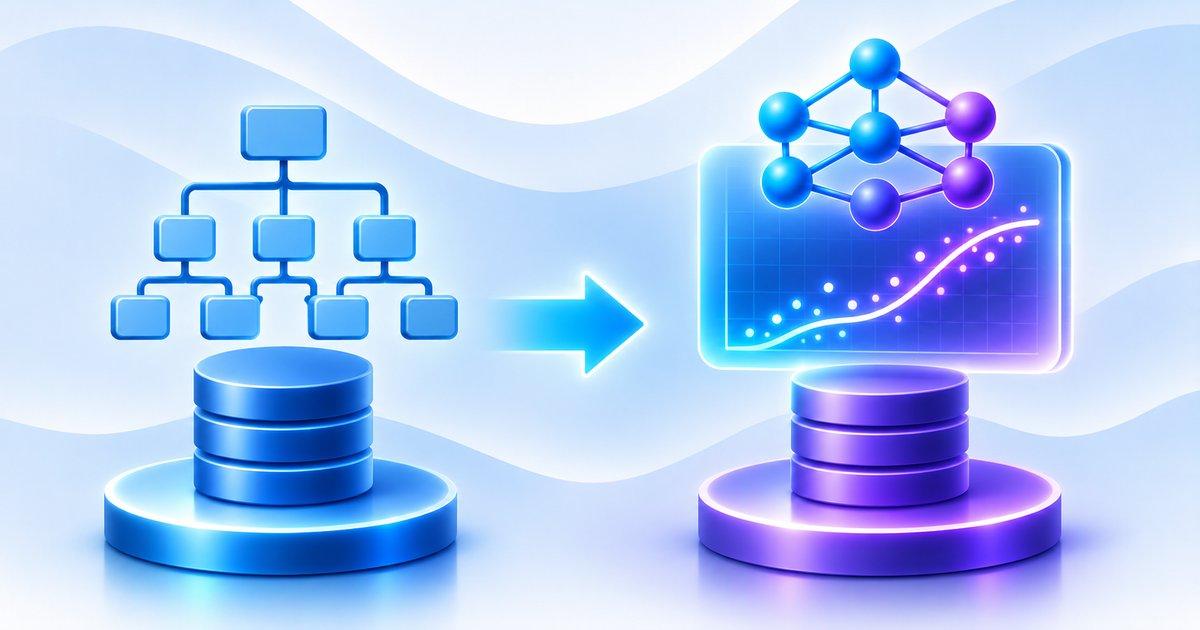
Predictive traffic engineering adds a forecasting capability to this existing operational foundation. Instead of waiting for an interface to exceed a utilization threshold, a predictive system can estimate that the interface is likely to reach a critical utilization level several minutes later. Operators can then evaluate potential adjustments while sufficient capacity remains available.
Understanding Network Telemetry: The Data Behind Congestion Prediction
Network telemetry provides the measurements required to understand current infrastructure behavior and estimate future conditions. It includes information collected from network devices, switches, routers, traffic-management systems, and application infrastructure. The usefulness of a predictive model depends heavily on whether telemetry captures the relevant traffic patterns and operational characteristics at an appropriate frequency.
Common measurements include bandwidth utilization, packets per second, bytes per second, flow statistics, queue depth, round-trip time (RTT), jitter, packet loss, ECN marks, and interface errors. These measurements provide different perspectives on network performance. For example, bandwidth utilization indicates how much link capacity is being consumed, while queue occupancy helps reveal whether packets are accumulating faster than a device can forward them.
Flow-level telemetry adds information about communication patterns between endpoints. Depending on the monitoring implementation, flow records can describe source and destination addresses, ports, protocols, traffic volume, and flow duration. Aggregating these observations produces a traffic matrix that estimates how much traffic moves between different network locations during a particular time interval.
Network topology provides another essential dimension. Two links with identical utilization measurements may have very different operational importance depending on their position in the network. A heavily utilized edge link with several alternative paths may present less risk than a moderately utilized backbone link connecting multiple critical network segments. Combining topology with telemetry helps predictive systems understand the relationships between individual network resources.
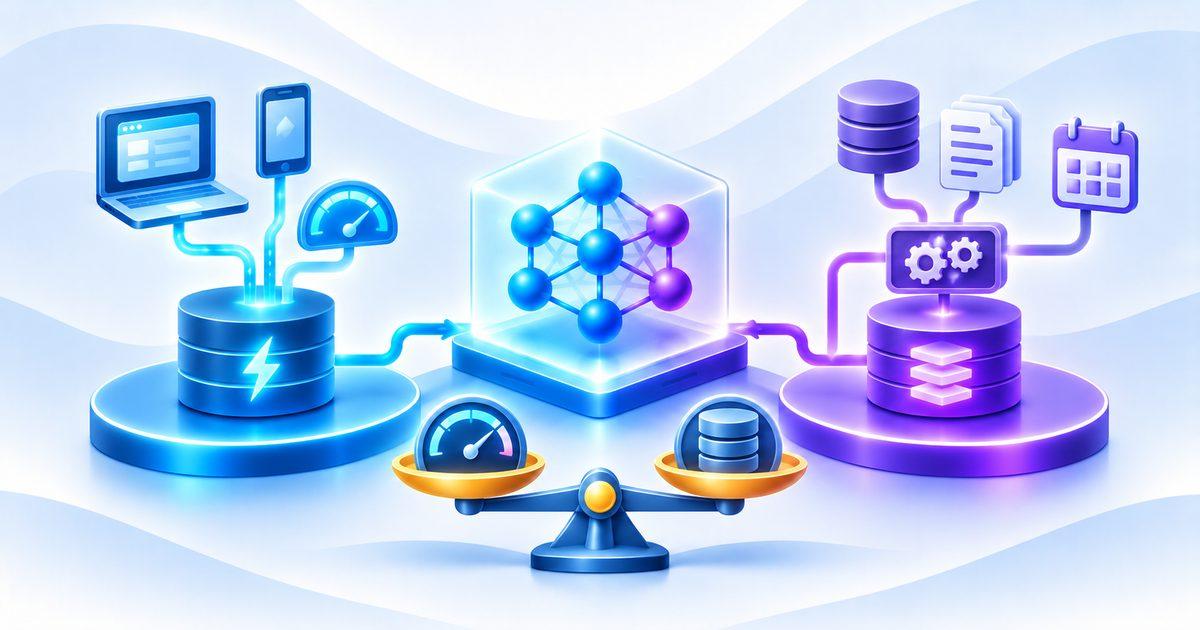
Streaming telemetry technologies allow network devices to continuously export operational measurements instead of relying exclusively on periodic polling. However, higher sampling frequency does not automatically guarantee better predictions. Engineers must balance observation granularity, storage requirements, processing overhead, timestamp consistency, and the cost of collecting detailed flow information.
Transforming these high-volume measurements into model-ready datasets requires reliable ingestion, aggregation, and preprocessing pipelines. Engineers working on this layer can benefit from understanding "ML Data Pipelines for Software Engineers: From Event Streams to Model-Ready Data", which explains how event streams become structured inputs for machine learning systems.
Key Takeaway
Predictive traffic engineering builds on conventional networking by adding the ability to estimate future demand and network conditions. Telemetry, flow statistics, queue measurements, and topology information provide the foundation for understanding where congestion may develop. The critical distinction is that high traffic demand does not necessarily mean congestion, and useful predictions must account for available capacity, traffic distribution, routing, and network constraints. By combining forecasting with established monitoring and congestion-control mechanisms, infrastructure teams can move toward more proactive network operations.
Section 2: How Machine Learning Models Predict Network Traffic and Congestion
Preparing Network Telemetry for Machine Learning
Raw network telemetry is rarely suitable for direct consumption by machine learning models. Network devices generate measurements at different frequencies, use different timestamp conventions, and expose different levels of operational detail. Engineers must transform these observations into consistent datasets that represent network behavior across meaningful time intervals.
A typical preprocessing pipeline begins by collecting interface counters, flow records, queue measurements, and application-level demand information. These measurements can be aggregated into fixed time windows, such as five-second, one-minute, or five-minute intervals, depending on the prediction objective. Aggregation helps reduce measurement noise while preserving the temporal patterns required for forecasting.
Feature engineering converts raw measurements into useful model inputs. Historical bandwidth utilization, moving averages, traffic growth rates, queue-depth changes, packet-drop frequency, and neighboring link utilization can reveal patterns that are difficult to identify from isolated measurements. Calendar features, including time of day, day of week, and recurring business activity, may also help models recognize predictable traffic cycles.
Traffic matrices are particularly valuable when the prediction task involves understanding demand between network locations. A traffic matrix can be represented as (T_{ij}(t)), where each element describes the traffic volume traveling from source location (i) to destination location (j) during time (t). This representation allows models to learn how demand changes between racks, data centers, enterprise sites, or mobile network regions.
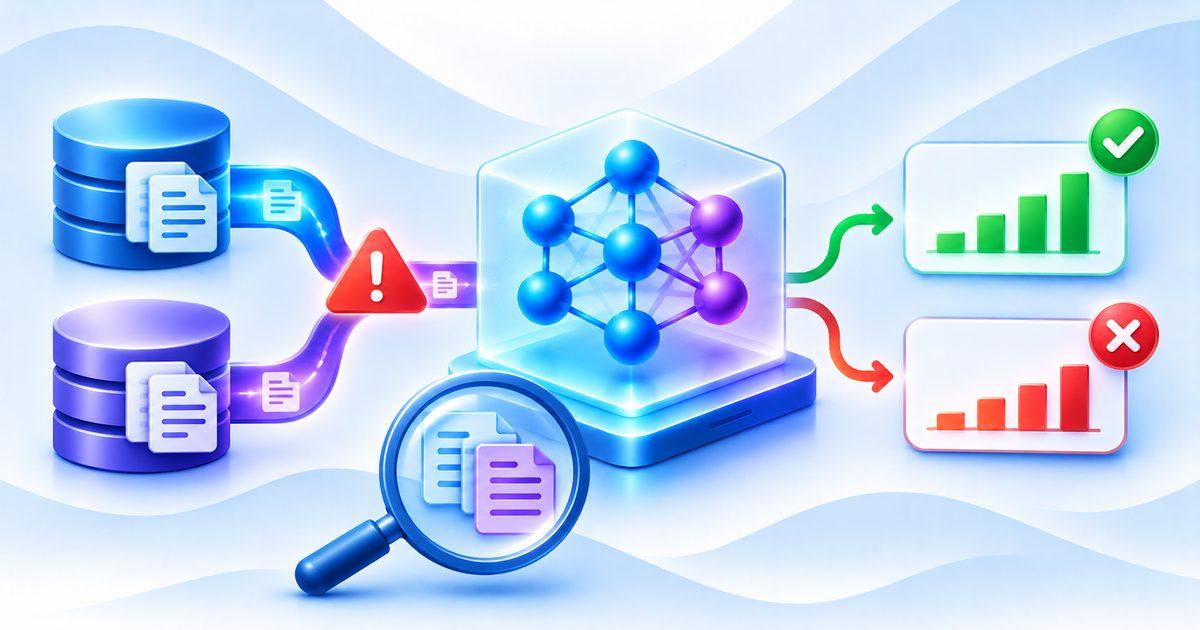
Data quality is equally important. Missing telemetry, duplicate records, inconsistent sampling intervals, and temporary device failures can introduce misleading patterns. Engineers must distinguish genuine traffic spikes from measurement errors and avoid replacing missing observations with values that incorrectly imply normal operating conditions.
The prediction target must also be defined carefully. A regression model may predict future bandwidth utilization, while a classification model may estimate whether a particular link will experience congestion within the next five minutes. A forecasting system can therefore provide an important input to congestion prediction without treating the two tasks as identical.
Time-Series Forecasting: Predicting Future Network Traffic and Bandwidth Demand
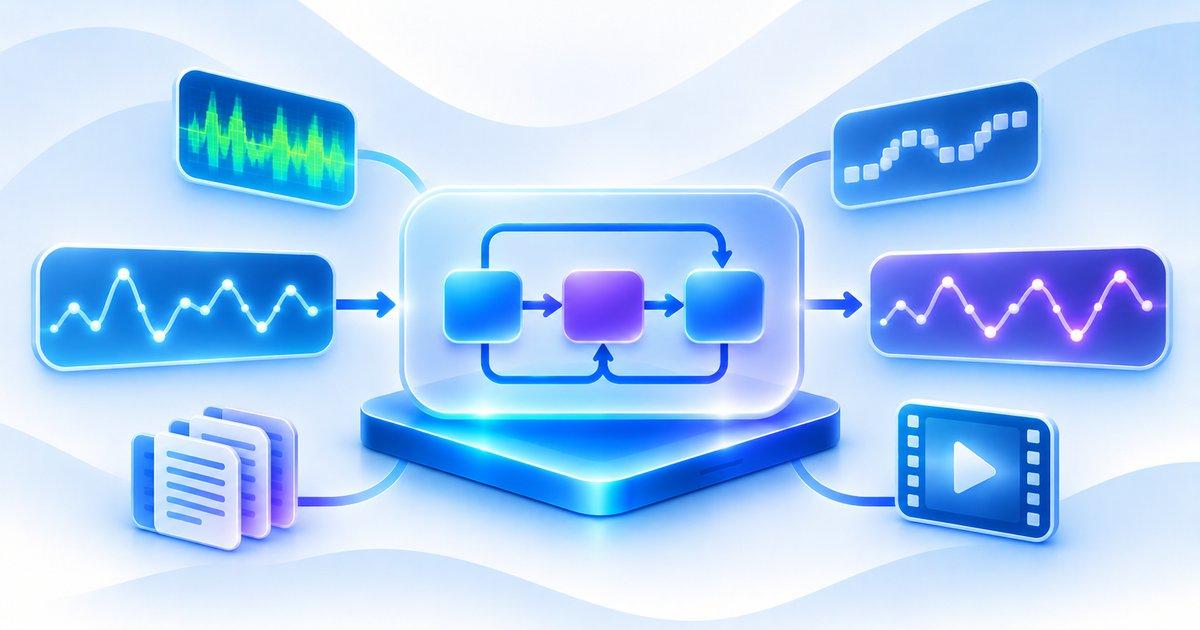
Time-series forecasting is one of the most established approaches to predicting network traffic. It uses historical observations to estimate future values of a measured variable, such as link utilization, traffic volume, queue depth, or throughput. Network traffic often contains recurring temporal patterns, sudden bursts, and longer-term trends, making forecasting a useful foundation for proactive traffic management.
Traditional statistical approaches such as ARIMA can model temporal dependencies and recurring patterns in traffic measurements. They can provide useful baselines when traffic behavior is relatively stable and historical observations are sufficiently consistent. However, highly nonlinear traffic patterns or interactions between multiple network variables may require more flexible approaches.
Conventional machine learning models such as linear regression, Random Forest, and gradient-boosted decision trees can incorporate several engineered features simultaneously. For example, a gradient-boosted model might predict future link utilization using current utilization, recent traffic growth, historical peak demand, neighboring link measurements, and time-of-day information. These models can be effective when structured telemetry is available but large sequential datasets are limited.
Deep learning architectures provide additional ways to capture temporal dependencies. Long Short-Term Memory (LSTM) networks use gated recurrent structures to retain information across sequential observations, making them useful for learning patterns that extend beyond individual time steps. Temporal convolutional networks use causal and dilated convolutions to capture temporal relationships while supporting efficient parallel computation during training.
Transformer-based forecasting architectures use attention mechanisms to identify relationships between observations across longer time windows. They can model complex temporal patterns and interactions between multiple variables, although their computational requirements and data requirements must be considered during deployment.
Model selection should depend on the characteristics of the network and the forecasting task. A lightweight regression model may be sufficient for predicting short-term utilization on a relatively stable link, while an LSTM or Transformer may be useful when traffic exhibits more complex temporal dependencies. Accuracy alone should not determine the choice; inference latency, training cost, data availability, interpretability, and operational reliability also matter.
Streaming and Adaptive Machine Learning for Dynamic Network Conditions
Production networks rarely operate under perfectly stable conditions. Application deployments, workload migrations, customer activity, infrastructure upgrades, seasonal demand, and unexpected traffic bursts continuously change the distribution of network observations. This phenomenon is commonly associated with non-stationary data and concept drift.
A predictive model trained on several months of historical traffic may perform well initially but gradually lose accuracy when application behavior changes or new infrastructure is introduced. For example, deploying a new distributed database architecture may increase east-west traffic between specific racks, creating patterns that were not represented in the original training dataset.
Streaming machine learning architectures help address the need to process continuously arriving telemetry. Feature pipelines can maintain rolling traffic statistics, update time-series windows, and provide recent network observations to models for low-latency inference. The prediction engine can then combine historical behavior with current operating conditions to estimate upcoming demand.
Adaptive systems may use periodic retraining, incremental learning, transfer learning, or model recalibration depending on the model architecture and operational requirements. Monitoring forecast errors helps determine whether performance degradation reflects normal traffic variation, changing network topology, or a more significant shift in the underlying data distribution.
For infrastructure teams interested in continuous model inference and evolving data streams, "Streaming Machine Learning: Building Models That Learn From Data in Real Time" provides useful context on designing systems that process incoming data without depending exclusively on periodic batch execution.
Adaptive forecasting is particularly valuable when combined with reliable telemetry and controlled model updates. A system should not automatically trust every new observation or retrain after every temporary traffic spike. Instead, engineers should distinguish genuine changes in network behavior from short-lived anomalies and ensure that updated models continue meeting operational performance requirements.
Key Takeaway
Machine learning models predict network traffic by learning from structured telemetry, historical utilization, traffic matrices, and temporal patterns. Statistical forecasting, tree-based algorithms, recurrent networks, Transformers, and graph neural networks offer different approaches to capturing temporal and spatial dependencies. No single architecture works best for every network environment. Reliable prediction requires suitable feature engineering, topology awareness, adaptive monitoring, and a clear definition of whether the system is forecasting demand, predicting congestion events, or estimating future network performance.
Section 3: Using Congestion Predictions for Proactive Network Traffic Engineering
Predicting Congestion Hotspots Before Network Links Become Saturated
The operational value of machine learning becomes clearer when predictions are used to identify network resources that may become bottlenecks. A congestion prediction system evaluates future utilization, traffic distribution, queue behavior, and network capacity to estimate which links or network segments are likely to experience performance degradation.
Consider a cloud infrastructure environment in which a network link currently operates at 65% utilization. A forecasting model may estimate that utilization will increase to 92% within the next three minutes because of a recurring workload pattern. If the network has limited alternative capacity, this forecast may indicate a meaningful congestion risk before the interface crosses its operational threshold.
However, a utilization forecast alone does not establish that congestion will occur. The system must consider available capacity, expected traffic distribution, routing options, queueing behavior, and the performance requirements of competing applications. A link with high predicted utilization may remain healthy if it has sufficient capacity and manageable queue behavior.
Congestion prediction can therefore be framed as a classification problem. A model may estimate the probability that a link will experience congestion within a defined prediction horizon. For instance, it might produce an estimated 85% probability of a congestion event within five minutes. This probability should be interpreted alongside the model's calibration, prediction confidence, and the operational impact of the potential event.
Network engineers can use warning thresholds to prioritize action. A low-confidence forecast may generate an informational notification, while a high-confidence prediction involving a critical backbone link may trigger an investigation or controlled mitigation workflow. This approach helps reduce unnecessary interventions while giving operators more time to respond to emerging risks.
Intelligent Routing, Traffic Redistribution, and Dynamic Load Balancing
Once a potential bottleneck has been identified, traffic engineering systems can evaluate whether changing traffic distribution would reduce the predicted risk. Routing optimization involves selecting paths that satisfy network constraints while balancing resource utilization, latency, reliability, and policy requirements.
Software-defined networking provides a useful foundation for this process because an SDN controller can maintain a centralized view of network topology and program forwarding behavior through supported interfaces. A predictive model can provide forecasts to the controller, which then evaluates alternative routing configurations based on projected demand rather than relying exclusively on current utilization.
For example, suppose several data center flows are expected to compete for capacity on the same spine switch uplink. The traffic engineering system may identify alternative paths with available capacity and estimate whether redistributing selected flows would reduce future queue buildup. Multipath routing and load balancing can help distribute traffic across suitable connections instead of allowing demand to concentrate on a single constrained resource.
The optimization process must account for more than bandwidth. A route with additional available capacity may have higher propagation latency or violate application-specific QoS requirements. Other constraints can include routing policies, security boundaries, service-level objectives, link protection requirements, and the possibility that multiple traffic changes could create a new bottleneck elsewhere.
Route stability is another important consideration. Excessive routing changes can produce oscillations, increase control-plane activity, and move congestion between network segments. Predictive systems should therefore consider the cost of changing routes and avoid responding aggressively to small or uncertain forecast variations.
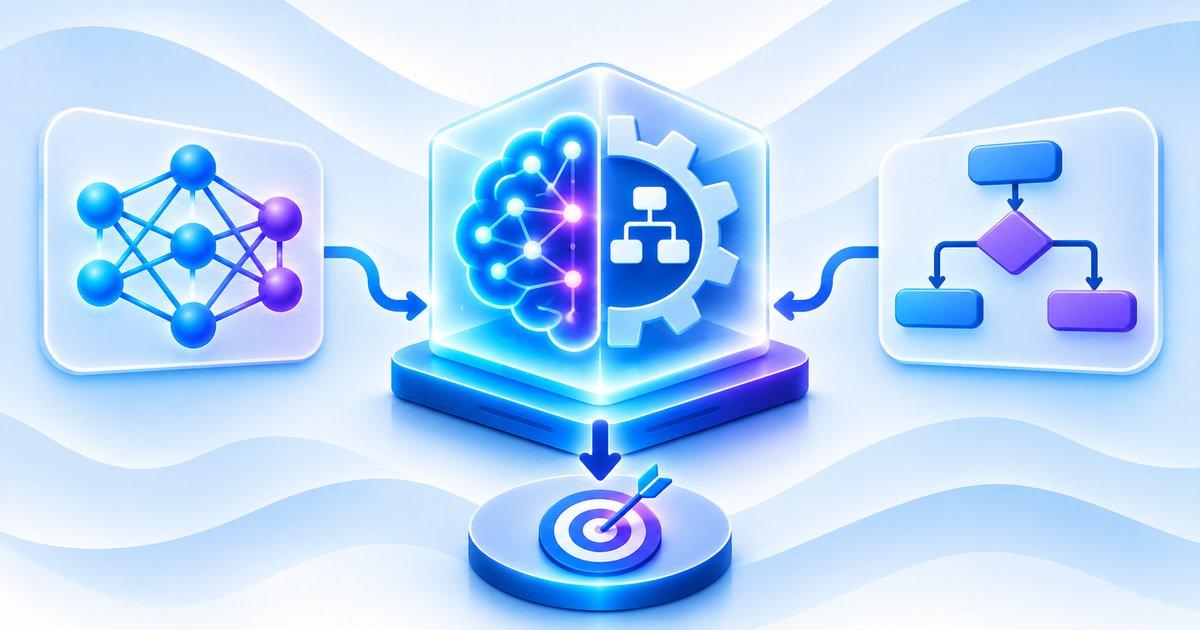
A practical approach is to use machine learning for demand estimation and established optimization techniques for selecting actions. The prediction model estimates future conditions, while a constrained optimization engine evaluates feasible traffic distributions. This separation allows network operators to retain deterministic policy enforcement while benefiting from more informed decisions.
Combining Machine Learning With SDN, Network Digital Twins, and Automated Control
Predictive models become operationally useful when integrated with network management and control infrastructure. Software-defined networking controllers, orchestration platforms, and network digital twins can provide the mechanisms needed to evaluate and execute decisions based on predicted conditions.
A network digital twin is a representation of network infrastructure that can be used to examine system behavior under different configurations and scenarios. Depending on its implementation, it may incorporate topology, link capacities, routing policies, device characteristics, and observed traffic patterns. Engineers can use this representation to evaluate how proposed changes might affect network performance before introducing them into production.
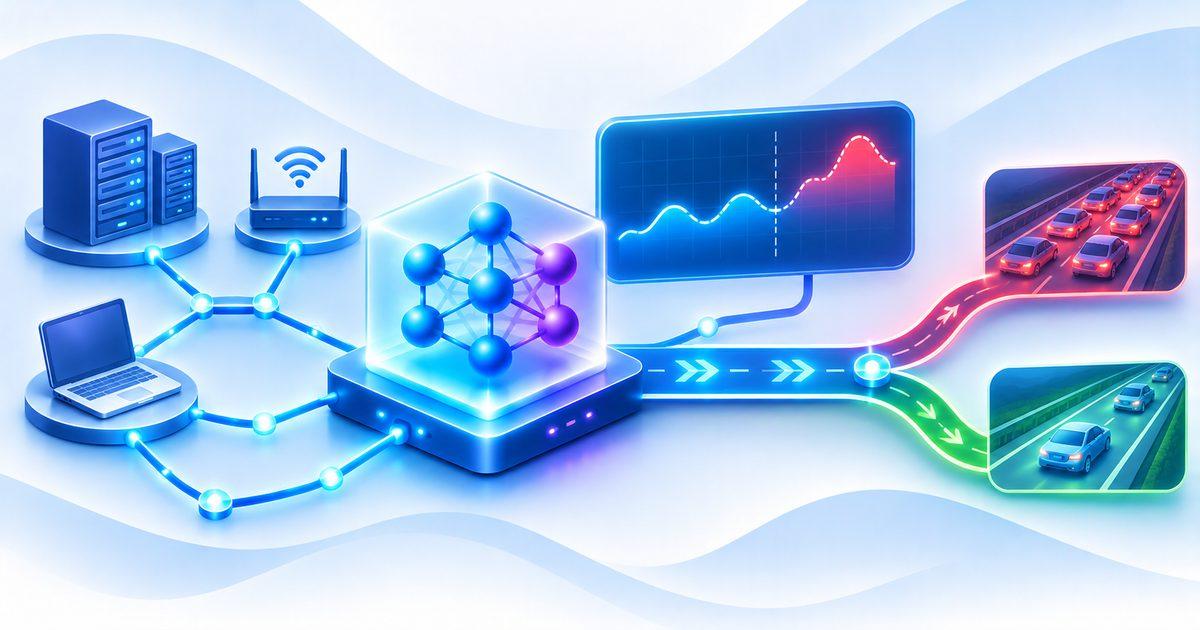
Consider a model that predicts congestion on a critical data center link within the next five minutes. Instead of immediately modifying production routing, the traffic engineering system can evaluate alternative paths using a digital twin or network simulation environment. The simulation can estimate whether the proposed traffic distribution reduces congestion without creating excessive utilization on neighboring links.
A production architecture can connect telemetry collection, feature engineering, forecasting, congestion-risk evaluation, policy validation, simulation, and controlled execution. The prediction engine supplies estimated future conditions, while the optimization layer identifies possible responses. The controller then checks whether the selected action satisfies network policies and operational constraints.
Automation should be proportional to the confidence and potential impact of the decision. Low-risk actions may be eligible for automatic execution after validation, while changes affecting critical network segments may require human approval. Rollback procedures should be available if the observed network behavior differs significantly from the expected outcome.
Adaptive models are also important because the effectiveness of routing decisions depends on changing network conditions. Infrastructure teams can explore "Adaptive ML Systems: How Models Respond When the Environment Changes" to understand how machine learning systems maintain performance when their operating environments evolve.
The most reliable design preserves established forwarding and congestion-control behavior as a fallback. Machine learning should enhance the decision-making process rather than become a mandatory dependency in latency-sensitive packet-forwarding paths. This architecture allows predictive intelligence to improve traffic engineering while maintaining operational control.
Key Takeaway
Machine learning predictions can help network operators identify emerging congestion hotspots and evaluate traffic redistribution before infrastructure becomes overloaded. Their value increases when connected to SDN controllers, constrained routing optimization, and network digital twins. However, prediction engines should not independently make unrestricted infrastructure changes. Reliable proactive traffic engineering requires confidence thresholds, policy validation, simulation, controlled execution, and rollback mechanisms that preserve network stability even when predictions are inaccurate.
Conclusion
Machine learning is changing network traffic engineering by introducing the ability to anticipate future traffic demand and identify emerging congestion before it significantly affects network performance. By combining historical traffic patterns, real-time telemetry, traffic matrices, and infrastructure topology, predictive models can estimate future bandwidth utilization and recognize network conditions associated with potential bottlenecks.
Different machine learning approaches contribute different capabilities. Time-series forecasting models estimate future traffic volumes and utilization, while recurrent networks and Transformers capture complex temporal dependencies. Graph neural networks incorporate relationships between connected network resources, helping infrastructure teams understand how demand and congestion risks propagate across network topologies.
However, accurate prediction is only one part of proactive network management. The operational benefit emerges when forecasts are connected to routing optimization, dynamic load balancing, bandwidth allocation, and capacity planning. SDN controllers, network digital twins, and orchestration systems can translate predictive information into controlled infrastructure decisions while enforcing routing policies and resource constraints.
Building reliable predictive traffic engineering systems also requires careful evaluation, continuous monitoring, and safe deployment practices. Telemetry quality, model drift, useful warning horizons, inference latency, false-positive rates, and missed congestion events all influence operational effectiveness. Automated decisions must be validated, simulated where appropriate, and supported by rollback and fallback mechanisms.
As communication networks become more distributed and application workloads become increasingly dynamic, predictive intelligence will become an important capability for network infrastructure teams. Machine learning does not replace established routing protocols or congestion-control mechanisms. Instead, it provides an additional intelligence layer that enables engineers to make better-informed decisions, anticipate network bottlenecks, and maintain more reliable communication infrastructure.
Frequently Asked Questions
1. What is machine learning for network traffic engineering?
Machine learning for network traffic engineering uses historical and real-time network data to forecast traffic demand, estimate future network conditions, and identify potential congestion hotspots. It helps network operators make proactive decisions about routing, bandwidth allocation, and resource distribution before performance deteriorates.
2. How does machine learning predict network congestion?
Machine learning models analyze telemetry such as bandwidth utilization, queue occupancy, traffic volume, packet loss, and historical traffic patterns. They use these observations to forecast future network conditions or estimate the probability that specific links and network segments will experience congestion within a defined prediction horizon.
3. What is the difference between reactive and predictive congestion management?
Reactive congestion management responds to existing network problems using monitoring alerts, routing adjustments, queue management, and congestion-control mechanisms. Predictive congestion management estimates future demand and potential bottlenecks, allowing operators to evaluate corrective actions before congestion develops.
4. What network telemetry is required for congestion prediction?
Common telemetry includes link utilization, packet rates, flow statistics, queue depth, RTT, jitter, packet loss, ECN marks, and interface errors. Network topology and traffic matrices provide additional information about connectivity and traffic distribution, helping models understand where congestion is likely to develop.
5. Which machine learning algorithms are used for network traffic forecasting?
Common approaches include linear regression, Random Forest, gradient-boosted decision trees, ARIMA, LSTM networks, temporal convolutional networks, and Transformer-based forecasting models. Graph neural networks are also useful when predictions must account for relationships between connected network resources.
6. How do LSTM and Transformer models predict network traffic?
LSTM networks use recurrent connections and gating mechanisms to learn temporal dependencies from historical traffic observations. Transformers use attention mechanisms to identify relationships across sequential observations, making them useful for capturing complex traffic patterns and longer-range dependencies.
7. What are graph neural networks, and how do they help predict network congestion?
Graph neural networks represent network infrastructure as interconnected nodes and edges, allowing models to learn from topology and neighboring network measurements. They can help identify congestion risks across connected links by considering how traffic conditions at one network location influence other locations.
8. How does traffic matrix prediction support network traffic engineering?
Traffic matrix prediction estimates future traffic volumes between different network locations, such as data center racks, enterprise sites, or network regions. These forecasts help engineers identify potential bottlenecks, evaluate routing alternatives, and distribute traffic more efficiently across available network capacity.
9. How can machine learning identify network congestion hotspots?
Machine learning models combine historical utilization, traffic growth, queue measurements, topology, and available capacity to identify network resources at risk of congestion. They can estimate future utilization or calculate the probability of congestion events, helping operators prioritize infrastructure segments that require attention.
10. How does predictive traffic engineering work with software-defined networking?
Predictive models provide future traffic estimates to an SDN controller or traffic engineering platform. The controller can evaluate alternative routing configurations, validate network constraints, and implement approved changes to redistribute traffic before predicted congestion affects performance.
11. How can machine learning improve data center congestion management?
Machine learning can identify traffic concentration, microburst patterns, and potential bottlenecks across data center switching fabrics. Its predictions can support workload-aware load balancing, multipath routing, queue management decisions, and more efficient distribution of east-west traffic.
12. How is machine learning used for congestion prediction in 5G networks?
Machine learning models analyze cell-level traffic measurements, network utilization, mobility patterns, and historical demand to forecast congestion across mobile infrastructure. These predictions can support radio resource planning, capacity allocation, and network optimization as traffic demand changes across geographic regions.
13. How do network digital twins support predictive congestion management?
Network digital twins provide representations of infrastructure topology, link capacities, routing configurations, and operational behavior. Engineers can use them to simulate proposed traffic engineering changes and evaluate their potential impact before applying those changes to live network infrastructure.
14. How should engineers evaluate network congestion prediction models?
Engineers should evaluate traffic forecasting using MAE, RMSE, and other suitable regression metrics, while congestion classification should use precision, recall, F1-score, and AUC. Production evaluation should also measure false-positive rates, missed congestion events, warning lead time, inference latency, and the operational impact of network decisions.
15. What are the challenges of deploying machine learning for network traffic engineering?
Major challenges include inconsistent telemetry, rapidly changing traffic patterns, incomplete topology information, limited congestion-event data, model drift, and low-latency inference requirements. Production deployments must also address safe automation, routing stability, policy enforcement, monitoring, rollback, and fallback to established network-control mechanisms.