Section 1: Understanding Invariant Representations and the Problem of Irrelevant Variation
What Is Invariant Representation Learning?
A machine learning model receives input data and transforms it into an internal representation that can be used to make predictions. This representation may contain information about the object's identity, shape, color, position, texture, background, or other characteristics.
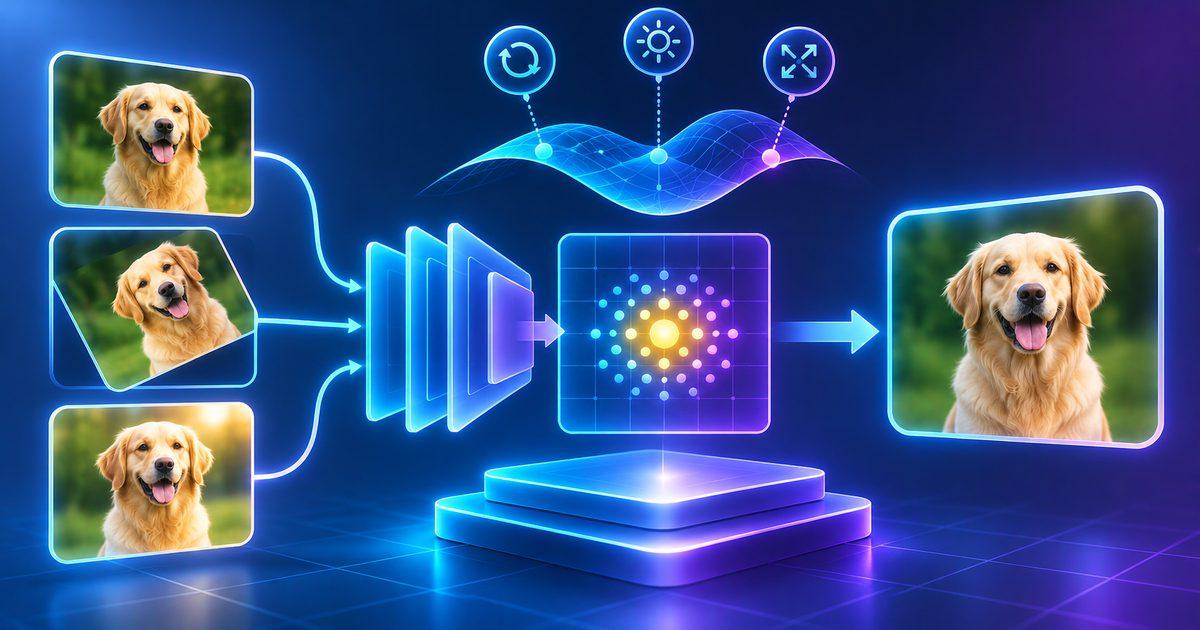
The objective of representation learning is to construct features that make downstream tasks easier. Invariant representation learning adds an important requirement: the learned features should remain stable when the input undergoes transformations that do not change the task-relevant information.
Let an input be represented by (x), and let (T) represent a transformation applied to that input. An encoder (f) produces a representation:
[
z = f(x)
]
For a transformation that should not affect the task, an ideal invariant representation satisfies:
[
f(T(x)) = f(x)
]
This equation describes exact invariance. In practical neural networks, exact equality is not always necessary or achievable. Instead, models are often trained to produce representations that remain sufficiently similar across task-preserving transformations.
For example, a model trained to identify vehicles should ideally recognize the same vehicle when the photograph is slightly brighter, the camera angle changes, or the background becomes different. These variations may affect the raw pixels, but they do not necessarily change the vehicle's identity.
The representation should preserve features such as vehicle structure and shape while reducing unnecessary dependence on lighting or background.
The same concept applies to structured and sequential data. A model predicting customer churn may need to remain stable when irrelevant formatting changes occur in customer records. A model identifying spoken commands should preserve linguistic meaning despite changes in speaker volume or recording conditions.
Invariant representation learning is particularly important when training data does not capture every condition that may occur during deployment. If a model learns stable task-relevant features, it may generalize better to environments that differ from the training environment.
However, the definition of an irrelevant transformation is task-dependent. There is no universal transformation that should always be ignored. The model designer must determine which changes preserve the semantic meaning of the target.
Invariance Versus Equivariance: Two Different Representation Objectives
Invariant and equivariant representations are closely related, but they describe different behaviors.
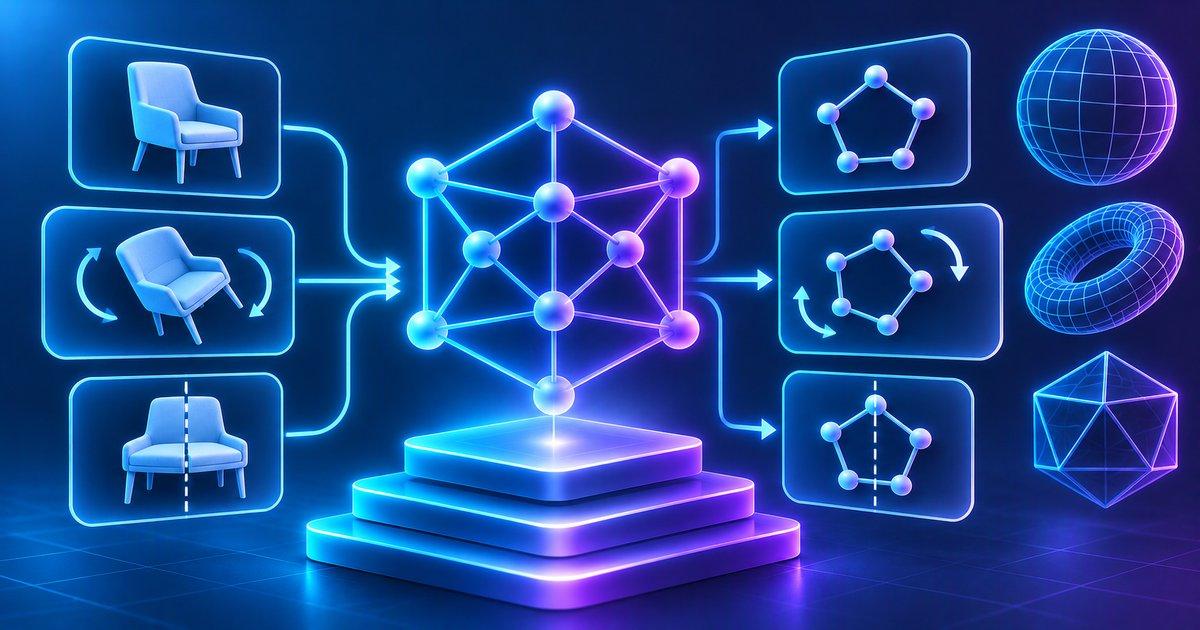
An invariant representation remains unchanged when an input undergoes a specified transformation. An equivariant representation changes in a predictable way that corresponds to the transformation applied to the input.
Formally, invariance can be expressed as:
[
f(T_g(x)) = f(x)
]
Equivariance is expressed as:
[
f(T_g(x)) = \rho(g)f(x)
]
Here, (T_g) represents a transformation associated with an element (g) of a transformation group, while (\rho(g)) describes how the representation should transform.
Consider an image of a car.
If the task is to classify whether the image contains a car, the model may benefit from an invariant representation. Rotating or translating the image should not necessarily change the predicted category.
If the task is to estimate the car's orientation, the representation should preserve information about the rotation. An equivariant representation is more appropriate because it changes predictably as the object rotates.
This distinction is important in computer vision, robotics, medical imaging, and three-dimensional object recognition.
For example, a robotic manipulation system may need to recognize an object regardless of its orientation while still estimating the object's exact position and rotation. A purely invariant representation could discard information needed for manipulation. An equivariant architecture can preserve geometric relationships while allowing the downstream system to reason about object identity and pose.
Group-equivariant neural networks provide a principled way to incorporate these transformation relationships into model architecture. Cohen and Welling's Group Equivariant Convolutional Networks introduced group convolutions that extend conventional convolutional operations to structured transformations such as rotations and reflections. The approach exploits symmetry through parameter sharing and can improve sample efficiency for suitable tasks.
The choice between invariance and equivariance should therefore be driven by the prediction objective. A model should discard variation only when that variation does not contain information required by the downstream task.
Defining the Transformations a Model Should Ignore
A successful invariant learning system begins with a clear definition of which transformations should preserve the target.
In image classification, transformations may include cropping, resizing, rotation, brightness adjustment, contrast changes, color variation, and background modification.
In speech recognition, transformations may include changes in volume, speaker identity, background noise, recording equipment, and acoustic conditions.
In natural language processing, transformations may include paraphrasing, harmless word substitutions, sentence reordering, and formatting differences.
In tabular machine learning, transformations may include changes in measurement units, column ordering, or representation formats, provided that the underlying semantics remain unchanged.
The important requirement is semantic preservation.
For example, changing an image's brightness may preserve the identity of an object. Cropping the image may or may not preserve it, depending on whether the crop removes important visual evidence. A horizontal flip may preserve the class of a generic object but alter the meaning of a medical image or a directional traffic sign.
Similarly, paraphrasing a sentence may preserve its meaning, but changing a negation can completely reverse the intended message.
Engineers can formalize this using a transformation family:
[
\mathcal{T} = {T_1,T_2,\ldots,T_n}
]
The family contains transformations considered valid for a particular task. Training data can then include multiple transformed views of the same underlying example.
A robust transformation policy should be based on domain knowledge, empirical validation, and downstream requirements. Randomly selecting aggressive augmentations can introduce semantic changes that teach the model the wrong invariances.
The distinction becomes particularly important in production systems, where input variation is not always predictable. Models may encounter sensor degradation, changing user behavior, new geographic regions, or previously unseen acquisition conditions.
Engineering teams should therefore test transformations against the actual task rather than assume that a common augmentation is universally safe.
For a broader understanding of how machine learning systems respond to changing environments, explore InterviewNode's “Adaptive ML Systems: How Models Respond When the Environment Changes”. The relationship between stable representations and changing environments is central to building models that remain useful after deployment.
Key Takeaway
Invariant representation learning aims to preserve task-relevant information while reducing sensitivity to transformations that should not affect the prediction. Understanding the distinction between invariance and equivariance is essential because some tasks require information about transformations rather than their removal. The first engineering decision is to define which changes preserve meaning and which changes alter the target.
Section 2: Designing and Training Invariant Representation Models
Building a Training Dataset with Multiple Views and Environments
The quality of invariant representation learning depends heavily on how training data is organized.
A conventional supervised dataset may contain one example and one label. Invariant learning often benefits from multiple related views of the same underlying example, or from datasets collected across different environments.
For image classification, multiple views can be generated through augmentation. For speech recognition, the same recording can be processed with different noise conditions or acoustic transformations. For medical imaging, data may be collected from multiple scanners, hospitals, and acquisition protocols.
The first task is to identify the sources of variation that occur in the actual deployment environment.
An engineering team building an image classification system for industrial inspection might encounter differences in camera angle, illumination, product orientation, sensor resolution, and manufacturing facility.
The dataset should represent these conditions as realistically as possible.
A useful training design separates the underlying content from the environment in which the content was observed. Each example can be associated with a label, an environment identifier, and one or more transformation descriptions.
Environment identifiers are particularly useful when the objective is to test whether learned representations remain predictive across distinct conditions.
For example, a model may be trained on images from three manufacturing facilities and evaluated on a fourth. This provides a more realistic test of generalization than randomly splitting images from all four facilities into training and test sets.
Data collection must also avoid accidental leakage. If multiple augmented versions of the same original image appear across both training and evaluation sets, the model may appear more robust than it actually is.
The original examples should be grouped before splitting so that related views remain within the same partition.
Dataset design should also consider representation balance. If one environment contains nearly all examples of a particular class, the model may learn environment-specific shortcuts. Where possible, training data should contain sufficient variation to separate stable task signals from environment-specific characteristics.
The objective is not simply to collect more examples. It is to collect examples that expose the model to meaningful variation while preserving the underlying task.
Selecting the Right Invariance Objective and Loss Function
Once the dataset is prepared, the next decision is how to express invariance during training.
Different methods use different objective functions.
Contrastive learning encourages representations of related views to become similar while separating unrelated examples. A common objective is based on the similarity between positive pairs relative to other examples in the batch.
For tasks where positive pairs can be generated reliably, this can be an effective approach.
However, contrastive learning depends on how positive and negative pairs are defined. If two examples are semantically related but treated as negatives, the model may be encouraged to separate representations that should remain close. This issue is sometimes described as false negatives.
Another approach uses a consistency loss. It directly penalizes differences between predictions or representations for task-preserving transformations:
\left|
f(T_1(x))-f(T_2(x))
\right|^2
]
This objective encourages two transformed views of the same example to produce similar representations.
An environment-based objective can also penalize differences in predictive behavior across environments. Invariance-based domain generalization methods use different formulations to encourage models to learn relationships that remain predictive across training distributions.
The total training objective may combine several components:
\mathcal{L}{task}
+
\lambda_1\mathcal{L}{invariance}
+
\lambda_2\mathcal{L}_{regularization}
]
Here, (\mathcal{L}{task}) measures the primary prediction error, (\mathcal{L}{invariance}) encourages stability across selected transformations, and (\mathcal{L}_{regularization}) controls model complexity or other desired properties.
The parameters (\lambda_1) and (\lambda_2) determine the relative influence of these objectives.
This introduces an important tradeoff. If the invariance penalty is too weak, the model may continue to rely on nuisance features. If it is too strong, the model may discard information required for accurate prediction.
The training objective must therefore be tuned against downstream performance and robustness tests, not simply minimized in isolation.
Engineers should also consider whether the desired transformation is best handled through the objective function, model architecture, data augmentation, or a combination of these approaches.
Production Architecture: Embeddings, Inference, and Continuous Validation
Invariant representation learning becomes particularly valuable when it is integrated into a production ML architecture.
A typical system contains an input processing layer, a representation encoder, a downstream prediction head, and a monitoring layer.
The input processing layer validates data and applies transformations that are part of the model's defined preprocessing pipeline. The encoder converts the input into a representation. A task-specific prediction head uses that representation to produce the final output.
For example, a visual inspection platform may process product images from multiple manufacturing facilities. The encoder generates embeddings designed to preserve defect-related information while reducing sensitivity to illumination and camera differences. A classification head then predicts whether the product contains a defect.
The encoder can also be reused across multiple downstream tasks, provided that the learned representation contains the information those tasks require.
In production, the representation pipeline should be versioned. Changes to preprocessing, augmentation policies, model weights, or embedding dimensions can alter the meaning of the output vectors.
If embeddings are stored in a vector database, the system must account for compatibility between embedding versions. A new encoder may produce vectors that are not directly comparable with those generated by an older version.
Inference monitoring should examine both the final predictions and the representation distribution. Engineers can track embedding norms, distances, distribution shifts, missing values, prediction confidence, and changes across environments.
However, a change in the embedding distribution is not automatically evidence of model failure. Some shifts may be expected and harmless, while others may indicate a new operating condition that was not represented during training.
Production systems should therefore connect representation monitoring with actual outcome labels and domain-specific validation.
For a broader understanding of how learned representations move from research prototypes into dependable inference systems, explore InterviewNode's “From Notebook to Low-Latency Service: The Engineering Journey of a Production ML Model”. The deployment principles are especially relevant when an encoder becomes a shared dependency across multiple production applications.
Key Takeaway
Building invariant representations requires deliberate dataset design, appropriate training objectives, realistic evaluation, and production-aware architecture. Multiple views and environments help expose the model to meaningful variation, while consistency and contrastive objectives encourage stable representations. Evaluation must verify both robustness and task performance, and production systems must monitor the behavior and compatibility of deployed embeddings.
Section 3: Applications, Limitations, and the Future of Invariant Representation Learning
Computer Vision, Medical Imaging, and Robotics
Computer vision is one of the most established application areas for invariant representation learning.
Images contain many sources of variation that are not always relevant to the classification task. Lighting, camera angle, background, object position, image resolution, and sensor characteristics can all change without changing the identity of the object being recognized.
A model that relies heavily on these variations may perform well on a controlled dataset but struggle when deployed in a different environment.
Invariant representations can help computer vision systems focus on stable visual structures.
In industrial inspection, a model may need to identify manufacturing defects across different cameras and lighting conditions. In autonomous systems, object recognition must remain reliable under changes in weather, road conditions, and camera viewpoints. In satellite imagery, a model may need to identify geographic features despite changes in image resolution and acquisition conditions.
Medical imaging is another important application, although the definition of irrelevant variation requires particular care.
A diagnostic model may encounter images from different scanners, hospitals, acquisition protocols, or patient populations. Invariant learning can help reduce dependence on scanner-specific artifacts and encourage the model to focus on clinically meaningful features.
However, some variations that appear technical may contain important diagnostic information. A transformation that removes subtle texture or contrast differences could eliminate evidence required for a medical decision.
Robotics also benefits from the distinction between invariance and equivariance. A robot may need to identify an object regardless of its orientation while preserving the spatial information needed to grasp it.
A representation that is invariant to object identity-related nuisance factors but equivariant to position and orientation can be more useful than one that removes every geometric change.
The central requirement across these applications is to define the transformations according to the physical and operational meaning of the task.
Natural Language Processing, Speech, and Multimodal Systems
Invariant representation learning is not limited to visual data.
Natural language processing systems must recognize meaning across different ways of expressing the same idea. A sentence can be rewritten, shortened, expanded, or expressed using different vocabulary while preserving its intended meaning.
For example, "The application failed after the latest deployment" and "The latest release caused the application to stop working" express similar information despite differences in wording.
A robust text representation should capture semantic similarity without becoming overly sensitive to superficial linguistic differences.
However, language transformations require caution. Replacing a word with a synonym may alter meaning in a technical context. Reordering clauses may change emphasis, and negation can reverse the intended statement.
Speech recognition presents a related challenge. The same spoken phrase can sound different depending on speaker identity, accent, microphone quality, background noise, speaking speed, and recording environment.
A speech representation should preserve phonetic and linguistic content while reducing unnecessary sensitivity to recording conditions.
This is useful for voice assistants, transcription services, call-center analytics, and multilingual speech applications.
Multimodal models introduce an additional dimension. A system may combine images, text, audio, and structured metadata. Each modality contains its own nuisance factors, and the model must learn which information should remain stable across them.
For example, an image-text retrieval model should associate a description with the correct image despite harmless visual transformations. A video understanding system may need to identify an action despite camera movement, lighting variation, and changes in background.
Invariant representation learning can help align related information across modalities, but the model must retain meaningful differences between them.
A good multimodal representation should not force every input into an identical form. It should preserve shared semantic information while maintaining modality-specific features that are important for the task.
The Future: Causal Representations, Foundation Models, and Adaptive Invariance
The future of invariant representation learning is closely connected to causal machine learning, foundation models, and adaptive systems.
Causal representation learning aims to identify underlying factors and relationships that generate observed data. Instead of learning only statistical associations, causal approaches attempt to distinguish mechanisms that remain meaningful across different environments from correlations that change when the environment changes.
This is relevant to invariant learning because stable predictive relationships may be connected to underlying causal structure.
However, identifying causal mechanisms from observational data is difficult. It requires assumptions about the data-generating process, sufficient environmental variation, and careful evaluation.
Foundation models provide another opportunity. Large pretrained models often learn representations from diverse datasets and tasks. These representations may capture semantic structures that transfer across different domains.
However, broad pretraining does not guarantee invariance. A foundation model can still rely on spurious correlations, exhibit sensitivity to input transformations, or perform poorly on unfamiliar environments.
A promising direction is to combine large pretrained encoders with task-specific invariant objectives. The pretrained model provides broad representations, while additional training encourages stability under transformations relevant to the target application.
Adaptive invariance is another important research direction.
Not every transformation should be ignored in every context. A model deployed in a new environment may need to adjust which features it considers stable. For example, a visual inspection system may encounter a new camera type or a different manufacturing process. Some changes can be treated as nuisance variation, while others may indicate a genuine change in the product or defect distribution.
An adaptive system could monitor environment changes, evaluate representation stability, and determine whether recalibration or retraining is required.
This requires careful governance. A model should not automatically discard new information simply because it differs from historical patterns. Engineers must determine whether the change represents irrelevant variation, a new operating condition, or a genuine change in the task.
The long-term direction is not to create models that ignore every change. It is to create models that understand which changes matter, which changes do not, and when their assumptions need to be revised.
For teams operating such systems at scale, InterviewNode's “MLOps for Software Engineers: Building, Deploying, and Monitoring Machine Learning Models in Production” provides useful context on model versioning, monitoring, and the operational processes needed to keep deployed ML systems reliable.
Key Takeaway
Invariant representation learning has applications across computer vision, medical imaging, robotics, NLP, speech, and multimodal AI. Its limitations are equally important: over-invariance can remove useful information, incomplete environment coverage can preserve hidden shortcuts, and genuine changes in the task may require adaptation rather than stronger invariance. Future systems will need to combine stable representations with causal reasoning and continuous monitoring.
Conclusion: Learning What Matters by Ignoring What Does Not
Machine learning models often fail not because they cannot identify patterns, but because they learn the wrong patterns. A model may rely on background colors, sensor characteristics, formatting conventions, or environment-specific correlations because those features are statistically useful during training.
Invariant representation learning addresses this challenge by encouraging models to preserve task-relevant information while reducing sensitivity to transformations that should not change the prediction.
The approach connects several important areas of machine learning. Contrastive learning uses related views to encourage stable representations. Invariant Risk Minimization seeks predictive relationships that remain consistent across environments. Group-equivariant architectures incorporate known transformation structures into neural networks. Self-supervised and disentangled learning provide additional ways to separate semantic content from nuisance variation.
However, invariance must be designed rather than assumed. Engineers need to understand which transformations preserve the task, which features carry meaningful information, and how deployment environments may differ from training conditions.
The strongest implementations combine carefully designed datasets, appropriate objectives, realistic out-of-distribution evaluation, and production monitoring. They also compare invariant methods against conventional baselines to establish whether the additional complexity produces measurable benefits.
As AI systems are deployed across increasingly diverse environments, the ability to distinguish meaningful signals from irrelevant changes will become more important.
The goal is not to build models that ignore the world around them. It is to build models that recognize which parts of that world matter for the decision they are expected to make.
Frequently Asked Questions
1. What is invariant representation learning?
Invariant representation learning is a machine learning approach that creates representations that remain stable under transformations that should not change the task outcome. It helps models focus on meaningful information while reducing dependence on irrelevant variations such as lighting, background, or recording conditions.
2. Why is invariant representation learning important?
It can improve model robustness when deployment data differs from training data. By reducing sensitivity to nuisance features and unstable correlations, invariant representations can help models generalize across different environments and operating conditions.
3. What is the difference between invariant and equivariant representations?
An invariant representation remains unchanged when a specified transformation is applied to the input. An equivariant representation changes in a predictable way corresponding to that transformation. Invariance is useful when the transformation should not affect the output, while equivariance is useful when transformation information must be preserved.
4. How does contrastive learning support invariant representation learning?
Contrastive learning creates multiple views of the same example using task-preserving transformations. It trains the model to produce similar representations for related views while distinguishing them from unrelated examples, encouraging stability across selected transformations.
5. What is Invariant Risk Minimization?
Invariant Risk Minimization, or IRM, is a learning framework that seeks representations supporting consistent prediction across multiple training environments. It is motivated by the idea that stable predictive relationships may generalize better than environment-specific correlations.
6. What are examples of irrelevant variations in machine learning?
Examples include lighting changes in images, background noise in speech recordings, camera differences in visual systems, harmless paraphrasing in text, and formatting changes in structured data. Whether a variation is irrelevant depends on the specific prediction task.
7. How does data augmentation help models learn invariance?
Data augmentation creates transformed versions of training examples. When transformations preserve the underlying label, the model can be trained to produce consistent predictions or representations across those versions.
8. Can invariant representation learning improve domain generalization?
It can help models generalize across environments by reducing reliance on unstable features. However, it does not guarantee domain generalization, particularly when the training environments do not expose the relevant variations or when the underlying task relationship changes.
9. What are group-equivariant neural networks?
Group-equivariant neural networks incorporate known transformation symmetries into their architecture. They are designed so that internal feature representations transform predictably when the input undergoes operations such as rotations, translations, or reflections.
10. Is invariant representation learning the same as feature selection?
No. Feature selection chooses a subset of input features, while invariant representation learning constructs new representations that preserve task-relevant information and reduce sensitivity to selected transformations. It can learn useful combinations of features rather than simply removing input columns.
11. What is over-invariance?
Over-invariance occurs when a model is trained to ignore variations that actually contain useful information. This can reduce predictive accuracy, especially in tasks where orientation, color, texture, timing, or other seemingly variable properties are important.
12. Can invariant representations be used in NLP?
Yes. They can help NLP systems preserve semantic meaning across paraphrasing, wording changes, and formatting differences. However, transformations must be carefully selected because small linguistic changes, such as negation or changes in context, can alter meaning.
13. How do engineers evaluate invariant representations?
Engineers can compare representations across transformed views, measure downstream task performance, and test models on held-out environments. They should also evaluate calibration, subgroup performance, and whether the representation retains the information required for the target task.
14. Does invariant representation learning solve distribution shift?
No. It can address some forms of distribution shift caused by irrelevant changes in input characteristics. It cannot guarantee performance when the relationship between inputs and target outcomes genuinely changes or when deployment conditions differ substantially from all observed training environments.
15. What is the future of invariant representation learning?
Future research is likely to combine invariant learning with causal representation learning, foundation models, multimodal systems, and adaptive machine learning. The goal is to build models that identify stable task-relevant features while recognizing when environmental changes require adaptation.